
NEWS
ISRO’s NVS-03 Launch Restores NavIC to Four Satellites
GSLV-F18 placed NVS-03 in transfer orbit on October 30, restoring NavIC to four satellites after NVS-02 stalled and a last atomic clock died.

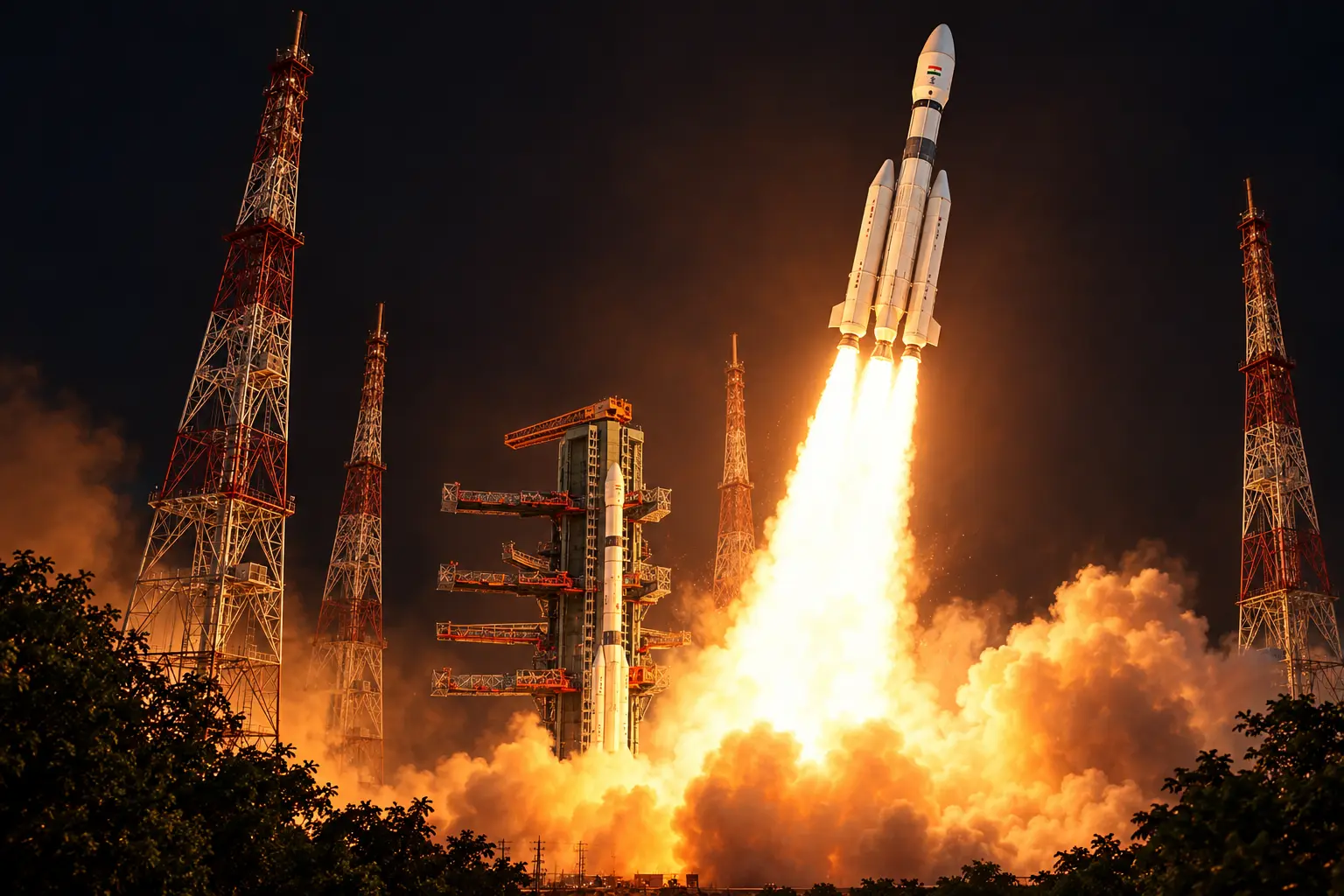
ISRO’s GSLV-F18 placed the 2,250 kg NVS-03 satellite into transfer orbit at 11:51 pm IST on October 30, 2026, restoring NavIC to four satellites.
ISRO Chairman V. Narayanan said three satellites were already working, and that this spacecraft brings the regional navigation system back to the minimum needed for independent position, navigation and timing.
GSLV-F18 Hits Its Transfer Orbit
The three-stage rocket, about 50 metres tall with a lift-off mass of about 420 tonnes, left the Second Launch Pad at Satish Dhawan Space Centre in Sriharikota. About 18 minutes later it released NVS-03 into geosynchronous transfer orbit, the elliptical path used before a satellite climbs to its working slot.
ISRO said the vehicle placed NVS-03 in the intended orbit. The flight was the 20th by India’s Geosynchronous Satellite Launch Vehicle. The brochure set a perigee of 170 km, an apogee of 37,023 km and an inclination of 20.75 degrees.
Narayanan congratulated ISRO teams, industrial partners and academia after the injection and said the vehicle systems had performed as predicted. The space agency put the same verdict on its own account within minutes of spacecraft separation.
Mission Success!
GSLV-F18 has successfully placed NVS-03 in the intended orbit.
Congratulations!Watch live: https://t.co/6X42ANRnTC
Mission details: https://t.co/wtZ6TmjUhc#GSLVF18 #NVS03 #ISRO #NavIC
— ISRO (@isro) October 30, 2026
It was only ISRO’s third space launch of 2026, after PSLV-C62 failed on January 12 with EOS-N1 and GSLV-F17 succeeded on September 4 with EOS-05. Narayanan said the NVS-03 campaign closed with the shortest gap yet between successive GSLV missions, 56 days.
NavIC Could Not Fix a Position on Its Own
Navigation with Indian Constellation, once called IRNSS, is built as a seven-satellite regional grid. It is meant to give position, navigation and timing over India and a belt about 1,500 km beyond the landmass, without borrowing a fix from the American GPS or Russia’s GLONASS.
A receiver still needs four healthy satellites to solve for a position. Union minister Jitendra Singh told Parliament earlier this year that after IRNSS-1F finished its 10-year life, only IRNSS-1B, IRNSS-1I and NVS-01 were providing those services. Timing still ran. Standalone positioning did not.
Narayanan said the new spacecraft restores the minimum operational set. That claim is an injection count. NVS-03 still has to raise itself from transfer orbit, and the last replacement satellite never completed that climb.
NAVIC SATELLITES AFTER GSLV-F18
| Satellite | Generation | Status |
|---|---|---|
| IRNSS-1B | First | In service for PNT |
| IRNSS-1I | First | In service for PNT |
| NVS-01 | Second | In service since May 29, 2023 |
| NVS-02 | Second | Stranded in transfer orbit, January 29, 2025 |
| IRNSS-1F | First | Last clock failed March 13, 2026 |
| NVS-03 | Second | Injected October 30, 2026; orbit raising ahead |
Four names now sit on the working list once NVS-03 is checked out: IRNSS-1B, IRNSS-1I, NVS-01 and NVS-03. That is the floor, not a spare-filled grid. Singh has already told Parliament that NVS-04 and NVS-05 are in an advanced stage of realisation, which is the next rebuild, not this night’s flight.
Atomic Clocks Died and NVS-02 Never Arrived
NavIC did not thin out in one accident. First-generation satellites aged off their 10-year design lives. Imported atomic clocks, the timekeepers a navigation signal is built on, failed in orbit. And the satellite sent to restock the fleet never reached its slot.
NVS-02 left Sriharikota on January 29, 2025 aboard GSLV-F15 and reached transfer orbit on time. Solar panels deployed. The liquid apogee motor then failed to fire, because oxidiser never reached the engine. An apex committee, made public on February 25, 2026, said the drive signal never arrived at the pyro valve on the oxidiser line. The most likely cause was a contact that had come loose in both the main and the backup paths of a connector.
On March 13, 2026, the last working atomic clock on IRNSS-1F stopped. The regional system was then below the four-satellite line Singh later described in the Lok Sabha. NVS-03, planned in a 2025 parliamentary reply for late that year, flew on October 30, 2026 instead.
HOW THE CONSTELLATION THINNED OUT
- May 29, 2023: NVS-01 reaches orbit as the first second-generation NavIC satellite, adding an Indian-made clock and the L1 signal.
- January 29, 2025: NVS-02 reaches transfer orbit, then cannot fire its apogee motor after a pyro-valve signal failure.
- November 2, 2025: CMS-03 flies with the committee’s connector and redundancy fixes; the pyro system works.
- February 25, 2026: ISRO makes the NVS-02 failure analysis public.
- March 13, 2026: IRNSS-1F’s last atomic clock dies, taking a first-generation bird out of PNT service.
- October 30, 2026: GSLV-F18 injects NVS-03 into transfer orbit.
The sequence is why a night launch that went to plan still reads as a repair. The grid had already lost the replacement bird and then lost a clock on a satellite that had finished its design life.
Why the Pyro Valves Opened on the Pad
A pyro valve is a one-shot gate. A small charge opens a sealed fuel or oxidiser line and the valve cannot be shut again. Satellites keep those gates closed through launch so propellant stays isolated while the rocket shakes. On NVS-02, the electrical pulse that should have opened the oxidiser valve in orbit never completed the circuit.
For NVS-03, ISRO flew with those pyro valves already open, a change senior mission officials described before liftoff as a way to delete the exact step that stranded NVS-02. The Mission Readiness Review cleared the layout. Downstream latch valves now have to hold the propellant during ascent and then feed the engine in orbit.
That is a trade, not a charm. Opening the valves on the ground removes the connector path that failed in January 2025. It also means isolation during the violent first minutes of flight depends on hardware further down the line. If those valves misbehave after separation, NVS-03 can still fail the same job NVS-02 failed: the burns that turn an ellipse into a working geosynchronous slot.
CMS-03 had already tested a more redundant pyro system after the committee’s report. NVS-03 went further. The injection on October 30 only proves the rocket and the open-valve ride to transfer orbit. The motor still has to work.
An Indian Clock and the L1 Signal
Second-generation NavIC satellites were designed to replace ageing first-generation craft and to make the signal easier for ordinary devices to hear. NVS-03 is the third bird in that series, after NVS-01 and the stranded NVS-02, and it is built for a 12-year mission life.
ISRO says the spacecraft carries an indigenous atomic clock along with procured clocks. The Indian unit is a rubidium clock from the Space Applications Centre. Narayanan said two Indian-made clocks were already working in orbit, and that NVS-03 carried the third. Older NavIC satellites leaned on imported clocks that had a habit of dying, which is how IRNSS-1F left the PNT roster.
WHAT NVS-03 CARRIES
- Timekeepers: An Indian-made rubidium atomic clock flies with imported clocks, so a timing failure on one unit does not kill the payload.
- Three bands: The satellite transmits on L1, L5 and S, covering India and about 1,500 km around the geopolitical boundary.
- Phone band: L1 is the frequency most consumer chips already listen to, so a NavIC fix does not need a special receiver.
- Service life: Design life is 12 years, two years longer than the first-generation 10-year spec that IRNSS-1F had already passed.
L1 is not new on this flight. NVS-01 already augmented NavIC services on the L1 band in May 2023, and the ground segment had to add tri-band reference receivers to track it. NVS-03 keeps that civilian frequency on the air so the constellation does not drop back to L5 and S alone if older satellites fail. The clock is the piece India used to buy. The L1 signal is the piece phones already understand.
Trains and Ships Already Ride the Timing Signal
Narayanan called NavIC a strategic national asset and listed the civilian load it already carries even when the position fix was short of four satellites. Timing never fully went away. Positioning did.
Already three satellites are successfully working in orbit, with this satellite we will have four satellites and restore the PNT services of the country. As you know, the NavIC constellation is a strategic national asset that provides the nation independent access to PNT services. It is also used for civilian applications like real-time tracking of trains along with tracking of vehicles and shipping vessels. It is an important component of the One Nation One Time Project.
V. Narayanan, Chairman, ISRO, post-launch address at Sriharikota
The government has notified the Legal Metrology (Indian Standard Time) Rules, 2026, a legal spine for a single national time. NavIC’s clocks are part of that project. Trains, trucks and ships can keep using the timing signal they already had. What four satellites buy, once NVS-03 is on station and certified, is a position solution that does not have to borrow from a foreign constellation.
Prime Minister Narendra Modi, posting on October 31, 2026, treated the launch as a step toward strengthening NavIC, India’s indigenous satellite navigation system, and toward navigation services that benefit people. The political line is self-reliance. The engineering line is narrower: a fourth clocked transmitter in the right part of the sky.
Congratulations to our scientists and engineers at ISRO on the successful launch of GSLV-F18 carrying NVS-03.
This mission marks an important step in strengthening NavIC, our indigenous satellite navigation system. Equipped with enhanced capabilities, NVS-03 will further our…
— Narendra Modi (@narendramodi) October 31, 2026
Calling injection the restoration skips the manoeuvre this programme already lost. Missile units and other users who still mix GPS and GLONASS into their kits will not switch on a press statement. They will switch when four NavIC birds are on station, healthy and tracked.
The Climb to Station Is Still Ahead
NVS-03 is aimed at a geosynchronous slot at 32.5 degrees East, the station tied to the clock-failed IRNSS-1F. Getting there means a chain of onboard burns. NVS-02 proved that the rocket can be the easy part.
WHAT WE KNOW
- The injection: GSLV-F18 put NVS-03 into the planned class of transfer orbit on October 30, 2026, and ISRO declared the launch a success.
- The floor: Narayanan said three satellites were already working and that this one brings the PNT set to four.
- The pad change: NVS-03 flew with pyro valves open, a direct answer to the NVS-02 connector failure.
- The next birds: Singh has told Parliament that NVS-04 and NVS-05 are in an advanced stage of realisation.
WHAT IS UNCONFIRMED
- The climbs: Whether the open-valve propulsion system completes orbit raising to 32.5 degrees East has not been shown yet.
- The service call: A date for full PNT restoration after in-orbit tests has not been given.
- The rebuild: Launch dates for NVS-04 and NVS-05 remain unset, so a spare-filled seven-satellite grid is still a later job.
GSLV-F18 did the part of the mission that cameras catch. NVS-03 still has to fire the engine NVS-02 never fired.

ADNOC Ship Hit in Hormuz Leaves One Crew Missing

SpiceJet’s Rs 5,500 Crore Plan Follows a Rescue That Failed

Hasina’s Return Fight Sets Fire to Yunus’s Bank

Bancroft Recants the 2018 Inquiry and Names the Team

Adhikari Ties the Saffron Saree Row to School Licences

Clancy Juror Says the Holdout Never Cited Evidence

The iPhone 18 Pro Max Splits Apple’s Fall in Two

OpenAI Calls GPT-6 Astra AGI Then Locks Its Exploits

Trump Claims Hormuz Control as Oil Holds Near $96

Russia Closes the Goethe-Institut Berlin Tried to Save

 NEWS2 months ago
Clancy Juror Says the Holdout Never Cited Evidence
- NEWS3 months ago
The iPhone 18 Pro Max Splits Apple’s Fall in Two
- NEWS3 months ago
OpenAI Calls GPT-6 Astra AGI Then Locks Its Exploits
- BUSINESS3 months ago
Trump Claims Hormuz Control as Oil Holds Near $96
- LIFESTYLE3 months ago
Russia Closes the Goethe-Institut Berlin Tried to Save
- AUTO3 months ago
Volkswagen’s Job Cuts Leave Four Plants Without Cars
- NEWS3 months ago
Dyson Puts Nurovi Robots on Sale Without the UV Flagship
- BUSINESS2 months ago
US Destroys Five Iranian Tankers as the Shock Hits Jordan










