
BUSINESS
Iran Warns of Earth-Shattering Blow as Hormuz Tankers Burn
Trump says the Iran war will wrap up soon and Hormuz is moving more oil, as tankers burn, Europe counts a 100 billion euro energy bill.

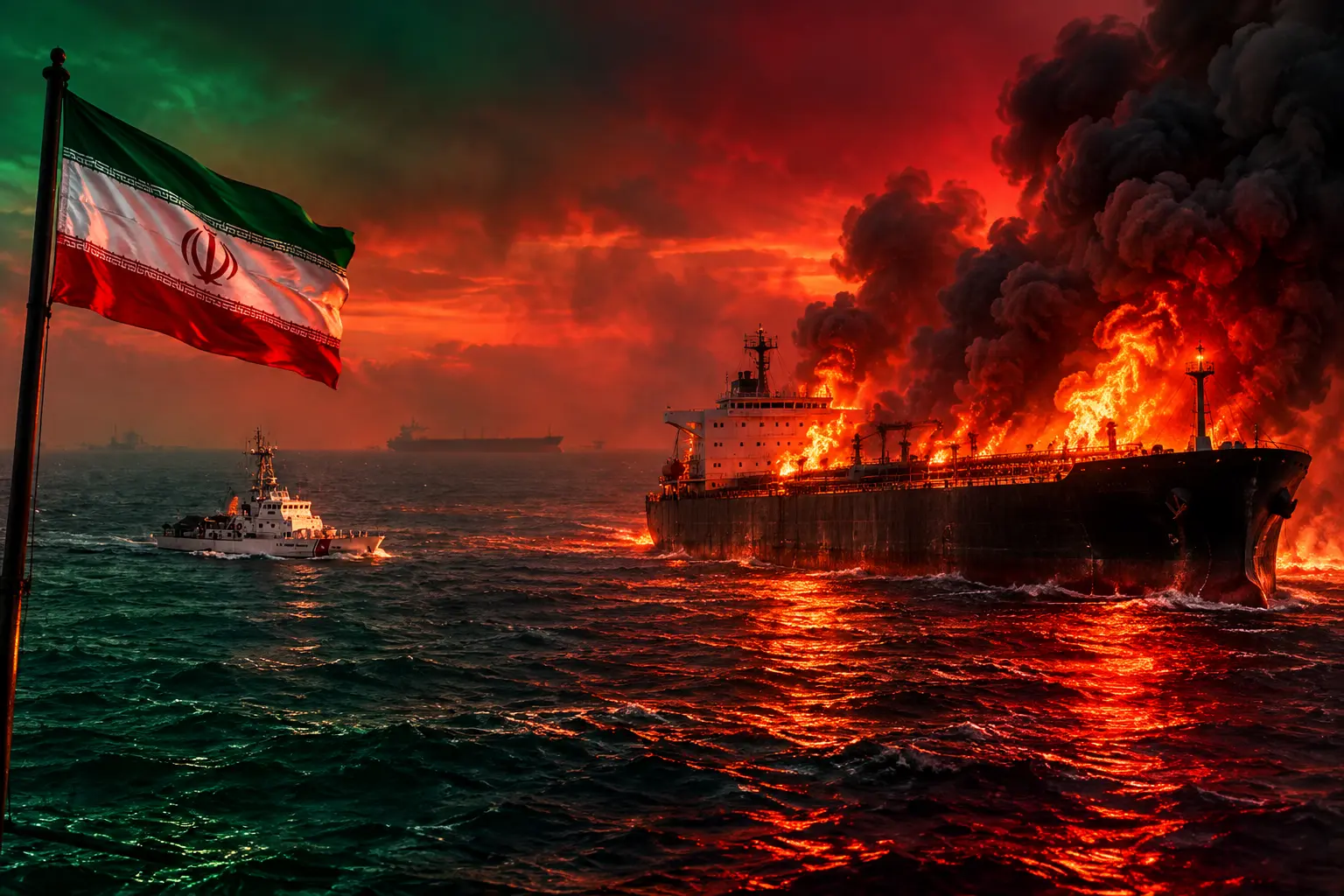
Iran’s foreign minister, Abbas Araghchi, warned on October 31 of an “earth-shattering blow” if Iranians are harmed again, after the Islamic Revolutionary Guard Corps said four oil tankers caught fire in the Strait of Hormuz.
The same news day had US President Donald Trump telling a Daytona Beach rally the war would “get wrapped up soon,” and claiming more oil was moving through Hormuz than seven months earlier, while Brent’s December contract closed at $117.64 a barrel.
Four Tankers Caught Fire Near Hormuz
The IRGC said the four ships struck naval mines while sailing what Tehran calls unauthorized routes, with at least one described as a supertanker. The Guards have told owners not to trust US Central Command’s public claims that lanes have been cleared.
Britain’s UK Maritime Trade Operations centre did not confirm four mine strikes. It did log fires and projectile hits on October 29 and 30, including a crude tanker struck on an outbound run and a ship hit 40 nautical miles south of Lavan Island that caught fire, with the crew reported safe.
Saudi air defences, speaking through coalition spokesman Turki al-Malki, said they destroyed a hostile drone over the Riyadh region after earlier intercepts in the Eastern Province and the south. Those Houthi claims sit on the same Gulf energy map as the tanker fires, even if the shooters are not the same.
EIGHT MONTHS TO THIS STANDOFF
- February 28, 2026: The United States and Israel open the war on Iran; Hormuz traffic collapses in the weeks that follow.
- June 17, 2026: Washington and Tehran sign a memorandum meant to resume traffic through the strait. The deal later breaks.
- October 29, 2026: A small boat attaches explosive devices to a tanker 25 nautical miles northeast of Khasab, Oman; the engine-room fire is put out and the ship sails on.
- October 30, 2026: Trump, campaigning in Florida, says the war will be wrapped up soon and that Hormuz is moving more oil than seven months ago.
- October 31, 2026: Araghchi answers Germany’s energy-cost complaint with a threat, and the IRGC repeats the four-tanker claim.
Qatari mediators were in Tehran on October 30, in contact with US officials, on a track that Iranian sources said could produce a meeting in Doha or Istanbul within a week. Abas Aslani, a researcher at the Center for Middle East Strategic Studies in Tehran, said there is still “no tangible progress,” because Washington wants nuclear concessions first and Iran is holding to a seven-point plan.
What the UKMTO Log Shows for October
October is the worst month for attacks on shipping in the Gulf and the Strait of Hormuz since the war began, with a tally of UKMTO data putting the count at least at 35, above March’s roughly 30. The centre has recorded 144 attacks in the strait, the Gulf of Aden and the Sea of Oman since February 28. Most ships no longer report every hit, so the log is a floor.
The late-October slice is ugly in a new way. Projectiles still arrive from above the waterline. A small boat also came alongside a tanker in the US-protected lane, stuck charges on the hull, and blew the engine room. That is a boarding-range attack inside a corridor Washington presents as secured.
THE OCTOBER 29-30 ATTACK LOG
| Date | Place | What UKMTO recorded |
|---|---|---|
| October 30 | 40NM south of Lavan Island | Unknown projectile, port-side hit, fire on board, crew safe |
| October 30 | Strait of Hormuz, outbound | Crude tanker struck by an unknown projectile |
| October 29 | 25NM northeast of Khasab | Small boat attached two explosive devices to the hull; engine-room fire put out, ship continued |
| October 29 | Strait of Hormuz, outbound | Tanker struck by an unknown projectile; no injuries reported |
In the week ending October 28, UKMTO counted 122 outbound and 155 inbound transits, up from 114 and 127 the week before, and still about 70 percent below pre-war traffic. Those figures mix AIS tracks with US-stated escorted runs. They are not the same thing as barrels leaving the Gulf by pipeline, shuttle, or ship-to-ship transfer east of the danger zone.
$37 a Barrel to Haul Gulf Crude to Asia
Trump’s Hormuz line is easier to defend against March than against peacetime. Market intelligence firm Kpler put crude transits through the strait at 195,000 barrels a day in March, then at an average of 3.9 million barrels a day from mid-July, even after the June memorandum failed. Seven months before October 31 is the bottom of the collapse, not the old normal.
Gulf crude exports, Hormuz plus bypass routes, averaged 24.6 million barrels a day in the week to October 18, above the pre-war average, Kpler said. In August, more than 70 percent of the crude that still crossed the strait did so by ship-to-ship transfer. By September, 40 percent of Gulf exports skipped the strait entirely, against 17 percent before the war, using Saudi Arabia’s East-West line to Yanbu and the UAE’s Habshan-Fujairah line.
Brent still rallied. The December contract finished October 30 at $117.64, up $2.76 or 2.4 percent on the day after trading as high as $118, and 13.6 percent higher across October, the strongest finish since April. West Texas Intermediate settled at $104.12. Kpler, in a note that the market’s operating environment is now the US-Iran confrontation through year-end, has been arguing that traders still fade headlines faster than they fade mines.
THE PRICE OF A WAR THAT DOES NOT END
- Brent close: December crude settled at $117.64 on October 30, up 2.4 percent, after printing $118.
- October move: Brent rose 13.6 percent on the month; WTI rose 15.2 percent to $104.12.
- Freight: Mid-October shipments of Gulf crude to Asia cost over $37 per barrel to Asia, more than five times the pre-war rate, the International Energy Agency said.
- Gulf recovery week: Kpler’s 24.6 million barrels a day for the week to October 18 counts all Gulf crude outflows, not Hormuz ship counts.
The IEA’s point is blunt: availability of Gulf crude is only half the bill. Insurance and longer, clumsier routes have turned the other half into a tax that refiners in Asia feel first. Adi Imsirovic, a lecturer in energy systems at the University of Oxford and a former oil trader, put the market’s logic in one line.
The market is doing exactly what it is supposed to do: It is telling us there is plenty of prompt oil, but there is no end to this war in sight, in fact … escalation is very likely.
Adi Imsirovic, lecturer in energy systems, University of Oxford
HOW THE BARRELS STILL MOVE
- Shuttle runs: Short-haul ships carry crude through the strait and reload VLCCs once they are outside the worst water.
- Saudi bypass: The East-West pipeline shifts eastern field output to Yanbu on the Red Sea, off the Hormuz map.
- UAE bypass: The Habshan-Fujairah line puts crude on the Gulf of Oman without a strait transit.
- US corridor: Escorted southern transits in Omani waters keep a reduced AIS-plus-navy count moving, which is the traffic UKMTO is measuring.
Isabel Figuerola-Ferretti, who follows oil markets at Comillas Pontifical University in Madrid, said barrels are moving, “but neither smoothly nor reliably,” and that this “should not be read as a sign of normalisation.” Delivering a barrel, she said, has become far more expensive. October 2027 Brent still sat above $90 on October 30, a price that only makes sense if traders think the war’s shipping tax lasts into next year.
Merz’s Energy Bill Meets a Direct Threat
German Chancellor Friedrich Merz said the US-Israel war on Iran has added more than 100 billion euros ($112bn) to Europe’s energy costs over eight months. Araghchi answered on X by throwing that figure back at him, noting that Merz had hailed earlier strikes and quoting the chancellor as saying Israel was doing Europe’s “dirty work.”
When Israel-US bombings of Iran began last year, Mr. Merz hailed them.
"Doing Europe's dirty work"
100bn Euro is nothing compared to the Earth-shattering blow Iran's Powerful Armed Forces will deal against those who dare harm our people.
Red lines are a thing of the past. https://t.co/HIclTatGiO
— Seyed Abbas Araghchi (@araghchi) October 31, 2026
“100bn Euro is nothing compared to the Earth-shattering blow Iran’s Powerful Armed Forces will deal against those who dare harm our people,” Araghchi wrote. “Red lines are a thing of the past.” Iran’s security chief, Mohsen Rezaei, asked on X whether people who “cheered on war crimes” thought “the fallout wouldn’t hit you, too.”
Trump, at the Ocean Center in Daytona Beach on October 30, went the other way on prices. He said petrol “prices are dropping to levels much lower” than under Democratic presidents, denied that the United States started the war, and said, “We are never going to give them a nuclear weapon.” He mocked Representative Ro Khanna for citing a $25 billion cost, adding that in Venezuela “we have made about 10 times that amount” after Washington took control of the oil sector following the January abduction of President Nicolás Maduro.
Europe is paying a war premium in euros. Trump is campaigning on a war that, in his telling, is both almost finished and a bargain next to Venezuelan barrels. Iranian officials are telling European capitals that the invoice they already hate is the cheap version.
Why Iranian Lawmakers Want Out of the NPT
Tehran’s nuclear file is no longer only a bargaining chip in talks with Washington. It is a live fight in parliament over whether the Non-Proliferation Treaty is still worth belonging to after eight months of bombardment and a US naval blockade on Iranian oil.
Seyyed Mahmoud Nabavian, a Tehran legislator, wrote that “now that we have paid the heavy costs of war and sanctions, it is time for the Iranian nation to withdraw from the NPT treaty and change the nuclear doctrine.” Ebrahim Rezaei, spokesman for parliament’s National Security and Foreign Policy Committee, said at least 10 withdrawal proposals are circulating, still in early stages, with a large bloc of signatures. On October 13 he had already said more than 10 bills were prepared and that membership had brought “damage, destruction, the assassination of nuclear scientists,” and “two wars.”
A withdrawal is not a tweet. Under Article X of the treaty, a party that wants out must give three months’ notice to the Security Council and to the other parties, and must state the “extraordinary events” it says have jeopardized its supreme interests. No such notice has been filed. President Masoud Pezeshkian’s government has argued for staying in. Senior officials have said leaving is not an immediate priority and that any move “totally depends on Washington’s behavior,” in Mohsen Rezaei’s phrasing.
WHAT AN NPT EXIT WOULD TAKE
- The bills: At least 10 withdrawal drafts sit with parliament, with the presiding board still to put them on the agenda.
- The notice: Article X requires three months’ written notice to all parties and to the UN Security Council, with a statement of the extraordinary events claimed.
- The split: Hardline deputies want a doctrine change; the presidency has defended remaining a party; the Supreme National Security Council has not taken a decision.
- The talks problem: A state arguing about leaving the treaty is a poor fit for a US draft that wants highly enriched uranium moved out or blended down as an early step.
Cleric Mohammad Javad Haj Ali Akbari, in a Friday sermon carried by state broadcaster IRIB, called a doctrine review a “national demand” and said it was not a rush of feeling after US failures to keep commitments. That language, from the pulpit, is how a parliamentary draft becomes harder for negotiators to ignore even if it never becomes a notice.
A Seven-Day Hormuz Reopening Is Still a Draft
A draft of possible US-Iran terms circulated on October 30 describing a Hormuz reopening to international traffic within seven days of an initial understanding, a transfer or blend-down of highly enriched uranium, Chinese guarantor language, and direct talks in Doha rather than Istanbul. Matching US steps would ease sanctions, the blockade, and other restrictions, with verification before each next phase.
Replies to that paper treated it as a document written for markets. One line of skepticism was that it had no named source. Another was that publishing it on a Friday night looked like an attempt to lift Monday crude. The draft may be real, partial, or a trial balloon. It is not a ceasefire.
WHAT WE KNOW
- The channel: Qatari mediators were in Tehran on October 30, coordinated with US officials, after a letter from Vice President JD Vance to Mohsen Rezaei proposing renewed talks.
- The Iranian read: Tehran received a US letter on ending the war and used Qatar to collect a response; a meeting in Doha or Istanbul was described as possible within a week.
- The US military track: Admiral Brad Cooper, head of US Central Command, briefed Trump on options for more attacks. Senator Chris Murphy, after a briefing, called the war plan “insane.”
WHAT IS UNCONFIRMED
- Four mine hits: The IRGC’s four-tanker account has no matching UKMTO confirmation of four mine strikes on named ships.
- Seven-day reopening: The circulating draft has not been published as an agreed text by Washington or Tehran.
- Post-election strikes: Gulf allies have been warned to prepare for possible action after November 3; no attack order has been announced.
The incentive problem is simpler than the paper. Trump wants something he can hold up before or just after the midterms. Iran has little reason to give him that win days before American voters, and more reason to fear a short deal that reopens Hormuz, lowers oil prices, and lets US and Israeli forces reset. Mohamed Elmenshawy, a Washington-based analyst, said Trump wants the standoff ended “whether through peace or war as quickly as possible,” that time is on his side because of the oil blockade and other pressure, and that he faces Israeli pressure to strike and Gulf pressure to talk.
The Pause Runs Through the Midterms
What looks like indecision is a calendar. The midterms are on November 3. Until then, the White House can keep both the Cooper options and the Vance letter in the air, while Qatar shuttles and the IRGC keeps writing the rules of the waterway in explosives. After that date, either the talks have to produce a first step people can see, or the attack briefing stops being a briefing.
The oil market is not waiting for the speeches. Global observed inventories were 509 million barrels below pre-war levels by the end of September, the IEA said, after a 10 million barrel drop that month, with on-land stocks at their lowest since at least 2016. IEA members have already released about 330 million barrels from emergency stocks and agreed to speed the rest of a drawdown first set at 400 million barrels, with some countries putting in more than they first pledged. Those barrels filled a hole. They did not refill the system.
Trump can say, against March, that more oil is leaving Hormuz. He can say, against Khanna, that $25 billion is small next to Venezuelan crude. He cannot say the strait is a normal shipping lane while UKMTO is posting fires south of Lavan Island, while Gulf-to-Asia freight sits above $37 a barrel, and while Araghchi is telling Europe that 100 billion euros is the opening price. The war he wants wrapped up soon is the same war the futures curve still refuses to end.
Disclaimer: This article is news reporting and analysis of military, diplomatic and energy-market events, and it is for information only. It is not investment advice, a recommendation to buy or sell crude oil, refined products, tanker shares or any other security, and it is not a forecast you should trade on. Readers who are considering energy-related investments should consult a licensed financial adviser or commodities professional who can review their own position, time horizon and risk. Oil prices, freight rates, stock draws, transit counts and the status of talks and military plans are taken from the sources cited as of October 31, 2026, and all of them can move quickly.

ADNOC Ship Hit in Hormuz Leaves One Crew Missing

SpiceJet’s Rs 5,500 Crore Plan Follows a Rescue That Failed

Hasina’s Return Fight Sets Fire to Yunus’s Bank

Bancroft Recants the 2018 Inquiry and Names the Team

Adhikari Ties the Saffron Saree Row to School Licences

Clancy Juror Says the Holdout Never Cited Evidence

The iPhone 18 Pro Max Splits Apple’s Fall in Two

OpenAI Calls GPT-6 Astra AGI Then Locks Its Exploits

Trump Claims Hormuz Control as Oil Holds Near $96

Russia Closes the Goethe-Institut Berlin Tried to Save

 NEWS2 months ago
Clancy Juror Says the Holdout Never Cited Evidence
- NEWS3 months ago
The iPhone 18 Pro Max Splits Apple’s Fall in Two
- NEWS3 months ago
OpenAI Calls GPT-6 Astra AGI Then Locks Its Exploits
- BUSINESS3 months ago
Trump Claims Hormuz Control as Oil Holds Near $96
- LIFESTYLE3 months ago
Russia Closes the Goethe-Institut Berlin Tried to Save
- AUTO3 months ago
Volkswagen’s Job Cuts Leave Four Plants Without Cars
- NEWS3 months ago
Dyson Puts Nurovi Robots on Sale Without the UV Flagship
- BUSINESS2 months ago
US Destroys Five Iranian Tankers as the Shock Hits Jordan










