
NEWS
Khalistani Defacement Hits Indian Embassy in Slovenia Amid Rising Europe Pattern
MEA cites Vienna Convention after Ljubljana premises vandalised, continuing Khalistani attacks on missions as India-Slovenia trade nears $1 billion.

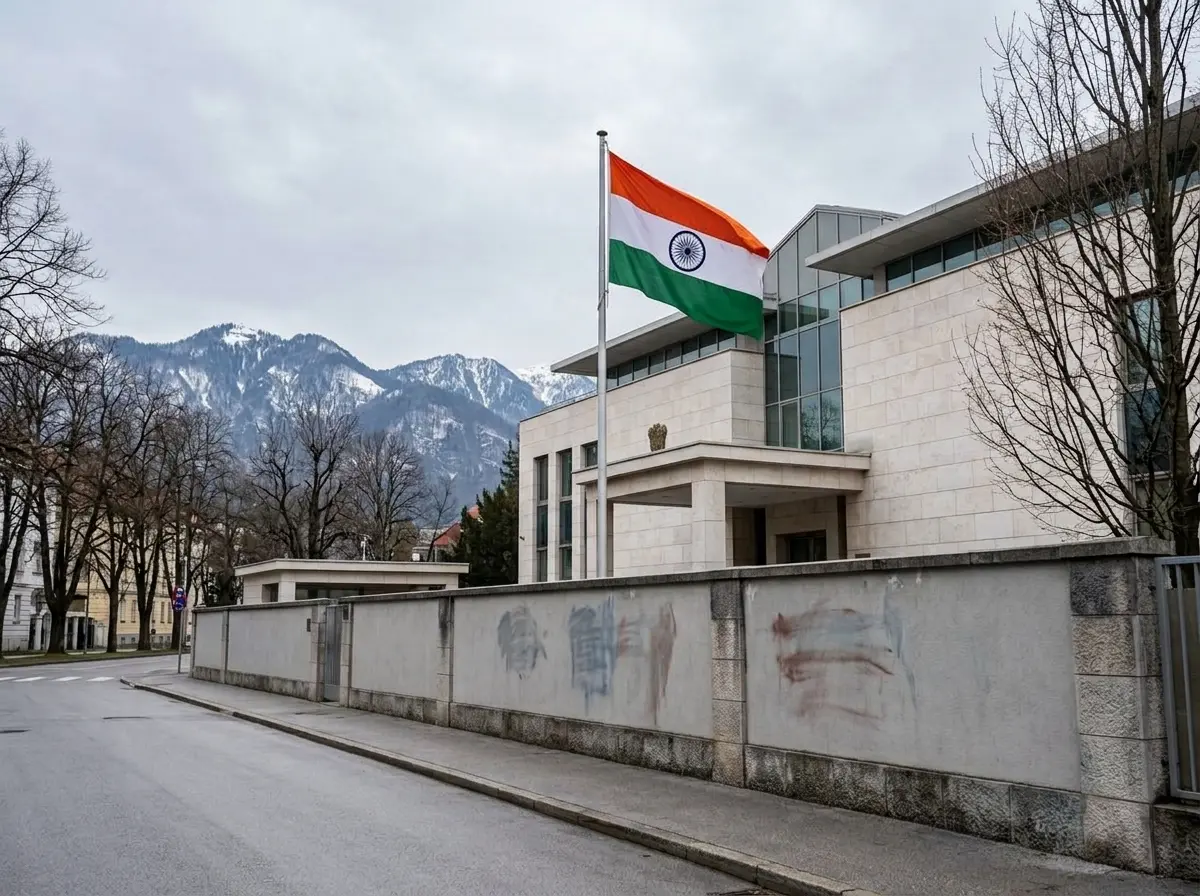
India’s Ministry of External Affairs on 10 August 2026 condemned the defacement of its embassy premises in Ljubljana by anti-India elements and demanded that Slovenian authorities hold the perpetrators accountable. The statement stressed that diplomatic premises remain inviolable under international law.
The act fits a documented run of similar attacks on Indian missions that has now reached smaller European capitals.
The Defacement and Immediate Response
The MEA said it had taken up the matter strongly with Slovenian authorities in both New Delhi and Ljubljana. It described the vandalism as a reprehensible act.
We condemn the defacement of the premises of our Embassy in Ljubljana, Slovenia by anti-India elements. Under the Vienna Convention, diplomatic premises are inviolable and must be protected.
The ministry called on law enforcement authorities elsewhere to note the hateful propaganda and disinformation spread by such groups. Foreign affairs editor Sidhant Sibal reported that Khalistani extremists were responsible for the vandalisation.
Online posts circulating the same day described pro-Khalistan slogans including “KHALISTAN Zindabad” and references to Prime Minister Narendra Modi, along with flags placed near the entrance. These details remain unconfirmed by official Indian or Slovenian statements and appear mainly in low-engagement social media tallies.
Ambassador Amit Narang heads the mission. No injuries or major structural damage have been reported.
A Pattern That Crossed Into Europe
The Ljubljana incident is not isolated. Khalistani-linked groups have repeatedly targeted Indian diplomatic and consular properties over the past several years, first concentrating in the United Kingdom, Canada and the United States before moving into continental Europe.
| Location | Date | Nature of incident | Claimed or reported link |
|---|---|---|---|
| Zagreb, Croatia | January 2026 | Trespass, national flag removed, Khalistan flag raised, graffiti including “Khalistan Zindabad, Hindustan Murdabad” | Sikhs for Justice / Gurpatwant Singh Pannun |
| London, UK | March 2023 | Mob attack on High Commission, windows smashed, flag desecrated | Pro-Khalistan protesters |
| San Francisco, US | July 2023 | Attempted arson at consulate | Sikh separatists |
| Ljubljana, Slovenia | August 2026 | Premises defaced | Anti-India / Khalistani elements (per MEA and reports) |
The Croatia episode stood out because it occurred outside the traditional Five Eyes diaspora hubs. SFJ claimed it as a first in 40 years for that mission and timed it ahead of India’s Republic Day. The Slovenia case arrives weeks before Independence Day on 15 August, continuing the calendar-driven timing.
Indian agencies have tracked “26-26” chatter referring to possible plots around Republic Day. The shift into EU member states with smaller Indian communities and thinner security perimeters raises fresh operational questions for New Delhi.
What Host States Must Deliver
India’s legal ground is explicit. Article 22 of the Vienna Convention on Diplomatic Relations states that the premises of the mission shall be inviolable. Agents of the receiving state may not enter except with the head of mission’s consent.
- The receiving state holds a special duty to take all appropriate steps to protect the premises against any intrusion or damage.
- It must prevent any disturbance of the peace of the mission or impairment of its dignity.
- The premises, furnishings, property and means of transport enjoy immunity from search, requisition, attachment or execution.
These obligations are absolute in the text. The International Court of Justice has treated breaches as serious in past cases involving attacks on embassies. Slovenia, as a party to the convention, carries the duty regardless of the size of its Indian mission or the political profile of the perpetrators.
The MEA’s dual-track demarche in Delhi and Ljubljana underscores that expectation. Host governments that treat such acts as low-level vandalism risk a sustained diplomatic bill.
India-Slovenia Ties Were Warming Fast
The timing lands against a backdrop of expanding bilateral engagement. India recognised Slovenia in 1992 after its independence from Yugoslavia. The resident mission in Ljubljana opened in 2007.
Recent steps include the 10th Foreign Office Consultations in New Delhi on 6 May 2025 and the 10th session of the Joint Committee on Trade and Economic Cooperation on 25 November 2025. An MoU on a five-year scientific and technological cooperation programme for 2025-2029 was signed in December 2025 covering health, biotechnology, ICT, renewable energy and artificial intelligence.
According to official India-Slovenia bilateral trade figures, two-way trade reached 1,064.01 million US dollars in 2025-26, with Indian exports at 765.17 million and a trade balance of 466.33 million in India’s favour. Main Indian exports include organic chemicals, pharmaceuticals, electrical machinery and vehicles.
Prime Minister Narendra Modi congratulated Janez Jansa on his election as Slovenian prime minister in May 2026 and expressed intent to deepen ties. Ambassador Narang met Foreign and European Affairs Minister Tone Kajzer last month and delivered a personal letter of congratulations from External Affairs Minister S. Jaishankar. An all-party Indian parliamentary delegation visited Slovenia in late May 2025.
Slovenia has backed India on cross-border terrorism. The embassy defacement therefore arrives as both countries prepare to mark 35 years of diplomatic relations and as commercial and scientific tracks accelerate.
The Propaganda Layer and Diaspora Extremism
Beyond the physical act, the MEA singled out hateful propaganda and disinformation. Khalistani groups have long used social media and diaspora networks to amplify vandalism into political messaging. Videos and photos from earlier incidents in London and Zagreb circulated widely within hours.
The same dynamic appeared on X within hours of the Ljubljana reports. High-engagement posts from journalists shared the official statement, while other accounts posted unconfirmed images of graffiti and flags. The crowd reaction mixed condemnation with familiar pivots to domestic Indian politics, a pattern that dilutes pressure on host governments.
European states with modest Sikh populations have historically treated these acts as fringe. The Croatia and now Slovenia cases show the infrastructure for such operations can travel. Smaller missions lack the hardened perimeters common in London or Washington, making prevention harder and the host’s special duty more consequential.
Accountability and the Next Test for Host Capitals
India has asked Slovenia to identify and prosecute those responsible. No public Slovenian statement had appeared in the first hours after the MEA release. Past cases produced mixed results: some arrests in Canada and the UK, limited follow-through elsewhere, and frequent claims by groups such as SFJ that the publicity itself was the victory.
The broader context includes India’s simultaneous management of other diplomatic pressures, from energy ties to regional security pacts that create broader India diplomatic pressures in the region. Mission security sits inside that larger set of demands on partners.
For Slovenia the choice is concrete. Prompt investigation and prosecution would reinforce the Vienna framework and protect the warming commercial and scientific relationship. Delay or soft-pedalling would add Ljubljana to the list of European capitals where Indian missions have been left exposed.
The physical paint can be cleaned. The pattern of targeting and the host response will set the next baseline.

-
 TECH1 year ago
Where Garmin Watches are Made and How They are Assembled
-

 AUTO3 months ago
Tesla’s Roadster Is ‘a Few Weeks Away,’ Says Its Chief Designer
-
 NEWS10 years ago
Samsung Releases Galaxy Note7 TV Ad as Reddit AMA Leaks Specs
-
 NEWS10 years ago
Android 7.0 Nougat Rolls Out To Nexus Devices With New Emoji, Features
-
 FINANCE9 years ago
Cardano Price Surges as ADA Enters the Crypto Top Ten List
-
 NEWS10 years ago
Pre-Order the First Camera Made for Facebook Live Streaming Video
-
 FINANCE1 year ago
Binance Suspends Trading and Withdrawals for a System Upgrade
-
 FINANCE9 years ago
RChain Price Jumps Nearly 150% to a New All-Time High of $2.03