
NEWS
Gandhi, Vajpayee AI Avatars to Debut at Delhi’s PM Museum by End-May 2026

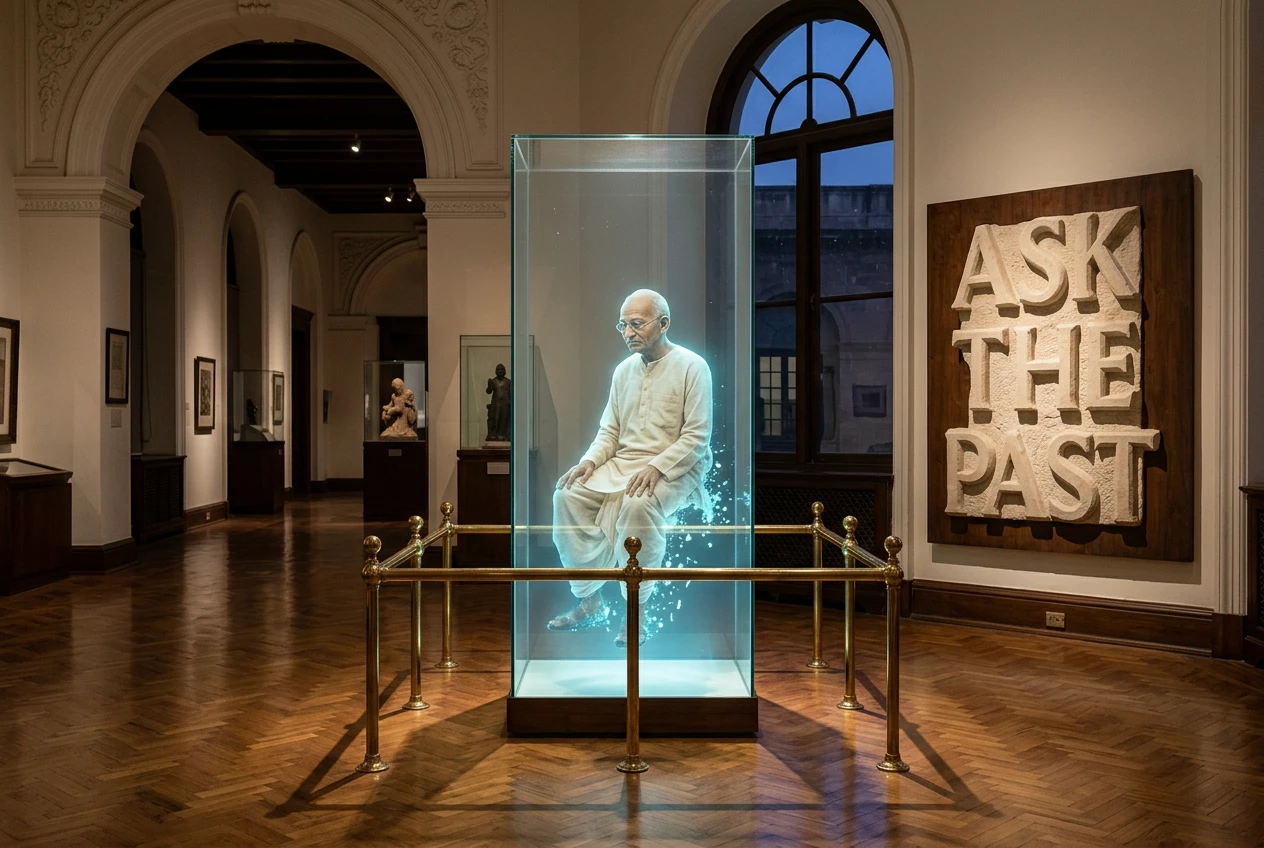
India is preparing to put Mahatma Gandhi and Atal Bihari Vajpayee inside glass boxes that talk back. The Prime Ministers’ Museum and Library (PMML) in Delhi, known as the Pradhanmantri Sangrahalaya, expects to launch AI-powered, hyper-realistic 3D avatars of both leaders by the end of May 2026, PMML Director Ashwani Lohani confirmed in an interview on April 23, 2026. They will join a life-size holobox of Sardar Vallabhbhai Patel, unveiled on September 17, 2025, and a newer one of former President A.P.J. Abdul Kalam. Together, the installations make the museum one of the world’s most ambitious posthumous-avatar experiments built around national political figures.
That scale is what separates the Delhi project from a novelty exhibit. Roughly 6.4 lakh people walked through the museum in financial year 2025-26, Lohani told PTI, and the site draws 1,400 to 1,500 visitors a day. Each new avatar is a machine that will speak in the voice of a dead statesman to an audience larger than most Indian newspapers reach in print.
What the Gandhi and Vajpayee Avatars Will Actually Do
The two new figures are being built to the same specification as the Patel holobox installed on September 17, 2025. Visitors walk up to a life-size transparent display, speak into a microphone in Hindi or English, and receive a reply delivered in a synthetic version of the leader’s own voice, framed by archival photos, speeches and writings.
Lohani, a 1980-batch officer of the Indian Railway Service of Mechanical Engineering who previously chaired Air India and the Railway Board, said the Gandhi and Vajpayee units are in their “final stage” of development. In his April 23, 2026 interview, he laid out the sequence plainly: “We started with a life-size AI-powered Holobox of Sardar Patel, and then of ex-president A P J Abdul Kalam. Soon, we will bring similar avatars of Gandhi ji and Atal ji.”
Both leaders are well suited to a training-data-heavy format. Gandhi’s collected works run to 100 volumes in English and Hindi. Vajpayee, who died in August 2018, left decades of televised speeches, parliamentary interventions and poetry in his own voice, a dataset his Patel predecessor never had.
Inside the 86-Inch Glass Box That Does the Talking
The hardware behind the experience comes from Vizara Technologies, a Gurugram-based startup founded by entrepreneurs holding doctorates from IIT Delhi, IIT Kharagpur and MIT, and empanelled with several government cultural agencies. The company specialises in holographic projection, 3D laser scanning and digital heritage work, and previously built the Digital Gandhi Gyan Vigyan exhibition and 3D-printed heritage replicas shown at Expo 2020 Dubai.
Each installation packs a defined stack of components. An 86-inch transparent screen projects the life-size figure. Directional speakers deliver voice toward the standing visitor only. A backend content system manages dialogue, and the AI supports up to 33 languages, including Hindi and English used at the Patel unit.
The answer engine is not free-form generation. Training material is curated: archives, speeches, letters and authorised biographies uploaded by PMML staff, with responses framed in the leader’s own voice. When a visitor asks a question, the backend scans that corpus and composes a reply that sounds conversational rather than read.
Why the Patel Holobox Is Already a Test Case
The Patel unit, six months old as of late April 2026, is the best window into how the Gandhi and Vajpayee avatars will behave. Around 20 visitors a day stop to interact with the Iron Man, according to PMML officials, and the questions they ask already range far outside the safe zone of textbook history.
Patel’s holobox fields queries on his ban of the Rashtriya Swayamsevak Sangh after the assassination of Mahatma Gandhi, his rivalry with Jawaharlal Nehru, and even counterfactuals about whether he should have been India’s first prime minister. The answers are careful. On the RSS question, the avatar tells visitors: “I suggested imposing a ban on the RSS in the aftermath of Gandhi’s assassination with a clear intention to investigate the truth. After a thorough investigation, I concluded that RSS as an organisation had no part in the conspiracy to kill Mahatma Gandhi.”
That response is historically defensible but editorially chosen. It lands inside a live political argument between the Congress and the Bharatiya Janata Party over who gets to claim Patel’s legacy. By the time a Gandhi avatar is answering questions on Partition, caste or the RSS, every syllable will be parsed by historians, activists and political parties for tone and omission.
The Ethics Problem Museums Abroad Are Already Debating
The technology class has a name in the academic literature: posthumous avatars, sometimes called deadbots or griefbots. A 2024 paper in Philosophy & Technology by Cambridge researchers Tomasz Hollanek and Katarzyna Nowaczyk-Basińska, titled “Griefbots, Deadbots, Postmortem Avatars: on Responsible Applications of Generative AI in the Digital Afterlife Industry,” argued that digital recreations of the dead need urgent regulation because they can mislead users and be steered to serve the interests of whoever controls the training data.
“AI bots that are coded to mimic a deceased person could help preserve historical figures,” Hollanek told the U.S. public-radio program Marketplace on March 18, 2026. “But, if developed unethically, a late person’s data could be manipulated to benefit a business model.”
The consent question is the one India has not yet answered in public. Patel died in December 1950. Gandhi died in January 1948. Vajpayee’s family has not, as of April 2026, issued a public statement on the PMML avatar project. In the United States, the 2024 Tennessee ELVIS Act extended personality-rights protection to AI-generated voice and likeness replicas of individuals, a framework India does not yet have.
Accuracy is a second fault line. The Patel holobox is restricted by design to questions pertaining to his life up to 1950, but visitors routinely ask it about contemporary politics. The avatar’s stock answer is that it is “not aware of the current challenges.” A Gandhi avatar is likely to face the same pressure, pushed toward positions on modern India that the historical Gandhi never voiced.
Beyond the Avatars: Smart Glasses and a Tourist Pipeline
The AI build-out at the Sangrahalaya is not limited to holograms. Lohani said the PMML is in talks with a startup that participated in the recent AI Summit in Delhi to develop smart glasses for visually impaired visitors. The device would identify persons and objects facing the visitor and deliver an audio commentary through a linked gadget.
The museum is also leaning harder on experience-driven draws to push its footfall numbers higher.
- A five-seater simulated “helicopter ride” takes visitors over the Atal Tunnel in Himachal Pradesh and the Chenab Bridge in Jammu and Kashmir.
- The ‘Suraksha’ gallery themes national security around recent military actions including Operation Sindoor and the 2019 Balakot airstrike.
- A photo booth generates composite images of visitors seated next to any prime minister from Nehru to Narendra Modi, emailed afterwards.
- A rooftop restaurant called Forest Table opened above the Nehru Planetarium, with a vintage piano and a view of the 18th-century Kushak Mahal monument.
The museum’s scale is worth anchoring. Building One is the former Teen Murti Bhavan, completed in 1929-30 by British architect Robert Tor Russell as the residence of the commander-in-chief of British forces in India, and later home to Nehru. The newer Building Two, completed in 2022 on the sunken site of the rear gardens, spans 15,600 square metres and houses 43 galleries. The PMML’s archives hold more than 25 million documents from 1,300 individuals and organisations, among the world’s largest collections of rare archival material on a single nation’s political history.
How the Wider Holobox Push Is Expanding
PMML is not the only Indian cultural institution experimenting with the format. In March 2025, the Ministry of Culture installed an “Ask AI Holobox” at the Symbiosis Society’s Ambedkar Museum and Memorial in Pune, focused on the Constitution and the life of B.R. Ambedkar. On January 23, 2022, Prime Minister Modi unveiled a hologram statue of Netaji Subhas Chandra Bose at India Gate on Bose’s 125th birth anniversary, later replaced by a granite statue.
The Gandhi avatar in particular will not be the first of its kind. UNESCO hosted a life-size hologram of Gandhi in dialogue with panellists at its Paris headquarters on October 1, 2019, for the Ahinsa Lecture, drawing an audience of about 1,000. The PMML version, however, will be the first permanent, daily-interactive Gandhi avatar installed in a state-run Indian museum.
Frequently Asked Questions
When will the Gandhi and Vajpayee AI avatars open to the public?
PMML Director Ashwani Lohani said on April 23, 2026 that the project is in its final stages and is expected to launch by the end of May 2026 at the Pradhanmantri Sangrahalaya in Delhi.
Who built the AI holoboxes at the Prime Ministers’ Museum?
The holoboxes are built by Vizara Technologies, a Gurugram-based startup incorporated by entrepreneurs with doctorates from IIT Delhi, IIT Kharagpur and MIT. The same firm earlier produced the Digital Gandhi exhibition and 3D-printed heritage replicas for India’s pavilion at Expo 2020 Dubai.
How does the AI holobox work?
Each unit pairs an 86-inch transparent display, directional speakers and a curated archive of the leader’s speeches, writings and authorised biographies. When a visitor speaks a question, the backend searches the archive and replies in a synthesised version of the leader’s voice. The system supports up to 33 languages.
Can the AI avatar answer questions about current politics?
By design, no. The Patel holobox is restricted to questions on his life up to his death in December 1950, and on modern queries it replies that it is “not aware of the current challenges.” The Gandhi and Vajpayee avatars are being trained on the same bounded principle.
How much of the Pradhanmantri Sangrahalaya is run on AI?
As of April 2026, AI powers the Patel and Kalam holoboxes, with Gandhi and Vajpayee to follow in May 2026. A separate project, developed with a startup from the recent Delhi AI Summit, will add AI-powered smart glasses to describe objects and persons to visually impaired visitors.
For the staff who run the galleries, the debut is already booked into the museum calendar. The Sangrahalaya completed four years on April 14, 2026, and its director is betting that a life-size Gandhi, answering questions in his own voice inside a transparent glass column in Delhi, will pull the next wave of students, scholars and foreign visitors through the door. Whether the avatar can carry the weight of a leader whose every recorded sentence has been studied for a century is the question the museum is about to put to 1,500 people a day.

-
 TECH1 year ago
Where Garmin Watches are Made and How They are Assembled
-

 AUTO3 months ago
Tesla’s Roadster Is ‘a Few Weeks Away,’ Says Its Chief Designer
-
 NEWS10 years ago
Samsung Releases Galaxy Note7 TV Ad as Reddit AMA Leaks Specs
-
 NEWS10 years ago
Android 7.0 Nougat Rolls Out To Nexus Devices With New Emoji, Features
-
 FINANCE9 years ago
Cardano Price Surges as ADA Enters the Crypto Top Ten List
-
 NEWS10 years ago
Pre-Order the First Camera Made for Facebook Live Streaming Video
-
 FINANCE1 year ago
Binance Suspends Trading and Withdrawals for a System Upgrade
-
 FINANCE9 years ago
RChain Price Jumps Nearly 150% to a New All-Time High of $2.03