BUSINESS
Flipkart Bets a 10% Take Rate Against Zomato and Swiggy
Flipkart is testing Eat-in by Minutes at a 10% restaurant cut, even though Bernstein sees only ₹20 to ₹30 in diner savings.

Flipkart is testing Eat-in by Minutes with more than 8,000 Bengaluru staff and a dedicated Ekart fleet, aiming for a public launch by the end of October. The Walmart-owned retailer has put a food delivery tab inside its main shopping app. Restaurants would pay a proposed cut of about 10%, against the 20% to 25% take Zomato and Swiggy usually charge.
Sagar Daryani, president of the National Restaurant Association of India and co-founder of Wow! Momo Foods, is already walking partners through that pitch. Bernstein estimates a new app might save a diner only ₹20 to ₹30 (about 20 to 30 cents) per order.
Eat-In by Minutes Is Already on the Flipkart App
The trial began with a few hundred employees and now sits on Flipkart’s main smartphone app as its own tab, next to Minutes grocery and travel bookings, according to two people familiar with the matter. Meals are not being sold as a separate download. They are being sold as another reason to open an app shoppers already use.
THE BENGALURU PILOT
- Staff on the test: The closed trial now covers more than 8,000 Flipkart employees in the company’s home city.
- Who carries the bag: Ekart has stood up a meal rider pool that is separate from the couriers on Minutes grocery runs.
- Where the menus come from: Listings flow from ONDC and from restaurants Flipkart signed up on its own.
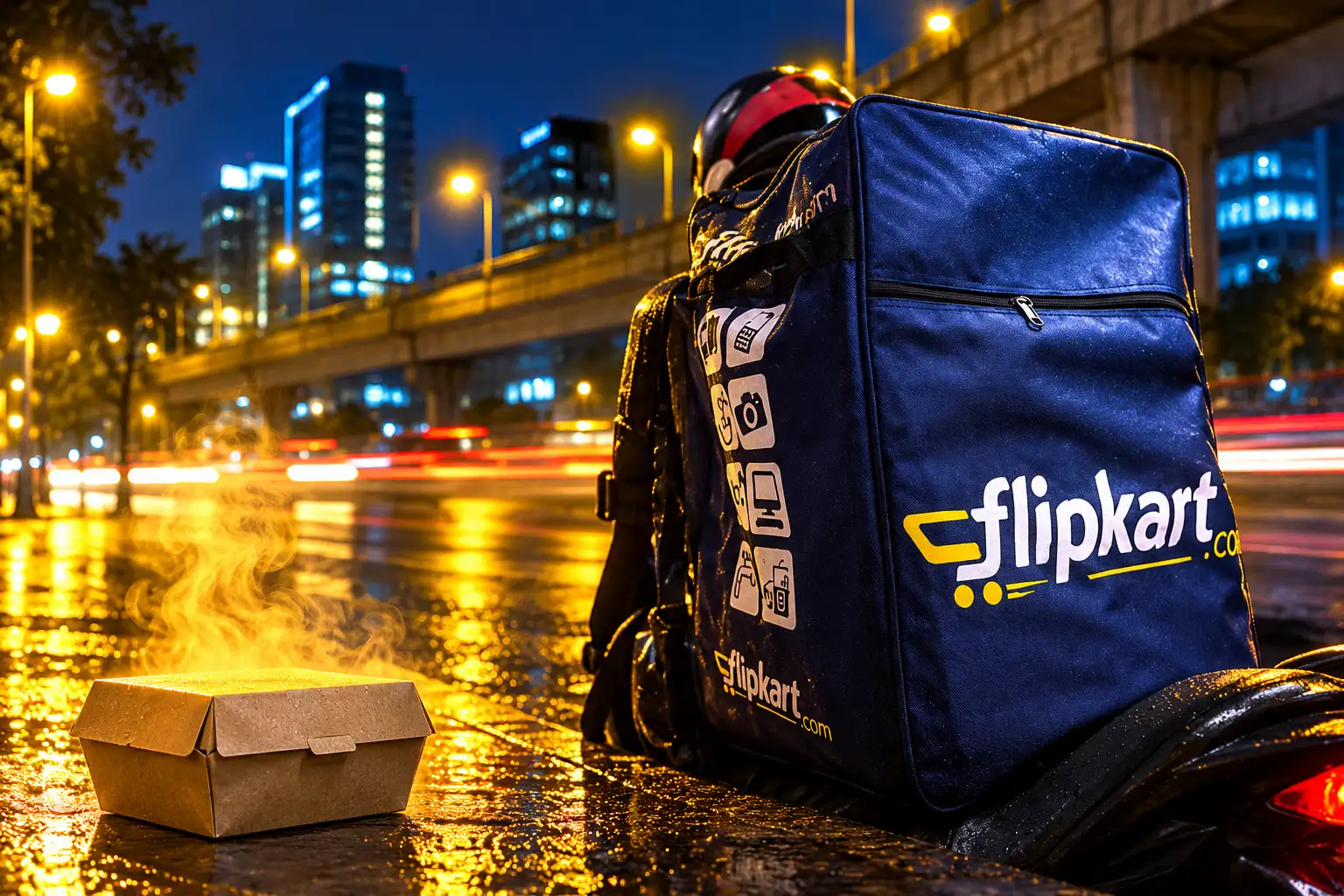
- What the street sees: Riders in Eat-in by Minutes jerseys have started closing trial orders in Bengaluru.
That catalog split is the cheap way to look big on day one. Flipkart can pull in more than 100,000 restaurants on ONDC, the government-backed open network, without knocking on every kitchen door, then add direct deals where it wants control. ONDC lists restaurant commissions on the network at about 8% to 11%.
The jersey is the tell that this is no longer a slide in a planning deck. Someone in Bengaluru is already being paid to move a hot bag under a Minutes-branded name.
Restaurants Are Being Pitched a 10% Take Rate
Daryani’s group represents more than 500,000 restaurants nationwide, and he did not bother with polite language about the two apps that take most of their online orders.
Monopoly is bad, but duopoly is more pathetic.
Sagar Daryani, president, National Restaurant Association of India
“What one does, the other follows suit,” he said. Restaurants, in his telling, have needed a third pipe for years. Flipkart has proposed a base commission of about 10%. Zomato and Swiggy typically take 20% to 25% before a kitchen spends another rupee on ads, discounts, and promotions.
WHAT KITCHENS WOULD PAY
| Channel | Base take rate | All-in cost Daryani cites |
|---|---|---|
| Flipkart Eat-in (proposed) | about 10% | 15% to 16% |
| Zomato and Swiggy | 20% to 25% | 40% to 50% |
| ONDC restaurant network | about 8% to 11% | not given as all-in |
Once those extras land, Daryani said, restaurants can spend 40% to 50% of an order’s value on the two incumbents. He expects Flipkart to hold the full bill closer to 15% to 16%. That is the restaurant book of the wager, and it is the one kitchen owners can feel on a Tuesday night without opening a customer app.
Signing the menu is still the easy half. A lower cut gets a listing live. It does not make a diner delete Zomato.
Bernstein Puts the Diner Saving at ₹20 to ₹30
Bernstein puts India’s food-delivery market on an 18% to 20% annual clip, with online orders still just over 15% of the wider food-services trade. Zomato, owned by Eternal, and Swiggy together serve an estimated 85 million to 95 million paying customers a year in a country with more than a billion internet subscriptions. The headroom is real. The switching cost is the problem.
The brokerage’s working figure for a more efficient new app is ₹20 to ₹30 off an order. That is a round of extra chutney, not a reason to rebuild a dinner habit. Zomato and Swiggy can also deepen discounts long enough to make that gap vanish, Bernstein noted.
Speed is the other leak in Flipkart’s story. Minutes grocery now averages about 11 minutes. ONDC’s own food-and-beverages page puts average delivery across its restaurant network at 31 minutes. Eat-in is borrowing ONDC’s menus and a Minutes name, then sending a different Ekart crew. The grocery density Daryani wants to “pass on” to meals is not sitting in the same rider pool.
And a dense Bengaluru cluster is a brutal first exam. If Eat-in cannot hold times there for a long stretch, the grocery habit stays in Minutes and dinner stays where the auto-suggest already knows the order. Restaurants can still cheer the 10% cut while the diner never moves.
Bengaluru Has Seen This Movie Before
Amazon picked the same city. It launched Amazon Food in Bengaluru in May 2020, onboarded restaurants, and still shut the service. In a letter to partners it said the end date was December 29, 2022.
After a careful evaluation, we have decided to discontinue Amazon Food from December 29, 2022.
Amazon letter to restaurant partners
Google’s Areo app, which mixed food ordering with other local jobs, never found a crowd. Uber sold its Uber Eats India business to Zomato in 2020 and left. Deep pockets were not the missing ingredient. Daily use was.
THE LAST ATTEMPTS TO BREAK IN
- May 2020: Amazon launches Amazon Food in Bengaluru.
- 2020: Uber sells its Uber Eats India business to Zomato.
- December 29, 2022: Amazon discontinues Amazon Food after the letter to restaurant partners.
- August 2024: Flipkart Minutes debuts as a minutes-scale grocery service.
- October 2026: Flipkart expands the Eat-in by Minutes staff trial past 8,000 employees.
Daryani’s answer is that Flipkart is walking the path in reverse. Zomato and Swiggy built meal apps, then added grocery. Flipkart already runs commerce and Minutes, and is now hanging dinner off that habit. “Flipkart’s quick commerce benefit will get passed on to food delivery, so it will be leaner, more efficient,” he said. The separate meal fleet is the clause that makes that sentence a hope rather than a wiring diagram.
What Flipkart Minutes Already Delivers in a Day
Flipkart Minutes, launched in August 2024, now runs 1.1 million to 1.2 million grocery orders a day from 1,020 to 1,050 small warehouses, with an average drop of about 11 minutes. That scale is the springboard Daryani says will make food delivery leaner, even though Eat-in riders are not the same people who carry the grocery bags.
Swiggy’s Instamart is still ahead on volume, at about 1.4 million orders a day, with more than 14 million monthly transacting users, over 1,200 dark stores, and coverage in over 130 cities. Minutes has been closing that gap by adding about 100 small warehouses a month. It had about 600 in January and about 340 a year before the August 2026 count, and it is aiming for 1,500 by the end of 2026.
Repeat use is the part that matters for a meals tab. About 65% to 70% of Minutes shoppers each month are coming back, people familiar with the service said, and orders per customer are up 50% to 60% from a year earlier. The average ticket sits at ₹400 to ₹500, with fruit, vegetables, staples, dairy, and meat among the fast-growing baskets. Average delivery time has come down to about 11 minutes from 13.
Satish Meena, an adviser at Datum Intelligence, put the grocery push in blunt terms. “Flipkart is already a serious player,” he said. “Once you open 1,000 dark stores and are doing a million orders per day, it’s serious enough.” Serious in atta and milk is still not a dinner graph. Eat-in has to prove that a person who already trusts Flipkart with tomatoes will trust it with a biryani that cools in 20 minutes.
Rapido’s Ownly Runs on Zero Restaurant Commission
Flipkart is late to the fee revolt, not early. Ride-hailing firm Rapido has been scaling Ownly, a food-ordering service that charges restaurants nothing to list. Swiggy has already split off Toing, a separate app aimed at cheaper meals, rather than wait for a new giant to steal that rung.
OTHER WAYS OFF THE 25% BILL
- Rapido Ownly: Restaurants pay zero commission, a direct attack on the take rate Daryani wants Flipkart to undercut.
- Swiggy Toing: The incumbent built its own low-price app instead of leaving budget dinners to a newcomer.
- ONDC menus: Any buyer app on the open network can reach the same restaurant pool Flipkart is using for its trial.
So the 10% pitch is not a secret weapon. It is the price of admission to a kitchen conversation that Ownly is already having at zero, and that ONDC advertises in the 8% to 11% band. Flipkart’s edge, if it has one, is the Minutes open-rate and the Ekart payroll, not a novel fee. The incumbents have seen this movie on price. They have not had to share a home screen with a grocery tab that already opens 1.1 million to 1.2 million times a day.
Five or Six Cities by the End of the Year
Daryani said Flipkart has told restaurants it expects a public launch by the end of October and a footprint of five or six cities by the end of the year. That is a short fuse for a category that punished Amazon in one city. The listing timetable at the parent company is no clearer. Group chief executive Kalyan Krishnamurthy has declined to give a date for an IPO, even as the company piles on services that could pull shoppers back into the app more often.
The restaurant book of the bet can clear first. A 10% base and a 15% to 16% all-in pitch is a language kitchens already speak. The diner book is slower. ₹20 to ₹30 does not rewrite a locked-in dinner app, and a separate meal fleet still has to beat 31-minute open-network norms without borrowing the 11-minute grocery clock.
Flipkart has not commented. The jerseys are already on Bengaluru streets.

Bulk Scotch Still Faces Full Duty After India’s UK Deal

Typhoon Champi Loops Off Taiwan and Still Injures 527

PM Modi Opens Chinmaya’s AI Guru and Asks for Unity

Mahim Police Hold a JeM Suspect on Enmity Charges

Gold Falls Below $4,000 as Hormuz Oil Hits $117

The iPhone 18 Pro Max Splits Apple’s Fall in Two

OpenAI Calls GPT-6 Astra AGI Then Locks Its Exploits

Clancy Juror Says the Holdout Never Cited Evidence

Trump Claims Hormuz Control as Oil Holds Near $96

Russia Closes the Goethe-Institut Berlin Tried to Save

 NEWS2 months ago
The iPhone 18 Pro Max Splits Apple’s Fall in Two
- NEWS2 months ago
OpenAI Calls GPT-6 Astra AGI Then Locks Its Exploits
- NEWS1 month ago
Clancy Juror Says the Holdout Never Cited Evidence
- BUSINESS2 months ago
Trump Claims Hormuz Control as Oil Holds Near $96
- LIFESTYLE2 months ago
Russia Closes the Goethe-Institut Berlin Tried to Save
- AUTO2 months ago
Volkswagen’s Job Cuts Leave Four Plants Without Cars
- NEWS2 months ago
Dyson Puts Nurovi Robots on Sale Without the UV Flagship
- NEWS2 months ago
The Lincoln’s 286-Day War Cruise Ends at a Thai Pier