
BUSINESS
Exxon Chevron $26.5 Billion Profits Spark Trump Export Threat
Record Exxon and Chevron earnings from Iran war refining margins draw Trump’s gouging probe and export-ban talk that could tighten future fuel supply.

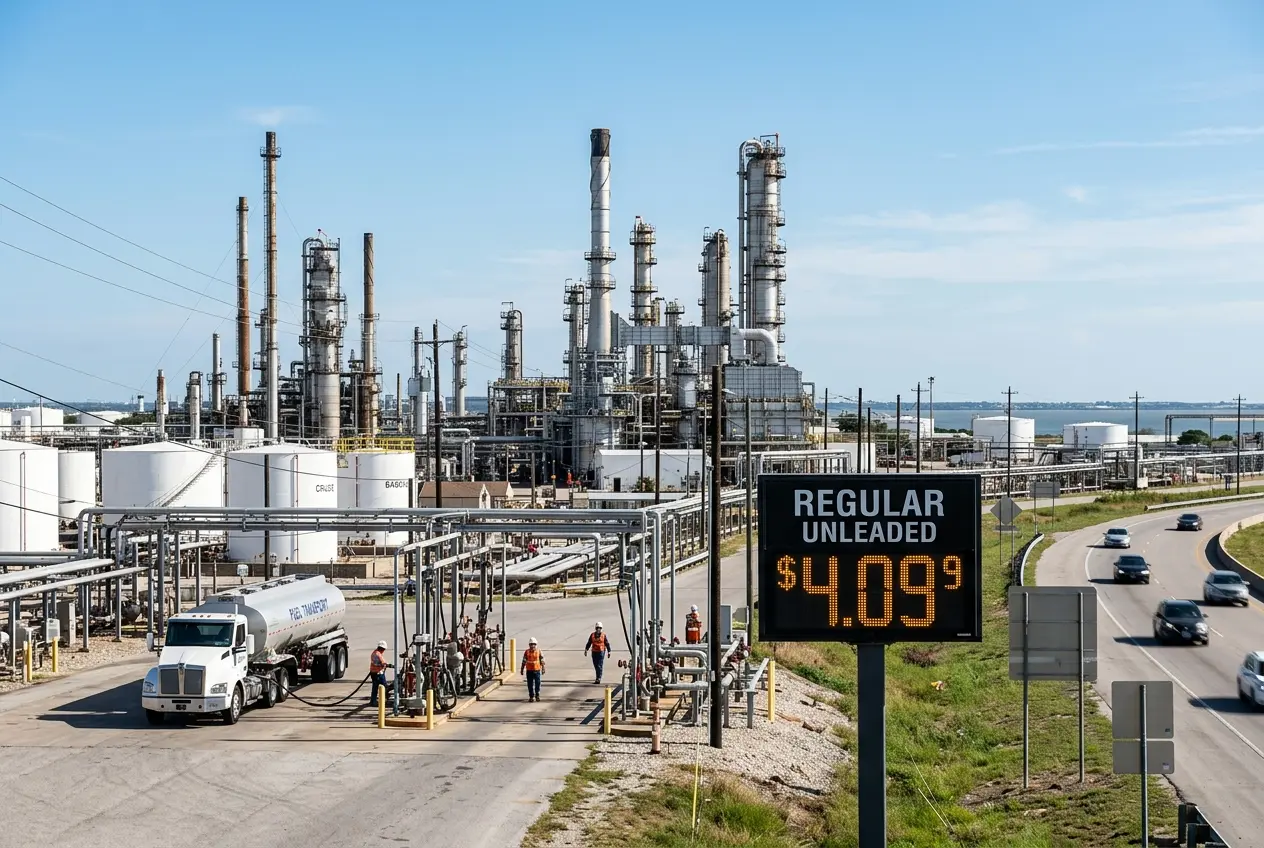
ExxonMobil and Chevron booked a combined $26.5 billion in second-quarter profit after lifting oil output to multi-year highs and running refineries near full tilt into a market upended by the Iran war. President Donald Trump has ordered a Justice Department probe into alleged price gouging and left an export ban on the table while the national average sits near $4.11 a gallon.
The same scarcity that filled corporate coffers now supplies the political case against the companies that filled it.
Record Cash From Output and Cracks
Exxon reported ExxonMobil second-quarter 2026 earnings of $14.5 billion, or $3.48 per share, with adjusted earnings at $14.7 billion. That more than doubled the year-earlier result and marked its strongest quarter since the early phase of Russia’s invasion of Ukraine. Cash from operations hit $23.6 billion; free cash flow reached $17.2 billion. Shareholder distributions totaled $9.4 billion.
Chevron posted Chevron reported earnings of $12.1 billion, or $6.11 per share diluted, with adjusted earnings of $12.0 billion. Return on capital employed jumped to 21 percent. Cash flow from operations came in at $22.6 billion and free cash flow at $18.1 billion. The company cut debt by a record $8.4 billion in the quarter.
| Metric | Exxon Q2 2026 | Chevron Q2 2026 |
|---|---|---|
| Net / GAAP earnings | $14.5 billion | $12.1 billion |
| Adjusted earnings | $14.7 billion | $12.0 billion |
| Upstream / production earnings | $7.9 billion | $8.2 billion |
| Refining / downstream earnings | $5.5 billion | $4.9 billion |
| Global production | 4.51 million boe/d | 4.07 million boe/d |
| U.S. production | Record Permian >1.8 Mboed | Record 2.08 million boe/d |
Both companies pointed to higher commodity prices, reliable operations and volume growth. Chevron’s worldwide production rose 20 percent year over year, helped by the Hess acquisition. Exxon’s Permian output set a new high and its diesel production hit a record on the current asset base.
How the War Scrambled Product Markets
The Iran conflict, which intensified from February 2026, cut Gulf production and collapsed tanker traffic through the Strait of Hormuz. Middle East refinery outages stacked on top of lost Russian capacity and tighter Chinese fuel exports. Crude prices surged; product markets tightened harder still.
Chevron’s average Brent realization for the quarter was $104 a barrel. Its downstream earnings swung to $4.9 billion from $737 million a year earlier. Exxon’s Energy Products segment earned $5.5 billion after a $1.3 billion loss in the first quarter. U.S. Gulf Coast utilization ran strong; Chevron’s U.S. crude unit throughput set a record at 1.07 million barrels per day with utilization above 97 percent.
- Hormuz tanker collapses and Gulf production cuts lifted crude.
- Regional refinery outages removed product supply just as demand held.
- China’s export restraint and residual Russian losses kept the product balance tight.
- U.S. majors ran integrated systems hard and captured the resulting cracks.
Exxon CFO Neil Hansen told investors the bigger price problem is no longer crude itself. It is the shrinking availability of the products made from it. That product crunch is exactly what delivered the refining windfall now under political scrutiny.
Trump’s $2.25 Goal Meets a Different Market
Trump has repeatedly said gasoline should be $2.25 a gallon. The AAA national average of $4.11 a gallon as of July 31 sits nearly double that mark. Diesel averages $5.35. Year-ago regular stood at $3.15.
The big Oil Companies are not dropping their price at the pump commensurate with the sharply lower prices they are paying for Oil. Those prices are dropping like a rock! In other words, customers are being “gouged”.
Trump wrote that on Truth Social when crude had pulled back earlier in the summer, ordering the Justice Department to look into it. He named Exxon, Chevron, Shell and BP. The DOJ and FTC later wrote state attorneys general urging them to enforce local price-gouging statutes, saying market volatility does not suspend antitrust or consumer-protection laws.
The $2.25 figure last appeared as a national average during the pandemic demand collapse, when driving stopped and oil prices cratered. Recreating that level with current mobility and with Middle East supply still disrupted would require a far larger surplus than today’s market holds.
Export Restrictions Move From Fringe to Live Option
An export ban on refined products is no longer dismissed out of hand. Chevron has warned that restricting exports would discourage investment and eventually leave the market with less supply. U.S. refiners have long used export markets to clear surplus gasoline and diesel when domestic demand softens seasonally; those barrels also balance global shortfalls when Hormuz traffic falters.
Integrated majors captured scarcity rents this quarter precisely because they could move molecules across the system and sell into the tightest markets. Cutting the export valve would reverse that flexibility. Capital that has just delivered record U.S. production and structural cost cuts would face a new political risk premium.
The American Petroleum Institute has pushed back that retail prices do not move in lockstep with crude because refining, transport, taxes and local competition all intervene. Industry executives argue the same point: the product gap is real, and choking exports would widen it.
Winners, Losers and the Feedback Loop
Shareholders collected large distributions and saw balance sheets strengthen. Exxon returned $9.4 billion; Chevron slashed debt while hitting cost and synergy targets early. U.S. production records in the Permian and Gulf of America give the companies a stronger domestic base than most peers.
Drivers and truckers face elevated pump prices that feed directly into household and logistics costs. Political pressure on the majors offers short-term optics but little immediate relief at the pump. An actual export curb would transfer the scarcity rent from corporate ledgers to tighter domestic inventories and higher prices over time.
Crowd reaction on X framed the quarter as producers harvesting the war premium while politicians harvest the outrage. One recurring observation is that scarcity rents flow to the companies with the best logistics and refining systems; the political response then threatens the very export and investment channels that keep those systems full. The Iran war disruptions that Hormuz crisis threatens global energy security continue to shape both the profits and the backlash.
- February 2026: Iran war escalates; Hormuz traffic and Gulf output drop; crude and product prices spike.
- Spring 2026: Brent averages climb toward and past $100; U.S. majors lift production and run refineries hard.
- June 2026: Trump singles out Exxon, Chevron, Shell and BP; orders DOJ gouging probe; cites $2.25 target.
- Early July 2026: DOJ and FTC urge states to enforce local price-gouging laws as crude eases but pump prices lag.
- July 31 2026: Exxon and Chevron report the $26.5 billion combined quarter; export-ban talk remains live.
Capacity Built for Exactly This Volatility
Both companies spent the prior years cutting structural costs, integrating acquisitions and expanding advantaged barrels. Chevron captured $3 billion in annual run-rate savings six months early and $1.5 billion in Hess synergies ahead of schedule. Exxon cites $16.3 billion in cumulative structural savings and record diesel output. Those moves let them harvest the disruption rather than be crippled by it.
The same portfolio that thrived on volatility now faces a political test of whether the United States wants the export and investment flexibility that produced the surplus capacity. Record free cash flow and strengthened balance sheets give the companies room to keep investing. An export restriction or prolonged regulatory chill would raise the hurdle rate on the next round of barrels and refining upgrades.
For now the numbers stand: $26.5 billion earned, production at multi-year highs, refining margins at extremes, and a White House that wants $2.25 gasoline while average prices remain above $4. The irony is structural. The profits arrived because the system still works under stress. The pressure those profits generate is the stress that could stop it working as well next time.

-
 TECH1 year ago
Where Garmin Watches are Made and How They are Assembled
-

 AUTO3 months ago
Tesla’s Roadster Is ‘a Few Weeks Away,’ Says Its Chief Designer
-
 NEWS10 years ago
Samsung Releases Galaxy Note7 TV Ad as Reddit AMA Leaks Specs
-
 NEWS10 years ago
Android 7.0 Nougat Rolls Out To Nexus Devices With New Emoji, Features
-
 FINANCE9 years ago
Cardano Price Surges as ADA Enters the Crypto Top Ten List
-
 NEWS10 years ago
Pre-Order the First Camera Made for Facebook Live Streaming Video
-
 FINANCE1 year ago
Binance Suspends Trading and Withdrawals for a System Upgrade
-
 FINANCE9 years ago
RChain Price Jumps Nearly 150% to a New All-Time High of $2.03