
BUSINESS
Dhanteras Shoppers Meet Gold Near December Prices
Delhi gold rose to Rs 1,42,500 per 10 grams on 2 November, a ten-month low landing just before Dhanteras under a 15% import duty.

Delhi gold of 99.9 per cent purity recovered Rs 500 to Rs 1,42,500 per 10 grams on 2 November, four days before Dhanteras. The bounce followed an October slide that took the metal back toward Rs 1,42,300, the All India Sarafa Association print on 26 December 2025, a window festive buyers did not have at the January peak.
STORY | Gold edges up ahead of Diwali on festive demand; silver remains steady in Delhi
Gold prices staged a modest recovery by Rs 500 to Rs 1,42,500 per 10 grams in the national capital on Monday, as festive purchases by jewellers and retailers ahead of Diwali helped the… pic.twitter.com/U0sVohRhVf
— Press Trust of India (@PTI_News) November 2, 2026
Monday’s Bounce Barely Covers October’s Damage
The All India Sarafa Association had gold at Rs 1,42,000 per 10 grams on 31 October, down Rs 3,200 from the previous session. Silver fell Rs 4,200 to Rs 1,86,000 per kilogram, near Rs 1,85,000 last seen on 8 December 2025. Those Saturday prints were the domestic floor of a two-month slide, not a one-day scare.
From Rs 1,49,300 on 30 September, gold lost Rs 7,300 through October. Silver shed Rs 46,000 from Rs 2,32,000. September had already cut gold by Rs 11,600 from Rs 1,60,900 on 31 August, and silver by Rs 13,500 from Rs 2,45,500. Taken together, 99.9 per cent gold is Rs 18,900, or 11.7%, below the 31 August print. Silver is Rs 59,500, or 24.2%, lower.
December gold futures on the Multi Commodity Exchange told a colder story than the jewellery shops. The contract closed at Rs 1,38,485 per 10 grams on 31 October. By 2:14 p.m. on 2 November it was only Rs 1,38,658, up Rs 173. Silver futures did more work, rising Rs 2,922 to Rs 1,82,054 from Rs 1,79,132. Physical Delhi gold jumping Rs 500 while futures barely moved is what restocking looks like, not a trend change in the dollar price.
Overseas, spot gold closed at $3,875.55 an ounce on 31 October, down $145.84, or nearly 4%, its weakest print in more than a year and last seen near $3,887.09 on 3 October 2025. Spot silver settled at $49.12, down $3.04, or 6%, last quoted at $48.02 on 6 November 2025. By 2 November spot gold had bounced to $3,900.90 and silver to $49.97.
Gold and silver prices were weighed down by rising energy prices, which fuelled inflation concerns, and hawkish commentary from the US Federal Reserve.
Rahul Khetawat, Senior Vice President and Fund Manager, 360 ONE Asset
Manav Modi, commodities analyst at Motilal Oswal Financial Services, tied the same tape to higher oil, firmer inflation, and bets on a December rate rise. He also flagged an AI-led equity selloff that forced cash raising, silver’s industrial use that made the fall worse, and speculative shorts built ahead of the US midterms. Unconfirmed talk of Chinese investors selling gold to raise cash sat on top of that mix.
Rajeev Sharan, head of research at Brickwork Ratings, put October’s drop from the intra-month high at about 6% for gold and about 17% for silver. Those shares are from the highs inside the month, not from the 30 September closes. He called the move a healthy pause rather than a break in the trend, and said festive and wedding buying in India should support demand in November, with central-bank purchases still a floor. He expects choppy trade and a slow recovery, not another vertical drop.
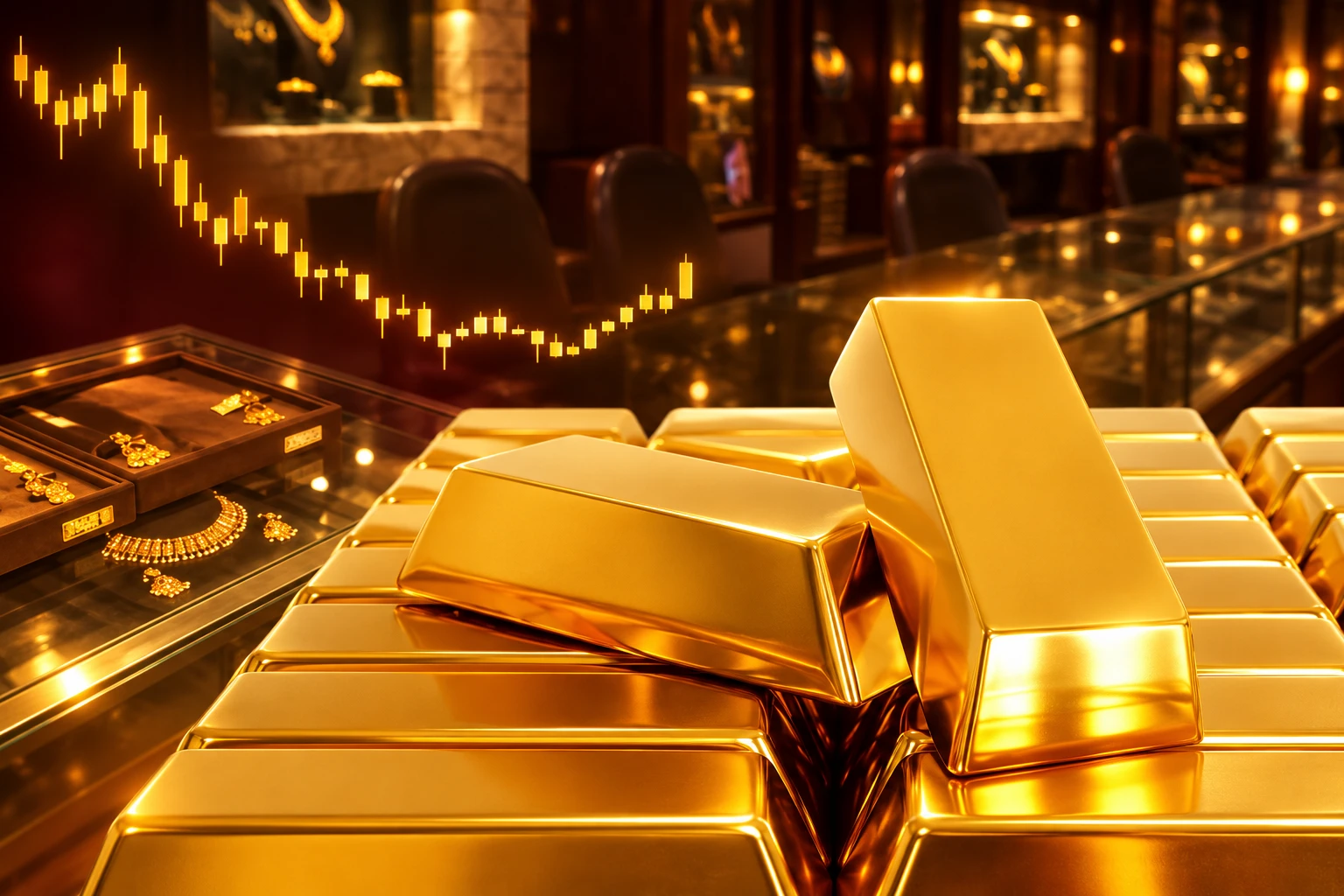
Dhanteras on 6 November Meets Gold Near December Prices
Dhanteras falls on Friday, 6 November, with Diwali on Sunday, 8 November. That is the week Indian families still treat as the proper time to buy metal, even after a year in which high prices pushed them into lighter pieces and old-gold exchange. The India Bullion and Jewellers Association set its 30 October afternoon rate for 999 gold at Rs 1,40,054 per 10 grams. On 29 January the same benchmark was Rs 1,75,340. That is a 20% fall from the peak, and it is the comparison that matters for anyone who bought the rally.
At the January rate, Rs 1,00,000 bought about 5.70 grams before tax. At the 30 October rate it bought about 7.14 grams, roughly 25% more metal, still before 3% GST and making charges. The same IBJA series was Rs 1,29,584 on 17 October 2025, the last working day before last year’s Dhanteras, so this festival still opens about 8% dearer than a year earlier. Cheaper than January is not the same as cheap.
THE DOMESTIC PRICE PATH
| Gold, 10 grams | Silver, 1 kg | |
|---|---|---|
| 31 August, Sarafa | Rs 1,60,900 | Rs 2,45,500 |
| 30 September | Rs 1,49,300 | Rs 2,32,000 |
| 31 October | Rs 1,42,000 | Rs 1,86,000 |
| 2 November, Delhi gold | Rs 1,42,500 | Steady in the capital |
Wedding jewellery is usually 22-carat, which trades below the 99.9 per cent Sarafa headline. That is the ticket size families actually pay, and it is why a drop of Rs 18,900 on the 24-carat print still leaves a full bridal set in rarified air. Organised jewellers spent October running price-lock bookings and exchange offers rather than waiting for a perfect print on 6 November.
Surendra Mehta, national secretary of the India Bullion and Jewellers Association, said October buying was better than September but still likely to finish about 11% below last year’s volume. Colin Shah, managing director of Kama Jewelry, said Dussehra value matched last year as buyers moved into lightweight and 9-carat pieces and diamond-studded work in the Rs 1.5-3 lakh band. Avinash Gupta, vice chairman of the All India Gem and Jewellery Domestic Council, said old-gold exchange, once about 30% of purchases, is now about 50%. The festive queue is real. It is just carrying last year’s jewellery in the other hand.
How India Kept Spending More for Less Gold
The World Gold Council’s India note for the April-June quarter is the cleanest map of that split. Total demand was 131 tonnes, down 6% from a year earlier, while spending hit a second-quarter record of INR 1,979 billion ($21 billion), up 50%. Jewellery demand fell 15% to 75.1 tonnes, the second-weakest second quarter in the council’s series back to 2000, yet jewellery spending rose 34% to INR 1,132 billion. India still accounted for 27% of world jewellery demand in the quarter.
INDIA GOLD DEMAND, Q2 2026
| Segment | Tonnes | Versus a year earlier |
|---|---|---|
| Jewellery | 75.1 | -15% |
| Bar and coin | 50.3 | +9% |
| Total demand | 131 | -6% |
Sachin Jain, the council’s regional chief executive for India, put the same value surge in rupee crore: consumption of Rs 1,98,100 crore against Rs 1,32,500 crore a year earlier. Kavita Chacko, the council’s research head for India, wrote that exchange volumes were up 10% to 20%, and that such deals were up to 70% of sales in some shops. Inventories stayed high at about 21 tonnes, above a 13-year average of 15 tonnes, as retailers kept stocking through the price.
Bar and Coin Held Up Better Than Jewellery
Bar and coin demand was 50.3 tonnes in the second quarter, up 9% from a year earlier even as it cooled from the prior three-quarter average of 100 tonnes. First-half bar and coin demand reached 112.5 tonnes, the strongest such half in 13 years. Indian gold ETFs still took in metal while other large markets saw outflows. Holdings were 119 tonnes at the end of June, with assets at INR 1.7 trillion. The Reserve Bank of India’s gold stock has been steady at 880 tonnes since mid-2025, but gold’s share of reserves rose from 12% to 16% on the price.
Full-year 2025 already showed the mix shift. Jewellery demand fell 24% to 430.5 tonnes, while bar and coin rose 17% to 280.4 tonnes. In the festival quarter of 2025, jewellery volumes fell 23% to 145.3 tonnes and bar and coin rose 26% to 96 tonnes. The council’s working range for 2026 Indian demand is 650 to 750 tonnes, and it is price sensitive. A Dhanteras print near December 2025 is the first real test of that range after the autumn dump.
Listed Jewellers Grew on Price, Not Weight
Chacko’s 20 October update found listed jewellers still posting 20% to 30% revenue growth in the July-September quarter, with the largest names adding 42 stores and same-store sales near 20%. Buyer counts rose only in the mid-single digits. Average tickets rose in double digits. Old-gold exchange rose more than 10% from a year earlier and made up more than 50% of sales at some chains. Coin demand, the investment slice, cooled once the price stopped rising. Management commentary for the next two quarters still leans on festivals and the peak wedding season.
Digital gold purchases were 1.7 tonnes in September, worth INR 25.9 billion, 83% above a year earlier. Gold ETFs took in INR 44.5 billion that month, about 3 tonnes, the strongest inflow in seven months, and added 140,231 new folios, taking the count to 12.68 million. Holdings reached 124 tonnes. Then, from 16 October, mutual funds halted fresh subscriptions into gold funds of funds after talks with the Securities and Exchange Board of India, a step read as another attempt to slow imports. Existing SIPs and direct ETF buying were left open. Fund-of-funds assets were INR 633 billion, about one-third of the INR 1,863 billion in gold ETFs.
Customs Duty Jumped From 6% to 15%
The price crash is colliding with a tax that did not exist at last year’s festival. From 13 May the government raised the gold import duty from 6% to 15%. With 3% GST applied on the duty-inclusive price, the tax load is 18.45%, up from 9.18%. Prime Minister Narendra Modi has also asked households to curb gold buying to help the trade gap. India still imports almost all the gold it uses.
THE POLICY STACK ON INDIAN GOLD
- Duty: Customs on gold rose from 6% to 15% with effect from 13 May.
- Tax load: Duty plus 3% GST takes the effective burden to 18.45% from 9.18%.
- Appeal: The prime minister has repeatedly asked Indians to buy less gold.
- Fund curb: Fresh gold fund-of-funds subscriptions were halted on 16 October.
- Imports: September shipments collapsed as official flows gave way to scrap and unofficial metal.
Himank Sharma, a director at Crisil Ratings, said doubling-plus the customs rate would deter jewellery demand. His house looks for organised jewellery volumes to fall another 13% to 15% this fiscal, after an 8% drop last year, to 620-640 tonnes, a ten-year low outside the pandemic year. In fiscal 2026 India imported about 720 tonnes, a $72 billion outflow. Mehta said demand in the fortnight to 27 May, right after the duty, fell about 70% from a year earlier, to about 7.5 tonnes from about 25 tonnes, and that smuggling risk would rise. Jain has flagged the same illicit channel as the industry’s largest threat.
September gold imports fell to $1.8 billion, the lowest since March 2024, against $9.61 billion a year earlier, an 81% drop, with gross volumes near 20 tonnes. Gold’s share of merchandise imports fell to 2.4% from 14%. Citi Research has put October-December shipments around 106 tonnes, about half a 212-tonne historical fourth-quarter average. Domestic discounts narrowed from an average of $66 an ounce in September to $8 by 16 October as seasonal demand returned, but a discount to import parity still pointed to enough local supply, including scrap and unofficial inflows. MMTC-PAMP has said large jewellery chains were still slow to restock, betting on a further fall, with sales skewed to smaller coins and bars.
That is the bind for the hidden buyer. The rupee price is the lowest in ten months, but the duty, the appeal, and tight official imports all tax the same kilogram. Exchange gold solves part of the bill for households that already own metal. First-time buyers and rural wedding demand do not get that offset, and a weaker monsoon has already been cited as a weight on village jewellery.
Silver’s Steeper Slide Hits Solar and Electronics
Silver’s extra damage is the industrial penalty Sharan and Modi both named. The white metal is jewellery, coins, and a factory input for solar panels and electronics. When investors dump everything for cash, that second job becomes a liability. From 31 August to 31 October silver lost 24.2% in the Sarafa series against 11.7% for gold. Sharan’s intra-month reading was about 17% for silver against about 6% for gold. Friday’s dollar session was 6% for silver and nearly 4% for gold.
Shanghai contracts also dropped while still sitting at a premium to the global price, especially in silver. On 2 November, MCX silver futures bounced harder than gold, up Rs 2,922 a kilogram, while Delhi retail silver was described as steady. That split fits a market where jewellers are covering festive silver coins and utensils for 6 November, and where factory users can wait. Sharan still treats solar and electronics as a demand floor over a longer stretch. They did not stop this slide.
Investment funds in both metals, he said, have kept taking money, which is why he sees choppy trade and a grind higher rather than a second collapse. The Monday futures bounce in silver was the first evidence of that grind. It is a thin one, and it arrived with crude slipping and with US midterms one sleep away, not with a new industrial order book.
Tuesday’s Vote Will Not Price the December Hike
The Federal Reserve held its funds rate at 3.75% to 4% on 28 October, six days before the 3 November midterms, in a 10-2 vote. Governor Lisa Cook, whom President Donald Trump is trying to remove, and Cleveland Fed President Beth Hammack wanted another quarter-point rise. Inflation was 3.7%. Chair Kevin Warsh said inflation is too high and that the committee would learn a lot over the next six weeks. CME Group’s FedWatch tool, after that hold, showed an 87.5% chance of a quarter-point hike at the 8 and 9 December meeting. Brent crude was still around $111.75 a barrel on 28 October after a 6% drop earlier that week. A further slide in oil on 2 November was cited alongside the bullion bounce.
Juan Carlos Artigas at the World Gold Council wrote on 22 October that US election days have no consistent gold pattern. Prices react to the fiscal, war-funding, and regulation choices that follow. Prediction markets then favoured Democrats taking at least part of Congress. Gridlock, in that note, could cut both ways: tighter spending might cool the gold bid, while limits on Iran-war funding could ease energy and yields, and a fight over AI rules could hit tech shares and send investors back to metal. Speculative shorts into the vote, Modi noted, are already on the book. The World Gold Council’s own read is that even a Republican sweep would likely keep non-US investors buying gold after 18 months of that behaviour.
THE DATES THAT STILL PRICE THE METAL
- 13 May 2026: India raises gold import duty from 6% to 15%.
- 31 August 2026: Sarafa gold at Rs 1,60,900 per 10 grams, silver at Rs 2,45,500 per kg.
- 28 October 2026: Federal Reserve holds 3.75% to 4% in a 10-2 vote.
- 31 October 2026: Delhi gold Rs 1,42,000, silver Rs 1,86,000.
- 2 November 2026: Delhi gold recovers to Rs 1,42,500 as jewellers restock.
- 3 November 2026: US midterm elections.
- 6 November 2026: Dhanteras. Diwali follows on 8 November.
- 8 and 9 December 2026: Next Federal Reserve meeting, with a hike heavily priced.
The Monday bounce looks like jewellers covering for Dhanteras, which is why Delhi retail moved more than MCX. If Gulf oil keeps cooling after the festival, the last geopolitical bid in both metals can fade, which is the risk hanging over the first week of November, not a verdict on Indian households. Those households still have to walk into shops on 6 November, pay 15% duty plus GST, and decide whether Rs 1,42,500 feels like a gift or like last year’s bill with a smaller discount.
Dhanteras counters open on 6 November with Delhi gold still near the 26 December print of Rs 1,42,300. The Federal Reserve’s next decision is due on 8 and 9 December.
Disclaimer: This article is news reporting and analysis of bullion prices, jewellery demand, and related policy, and it is for information only. It is not investment, tax, or jewellery-purchase advice and it does not recommend buying or selling gold, silver, coins, bars, ETFs, or shares of jewellery companies. Readers should consult a SEBI-registered investment adviser and, for physical metal, a hallmarked jeweller or bullion dealer who can explain making charges, GST, and purity before acting. Figures and market statuses are drawn from the named associations, exchanges, and research houses as dated in the piece and will change with trade, duty rules, and central-bank decisions.

ADNOC Ship Hit in Hormuz Leaves One Crew Missing

SpiceJet’s Rs 5,500 Crore Plan Follows a Rescue That Failed

Hasina’s Return Fight Sets Fire to Yunus’s Bank

Bancroft Recants the 2018 Inquiry and Names the Team

Adhikari Ties the Saffron Saree Row to School Licences

Clancy Juror Says the Holdout Never Cited Evidence

The iPhone 18 Pro Max Splits Apple’s Fall in Two

OpenAI Calls GPT-6 Astra AGI Then Locks Its Exploits

Trump Claims Hormuz Control as Oil Holds Near $96

Russia Closes the Goethe-Institut Berlin Tried to Save

 NEWS2 months ago
Clancy Juror Says the Holdout Never Cited Evidence
- NEWS3 months ago
The iPhone 18 Pro Max Splits Apple’s Fall in Two
- NEWS3 months ago
OpenAI Calls GPT-6 Astra AGI Then Locks Its Exploits
- BUSINESS3 months ago
Trump Claims Hormuz Control as Oil Holds Near $96
- LIFESTYLE3 months ago
Russia Closes the Goethe-Institut Berlin Tried to Save
- AUTO3 months ago
Volkswagen’s Job Cuts Leave Four Plants Without Cars
- NEWS3 months ago
Dyson Puts Nurovi Robots on Sale Without the UV Flagship
- BUSINESS2 months ago
US Destroys Five Iranian Tankers as the Shock Hits Jordan










