
NEWS
Apple HomeView Launches at $299 Without the EU
Apple’s $299 HomeView smart display runs Siri AI on Gemini-based models, skips the EU, and leaves the lock to LG.

On October 13, Apple opened pre-orders for HomeView, a $299 smart display due on November 13 in eight countries, with no sale planned in the European Union. The unit pairs a square screen with a speaker base, runs the rebuilt Siri AI assistant, and is one of the first products under CEO John Ternus, who took over from Tim Cook on September 1.
The pitch is a family command center for lights, locks, cameras, FaceTime and music. The catch is already printed in Apple’s own footnotes: the assistant still leans on Google, personal tricks need an iPhone, and Europe is left off the order page.
A Square Screen on a Speaker Base
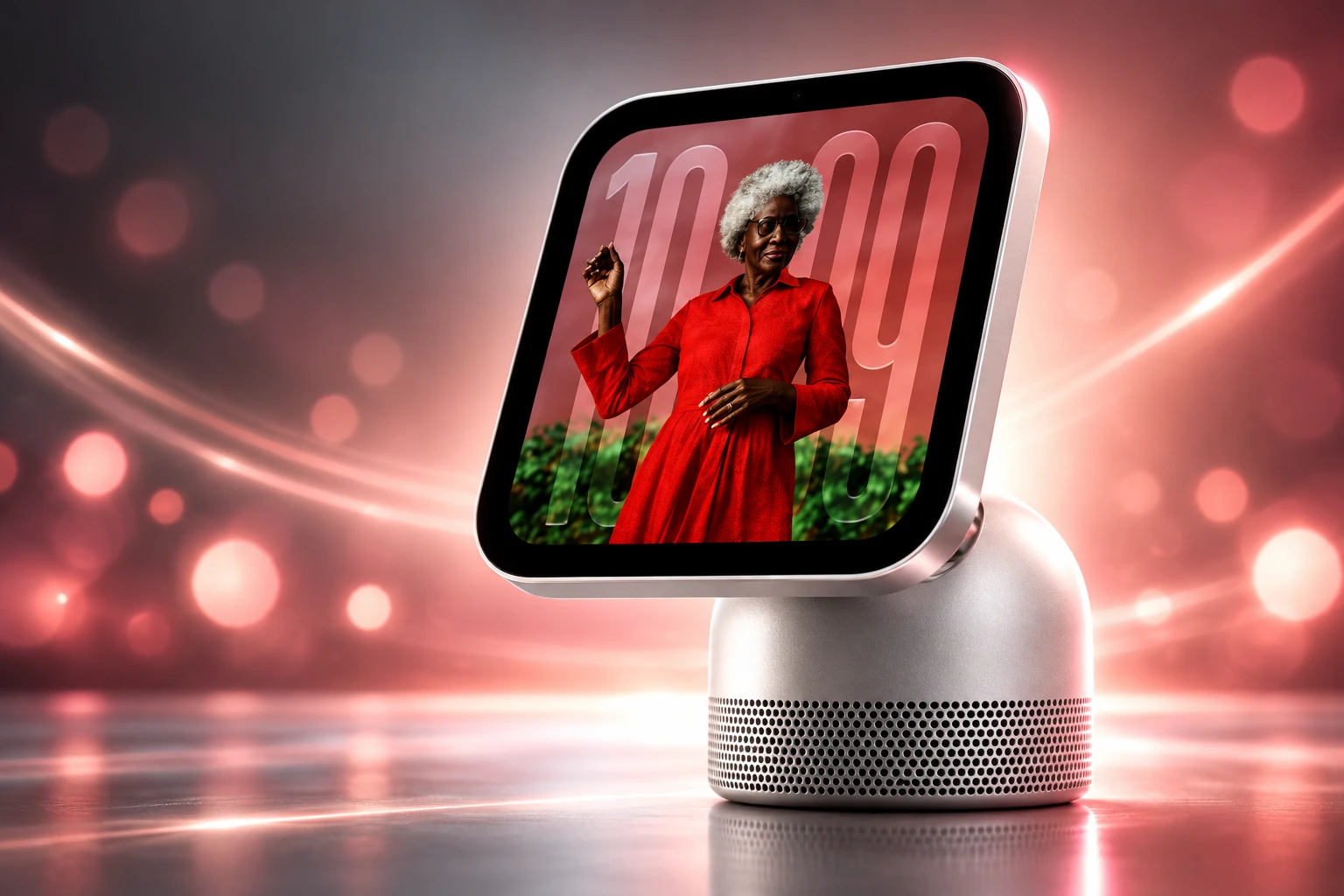
HomeView is Apple’s first dedicated smart display, a 7-inch Liquid Retina display in an aluminum shell, joined to a domed speaker by a stainless steel hinge. A second model drops the base and hangs on the wall with three Schneider Home mounts sold separately. Both versions cost $299 in the United States.
HOMEVIEW AT A GLANCE
- Price: $299 for the tabletop unit and $299 for the wall unit.
- Screen: 7-inch Liquid Retina that ramps from 500 nits down to 0.3 nits.
- Household: Face ID for up to six people, each with a private Home Screen.
- Ship date: November 13, after pre-orders that opened October 13.
The tabletop finish list is silver, starlight, rose pink and space gray, each with a matching cable. The wall unit comes only in space gray and silver. Greg Joswiak, Apple’s senior vice president of Worldwide Marketing, framed it as a shared object that still feels private.
Apple HomeView is designed to be shared by everyone in the home yet feel completely personal to each user. It recognizes your face to shift from a household screen to your own experience, fills the room with incredible sound, keeps you connected to the people who matter most with FaceTime, and makes it easy to control your smart home.
Greg Joswiak, senior vice president of Worldwide Marketing, Apple newsroom
Introducing Apple HomeView!
It recognizes up to six people, connects seamlessly across your Apple devices, and makes managing your home easy with Siri AI. All in a stunning, elegant design with privacy built right in. pic.twitter.com/S83Rzt4H6A
— Greg Joswiak (@gregjoz) October 13, 2026
Two full-range drivers sit in the display, with a down-firing woofer and two force-cancelling radiators in the base. The wall unit retunes that array for on-wall placement. The A18 chip runs the software, including Secure Exclaves that Apple says wall off camera and microphone data from apps, from the user, and from Apple itself. Messages and Calendar appear only when the enrolled face is in view and the paired iPhone or iPad is present and recently unlocked.
Siri AI Ships With Caps and an iPhone Catch
Apple calls Siri AI an entirely new assistant, more conversational, with world knowledge, on-screen awareness and better music discovery. Anyone in the room can ask general questions. The personal layer is gated. Calendar, Messages and app actions need an Apple Intelligence iPhone or iPad, current software, Siri AI turned on, and a supported language. Apple’s product page says Siri AI is available in English to start, and that usage limits may apply.
A conversation that begins on the kitchen screen can continue in the Siri app on iPhone, iPad, Mac, Apple Watch or Apple Vision Pro, with history synced through iCloud. Without that paired phone, HomeView still answers general questions and helps with music. It will not pull a party RSVP out of Messages. Setup and the six-person household split also need a compatible iPhone or iPad, so the $299 screen is not a stand-alone computer in the way an Echo Show can be.
The dashboard side is more complete on day one. The Home Modular face surfaces favorite accessories. The Home Camera face can show up to nine live feeds. With a supported iCloud+ plan, compatible cameras can flag people, pets, packages and vehicles, keep 10 days of clips, and add short video descriptions. HomeView also listens for smoke and carbon monoxide alarms and pings an iPhone, iPad or Apple Watch. FaceTime uses Center Stage. Intercom reaches other HomeView and HomePod speakers. A recipe in Safari can be converted into hands-free steps. None of that replaces the fact that the headline feature, Siri AI with personal context, is a phone feature that happens to have a speaker attached.
Google’s Gemini Models Sit Under the New Voice
Apple’s HomeView release never names Google. The assistant it is selling is the same Siri overhaul Apple already tied to Gemini in January. On January 12, Apple and Google said the next Apple Foundation Models would be based on Google’s Gemini models and cloud technology, and that those models would help power future Apple Intelligence features, including a more personal Siri.
After careful evaluation, Apple determined that Google’s AI technology provides the most capable foundation for Apple Foundation Models and is excited about the innovative new experiences it will unlock for Apple users. Apple Intelligence will continue to run on Apple devices and Private Cloud Compute, while maintaining Apple’s industry-leading privacy standards.
Apple and Google, joint statement, January 12, 2026
That is the odd geometry of this launch. HomeView is the appliance Apple wants on the counter to keep households inside Apple Music, FaceTime and the Home app. The voice that makes the appliance feel current was trained on a rival’s frontier models. Apple says requests still run on the device or in Private Cloud Compute, and that data processed there is not stored or made available to Apple. The Foundation Models underneath still come from the company that already sells Nest and Assistant into the same rooms.
Terms of the Gemini work were not disclosed. OpenAI’s ChatGPT remains an opt-in extra on Apple devices rather than the default layer. For a product whose job is to sit in a kitchen and talk, the supplier of the talking is not a footnote. It is how Apple closed a gap it could not close with its own models in time for Ternus’s first hardware season.
Why HomeView Will Not Go on Sale in the EU
Apple’s order page is blunt: HomeView is not for sale in the European Union, because Siri AI is currently unavailable in iOS there, and the company is working with the EU to find a path forward. Pre-orders are live in the United States, the United Kingdom, Canada, Australia, India and New Zealand. Singapore opens at 9 a.m. SGT on October 15. South Africa gets the hardware on November 13 through authorized resellers. That is eight markets. The bloc that includes France, Germany, Italy and Spain is not on the list.
The iOS hole is four months old. On June 8, Apple unveiled Siri AI and said it would not ship on iPhone or iPad in the EU, with no date attached. It blamed the Digital Markets Act, arguing that an extreme reading of interoperability would force Apple to give rival assistants the same deep reach Siri AI has, including messages, purchases and actions across apps. Craig Federighi, Apple’s senior vice president of Software Engineering, said EU users would not get Siri AI on iPhone or iPad when the new software landed, and that there was no timeline.
THE SIRI AI HOLDUP
- January 12, 2026: Apple and Google announce a multi-year deal so Apple Foundation Models rest on Gemini.
- June 8, 2026: Apple unveils Siri AI and withholds it from iOS and iPadOS in the EU, while still planning it for Mac, Watch and Vision Pro there.
- June 9, 2026: The European Commission says the holdup is Apple’s choice and that Apple asked for an 18-month waiver from DMA interoperability duties.
- October 13, 2026: HomeView opens for pre-order and is withheld from EU sale on the same Siri AI iOS gap.
Thomas Regnier of the European Commission told reporters the decision not to roll out Siri AI in the EU is Apple’s and Apple’s only, that nothing in the DMA stops new products, and that Apple had failed to build interoperability that met EU privacy and security standards. He said Apple asked to be exempted from those duties for at least 18 months, and that a waiver was not on offer, because it would leave other AI agents without an equal shot on iPhone. Apple says it offered safeguards and was refused. The Commission says Apple did not offer a compliant design and asked to sit out the rule instead.
WHERE APPLE AND BRUSSELS DISAGREE
- Apple’s account: Regulators rejected every proposal for a safe Siri AI launch under the DMA, so there is no timeline for the assistant on EU iPhones and iPads.
- The Commission’s account: Apple requested an 18-month exemption rather than a working interoperability scheme, and the DMA does not bar the company from shipping new hardware.
HomeView makes that fight visible on a price tag. A phone software dispute is now a product that European households cannot buy. This is also the second time Apple has held back an Intelligence feature from EU iPhones; the original suite was delayed there in 2024. Mac, Watch and Vision Pro users in the EU were told they would still get Siri AI, because those platforms are not the DMA gatekeeper in the same way iOS is. A kitchen display that needs iOS Siri AI does not get that carve-out. Until iPhone in Europe runs the assistant, Apple is not putting the screen on sale there either.
Locks, Cams and Thermostats From LG and Schneider
The $299 display can dim lights and show cameras. The lock, the doorbell and the thermostat in Apple’s new recommended set are not Apple-made. Apple Home Collection is a nine-piece lineup designed with LG Electronics and Schneider Electric, sold through Apple’s stores, set up with a tap on iPhone, and no separate app or account. Footage and Home app data are end-to-end encrypted, Apple says, so LG, Schneider and Apple cannot read them. Sales start in December, with some items slipping into early 2027.
APPLE HOME COLLECTION U.S. PRICES
| Product | Maker | Starts at (U.S.) |
|---|---|---|
| Video Doorbell Wired | LG Electronics | $249.95 |
| Floodlight Cam | LG Electronics | $399.95 |
| Outdoor Cam Plug-In | LG Electronics | $299.95 |
| Indoor Cam Plug-In | LG Electronics | $199.95 |
| Smart Deadbolt Lock | LG Electronics | $349.95 |
| Smart Thermostat | LG Electronics | $199.95 |
| Temperature Sensor | LG Electronics | $39.95 |
| Smart Thermostat | Schneider Home | $199.95 |
| Room Sensor | Schneider Home | $39.95 |
The span is $39.95 to $399.95. A wired doorbell plus the $349.95 deadbolt already starts at $599.90 before anyone heats a room. LG’s lock uses Ultra Wideband to open as an iPhone or Apple Watch walks up, with a PIN pad and a hidden backup key. It is Matter compatible, supports Aliro, and keeps core access working with no internet. The doorbell uses dual cameras, 2.5K at the front and full HD at the parcel lens, and can chime through HomeView or HomePod. In the Home app, the two can act as one front door. Cameras and the doorbell are listed for the United States, Canada and the United Kingdom. The lock and both thermostats are listed for the United States and Canada only.
Olivier Blum, chief executive of Schneider Electric, said Schneider Home’s thermostat is a true collaboration with Apple to help manage energy use without extra fuss. Both thermostats use Adaptive Temperature, which leans on iPhone to raise or lower heat based on whether someone is home, winding down, or away. In the contiguous United States, Clean Energy Guidance can shift heating and cooling toward cheaper, cleaner hours on a compatible utility plan. Apple Retail will offer paid ADT installation in the United States. Thread stays up if Wi-Fi drops, and the accessories update themselves if the home network name changes. The cheap object in this stack is still the screen. The house it is supposed to run is billed in $200 and $350 pieces, some of which will not arrive until 2027, and some of which will not ship to the United Kingdom at all.
Apple Still Holds 7% of the U.S. Speaker Base
HomeView is a second try at a room Apple already lost. For the twelve months ending June 2026, Consumer Intelligence Research Partners put Apple at 7% of the installed base among U.S. smart-speaker homes, with Amazon at about two-thirds and Google at about a quarter. That 7% has sat in the mid-single digits for years. CIRP also found that only 57% of recent Apple buyers own a smart speaker of any brand, which is the opening Apple is actually aiming at: households that already have iPhones and never put an Echo on the counter, not people who will rip Alexa out of the wall.
Amazon still owns the cheap speaker, the Show display, and Ring at the door. Google still owns Nest. Apple’s same-day lineup tries to hit all three at once. HomePod mini 2 is $149. A new Apple TV 4K is $299. HomeView is the Show rival. LG’s cameras and lock are the Ring rival. That does not change the installed-base math on day one. A $299 screen with a beta-era assistant, a missing EU catalog, and a partner lock that lands in December is a slow way to eat a two-thirds lead. It is a faster way to give Apple-only homes a reason not to add an Echo in the first place.
The Launch Film Turned a Kitchen Into a Queue
The hardware is prettier in stills than the argument Apple chose to film. The launch spot puts a household in a shared morning and lets them compete for one display, which is a strange way to sell a product whose slogan is that the screen feels personal to each user. The commercial left a sour aftertaste, and in at least one living room it tripped Siri on a nearby iPhone. A fair reading of that film is that Apple still has not decided whether HomeView is a communal appliance or a per-person terminal, and the tension shows. People who wanted a floating G4-style panel also got a thick-bezel pad on a speaker dome. That is a taste fight. The structural fight is simpler. A shared 7-inch pane will always lose to the phones already in those pockets unless the assistant on the pane is clearly better, always on, and legal to sell where Apple sells iPhones.
Right now it is better only with a paired Apple Intelligence device, capped, in English, and absent from EU iOS. Singapore can pre-order on October 15. The United States, the United Kingdom and the other launch markets get hardware on November 13. Cameras and thermostats follow in December. Apple says it is working with the EU on a path forward and has not named a date. Until that date exists, HomeView is a home product that does not ship to a home market Apple cannot afford to treat as optional.

Bulk Scotch Still Faces Full Duty After India’s UK Deal

Typhoon Champi Loops Off Taiwan and Still Injures 527

PM Modi Opens Chinmaya’s AI Guru and Asks for Unity

Mahim Police Hold a JeM Suspect on Enmity Charges

Gold Falls Below $4,000 as Hormuz Oil Hits $117

The iPhone 18 Pro Max Splits Apple’s Fall in Two

OpenAI Calls GPT-6 Astra AGI Then Locks Its Exploits

Clancy Juror Says the Holdout Never Cited Evidence

Trump Claims Hormuz Control as Oil Holds Near $96

Russia Closes the Goethe-Institut Berlin Tried to Save

 NEWS2 months ago
The iPhone 18 Pro Max Splits Apple’s Fall in Two
- NEWS2 months ago
OpenAI Calls GPT-6 Astra AGI Then Locks Its Exploits
- NEWS1 month ago
Clancy Juror Says the Holdout Never Cited Evidence
- BUSINESS2 months ago
Trump Claims Hormuz Control as Oil Holds Near $96
- LIFESTYLE2 months ago
Russia Closes the Goethe-Institut Berlin Tried to Save
- AUTO2 months ago
Volkswagen’s Job Cuts Leave Four Plants Without Cars
- NEWS2 months ago
Dyson Puts Nurovi Robots on Sale Without the UV Flagship
- BUSINESS2 months ago
Japan’s 3 Percent Yield Reprices Government Debt Worldwide










