NEWS
Apple’s Foldable iPhone Depends on Samsung’s Factory Floor
Apple’s first foldable iPhone arrives on Sept. 9 with as few as 500,000 units, because Samsung Display and two hinge shops set the pace.

Apple is eight days from unveiling its first foldable iPhone, and supply-chain checks say it will have as few as 500,000 to 1 million finished units this quarter.
The Wednesday, September 9 Apple event is John Ternus’s first as chief executive, and the foldable, widely expected to carry an iPhone Ultra name, will share the stage with the iPhone 18 Pro and Pro Max. Getting one will depend less on that keynote than on Samsung Display, two hinge makers, and a Korean shop that stamps metal plates into the screen.
Kuo’s Survey Caps Q3 at One Million Phones
Ming-Chi Kuo, the TF International Securities analyst who tracks Apple’s Asian suppliers, posted his latest factory check on July 5. He put second-half assembly of the foldable iPhone at 7 to 8 million units, with only 0.5 to 1 million of those landing in the third quarter, about 10 percent of the half-year total.
In the same window he expects 20 to 22 million iPhone 18 Pro and Pro Max phones, a pile large enough for a normal September sale. The foldable does not have that pile.
https://x.com/mingchikuo/status/2073770705905123705
My latest industry survey indicates that assembly shipments for the foldable iPhone in 2H26 will be roughly 7-8 million units, with 3Q26 shipments at 0.5-1 million units, or about 10% of the total. By comparison, estimated 3Q26 shipments of the iPhone 18 Pro / Pro Max total roughly 20-22 million units, significantly higher than the foldable iPhone and already meeting the inventory requirement for an official launch.
Ming-Chi Kuo, analyst, TF International Securities
He still expects the phone to sell out when pre-orders open, with delivery times stretching to four to six weeks or longer through December, and with resale markups of 50 to 100 percent. The price band he is using is $2,300 to $2,500, which would make it Apple’s most expensive iPhone.
Some Chinese supply-chain reports have put the year’s build closer to 10 million, and IDC has said Apple could move more than 10 million in the first 12 months of sales. Even the fatter figures leave the foldable as a small line next to the Pro models. Kuo has not lifted his third-quarter band.
KUO’S BUILD VERSUS THE PRO LINE
| Line | Q3 2026 assemblies | What that covers |
|---|---|---|
| Foldable iPhone | 0.5 to 1 million | About 10% of Kuo’s 7 to 8 million second-half total |
| iPhone 18 Pro and Pro Max | 20 to 22 million | Enough, in his view, for a September on-sale date |
| Foldable, full second half | 7 to 8 million | Still a halo run, not a volume iPhone |
That gap is why the September event can show a finished phone while stores still have almost nothing to scan.
Samsung Display Locked a Three-Year Exclusive
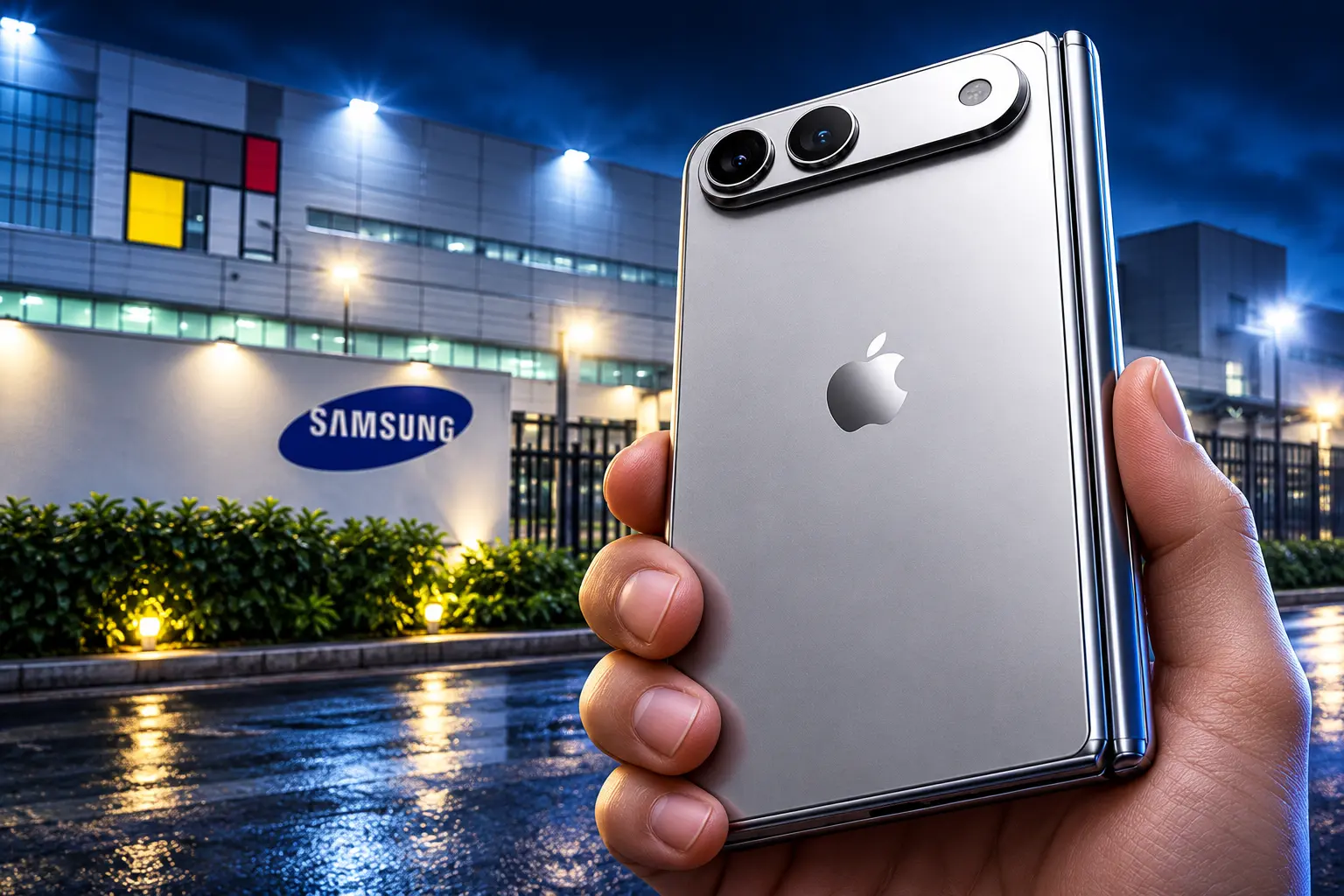
The screen is not an Apple part. Samsung Display is the sole foldable OLED supplier under a three-year exclusive, so no other panel maker is booked to ship this display. The same company that builds Galaxy Z screens is printing the inner and cover panels for the phone meant to take share from those Z models.
Apple signed off on module production after yields at Samsung Display’s Vietnam plant cleared more than 80 percent. Apple’s usual bar for that approval is about 70 percent. The first shipment is expected to total about 3 million panels this year, from a Vietnam backend campus that runs roughly 50 of its 80 lines.
SAMSUNG DISPLAY’S APPLE DEAL
- The lockup: A three-year exclusive, so rival panel makers are shut out of this iPhone.
- First batch: About 3 million modules from Vietnam scheduled for this year.
- The yield bar: Apple wants 70 percent or better; Samsung Display cleared more than 80 percent.
- The stack: M16 organic materials and Color Filter on Encapsulation, which drops the polarizer.
Foldable panels are unforgiving. The fold has to survive thousands of bends without a deep crease, and the module has to stay thin enough for a phone that is rumored to measure 4.5 to 4.8 mm when open and 9 to 9.5 mm shut. CoE and the M16 stack are Samsung Display’s answer to brightness, life, and thickness. They are also why a 3 million-panel first order can trail a 7 million-phone second-half plan: yield loss and spare stock eat the difference before Foxconn screws the thing together.
Kuo’s rumored geometry is a 7.8-inch inner display and a 5.5-inch cover, a book-style, passport-like slab rather than a clamshell. That is the same wide fold Samsung just put on sale with the Galaxy Z Fold 8. Apple is late to the shape, and it is buying the panel from the company that already ships it.
The Hinge Still Sets the Clock
If the screen is Samsung Display’s, the hinge is not. Taiwan’s Shin Zu Shing and U.S.-based Amphenol are supplying 3D-printed hinge modules, the part that sets fold feel, crease depth, and whether the phone lasts. There is no equivalent part on a bar iPhone, which is why this is the piece that kept slipping.
Industry sources speaking to The Elec in June said durability tests running to several million folds produced minor hinge noise, and that some assembly steps ran with wider tolerances than Apple wanted, which pushed the defect rate up. The slip on mass production was put at two weeks to a month. Most of those problems, the same sources said, were then brought under control, with Foxconn pointed at a late-July ramp after an April trial run.
There are no issues on Samsung Display’s side. The launch schedule depends on Apple’s readiness with device components, especially the hinge.
Industry source, The Elec, June 22, 2026
Mark Gurman at Bloomberg later wrote that people who had already handled the hardware liked how it fit in a pocket, how the hinge felt, and how the inner screen took an iPad-style layout. The same notes flag the trade: Touch ID in the side button instead of Face ID, no telephoto, and a price above $2,000. The hinge can impress a tester and still be the slowest part on a line that has to hold noise, crease, and millions of folds at once.
Metal Plates Cost $30 and Eat Yield
Under the Samsung Display stack sits another Korean part most launch previews will skip. Fine M-Tec makes the display metal plate, sometimes called an internal hinge, that spreads bending stress so the OLED does not crease. Kuo has said Apple is using Samsung Display’s crease-free recipe rather than an in-house plate, which funnels the work to Fine M-Tec.
He expects the firm to ship display metal plates at $30 to $35 each, starting in the first quarter of 2026, with 13 to 15 million units for the year and an 80 percent-plus share of that part. That plate count is larger than the finished-phone plan on purpose. Yield loss and repair stock require extras, and the laser-drilled microstructure that guides stress is itself another $30-to-$35 step on top of a cheaper etch.
Those dollars help explain a $2,300 floor before Apple’s margin. They also explain why a “nearly crease-free” demo on stage is a supplier product. Fine M-Tec, Samsung Display, and the hinge pair have to hit at the same time or the assembly line starves.
WHO GETS PAID ON EVERY UNIT
- Samsung Display: Exclusive foldable OLED for three years, modules finished in Vietnam.
- Fine M-Tec: Stress plates under the screen, most of that part, billed in the $30s.
- Shin Zu Shing and Amphenol: 3D-printed hinges that failed noise tests, then cleared.
- Foxconn: Final assembly after an April trial and a late-July start.
Foxconn is the last gate. A finished panel and a quiet hinge still have to meet cover glass, frame, and cameras on a line that has never built this product. The April trial was the check that those pieces fit. Late July was the check that they fit at volume.
Foldable Share Shifts Toward Apple in Year One
The brand that loses when those factories work is Samsung’s phone group, not its display group. Counterpoint Research expects global foldable shipments to rise 21 percent in 2026, with book-style models carrying the growth. Samsung is still forecast to hold 32 percent of foldable shipments, down from 40 percent in 2025. Apple is penciled in at 25 percent in its first year. Huawei is at 24 percent, Motorola 8 percent, Honor 3 percent.
2026 FOLDABLE BRAND SHARE, COUNTERPOINT
| Brand | 2026 forecast | 2025 share |
|---|---|---|
| Samsung | 32% | 40% |
| Apple | 25% | – |
| Huawei | 24% | – |
| Motorola | 8% | – |
| Honor | 3% | – |
On the panel side the split is even starker. Counterpoint sees 27.5 million foldable panels this year, up about 24 percent, with Apple around 29 percent of that buy in year one. Samsung Display, which lost ground to BOE in a weak first quarter, is the supplier set to take the full-year lead once Apple’s orders land. Samsung the brand can drop eight points of phone share and still collect the OLED invoice on Apple’s units.
Apple’s entry is expected to lift overall consumer awareness and raise the benchmark for premium foldables, but Samsung still has a clear advantage in product maturity, channel reach and foldable user experience.
Liz Lee, associate director, Counterpoint Research
That maturity is already on the shelf. The Galaxy Z Fold 8 is in stores at $1,899 for 256 GB, a passport-style book that some long-time iPhone buyers have said is the first Samsung they actually want. Apple is walking on stage about a month later with a rumored $2,300-to-$2,500 phone most of those people cannot order. The category education Samsung paid for over seven years is the demand Apple is about to skim, in small numbers, at a higher ticket.
Why Pre-Orders May Wait Until October?
Kuo’s comparison is the iPhone X. Apple unveiled that phone with the iPhone 8 on September 12, 2017. The 8 went up for pre-order three days later. iPhone X pre-orders did not open until October 27, because OLED and Face ID inventory had not reached a September launch level. He thinks the foldable repeats that split: announce with the Pro phones, sell later.
FROM THE IPHONE X TO THIS FALL
- September 12, 2017: Apple unveils the iPhone X with the iPhone 8, then holds X pre-orders until October 27.
- June 22, 2026: Samsung Display starts foldable OLED modules after yields top 80 percent.
- Late July 2026: Foxconn begins mass production after hinge noise is mostly cleared.
- September 1, 2026: John Ternus becomes chief executive, eight days before the event.
- September 9, 2026: Apple is set to show the foldable with the iPhone 18 Pro and Pro Max.
One Australian trade report has first units staying in the United States, with other markets months later. That remains a single-source claim. What is not in dispute is the math: a few hundred thousand phones in the quarter of the event cannot fill every flagship store and every carrier at once. UBS has used a cheaper $1,800-to-$2,000 band; Fubon has used $2,400. Kuo has stayed at $2,300 to $2,500. Storage rumors run 256 GB, 512 GB, and 1 TB. That is not public pricing. All of it assumes a phone that is hard to find.
The standard iPhone 18 is not expected on this stage. Supply-chain sources have said this fall’s lineup centers on the Pro, Pro Max, and the foldable, with the cheaper model slipping toward 2027. That choice keeps the event at the high end, which is also where the scarce foldable lives. People who cannot get the foldable still have a $1,000-plus Pro in stock. That is convenient for Apple. It is the outcome a 1 million-unit Q3 run almost forces.
Ternus Opens With a Phone He Cannot Stock
Ternus spent years as hardware chief. The foldable is the first new iPhone shape of his tenure, and it arrives the week he takes the job. Greg Joswiak’s “Surprise and shine” note dated the event to September 9 and left the product list unsaid. The surprise, if the factories hold, is a crease-light inner screen and a hinge that no longer squeaks. The constraint is how many of those objects exist.
A20 Pro silicon, 12 GB of memory, an in-house C2 modem, dual rear cameras, and a battery rumored near 5,500 mAh are the rest of the spec sheet people will argue about after the stream. Those parts are familiar Apple problems. The new problems are a Vietnam OLED module, a $30 stress plate, and a 3D-printed hinge that had to go through millions of folds before Foxconn was allowed to run.
Ternus’s first product event is Wednesday. Kuo’s third-quarter band is still 500,000 to 1 million units. Pre-order dates, once Apple posts them, will show how much of that pipeline is real.

Police Tighten the Ring Around Gyanesh Kumar’s House

Ravi Shankar Calls Hanuman Ansh a Slap to Big Spenders

Microsoft Puts Nvidia in the Surface Laptop Ultra Flagship

Adult Fires on an Armed Juvenile at Longmont Dollar Tree

Jordan Absorbs Iranian Missiles Aimed at Parked US Jets

The iPhone 18 Pro Max Splits Apple’s Fall in Two

OpenAI Calls GPT-6 Astra AGI Then Locks Its Exploits

Clancy Juror Says the Holdout Never Cited Evidence

Russia Closes the Goethe-Institut Berlin Tried to Save

Trump Claims Hormuz Control as Oil Holds Near $96

 NEWS2 months ago
The iPhone 18 Pro Max Splits Apple’s Fall in Two
- NEWS2 months ago
OpenAI Calls GPT-6 Astra AGI Then Locks Its Exploits
- NEWS1 month ago
Clancy Juror Says the Holdout Never Cited Evidence
- LIFESTYLE2 months ago
Russia Closes the Goethe-Institut Berlin Tried to Save
- BUSINESS2 months ago
Trump Claims Hormuz Control as Oil Holds Near $96
- AUTO2 months ago
Volkswagen’s Job Cuts Leave Four Plants Without Cars
- NEWS2 months ago
Dyson Puts Nurovi Robots on Sale Without the UV Flagship
- NEWS2 months ago
The Lincoln’s 286-Day War Cruise Ends at a Thai Pier