
NEWS
A Private Vegetarian Kitchen Became Kerala’s First Political Fight
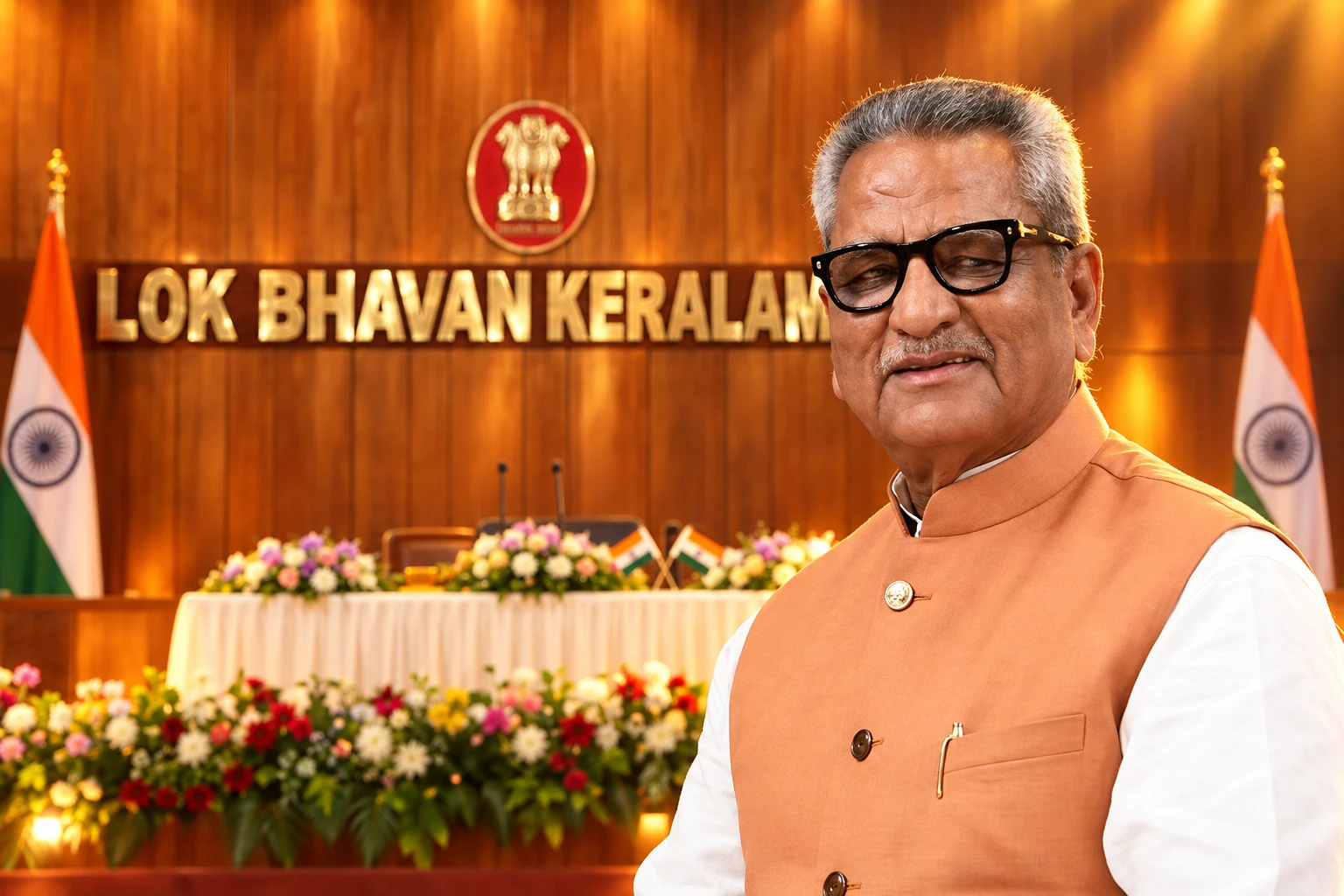
Om Prakash Mathur’s personal vegetarian kitchen at Lok Bhavan, staffed by Rajasthani cooks, was framed within an hour as an assault on Kerala’s fish-eating culture.

Om Prakash Mathur ordered meat and fish out of the Lok Bhavan kitchen on his first day as Kerala’s 29th Governor. The ruling Congress and the opposition CPI(M) called that vegetarian rule a Sangh Parivar opening move against Kerala’s food culture.
Lok Bhavan sources said the kitchen cooks for the governor and a few personal staff, with no order on what other employees eat, yet cooks from Rajasthan have been brought in and guests at the house will now be served vegetarian food.
Mathur Took Charge With a Kitchen Order Waiting
Mathur, 74, 29th Governor of Keralam, took the oath on Friday, October 23, 2026, at the Lok Bhavan auditorium in Thiruvananthapuram. Kerala High Court Chief Justice Soumen Sen administered it in Hindi, after President Droupadi Murmu’s appointment order was read out. Chief Minister V. D. Satheesan, Speaker Thiruvanchoor Radhakrishnan, cabinet ministers and Sikkim Chief Minister Prem Singh Tamang were in the room. Leader of the Opposition Pinarayi Vijayan was not. The Left Democratic Front stayed away. The ceremony opened and closed with Vande Mataram and the national anthem.
The official account posted the swearing-in the same morning.
Shri @OmMathur_Raj was sworn in as the 29th Governor of Keralam at Lok Bhavan today. Hon'ble Chief Justice, Justice Soumen Sen, administered the oath of office in the presence of Hon'ble Speaker Shri @Thiruvanchoor, Hon'ble Chief Minister Shri @vdsatheesan, his cabinet… pic.twitter.com/r4fRXnx8wg
— Kerala Governor (@KeralaGovernor) October 23, 2026
The kitchen instruction did not wait for the oath. Local reports on Thursday, October 22, the day Mathur landed and Satheesan received him at the airport, said non-vegetarian food was not to be cooked or served in the Lok Bhavan kitchen. Sources in the governor’s office said he is a strict vegetarian and had asked that meat and fish stay out of the kitchen where his own meals are made. They said other employees were free to bring food from home or eat outside.
THE FIRST 48 HOURS
- Thursday, October 22, 2026: Mathur arrives in Thiruvananthapuram, is received by Satheesan, and local reports say the Lok Bhavan kitchen will cook no meat or fish, with cooks brought from Rajasthan.
- Friday, October 23, 2026: He takes the oath in Hindi. AICC general secretary K. C. Venugopal attacks the order within an hour. Home Minister Ramesh Chennithala and CPI(M) state secretary M. V. Govindan follow.
- Saturday, October 24, 2026: Minister Ram Kripal Yadav, speaking in Patna, defends Mathur’s right to eat and cook as he wishes and says Venugopal is targeting Raj Bhavan because he has no issue to raise.
Satheesan posted greetings after the oath and wished Mathur a tenure of distinguished service. He has not spoken about the kitchen.
The Governor’s Kitchen Does Not Feed the Staff
The political argument ran ahead of the floor plan. Lok Bhavan sources said food from the official kitchen is served to the governor and a few members of his personal staff, and that some earlier governors had allowed fish and meat to be cooked there. They also said staff have a separate kitchen in the residential quarters on the estate, where they cook what they like.
That is a smaller operation than a statewide food rule. It is not a private tiffin box either, because the same official kitchen is the one that plates the house. Meals there are provided for the governor, his personal staff and select officials, and guests will now be served vegetarian food. A former Goan occupant had no objection to guests and staff eating non-vegetarian food from that table.
WHAT THE KITCHEN ORDER COVERS
- The governor’s plate: No meat or fish is to be cooked in the kitchen where Mathur’s meals are made.
- Personal staff at that table: Food from this kitchen is served to a few members of his personal staff as well.
- Guests at the house: Guests will now be served vegetarian food from the official kitchen.
- Staff quarters: Employees have a separate kitchen in the residential quarters and may cook what they want there.
- Tiffins and eating out: No restriction has been placed on food that staff bring from home or buy outside.
One Lok Bhavan official called the uproar a non-issue and asked who calls the shots in Venugopal’s kitchen, saying the governor’s kitchen exists to match his diet and that he is entitled to bring his own cook. The live argument is not whether Mathur may eat vegetarian food. It is whether the official table, once it also feeds guests, still counts as a personal kitchen.
Why Kerala Heard a Statewide Food Ban
Venugopal, the AICC general secretary and Alappuzha MP, did not describe a household menu. He described a coastal people being told what to eat. Kerala, he said, has a mixed food culture and, as a coastal state, abundant fish, and both vegetarians and non-vegetarians have long lived with that. “Any attempt to restrict the food habits Keralites are accustomed to or dictate what they should eat from now on cannot be accepted,” he said.
That sentence only lands because fish is not a side dish here. An ICAR-Central Institute of Fisheries Technology paper in Fishery Technology, citing the Union Department of Fisheries for 2023, put Kerala’s 20.65 kg annual fish intake at more than double the national average. The state has a 589.5 km coastline, about 10 percent of India’s, and accounts for about 15 percent of national marine landings.
KERALA FISH ON THE PLATE
- Statewide yearly figure: 20.65 kg of fish per person, more than double the national average, per the Department of Fisheries for 2023 as cited by ICAR-CIFT.
- High-frequency homes: 2.94 kg per person per month among regular fish-eating households surveyed in 2020.
- The survey: 399 households in Ernakulam, Kozhikode, Palakkad and Kottayam, two coastal districts and two inland.
- The coast behind the plate: 589.5 km of shoreline and 15 percent of India’s marine landings.
Mathur’s home state sits at the other end of that map. He is a lifelong vegetarian from Bedal village in Pali district, Rajasthan, and he has brought Rajasthani cooks to match that diet. A personal plate from that belt, set down in a house that used to serve fish, is easy to read as a cultural transfer even when the cooks are only feeding the governor’s table.
Rajasthani Cooks Followed a Goan Fish Kitchen
The change is sharp because the last kitchen was not vegetarian. Rajendra Vishwanath Arlekar, who has been sent to Tamil Nadu as Governor, is from Goa. He kept a cook from Goa, served dishes including fish, and did not object to guests and staff eating non-vegetarian food. Lok Bhavan sources said fish and meat had been prepared in the kitchen during the tenure of some previous governors as well.
LOK BHAVAN KITCHENS BEFORE AND AFTER MATHUR
| Occupant | What the official kitchen cooked | Who cooked it |
|---|---|---|
| Om Prakash Mathur | Vegetarian only; no meat or fish | Cooks brought from Rajasthan |
| Rajendra Arlekar | Fish and other non-vegetarian dishes served | A cook from Goa |
| Some earlier governors | Fish and meat allowed, per Lok Bhavan sources | Not specified |
Arlekar, a BJP appointee like Mathur, did not walk into a food fight. Satheesan had a cordial working relationship with that Raj Bhavan. The difference on Friday was not party label. It was a menu that stopped cooking fish in a house that had been serving it, on the first morning of a Governor whose public life began in the RSS.
Mathur, arriving a day before the oath, said he was immensely happy to come for the first time to Kerala, “God’s Own Country,” a land he described as filled with love and harmony. The kitchen order, already in circulation that night, gave the political class a more useful script than the greeting.
Venugopal Called It the First Saffron Step
Venugopal went out within an hour of the oath. He said a person in a constitutional office, bound to protect the right to decide what to eat and how to live, was insisting that others follow his own food habits, and that the new governor was using his authority to curtail individual freedom. He asked Mathur to withdraw any decision that restricted food choice.
This is a continuation of the unconstitutional interests of the Sangh Parivar. This is the first step towards implementing the saffron agenda of the Sangh Parivar in Keralam.
K. C. Venugopal, AICC general secretary and Alappuzha MP
He said it was fine for Mathur to stay vegetarian and unacceptable to make the Lok Bhavan kitchen, where Malayalis also work, run on that personal preference. He added that in BJP-ruled states people have been killed over what they eat and even what they wear. That is a national charge hung on a house kitchen, and it is the charge both the ruling party and the CPI(M) chose on day one.
Chennithala, the deputy chief minister and home minister, is himself a vegetarian. He still told reporters that what one wears, which language one speaks and what one eats are matters of individual freedom, and said, “Let us eat what we want to eat.”
I may be a vegetarian, and I am also a vegetarian, but my wife is not, because I have never asked her to become one. It is a matter of individual freedom. Why should we infringe on anyone’s freedom? This is not right, and he should rectify it.
Ramesh Chennithala, Kerala Home Minister, to ANI
Govindan, speaking for the CPI(M) at a press conference, said India is a country where people have the democratic right to choose vegetarian or non-vegetarian food, that attempts are being made to take that right away, and that the Sangh Parivar agenda of communal polarisation sits behind those efforts. He said there were attempts to turn even food into a “communal weapon.”
Congress and the CPI(M) spent the last assembly campaign fighting each other. They did not need a briefing to share this line. Food is the fastest way in Kerala to fold a Raj Bhavan quarrel into a story about whose culture the Constitution protects, and both parties reached for it before Mathur had signed a file.
From Pali to the Lok Bhavan Auditorium
Mathur was born on January 2, 1952, in Bedal village in Bali tehsil of Pali district, Rajasthan, and graduated from the University of Rajasthan. Kerala’s information department records that he began public life as a pracharak of the Rashtriya Swayamsevak Sangh. The Rajasthan BJP’s own page lists him as an RSS pracharak since 1972.
He was jailed for 11 months during the Emergency. He worked in the RSS and then the BJP alongside Narendra Modi from the 1970s, served as the party’s general secretary in charge of Gujarat, sat in the Rajya Sabha from Rajasthan from 2008 to 2014 and again from 2016 to 2022, and led the Rajasthan BJP as state president. He came to Thiruvananthapuram after two years and two and a half months as Governor of Sikkim.
That résumé is why a kitchen order was never going to be read as a diet chart. A lifelong organiser from the Sangh, posted to a state the BJP does not govern, changed the official menu before he took the oath. Venugopal named the Sangh because that is the biography he was handed. Lok Bhavan named vegetarianism because that is the biography Mathur lives. Both can be true at once, which is why the speeches and the clarification keep missing each other.
Silence From the Chief Minister on Food
The person with the most practical stake in a calm Raj Bhavan has said nothing about the plate. Satheesan sat through the Hindi oath, posted a warm note, and left the kitchen to his home minister and to the AICC general secretary. Arlekar’s tenure had taught this chief minister that a BJP Governor and a Congress government can share a working relationship. Mathur’s first morning tested whether that habit survives a menu.
Yadav, speaking in Patna on Saturday, October 24, took the other side of Venugopal’s charge. Everyone, he said, has the freedom to eat and cook what they want, to speak their language and to practise their religion. “Will you now impose restrictions on food?” he asked. “Venugopal is trying to unnecessarily target the Raj Bhavan because he has no issue to raise. This is unfortunate.”
The staff tiffin was never in danger. The guest table is the part that moved. If official visitors now eat vegetarian food because that is what the house kitchen cooks, the order is larger than one man’s plate and smaller than a ban on Keralites. That is the size of the thing both sides inflated, and the size on which the next banquet will settle the argument.

Bulk Scotch Still Faces Full Duty After India’s UK Deal

Typhoon Champi Loops Off Taiwan and Still Injures 527

PM Modi Opens Chinmaya’s AI Guru and Asks for Unity

Mahim Police Hold a JeM Suspect on Enmity Charges

Gold Falls Below $4,000 as Hormuz Oil Hits $117

The iPhone 18 Pro Max Splits Apple’s Fall in Two

OpenAI Calls GPT-6 Astra AGI Then Locks Its Exploits

Clancy Juror Says the Holdout Never Cited Evidence

Trump Claims Hormuz Control as Oil Holds Near $96

Russia Closes the Goethe-Institut Berlin Tried to Save

 NEWS2 months ago
The iPhone 18 Pro Max Splits Apple’s Fall in Two
- NEWS2 months ago
OpenAI Calls GPT-6 Astra AGI Then Locks Its Exploits
- NEWS1 month ago
Clancy Juror Says the Holdout Never Cited Evidence
- BUSINESS2 months ago
Trump Claims Hormuz Control as Oil Holds Near $96
- LIFESTYLE2 months ago
Russia Closes the Goethe-Institut Berlin Tried to Save
- AUTO2 months ago
Volkswagen’s Job Cuts Leave Four Plants Without Cars
- NEWS2 months ago
Dyson Puts Nurovi Robots on Sale Without the UV Flagship
- NEWS2 months ago
The Lincoln’s 286-Day War Cruise Ends at a Thai Pier










