NEWS
HPE’s Tiny Lunar Computer Must Think Without Houston
HPE Spaceborne Computer-4 will ride a lunar rover to run HPC and onboard AI, testing whether missions can decide at the south pole without Earth.

Hewlett Packard Enterprise will send a 2.6-pound fanless computer to the lunar south pole in late 2026 to run onboard AI and HPC tests. The HPE Spaceborne Computer-4 module will ride Astrolab’s FLIP rover after Voyager Technologies’ Griffin-1 lander touches down. On October 20, 2026, HPE said the box is set to try the first high performance computing benchmarks on the Moon, plus language models, vision, and laser mapping at the far end of the radio link.
Distance already forbids a joystick. A command from Earth and the reply from the Moon take about 2.6 seconds at light speed, before any ground computer thinks, so the module has to see, map, and choose a path in the chassis that carries it.
For more than 70 years, @HPE innovation has helped power space exploration. Next up: the Moon.
HPE Spaceborne Computer-4 will power the first HPC benchmarks on the lunar surface, helping unlock new discoveries and advance the future of lunar exploration.
Read more:… pic.twitter.com/Ze5uU2TZ2K
— Antonio Neri (@AntonioNeri_HPE) October 20, 2026
Client SSDs and a Lattice Radiator
HPE showed the flight-style module at Astrolab’s Hawthorne, California shop in mid-October. Dr. Mark Fernandez, principal investigator for Spaceborne Computer-2, held a mockup of an aluminum brick about 249 mm by 132 mm by 26 mm. The whole stack, HPE said, weighs 2.6 pounds.
There is no air on the Moon to push across a heatsink, so the housing uses a lattice radiator instead of fans and dumps heat into FLIP’s thermal loop. Some of that waste heat is meant to keep the rover alive after sunset, when surface temperatures fall to about -280 degrees Fahrenheit, and lower still in shadowed polar craters.
THE MODULE AT A GLANCE
| Item | Figure |
|---|---|
| Mass | 2.6 pounds |
| Chassis | about 249 mm by 132 mm by 26 mm aluminum |
| Storage | two 1TB Kioxia BG6 SSDs, mirrored |
| SSD power cap | 5 watts |
| Rover bus | 28 VDC |
| Cooling | fanless lattice radiator, tied into the rover loop |
| Chips | low-power CPU and GPU, vendor undisclosed |
The drives are the same class of DRAM-less Kioxia BG6 you would find in a cheap small PC, with a power limit most Earth users never turn on. HPE and Kioxia enabled that cap so each SSD stays at 5 watts. Two of them sit in a mirrored pair. Faraz Velani of Kioxia stood on the Hawthorne panel with Fernandez while the company walked through that choice.
HPE also said there is little extra metal around the chips. Bit flips from cosmic rays are rare on Earth and common on a surface with no magnetic field and no air, so the plan is software that checks itself, plus the mirrored flash, rather than a thick radiation vault. You spend CPU cycles to buy trust. The CPU and GPU vendors were not named.
For more than 70 years, HPE innovation has supported some of the world’s most important space missions. The next chapter of lunar exploration will depend on the ability to turn data into insights at the point of discovery. With HPE Spaceborne Computer-4, we are bringing AI and high performance computing to the lunar edge, helping the acceleration of scientific discovery and building the infrastructure for the next era of exploration.
Scott Wiest, vice president, fellow and global sales chief technologist, HPE, October 20, 2026 announcement
Wiest’s line is the corporate case. The hardware in the clean room is smaller and more ordinary than that language, and that gap is the experiment.
Why a 2.6-Second Lag Blocks Remote Driving
About 2.6 seconds is the floor for a radio round trip between Earth and the Moon, and ground processing makes it longer. FLIP cannot wait that long to decide whether a wheel is about to drop into a crater. Storage of camera frames and LiDAR sweeps also has to happen on the rover, because south-pole links back to Earth are slow.
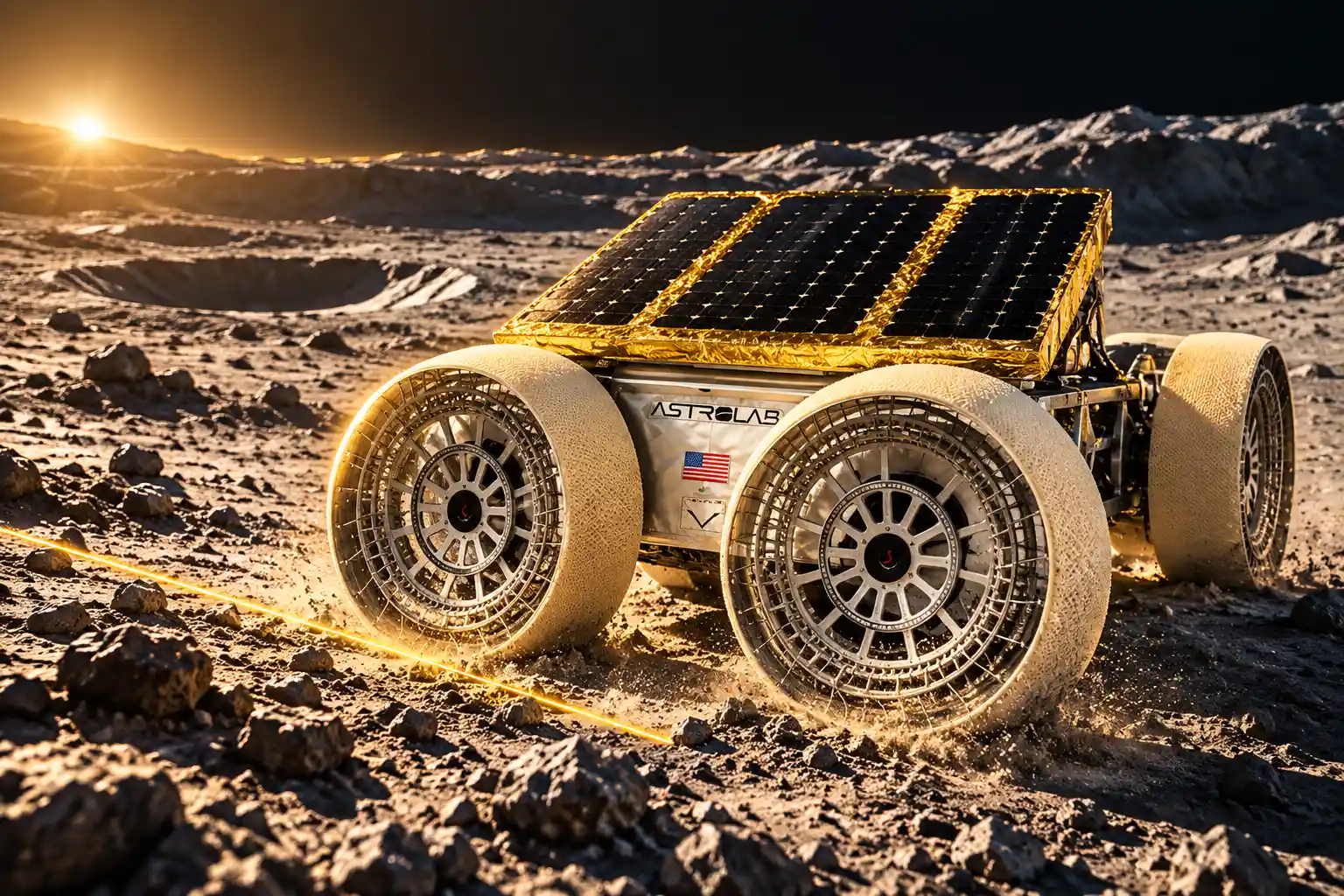
The rover’s solar panel is built to stand vertical. At the south pole the Sun sits on the horizon during the lunar day, so a flat deck array would see little of it. Venturi tires and full-size batteries on FLIP are there to mature parts for FLEX, Astrolab’s later cargo rover. HPE Spaceborne Computer-4 is the compute slice of that same rehearsal.
Vision inference is supposed to read the camera array on the spot, so the mission does not have to ship every raw frame home. LiDAR processing is supposed to build a local map for navigation, terrain reading, and later site work. If those jobs fail, FLIP falls back toward the old pattern: crawl, wait, crawl. If they hold, a commercial rover can spend its short polar day on science instead of on the queue to Houston.
HPE packed a Linux container stack for that local work, plus software to hand a short list of results back to Earth and to pull new jobs up. HPE Private Cloud and HPE CloudOps at Astrolab’s Hawthorne control room are meant to run that loop from the ground. The interesting split is what never has to make the trip.
NASA’s FLUID Test Splits Training Across Earth and Moon
NASA, Deloitte, and HPE are loading extra jobs onto the same box. The agency’s FLUID experiment, Federated Learning for Unbounded and Intelligent Decentralization, trains three neural nets on three sets of data: Earth, the Moon, and the International Space Station. The point is to share what those nets learn without parking every byte in one hall.
That is a different bet from a rover that only compresses pictures. If FLUID works, a model that saw ISS telemetry could update a cousin sitting on FLIP without a bulk dump through Houston, and a lunar net could send a small update the other way. NASA will also run a tuned language model that searches and reads documents stored on the rover, so a crew or an operator is not paging through manuals over a laggy link.
WORKLOADS SCHEDULED AFTER LANDING
- HPL and HPCG: High-Performance LINPACK and High-Performance Conjugate Gradient, HPE’s planned scorecard for sustained math and for memory-heavy work on the surface.
- LLM with RAG: A language model that pulls from local documents before it answers, for context at the lunar edge.
- Vision inference: Onboard reading of FLIP’s cameras so raw video can stay on the rover.
- LiDAR mapping: Laser ranging turned into maps for driving, terrain study, and later building.
- AI services container: A test of whether new apps can be loaded and run on the Moon after landing.
- FLUID plus a document LLM: NASA’s three-site training test and a model that searches onboard files.
- Silent Shield: Deloitte’s intrusion monitor, running near real time anomaly checks on the module.
HPL is the classic Top500-style grind. HPCG is the meaner cousin that punishes weak memory paths. Together they are how HPE wants to say, later, that the box still did real HPC after a landing, a polar day, and a vacuum. Deloitte’s Silent Shield watches the same module for odd traffic, a reminder that a networked rover is a target as soon as it talks.
A Clean-Room Rover and a Newly Bought Lander
FLIP, the Flex Lunar Innovation Platform, sat in Astrolab’s clean room in October with a camera array, a LiDAR, a headlight, an image projector, and an American flag patch that flew on Apollo. Jaret Matthews, Astrolab’s founder and CEO, said the south-pole target includes permanently dark crater floors that may hold water ice, the resource a future camp would want.
The Moon presents a challenging environment for advanced computing, and we’re pleased to provide HPE with an opportunity to demonstrate its technology on the lunar surface. Our FLIP rover is designed to accommodate a variety of payloads, and this mission will demonstrate how commercial lunar mobility platforms can support technology development and scientific research.
Jaret Matthews, founder and CEO, Astrolab, HPE announcement
The ride to the surface is Griffin-1. HPE’s release names Voyager Technologies as the lander provider under NASA’s Commercial Lunar Payload Services initiative. Voyager completed its acquisition of Astrobotic in July 2026, and Griffin-1 is now the lunar lander inside that group. Astrobotic had already said Griffin Mission One would deliver FLIP to the Nobile region of the south pole.
HPE will also run private-cloud kit for Astrolab mission control in Hawthorne. The rover, the lander, the Japanese flash, the NASA nets, and the Deloitte monitor are one commercial stack. None of them is useful if the 2.6-pound module fails to boot after touchdown.
What Nine Years on the Space Station Proved
The lunar box is the fourth named chapter of a line that started in low Earth orbit. HPE and NASA launched the first Spaceborne Computer in August 2017 and ran it as a commercial off-the-shelf system at 1 teraFLOP on the station. That flight answered a simpler question: can ordinary servers, in a special enclosure, survive orbit without the usual space-grade redesign.
FROM THE STATION TO THE SOUTH POLE
- August 2017: The first Spaceborne Computer launches and later holds 1 teraFLOP on the ISS.
- April 2022: Spaceborne Computer-2 finishes 24 research experiments on the station.
- January 30, 2024: A refreshed station stack flies with more than 130 TB of flash storage from Kioxia.
- August 1, 2024: HPE says it deployed a generative language model on the ISS, which it called the first LLM in space.
- April 2025: Spaceborne Computer-2 runs Space Llama, a vision-language model based on Llama 3.2.
- February 12, 2026: Spaceborne Computer-4 is delivered to Astrolab and mechanically integrated into FLIP.
- October 20, 2026: HPE announces the lunar HPC and AI test campaign for late 2026.
The station work is the Spaceborne Computer program on the station, and it is also the trap in this story. Air cooling, crew hands, and Earth’s magnetosphere are not waiting at Nobile. Fernandez has said the company is taking ISS lessons in AI, machine learning, data compression, cyber security, medical work, manufacturing, and image and signal processing to the Moon with Astrolab. Those lessons still have to meet vacuum, polar night, and a rover that no one can reboot with a screwdriver.
Kioxia’s jump is sharp in the other direction. The 2024 station load used more than 130 TB. The lunar module uses two 1TB client drives. Mass and watts, not capacity, set the south-pole budget.
Power-On at the Pole Still Has to Happen
HPE has not published target HPL or HPCG scores, clock speeds, or a CPU name. The launch remains “late 2026.” Griffin-1 has already slipped once in public timelines, from an earlier window toward mid-2026 and then late 2026, and the computer cannot outrun the lander.
WHAT WE KNOW
- The payload: Spaceborne Computer-4 is integrated on FLIP and slated to land near the lunar south pole on Griffin-1 in late 2026.
- The jobs: HPL, HPCG, RAG, vision, LiDAR, an AI container, NASA’s FLUID trio, a document LLM, and Deloitte’s Silent Shield are on the manifest.
- The parts: A 2.6-pound fanless aluminum module, two 1TB Kioxia BG6 SSDs at 5 watts each, mirrored, on a 28 VDC rover bus.
WHAT IS UNCONFIRMED
- The chips: HPE has not named the CPU or GPU vendor or posted a watt budget for the whole module.
- The scores: No lunar HPL or HPCG number exists, because the box has not run there.
- The night: Survival through polar dark, and through cosmic-ray upsets with little shielding, is still a claim rather than a log file.
FLIP already carries an Apollo flag patch in the same clean room as the computer. The patch has been to the Moon. The 2.6-pound module has not. Until Griffin-1 puts the rover on the regolith and the lattice radiator dumps its first watts into the dark, the scoreboard is empty.

Bulk Scotch Still Faces Full Duty After India’s UK Deal

Typhoon Champi Loops Off Taiwan and Still Injures 527

PM Modi Opens Chinmaya’s AI Guru and Asks for Unity

Mahim Police Hold a JeM Suspect on Enmity Charges

Gold Falls Below $4,000 as Hormuz Oil Hits $117

The iPhone 18 Pro Max Splits Apple’s Fall in Two

OpenAI Calls GPT-6 Astra AGI Then Locks Its Exploits

Clancy Juror Says the Holdout Never Cited Evidence

Trump Claims Hormuz Control as Oil Holds Near $96

Russia Closes the Goethe-Institut Berlin Tried to Save

 NEWS2 months ago
The iPhone 18 Pro Max Splits Apple’s Fall in Two
- NEWS2 months ago
OpenAI Calls GPT-6 Astra AGI Then Locks Its Exploits
- NEWS1 month ago
Clancy Juror Says the Holdout Never Cited Evidence
- BUSINESS2 months ago
Trump Claims Hormuz Control as Oil Holds Near $96
- LIFESTYLE2 months ago
Russia Closes the Goethe-Institut Berlin Tried to Save
- AUTO2 months ago
Volkswagen’s Job Cuts Leave Four Plants Without Cars
- NEWS2 months ago
Dyson Puts Nurovi Robots on Sale Without the UV Flagship
- NEWS2 months ago
The Lincoln’s 286-Day War Cruise Ends at a Thai Pier