BUSINESS
India Puts Three More Kalvari Submarines Before the Cabinet
A Rs 33,000 crore Kalvari follow-on is heading to Cabinet after India parked extra Scorpenes for AIP boats that are still unsigned.

A modified proposal to build three extra Kalvari-class submarines at Mazagon Dock, at about ₹33,000 crore, is going to the Cabinet Committee on Security. The boats would be follow-on Scorpenes from France’s Naval Group, ordered after the sixth hull, INS Vaghsheer, joined the fleet on 15 January 2025.
Defence Secretary Rajesh Kumar Singh has already said the extra Scorpenes are less advanced than the German Project 75I boats that are still waiting for a final decision. That is the buy India parked the extra Kalvaris to make room for.
Three More Kalvaris Go Back to the Cabinet
Prime Minister Narendra Modi has pushed the three-boat paper back onto the Cabinet committee’s list so the Navy can hold diesel-attack numbers as older Russian and German hulls age out. Mazagon Dock Shipbuilders Limited would build the boats in Mumbai with Naval Group support, on the same Project 75 line that finished the first six.
The original Kalvari class was approved in 2004 and contracted in 2005. The extra hulls were then set aside while planners put Project 75I, six boats with air-independent propulsion, first. Singh, speaking in New Delhi on 1 October 2026, still treated both tracks as open, and he did not pretend they were equals.
Both Project-75(I) and additional Scorpene submarines are being considered. Project-75(I) is at the final stage. It has been submitted and is pending a final decision by the competent authority. Additional Scorpene submarines are also being considered. It is not as advanced as the other one, but that is also under consideration.
Rajesh Kumar Singh, Defence Secretary, in New Delhi
He added that the Navy is running several lines at once to thicken its underwater force. The CCS paper is the fastest of those lines, and the one that uses a design MDL already knows how to weld.
The Mumbai Yard Went Quiet After Vaghsheer
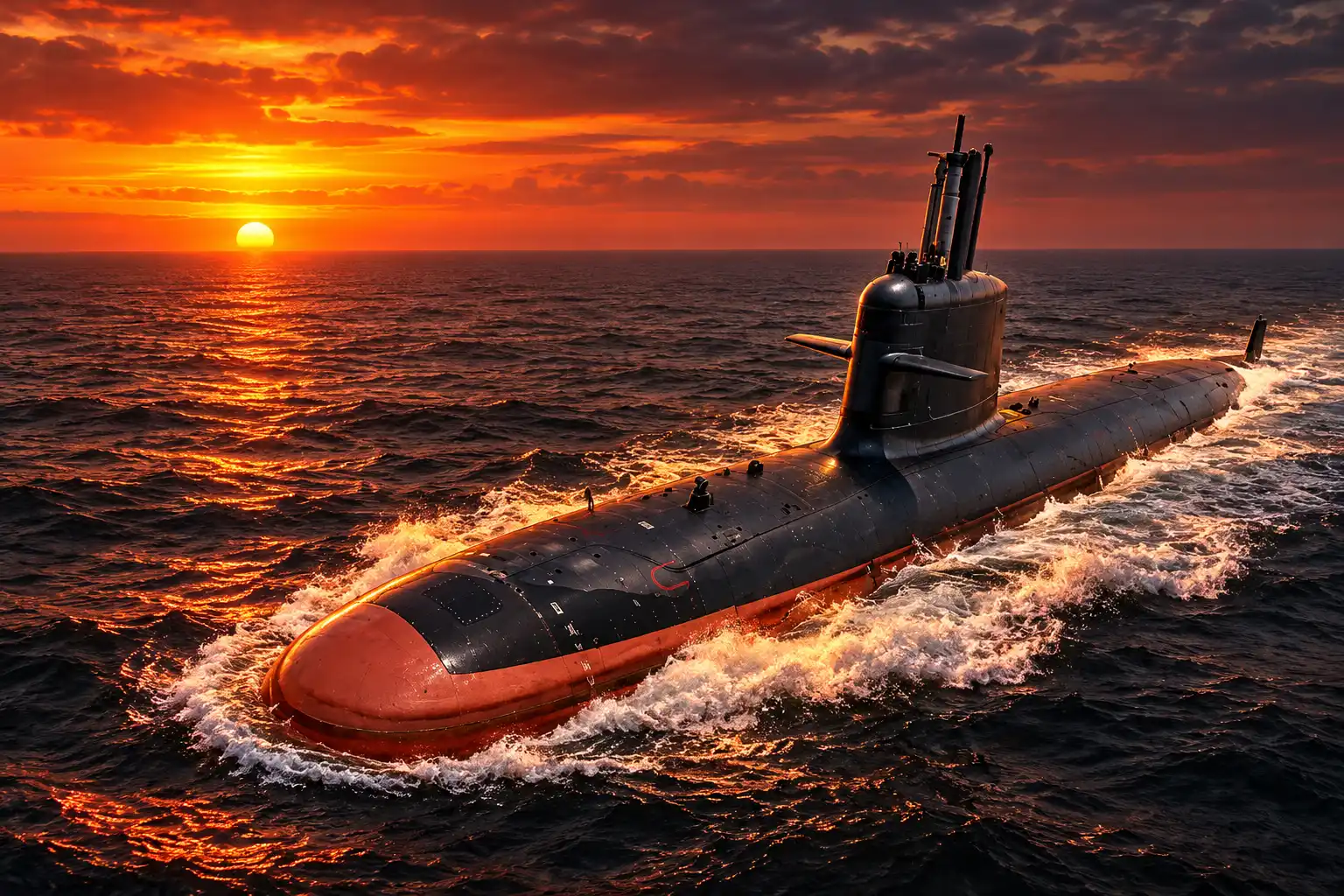
Naval Group marked the commissioning of INS Vaghsheer as the close of the six-boat Project 75 series. The boat was launched on 20 April 2022 and, once in commission, sat alongside INS Kalvari, INS Khanderi, INS Karanj, INS Vela and INS Vagir, which joined in December 2017, September 2019, March 2021, November 2021 and January 2023.
Chairman and CEO Pierre Éric Pommellet called P75 a cornerstone of the Indo-French partnership and said the group would stay on for later work with Indian industry. The yard’s own follow-on, though, never arrived. After Vaghsheer, the Scorpene workforce had no next hull on the blocks.
That idle stretch is the industrial reason the extra boats are back. Keep the jigs, welders and combat-system teams in work, or watch the skill fade before Project 75I, or the later Project 76 design freeze due at the end of 2028, needs them.
INDIA’S CONVENTIONAL SUBMARINE FLEET
| Class | Origin | In service | Age and outlook |
|---|---|---|---|
| Kalvari (Scorpene) | France / Mazagon Dock | 6 | Last boat joined 15 January 2025 |
| Sindhughosh (Kilo) | Russia | 6 | Lead boat retired 19 December 2025; up to 3 more may leave in 2 to 5 years |
| Shishumar (Type 209) | Germany / Mazagon Dock | 4 | 1980s and 1990s boats, some in mid-life work |
Those three classes add up to 16 conventional boats after INS Sindhughosh left the line. The remaining Kilos are INS Sindhuraj, INS Sindhuratna, INS Sindhukesari, INS Sindhukirti, INS Sindhuvijay and INS Sindhushastra. If three more Kilos go, the diesel force falls to 13 before any new Kalvari is even laid down.
Project 75I Still Waits for a Signature
Project 75I is meant to be the grown-up buy: six diesel boats with air-independent propulsion, built in India by Mazagon Dock with Germany’s Thyssenkrupp Marine Systems on a Type 214 base. Singh put the Indian working cost at more than ₹80,000 crore and said the file had already gone to the competent authority.
On 12 October 2026, German ambassador Philipp Ackermann said he was hopeful and confident the accord could be signed in the coming weeks. The programme has been in motion since 2018. Even a prompt signature still leaves the first new AIP boat in the early 2030s, which is why the less advanced Scorpene follow-on is being treated as the bridge.
The extra Kalvaris will not close that gap on their own. They buy time, and they buy a hot production line. They do not buy the AIP endurance India said it wanted when it put the follow-on on hold.
Hangor’s Live Round in the Arabian Sea
Pakistan ordered eight Hangor-class boats from China in 2015, four to be built at Wuchang and four at Karachi Shipyard. The class is an export cut of the Type 039B Yuan design, about 2,800 tons and 76 metres long, and it is built around air-independent propulsion.
PNS Hangor was commissioned on 30 April 2026 at Sanya, with President Asif Ali Zardari present. She later made her own passage home, called at Kota Kinabalu, and on 26 September 2026 carried out her maiden live firing in the North Arabian Sea. Rear Admiral Monty Khanna (retd), writing for the National Maritime Foundation, laid out the Hangor launch and commissioning dates for the China-built batch and judged that four new AIP boats could be in Pakistani service by mid-2027.
HANGOR BOATS BUILT IN CHINA
- 26 April 2024: PNS Hangor launches at Wuchang’s Shuangliu yard.
- 15 March 2025: PNS Shushuk launches.
- 16 August 2025: PNS Mangro launches.
- 17 December 2025: PNS Ghazi, the last China-built hull, launches.
- 30 April 2026: Hangor commissions at Sanya and sails for home under her own flag.
- 26 September 2026: Hangor completes her first live weapon firing in the North Arabian Sea.
The Karachi four are a different story. Steel was cut on PNS Tasnim in December 2021, and the sixth boat’s keel went down on 14 February 2024, but public progress on hulls seven and eight has been thin. Khanna’s reading is that the local batch slips into the 2030s. The threat India is answering is therefore one boat already at sea, three more China-built hulls close behind, and a slower Karachi trickle, not eight AIP submarines tied up by 2028.
What the Extra Boats Would Carry
Naval Group sells the Scorpene as a 2,000-ton diesel boat with six tubes and 18 weapons, built for anti-ship work, anti-submarine work, long-range strikes, special operations and intelligence. The CCS paper is for an evolved cut of that design, not a clean-sheet submarine.
WHAT THE CCS PAPER DESCRIBES
- The yard: Three follow-on hulls at Mazagon Dock with Naval Group support, on the line that finished Vaghsheer.
- The batteries: Lead-acid sets at build, with a later swap to lithium-ion during upgrade.
- The weapons path: The class is already under a 30 December 2024 deal with Naval Group, worth about ₹877 crore, to integrate DRDO’s electronic heavyweight torpedo.
- The industrial bet: Keep Mumbai’s Scorpene crews in work while Project 75I and Project 76 remain on paper.
Naval Group India’s own count, from the Vaghsheer note, is more than 70 Indian engineers and a chain of more than 50 Indian firms around the first six boats. A follow-on order is how that chain stays paid. It is also how France keeps a Scorpene customer that has not placed a new hull since the original Project 75 set closed.
Lead-Acid Power, With Lithium on Paper
The extra Kalvaris would go to sea on lead-acid batteries. The CCS paper says those packs can later give way to lithium-ion, which stores more energy for a given weight and can cut the time a boat spends near the surface charging.
That swap is real technology, just not Indian technology on this timetable. In July 2026 Naval Group awarded Saft, a TotalEnergies battery firm, a contract to supply lithium-ion systems for future Barracuda and Scorpene families, replacing lead-acid packs.
Integrating Saft’s Li-ion technology onboard the Barracuda and Scorpene submarine families is of great value, allowing us to enhance performance at sea.
Pierre Éric Pommellet, Chairman and CEO, Naval Group
Saft CEO Cedric Duclos said battery tech now defines submarine performance. Japan’s Soryu and Taigei classes are the boats already running lithium-ion at sea. India’s extra Kalvaris would not. They would launch on the older chemistry, with a shop-floor promise to change it later, and they would still lack the AIP plant India has spent years trying to bolt onto the existing class.
Calling lithium-ion a match for Pakistani AIP boats in speed and stealth is a claim the Navy will have to prove in the water. On paper, an AIP boat can linger submerged for days without snorkelling. A lithium pack helps a diesel boat sprint and hide between charges. They are not the same trick.
Khanderi Takes the AIP Plug in 2027
India’s own AIP is not arriving on a new hull. It is arriving as a refit. Singh said the DRDO fuel-cell plant will go into a Kalvari-class boat when that boat comes in for work around mid-2027, with sea trials in July and August 2027 and a return to service in 2028. Open reporting has named INS Khanderi, the second boat, commissioned on 28 September 2019, as the first recipient.
The Ministry of Defence signed a Rs 1,990 crore AIP plug contract with Mazagon Dock on 30 December 2024 for the plug and its integration, a job the ministry said would support nearly three lakh man days. The same sitting produced the ₹877 crore torpedo deal. Together the two contracts were worth about ₹2,867 crore.
DRDO’s Naval Materials Research Laboratory built the plant. A land prototype ran endurance and max-power tests on 8 March 2021. On 23 January 2023, NMRL and Naval Group signed a detailed-design pact because the fuel-cell AIP first meant for INS Kalvari still needed French certification to sit inside a Scorpene pressure hull. The hydrogen is made on board, which is the feature DRDO cites as its edge. Delays shifted the first fit from the lead boat to a later refit.
So the sequence is inverted. Pakistan’s first new AIP submarine is already shooting. India’s first AIP submarine will be an existing Kalvari cut open in Mumbai. The three extra boats meant to hold force levels will, if the Cabinet clears them, still be lead-acid Scorpenes when they are laid down. Project 75I, the reason those extra boats were parked, remains a file pending a signature.
PNS Hangor has already fired in the Arabian Sea. The extra Kalvaris are still a Cabinet paper, and the first Indian AIP module is scheduled to go into Khanderi in a mid-2027 refit.

Bulk Scotch Still Faces Full Duty After India’s UK Deal

Typhoon Champi Loops Off Taiwan and Still Injures 527

PM Modi Opens Chinmaya’s AI Guru and Asks for Unity

Mahim Police Hold a JeM Suspect on Enmity Charges

Gold Falls Below $4,000 as Hormuz Oil Hits $117

The iPhone 18 Pro Max Splits Apple’s Fall in Two

OpenAI Calls GPT-6 Astra AGI Then Locks Its Exploits

Clancy Juror Says the Holdout Never Cited Evidence

Trump Claims Hormuz Control as Oil Holds Near $96

Russia Closes the Goethe-Institut Berlin Tried to Save

 NEWS2 months ago
The iPhone 18 Pro Max Splits Apple’s Fall in Two
- NEWS2 months ago
OpenAI Calls GPT-6 Astra AGI Then Locks Its Exploits
- NEWS1 month ago
Clancy Juror Says the Holdout Never Cited Evidence
- BUSINESS2 months ago
Trump Claims Hormuz Control as Oil Holds Near $96
- LIFESTYLE2 months ago
Russia Closes the Goethe-Institut Berlin Tried to Save
- AUTO2 months ago
Volkswagen’s Job Cuts Leave Four Plants Without Cars
- NEWS2 months ago
Dyson Puts Nurovi Robots on Sale Without the UV Flagship
- NEWS2 months ago
The Lincoln’s 286-Day War Cruise Ends at a Thai Pier