
NEWS
TP-Link’s First Wi-Fi 8 Router Sells a Draft Standard
TP-Link’s Archer 8 Ultra Wi-Fi 8 router opens preorders on a draft spec, with key features and a US sale still pending.

TP-Link unveiled its first Wi-Fi 8 router at IFA in Berlin yesterday and set Archer 8 Ultra preorders for September 30. The Deco 8 Ultra mesh kit is due in the first quarter of 2027, built on a draft of IEEE 802.11bn that is not slated for final approval until May 2028.
The headline rate does not jump. Peak PHY speed stays at 46 Gbps, matching Wi-Fi 7, while several of the reliability tricks that justify the box, and a legal US sale, still depend on later software and a federal waiver.
Archer 8 Ultra Packs 18 Antennas and 10 Gbps Ports
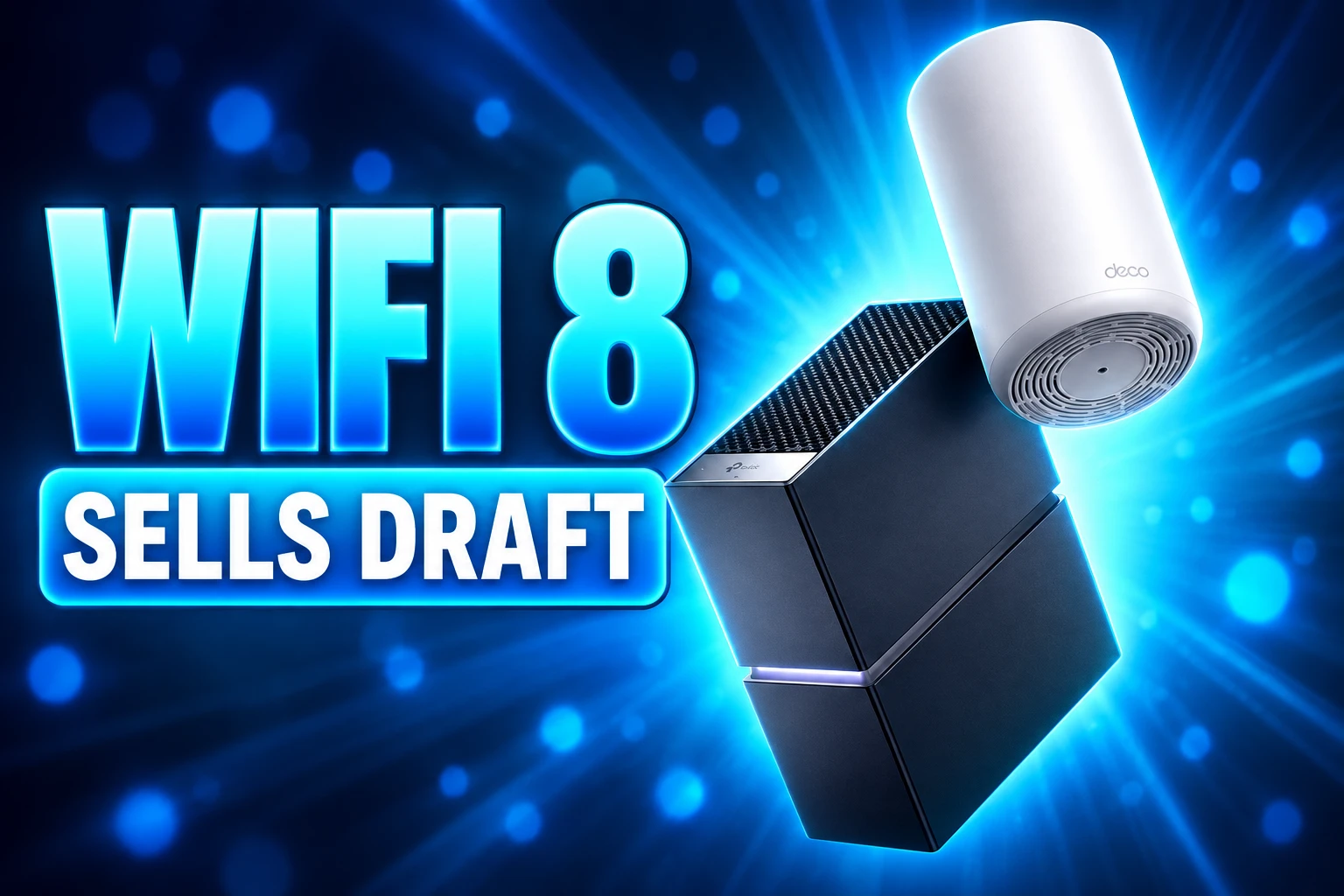
The Archer 8 Ultra (model BN19000, also tagged Archer BN800) is a tri-band box with no built-in modem. TP-Link rates it at 19 Gbps of combined wireless throughput and 10 Gbps on the wire, with 18 internal antennas. The Deco 8 Ultra (BN22000 / Deco BN85) is the mesh sibling, rated at 22 Gbps wireless and the same 10 Gbps wired link.
ARCHER 8 ULTRA VERSUS DECO 8 ULTRA
| Item | Archer 8 Ultra | Deco 8 Ultra |
|---|---|---|
| Form | Single tri-band router | Tri-band mesh, three-pack |
| Antennas | 18 internal | 5 transmit and 5 receive |
| Coverage claim | Not published in the IFA brief | 9,800 square feet, more than 200 devices |
| First availability | Preorder September 30; October in Germany and the UK | First quarter of 2027 |
IFA briefings put Qualcomm FastConnect 8800 or Broadcom BCM6718 silicon in the flagship hardware, plus USB storage on the Archer. The growing Wi-Fi 8 lineup also names MediaTek as a chip partner. The Archer uses a dual-tone grille and a soft center status light; the Deco 8 Ultra is a compact puck with mixed matte and glossy finishes, kept close to TP-Link’s current mesh look.
Wi-Fi 8 Does Not Raise the Speed Ceiling
Wi-Fi 8 is IEEE 802.11bn, branded Ultra High Reliability. It keeps 320 MHz channels, 4096 QAM, and 16 spatial streams, so the paper maximum stays 2,880 Mbps times 16, or 46 Gbps, the same ceiling TP-Link lists for Wi-Fi 7. The company says the work is about holding a link in a crowded house, not posting a bigger speed test.
Qualcomm’s Ultra High Reliability work on 802.11bn is still moving through the IEEE, and the IEEE 802.11bn timeline toward May 2028 has not been pulled forward to match this launch. Rolf de Vegt, Qualcomm’s vice president of technical standards, has said final IEEE approval is expected in May 2028, with the Wi-Fi Alliance aiming to open certification around CES 2028. That is about 20 months after these Ultra boxes go up for preorder, and two years and eight months after Wi-Fi 7 itself was finalized in January 2024.
For years, Wi-Fi innovation has been measured by peak theoretical speeds. But what users actually care about is consistency. Archer 8 is designed to deliver exactly that: lower latency, better performance under interference, and more stable connectivity in real world environments.
Jeff Barney, President, TP-Link Systems Inc.
Older phones and laptops will still connect. TP-Link says they can pick up steadier airtime from the new scheduling even if they never speak 802.11bn. The full bag of new tricks needs Wi-Fi 8 clients, which briefings put on phones, PCs, and tablets in early to mid-2027. Current Wi-Fi 7 routers cannot be upgraded.
What Wi-Fi 8 Changes in a Busy Home?
The company wraps the new radio behavior in a house name, StabilityEngine. On its Wi-Fi 8 page it lists Distributed Resource Units and Enhanced Long Range as the tools for the far rooms and the weak uplink from a camera or a phone at the edge of the house. Early lab notes from the May platform launch claimed up to 33% higher throughput from new modulation and coding, and up to 24% from unequal modulation, versus Wi-Fi 7 at similar range. The same materials cite up to 15% better mesh throughput between access points under interference.
WI-FI 8 TOOLS IN THE STABILITYENGINE
- Enhanced Long Range: Tougher packet coding is meant to hold a link in upstairs rooms, garages, and outdoor cameras.
- Distributed Resource Units: A far or low-power device spreads its uplink across more tones so the router can hear uploads such as a video call.
- Unequal Modulation: Each spatial stream can run at its own rate, so a weak stream does not drag the strong ones down.
- New MCS steps: Extra modulation rungs are meant to stop the sudden speed drop when you walk away from the box.
- Non-Primary Channel Access: A client can use a clear sub-channel when the 20 MHz primary channel is busy.
- Dynamic Sub-band Operation: The router can give a narrow device only the width it needs, instead of parking it on a wide channel.
- Multi-AP coordination: Mesh nodes share timing, beamforming, and power so they interfere less with each other.
Those are protocol changes, not a new radio band. Wi-Fi 8 still uses 2.4, 5, and 6 GHz. If the home internet plan is 200 or 400 Mbps, the sell is fewer stalls on calls and walks between rooms, not a fatter pipe from the street.
Firmware Will Have to Finish the Job
TP-Link’s Archer 8 platform announced in May already put a router in October 2026, a Deco mesh in the first quarter of 2027, and the Roam 8 travel router plus extenders and adapters in the second quarter. The Ultra names shown at IFA sit on that calendar. They also sit on a draft. Chip vendors have been shipping 802.11bn silicon while the working group is still grinding comments, which is how every recent Wi-Fi generation reached stores.
Buyers of these first units will not get every named trick on day one. After questions at IFA, TP-Link said Seamless Mobility Domain, the feature that lets a phone stay attached to more than one access point at once while you walk, needs a firmware update in summer 2027. Other coordination pieces can still move in the draft and land even later. That is a long wait if the reason you paid up was roaming without a drop.
FROM THE IFA STAGE TO A FINISHED SPEC
- March 20, 2026: The White House interagency body issues a national security determination on routers made abroad.
- March 23, 2026: The FCC adds those routers to its Covered List, blocking new model approvals without a waiver.
- May 28, 2026: TP-Link Systems Inc. announces the Archer 8 platform for an October launch.
- September 1, 2026: The Archer 8 Ultra and Deco 8 Ultra appear at IFA in Berlin.
- September 30, 2026: Preorders open in select regions, with a global online launch the same day.
- October 2026: The Archer 8 Ultra is due on sale in Germany and the UK.
- First quarter 2027: The Deco 8 Ultra mesh system is due.
- Second quarter 2027: The Roam 8 travel router, range extenders, and adapters are due.
- Summer 2027: TP-Link says Seamless Mobility Domain firmware is due.
- CES 2028: The Wi-Fi Alliance is expected to open Wi-Fi 8 certification.
- May 2028: IEEE 802.11bn is expected to receive final approval.
Early hardware can still be useful. It can also freeze a design before the last votes. Firmware can patch behavior. It cannot add radios, antennas, or ports that were never built.
Preorders Open September 30 in Select Regions
That date is 28 days from today. TP-Link has not named a price, a full country list, or a US ship date in the IFA papers. Show briefings pointed to a tag under $1,000 for the Archer 8 Ultra, with cheaper Pro and base models later in 2027. Treat that as a briefing, not a store listing.
The company’s US account posted the lineup the same day as the Berlin reveal and pointed to the September 30 online event for the rest of the family.
https://x.com/TPLINKUS/status/2094813325439688710
Select regions is doing a lot of work in that sentence. Germany and the UK have already cleared the hardware for an October sale. Other markets, including the United States, are still a separate problem.
New Foreign-Made Routers Still Need a US Waiver
In March the FCC placed foreign-made routers on the Covered List after a March 20 national security determination. New consumer models produced abroad cannot get equipment authorization unless the Department of War or the Department of Homeland Security files a finding that the gear does not pose an unacceptable risk. Production in that paper includes manufacturing, assembly, design, and development. A US headquarters does not, by itself, pull a Vietnam-built board off the list.
The determination says 96 percent of Americans use the internet and that a majority of home and business routers are made abroad. It cites compromised foreign-made routers in campaigns including Volt Typhoon, Flax Typhoon, and Salt Typhoon, and it repeats CISA’s line that edge gear has become an attack vector of choice. Models that already have an FCC ID can still be imported, sold, and patched; existing units were later allowed software updates through 2029. Brand-new names such as Archer 8 Ultra are a different file.
WHAT WE KNOW
- The rule: New foreign-made consumer routers need a DoW or DHS waiver before the FCC will authorize them.
- The company line: TP-Link says the Wi-Fi 8 lineup pairs Broadcom, Qualcomm, and MediaTek chipsets with US-led hardware and software engineering.
- The plants: TP-Link, founded in China and moved to the US in 2024, has said it builds product in Vietnam and has talked about adding US manufacturing.
- Old stock: Routers already authorized can still be sold and used; the ban hits new models.
WHAT IS UNCONFIRMED
- A US waiver: TP-Link has not announced conditional approval for the Ultra hardware.
- A US price or date: Briefings put US sales in early 2027; there is no store page.
- How much of 802.11bn ships in the first firmware image: SMD is promised for summer 2027; other draft items may slip.
The IFA language about US-led engineering and Western silicon is aimed at that file. Some US brands have already received time-limited waivers for other models. TP-Link met FCC staff in April and was still seeking an exemption in May. Nothing in the Berlin papers closes that gap.
Germany and the UK Get the Hardware First
If you are in those two markets and you want the first consumer 802.11bn radio, the October window is real. You will still be buying a draft-standard flagship whose best roaming story is a 2027 software promise, and you will need Wi-Fi 8 clients before the new coding does much at the phone in your pocket. If you are in the United States, the wait is longer and less certain, because the waiver and the store date are not the same thing.
TP-Link will fill in regional availability at the September 30 online launch. Until then the Ultra boxes are a European October product on an unfinished spec, with a US path that still runs through Washington.

Eiffel Tower Managers Hid Women for a Guru’s Visit

Russia Ends the Kyiv Pause With Missiles After Envoys Leave

Putin Meets Modi With Jets and Reactors Under a Tariff Cloud

iOS 27 Folds Pro Camera Tools Into the Default App

Adobe Bets on Its Experience Cloud Chief as CEO

The iPhone 18 Pro Max Splits Apple’s Fall in Two

OpenAI Calls GPT-6 Astra AGI Then Locks Its Exploits

Trump Claims Hormuz Control as Oil Holds Near $96

Russia Closes the Goethe-Institut Berlin Tried to Save

Volkswagen’s Job Cuts Leave Four Plants Without Cars

 NEWS2 weeks ago
The iPhone 18 Pro Max Splits Apple’s Fall in Two
- NEWS1 week ago
OpenAI Calls GPT-6 Astra AGI Then Locks Its Exploits
- BUSINESS1 week ago
Trump Claims Hormuz Control as Oil Holds Near $96
- LIFESTYLE1 week ago
Russia Closes the Goethe-Institut Berlin Tried to Save
- AUTO1 week ago
Volkswagen’s Job Cuts Leave Four Plants Without Cars
- NEWS2 weeks ago
Samsung Splits Galaxy Book6 With a $799 Core 3 Twin
- BUSINESS1 week ago
Cable Stocks Fall as UltraTech Copies the Paints Playbook
- BUSINESS2 weeks ago
Japan’s 3 Percent Yield Reprices Government Debt Worldwide