NEWS
China Rebuilt Gyirong Port, Then Ice Flattened It Again
China rebuilt Gyirong Port after a 2025 glacial flood. An ice-rock avalanche then flattened it in minutes, while Tibet’s official toll stayed at 16 dead.

Tibet’s regional government still lists 16 dead and 546 missing from the August 26 flood at Gyirong Port, a count unchanged since Saturday. Nepal’s disaster agency has recovered 1,114 bodies and lists 3,916 people missing, a week after ice and rock tore down the same gorge.
The port had been rebuilt after a glacial-lake flood in July 2025. The new walls were poured for a bursting lake. The mountain dropped a different kind of disaster in six to seven minutes.
Ice and Rock Reached Gyirong Port in Minutes
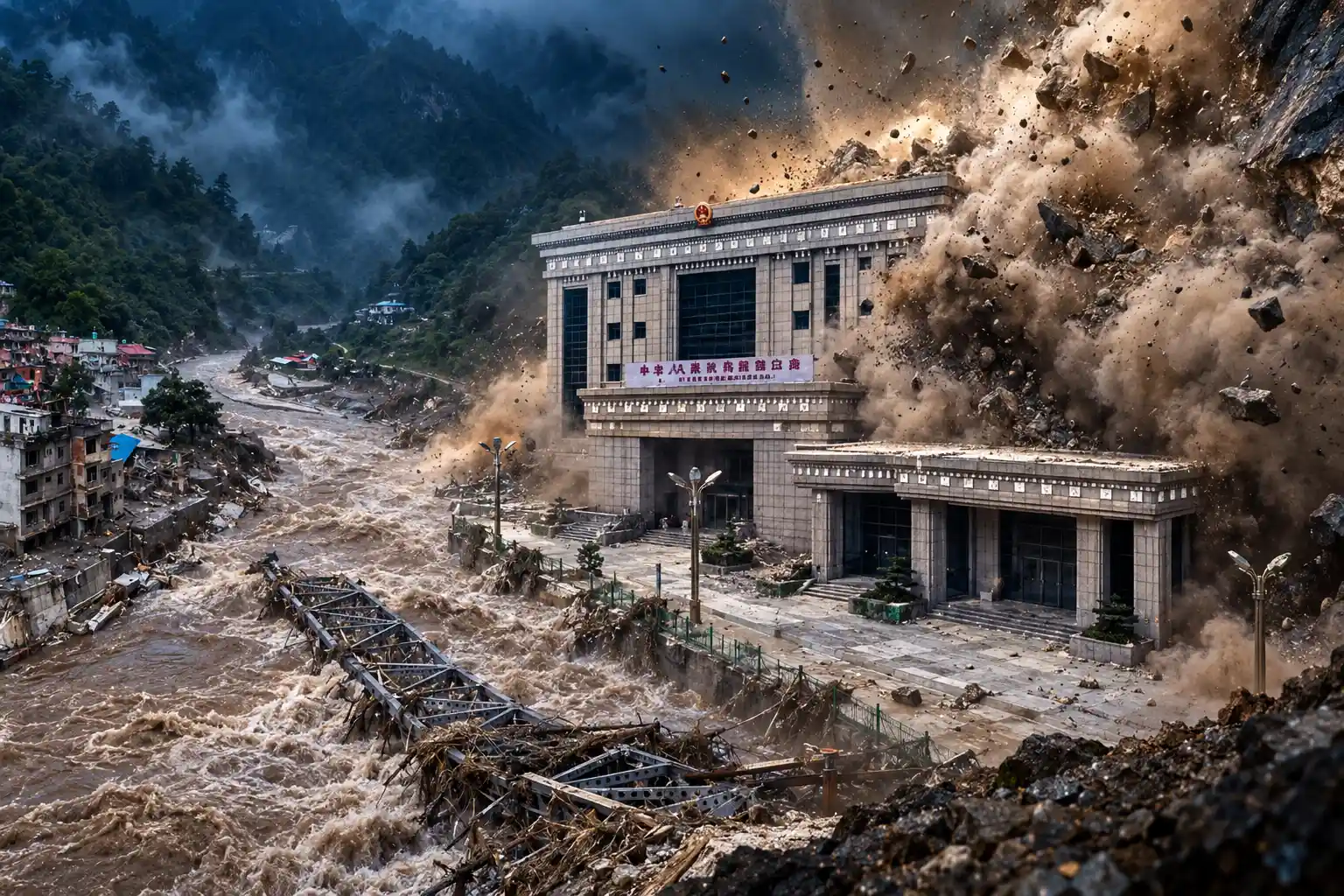
At about 10:52 a.m. Beijing time on August 26, a glacier on the south face of Langtang Lirung, at roughly 5,200 meters, gave way. The Chinese Academy of Sciences’ Institute of Mountain Hazards and Environment said ice and rock fell into the Lhende valley and became a mudslide that ran about 22 kilometers, reaching Gyirong Port at about 1,800 meters. The whole chain, avalanche to impact, took about 6 to 7 minutes.
An international group of geologists reading satellite frames and seismographs said a mass of bedrock and glacier ice broke off a slope north of the peak and slammed into the valley about 1,200 meters below. The fall registered as a magnitude 5.2 shock, the U.S. Geological Survey confirmed. Early local reports treated that pulse as a 4.4 earthquake that started the slide. The later reading is that the collapse made the tremor.
Dan Shugar’s before-and-after satellite comparison, cited by the same science group, showed a lot of snow gone from the face in the days before the fall. Meltwater in the cracks is one way a hanging slope loses its grip. The ice that actually dropped, the group said, was probably not enough by itself to make the flood that followed. A short-lived debris dam on the river, then a sudden release, is the working theory for the wall of water.
THE FALL INTO THE PORT
- The clock: About six to seven minutes from the ice-rock avalanche to impact at Gyirong Port.
- The drop: Ice and rock fell about 1,200 meters from a face near 5,200 meters.
- The run: The mudslide traveled about 22 kilometers down to the port at about 1,800 meters.
- The hit: Officials said it flattened 27 buildings and related facilities across about 0.7 square kilometers.
On the Nepal side the surge entered the Lhende Khola, then the Bhote Koshi, then the Trishuli, and ran on the order of 100 kilometers through Rasuwa, Nuwakot, Dhading and down toward Chitwan. Water in the Trishuli was reported to have risen as much as 9 meters in 30 minutes. A barrier lake later ponded behind debris near the Chhochen Khola and Purepu Tsangpo confluence, swelling to about 2.5 million cubic meters by August 28 before it drained enough for rescue work to restart.
Fourteen Months After the Last Flood, the Walls Failed
Gyirong Port sits on a narrow strip where two glacier-fed rivers meet after dropping about 10,000 feet. For the past decade it has been the main land link between China and Nepal, carrying almost a third of China’s trade with Nepal, much of it electric vehicles, and more than 180,000 travelers. It became the main gate after the Zhangmu-Kodari crossing farther east was wrecked in the 2015 Nepal earthquake.
In July 2025 a lake on a nearby glacier burst. The flood took container trucks, houses and the China-Nepal Friendship Bridge. Officials closed the port for almost half a year, added glacial-lake outburst defense to local training, posted a 24-hour water-level sentry, and put out tenders for a flood wall, reinforced dikes and diversion channels. In May the county ran a session with experts. In July the top county official told staff to detect, report and resolve signs of glacial floods early.
A 2024 study by researchers in Chengdu had already ranked this crossing, among the China-Nepal transport corridors, at the highest risk of glacial lake outburst floods. The monitoring that followed still pointed at the more than 200 glacial lakes in Gyirong. Ice-avalanche sensors were being built in a different valley, Sedongpu, not here.
THE SAME GORGE, TWO FLOODS
- July 8, 2025: A previously unlisted glacial lake on Purepu Glacier bursts, wrecks the Friendship Bridge, and kills at least nine people on official figures.
- Late 2025 to mid-2026: The port stays closed for almost half a year while a flood wall, dikes, a 24-hour sentry and GLOF drills are added.
- August 26, 2026: An ice-rock avalanche on Langtang Lirung becomes a debris surge that flattens 27 buildings at the rebuilt port in six to seven minutes.
- August 28, 2026: A new barrier lake is judged a high risk, then eases enough for rescue work to resume.
- August 30, 2026: Tibet’s regional government sets the local toll at 16 dead and 546 missing, including 261 foreign nationals, and has not moved those numbers since.
Saswata Sanyal, a disaster-risk specialist at the International Centre for Integrated Mountain Development, said the flat ground in the gorge is exactly where the bridge, customs yard, dry port and truck park sit, so they take the direct hit every time. People were swept from the customs yard in 2025, he said, and the same sites were struck again this year.
That flat ground is exactly where the bridge, customs yard, dry port and truck park sit so they take the direct hit every time.
Saswata Sanyal, disaster risk reduction specialist, International Centre for Integrated Mountain Development
On Monday, China National Radio ran a piece asking why the port was built in a deep river valley. Tian Bingwei, an associate professor at Sichuan University’s Institute for Disaster Management and Reconstruction, said history had shown the route was relatively safe, which is why it was built. Austin Lord, a senior fellow at the Stimson Center who studies Himalayan disaster risk, called it spooky that a different climate-linked event hit the same river a year later.
The Workers Still Inside the Tunnels
The flood was lethal because of what had been parked in the path. Nepal’s electricity authority said the surge knocked about a dozen major generation and transmission sites offline. Named plants along the corridor include Rasuwagadhi, Chilime, Trishuli 3A, the Trishuli 3B Hub, Trishuli and Devighat. Authorities have said 11 projects, finished or still being built, were damaged.
Prime Minister Balendra Shah said 279 workers had been pulled from hydropower sites. Officials still list 639 people missing at those plants, some of them believed to be in tunnels and powerhouse rooms. A mountain guide helping at Trishuli, Asish Gurung, said from Haku in Rasuwa that the first look inside one tunnel showed it was not possible to go in without bulldozers and excavators, and that about 500 people might be trapped there. Crews at Trishuli 3A cleared about 10 meters of mud at the crown head, then had to drill a second hole when water blasted back.
India, China, Korea, Australia and the United States have sent tunnel specialists after Nepal first said it could handle the search itself. On Wednesday an Indian army team with medical staff was reported heading to the Rasuwagadhi tunnels. Phanindra Paudel, a senior official at Nepal’s National Emergency Operation Center, said on Wednesday that hope of finding more survivors was decreasing.
This is a known pattern in these valleys, not a one-off. In 2021 a rock-and-ice avalanche in India’s Uttarakhand state wrecked one hydropower plant, badly damaged another, and killed or left missing about 200 people, many of them dam workers. A 2023 study of glacial-lake hazard across the so-called Third Pole found GLOF paths threatening 105 hydropower projects in the Third Pole, along with 55,808 buildings, and recorded intensified activity on the China-Nepal border over the past decade.
WHO THE WATER HIT AT WORK
- The plants: About a dozen major generation and transmission sites were knocked offline, with 11 projects listed as damaged.
- The rescued: Shah said 279 people had been brought out of hydropower sites.
- The missing: Officials still count 639 people unaccounted for at those plants, some of them in flooded tunnels.
- The parallel: The 2021 Uttarakhand ice-rock flood also killed or erased dam workers in large numbers.
Maya Wang of Human Rights Watch said questions have been raised over how development of valleys in an ecologically and geologically fragile area may have related to this disaster. Guo Jiakun, a Chinese foreign ministry spokesperson, said on Monday, when asked about claims that China ignored scientists’ warnings on hydropower construction, “We firmly oppose such baseless and malicious speculation.”
Why China’s Official Toll Has Not Moved
Nepal’s numbers have moved every day. Tibet’s have not. The regional government, after a joint check by foreign affairs, public security, culture and tourism, and emergency staff, announced at a Saturday press conference that 16 people were confirmed dead and 546 were missing as of 6 p.m., including 261 foreign nationals from 23 countries. It also said 2,141 Chinese rescuers were on the mission, and that after several rounds of checks no foreign tourists were stranded in Gyirong County.
Those two headline figures, 16 and 546, were still the ones read at memorials in Gyirong County on Tuesday morning, at the port branch of the Xigaze public security bureau and at rescue sites.
https://x.com/ChinaMilBugle/status/2094729621178892691
Tencho Gyatso, president of the International Campaign for Tibet, said the little information that can be gathered from the ground suggests the numbers affected are far higher than Chinese officials have reported. “What is visible in Nepal exposes what is being concealed in Tibet,” she said. ICT has called on Beijing to disclose complete and verifiable information about casualties, permit independent reporting, and allow unhindered humanitarian access.
What is visible in Nepal exposes what is being concealed in Tibet. Four villages, Sale, Serchung, Labi and Rizi, were among the hardest hit, with approximately 300 homes reportedly destroyed and many people still missing.
Tencho Gyatso, president, International Campaign for Tibet
Guo said the release of information about the floods and mudslide near the Nepal border had been transparent and timely. “Malicious smear campaigns and hype using the disaster situation does not align with popular sentiment,” he said, answering allegations that China censored videos and understated the missing. Independent checks inside Tibet are extremely hard. Foreign journalists face tight limits, and Tibetans can be jailed for sharing information with reporters and groups outside China.
The public already has one unfiltered view of the Chinese-side hit: CCTV from the crossing that shows a wall of debris throwing buses and cars in seconds. That clip is why the frozen ledger is so hard to defend. Nepal keeps publishing new body counts from districts a hundred kilometers downstream. Tibet is still on Saturday’s press conference.
Sale, Serchung, Labi and Rizi
ICT’s sources inside Tibet said videos and other first-hand files uploaded to Chinese social platforms were being taken down. A source from Kyirong told the group that flooding at the border completely destroyed Tibetan-owned shops, restaurants and teahouses near the crossing and caused numerous casualties on the Tibetan side. Advocacy sources also said survivors had been moved to Gyirong town, about 30 kilometers from the wrecked crossing, and were under strict management with limits on free communication.
On Sunday, Tibetan public security officials said they had penalized at least 10 people for sharing “false disaster information” or “disrupting online order.” A report posted on August 27 in the state-run Tibet Daily said two Tibetans were detained for questioning after posting “rumors” that more than 1,000 people had been swept away near the border.
In one cited case, a user identified only as Zhang wrote, “Clearly thousands of people were swept away, yet the authorities reported only three deaths and 265 people missing.” Another, named Zhou, wrote that one entire village was wiped out and that it was “definitely more than a thousand” deaths. Those posts were treated as the offense. Hu Xijin, the former editor of the state-run Global Times, accused a small number of voices of seeking to stir controversy by fabricating baseless claims. Under that post, at least one comment asked why all the updates were coming from the Nepali side of the border.
HOW THE TIBET SIDE WAS CLOSED
- The takedowns: ICT sources said first-hand videos of the disaster were being removed from Chinese platforms.
- The penalties: Public security officials said at least 10 people were punished for false disaster posts; two were detained over a 1,000-dead claim.
- The survivors: Sources told ICT that people from the crossing were moved to Gyirong town and restricted in how they could communicate.
- The villages: Gyatso named Sale, Serchung, Labi and Rizi, with about 300 homes reported destroyed.
His Holiness the Dalai Lama, in a condolence message carried by ICT, said the region has seen calamities before and that these are “certainly symptoms of a deeper underlying cause, whether climate change or other factors.” Sikyong Penpa Tsering of the Central Tibetan Administration directed relief toward five Tibetan settlements on the Nepal side, of which Shabru and Timure on the Kyirong border were the hardest hit. Wang Yi, China’s foreign minister, told his Nepali counterpart the mudslide was their most severe cross-border disaster in recent years.
Two Missing Lists Split by the Border
The two governments are not counting the same event in the same way. Nepal’s National Disaster Risk Reduction and Management Authority, as of Wednesday, had 1,114 recovered bodies and 3,916 people still out of contact, including 583 foreign nationals. Nepal Police, working from its own intake, put recovered bodies at 1,127 and the missing list higher still; the disaster agency’s ledger is the one used here. Only 95 bodies had been handed back to relatives. Details of 911 unidentified bodies were posted to help families.
Chitwan, far down the Trishuli, has taken the heaviest share of recoveries, with 348 bodies in the Wednesday district split, because the river carried people tens of kilometers from where they were last seen. Rasuwa, where the flood first hit, had 41 recovered bodies on that same split, a reminder that the count is a recovery count, not a census of the gorge.
THE TWO OFFICIAL LEDGERS
| Ledger | Dead | Missing | Foreign missing | Last moved |
|---|---|---|---|---|
| Nepal (disaster agency) | 1,114 | 3,916 | 583 | September 2 |
| Tibet (regional government) | 16 | 546 | 261 | August 30 |
The 261 foreigners on the Tibet list, from 23 countries, were named by nationality at Saturday’s briefing: 104 from Nepal, 49 from India, 33 from Latvia, 18 from the United States, 15 from Britain, six from Canada, six from Australia, then smaller groups from South Africa, Malaysia, Germany, Russia and a dozen other states. Embassies were notified. Hotlines were opened. Adding the two foreign-missing figures would double-count people who might appear on both sides of a wrecked border, so they stay separate.
Late August is peak season for the overland Kailash Mansarovar pilgrimage, which is why the missing lists are heavy with Indian pilgrims, trekkers and guides. Nepal said 11,814 people had been rescued as of Tuesday, and about 3,500 were living in 27 displacement sites in Nuwakot and Rasuwa. Combined confirmed deaths, if the two official dead counts are added, stand at 1,130, with thousands still unaccounted for on both ledgers.
Sensors Watched Lakes and Missed Falling Ice
Liu Weiming, a researcher at the Institute of Mountain Hazards and Environment, said the ice avalanche turned into a debris flow without a pause, at very high speed, and that this form is rare in China. Sanyal put the sensor gap in one line: there were sensors for flood risk, but not for this kind of ice avalanche. Kang Shichang of the Chinese Academy of Sciences has said that, in theory, spotting an ice-rock avalanche upstream could give about 20 minutes of warning, but that gear is thin at this site and the source was on the Nepali side.
A China-Nepal glacial-flood alert system had issued seven warnings in recent years, including one at this border last year. It did not catch this collapse. Nepal’s own river gauges work better for monsoon rise than for a wall of mud moving tens of meters a second, and the flood likely destroyed the gauges it needed. Across the Hindu Kush Himalaya, ice loss rates roughly doubled since 2000, according to ICIMOD. Permafrost that acts like cement in high rock faces is thawing at the same time, which is why hanging ice-and-rock slopes now fail in ways lake-only watch lists do not see.
The Zhangmu crossing that some travelers are now being pointed back to was itself hit by a glacial-lake flood in 2016 and sits below another large lake that still has to be watched. Lord called the pattern Whac-a-Mole: risk rises in one place, traffic shifts, and the next gorge takes the hit. Gyirong was supposed to be the answer to Zhangmu. It is now a wrecked yard behind a new wall that never got to meet the hazard it was poured for.
On Tuesday, rescuers in Gyirong stood in silence for the dead. The count they were given was the same one issued on Saturday.

Bulk Scotch Still Faces Full Duty After India’s UK Deal

Typhoon Champi Loops Off Taiwan and Still Injures 527

PM Modi Opens Chinmaya’s AI Guru and Asks for Unity

Mahim Police Hold a JeM Suspect on Enmity Charges

Gold Falls Below $4,000 as Hormuz Oil Hits $117

The iPhone 18 Pro Max Splits Apple’s Fall in Two

OpenAI Calls GPT-6 Astra AGI Then Locks Its Exploits

Clancy Juror Says the Holdout Never Cited Evidence

Trump Claims Hormuz Control as Oil Holds Near $96

Russia Closes the Goethe-Institut Berlin Tried to Save

 NEWS2 months ago
The iPhone 18 Pro Max Splits Apple’s Fall in Two
- NEWS2 months ago
OpenAI Calls GPT-6 Astra AGI Then Locks Its Exploits
- NEWS2 months ago
Clancy Juror Says the Holdout Never Cited Evidence
- BUSINESS2 months ago
Trump Claims Hormuz Control as Oil Holds Near $96
- LIFESTYLE2 months ago
Russia Closes the Goethe-Institut Berlin Tried to Save
- AUTO2 months ago
Volkswagen’s Job Cuts Leave Four Plants Without Cars
- NEWS2 months ago
Dyson Puts Nurovi Robots on Sale Without the UV Flagship
- NEWS2 months ago
The Lincoln’s 286-Day War Cruise Ends at a Thai Pier