
LIFESTYLE
CJP Calls Off the March the Court Refused to Stop
A day after the Supreme Court refused to stop the CJP September 5 Delhi march, the same bench quashed protest FIRs and the march was pulled.

The Cockroach Janta Party called off its September 5 Delhi march on Tuesday after the Supreme Court quashed protest FIRs across the country. A day earlier the same bench had refused to stop the march, saying it saw no compelling reason to assume violence and leaving law and order to the police.
The Bench Would Not Hear the Plea Before September 5
On Monday, August 31, Chief Justice of India Surya Kant sat with Justices Joymalya Bagchi and V Mohana on a plea by retired Delhi Police officer Rajendra Singh. Singh, through advocate Syed Rizwan Ahmed, wanted large marches in sensitive parts of the capital held only after police permission, and he asked the court to take the case on September 3, two days before the planned walk from India Gate to Delhi Police Headquarters.
Ahmed told the bench the organisers had announced the procession on social media and, to his knowledge, had not sought permission. He asked whether the capital should be exposed, in his words, to anarchy at the doors of a summit, and he wanted the march pushed 10 days to September 15. International guests, he said, were due on September 12 and 13.
There are no compelling circumstances for us to presume that anything wrong would happen. Everybody will conduct themselves in a peaceful, lawful and reasonable manner. It is the responsibility of the Union government and the Delhi Police to maintain law and order.
Chief Justice of India Surya Kant, Supreme Court, August 31, 2026
The bench issued notice to the Centre and Delhi Police and tagged the plea with other student-protest matters for September 10, five days after the date it was asked to police. Kant told Ahmed to impress his fears on the Union and on the government of the National Capital Territory, and he left the door open for a mention if something alarming arose in the meantime.
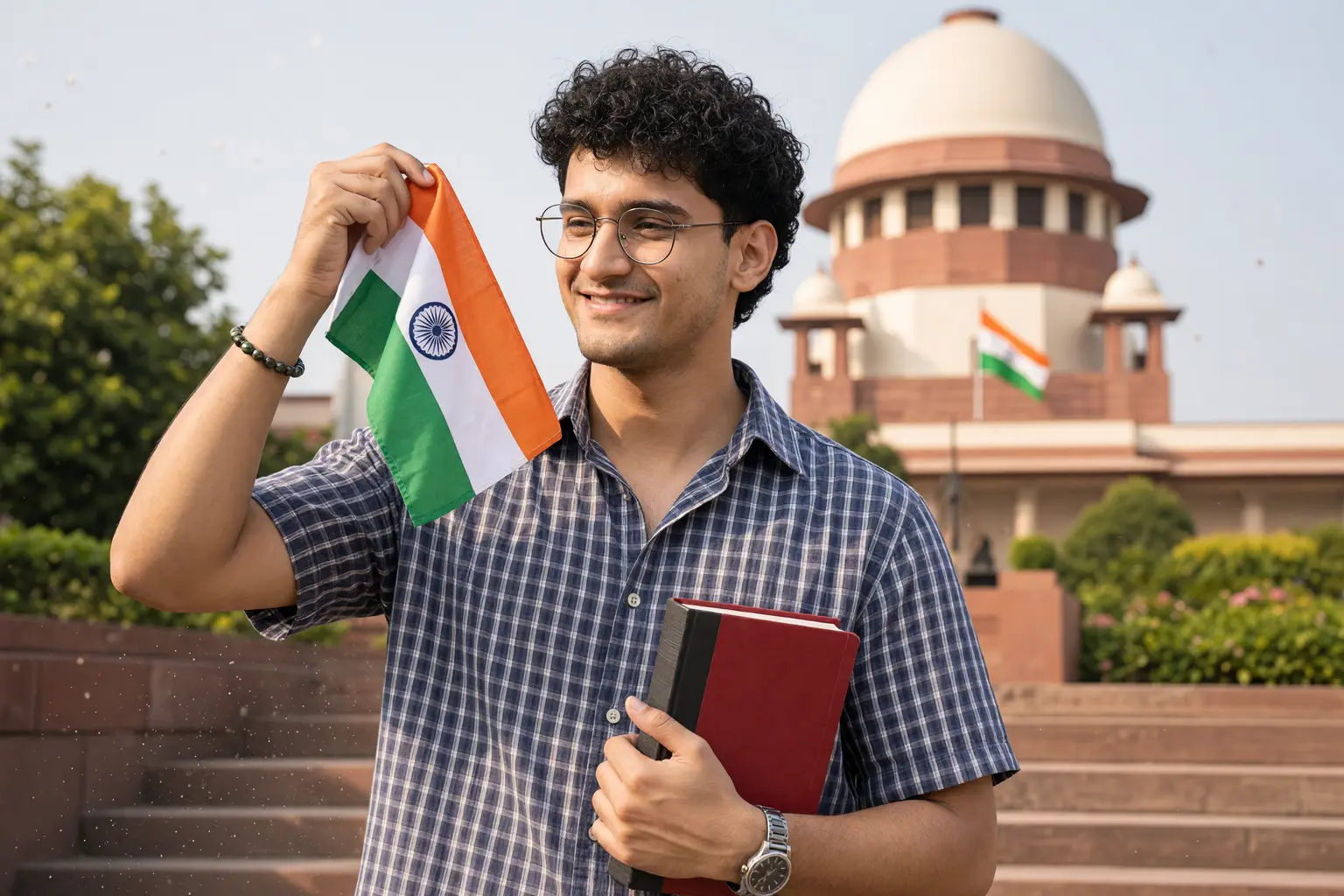
An Urgent Plea After the Court Rose
The Centre did not wait to test that presumption. In the afternoon, as the bench prepared to rise, Solicitor General Tushar Mehta mentioned an application by Delhi Police asking the court to use Article 142 of the Constitution to quash FIRs from the July protests. Kant listed it for the next day. If parties are reconciling, he said, we have no difficulties.
Delhi Police, which answers to the Union home ministry, told the court it no longer wished to pursue the FIRs registered after the July 20 crackdown at stations from Barakhamba Road to Parliament Street and Connaught Place. Those cases had carried charges of rioting, attempt to murder, and damage to public property. The force still wanted leave to file a fresh, specific case against 2,873 people with criminal records who, it said, facial recognition had placed at Jantar Mantar.
The calendar is the tell. The retired officer wanted a stay before the street moved. He did not get one. Within hours the police force that would have had to manage the march asked the same judges to erase the cases that were the march’s reason for existing, with the summit a fortnight away.
What the September 1 Order Did
Tuesday’s hearing ran about an hour. Mehta said papers had been filed that morning and asked for a 2 pm slot, which the bench gave him. Delhi Police was joined by Maharashtra, Assam, Bihar and West Bengal in asking the court to quash the listed FIRs. Mehta said the state applications were, in his word, verbatim copies of the Delhi plea, and he also pressed, with senior advocate N. Hariharan and advocate Vrinda Grover, for a wide bar on any new case linked to the same protests.
Kant’s bench invoked Article 142, which lets the court order as is necessary for doing complete justice in a matter before it. Keeping in view the future prospects of the young protestors, the Chief Justice said, we invoke our powers under Article 142 of the Constitution to do complete justice. All the FIRs before the court were quashed. Any other FIR from the protests between July 20 and July 25, in any state or Union Territory, even one not formally shown to the bench, is not to be pursued or investigated and is to be treated as closed. No state or Union Territory is to register a fresh FIR for those dates.
THE SEPTEMBER 1 DIRECTIONS
| Item | What the bench did |
|---|---|
| FIRs in the Delhi Police and four-state applications | Quashed |
| Other protest FIRs from July 20-25, anywhere in India | Closed and not to be investigated |
| New FIRs for those same dates | Barred in every state and Union Territory |
| 2,873 people with alleged criminal records | Delhi Police may file one fresh, specific FIR |
| Families of students who died by suicide after the NEET-UG leak | Centre’s three-month compensation timeline recorded |
| September 5 Delhi march | Withdrawn in court by CJP co-convener Saurav Das |
CJP co-convener Saurav Das, who was in the courtroom, was called to the front row and read a statement from his phone. In view of the positive assurances of the Government of India and the judicial sanctity bestowed upon them today, and in view of the order being passed by this Court, he said, the CJP deems it appropriate to withdraw the call for the march on September 5 and looks forward to compliance with today’s order. The court asked for the text to go on the record. Mehta offered a printout from his chambers. Das later called the order historic and thanked Grover and the Solicitor General.
https://x.com/SauravDassss/status/2094829134023475692
Union minister JP Nadda said the government welcomed the decision to drop the march and that FIRs against those who took part in the earlier protests would be withdrawn. We consulted all BJP-ruled states, he said; they also assured they would withdraw FIRs against CJP protesters. Kant, after the order, told the room that all of us have seen student life, and he advised students to concentrate on careers. As an institution, he said, we are thankful a constructive environment has been created that will help youngsters.
2,873 People Still Face a Fresh FIR
The wipe is not total. Delhi Police may still register a fresh, specific FIR against 2,873 people it says have serious criminal antecedents, including cases of murder, attempt to murder, dacoity, rape and offences under the POCSO law, and who were spotted by facial recognition at the Jantar Mantar site. The bench said that case should not prejudice their rights and that they should have every chance to defend themselves. Das said that if people with such records were at the site and had committed grave crimes, they should be investigated and prosecuted.
Mehta had already drawn that line on an earlier date. FIRs against student protestors must be quashed, he had told the court; anti-social elements who infiltrated have to be probed. How to do it, he added, was for the judges. The carve-out is the price the Centre extracted for walking away from the rest of the docket, and it sits on camera evidence whose use in these protests is already before the court in a separate fight over proportionality.
The bargain is already being read as a template. If these files can be closed in a day, other groups will ask why theirs cannot, and that question will return the next time a large protest ends in cases. It is also being read as a product of the diary. The government agreed in open court after it had spent a month stalling on a July 25 promise, and it did so with a heads-of-government meeting in the same city.
Tear Gas, Barricades and a 36-Day Sit-In
CJP grew out of anger over the NEET-UG 2026 paper leak, which led to the exam’s cancellation and a re-test. Founder Abhijeet Dipke and spokespersons Das and Ashutosh Ranka turned a sit-in at Jantar Mantar into a national fight that also drew activist Sonam Wangchuk’s hunger strike. The name itself traces to remarks in this court about cockroaches and parasites, which the group took and wore.
HOW THE FILE REACHED THIS BENCH
- July 20, 2026: The Sansad Chalo march toward Parliament on the opening day of the Monsoon Session is stopped near Kerala House. Protesters and police clash at barricades around Connaught Place and the central secretariat. More than 118 police and paramilitary personnel are injured, about 60 protesters are hurt, and 70 people are detained. Tear gas is fired; later court papers describe pellet guns used against students who were fleeing.
- July 24, 2026: Das and Ranka meet Union ministers JP Nadda and Jitendra Singh. CJP lists a resignation, Rs 1 crore for each family of a student who died by suicide, withdrawal of FIRs, and a public apology from the Rapid Action Force and the Delhi Police Commissioner.
- July 25, 2026: Dharmendra Pradhan resigns as education minister. CJP calls off a 36-day agitation in good faith on assurances that cases will not be pursued and that compensation will come.
- August 18, 2026: The same court indicates it is willing to use Article 142, after being told that a police force cannot simply retract an FIR once it is registered.
- August 24, 2026: CJP announces the September 5 march, saying three pledges still sit unmet: compensation, the FIR withdrawal, and the police apology.
- August 31 to September 1, 2026: The stay is refused, the police ask for a wipe, the wipe is granted, and the march is withdrawn in the same courtroom.
The apology to the RAF and the Delhi Police Commissioner is not in Tuesday’s order. Das told the bench the commitments had been honoured. The street demand that named uniformed forces dropped out of the bargain that closed the files.
After the Wipe, BRICS Week Still Runs the City
The march had been aimed at Teachers’ Day, seven days before the leaders’ meetings of the 18th BRICS Summit under India’s chairship on September 12 and 13 at Bharat Mandapam, Pragati Maidan. Delhi Police, before the pullout, had already drawn a plan of drones, call-record checks and border filters, and had said no permission existed for a gathering at India Gate or the police headquarters. Prohibitory orders under Section 163 of the Bharatiya Nagarik Suraksha Sanhita were likely, officials said at the time.
Those street plans are now surplus. The city is still on a summit clock. On Wednesday, September 2, traffic police ran a motorcade rehearsal from 10 am to 3 pm across more than 35 roads and 22 diversion points, the same corridors a march to the police headquarters would have cut.
WHAT THE ORDER SETTLED, AND WHAT IT DID NOT
- FIRs from July 20-25: Closed nationwide, including cases not named in the five applications.
- The September 5 march: Withdrawn on the record by Das, at the Union’s request, he later said.
- Compensation: A pan-India policy, with payments due within three months, about December 1, for families of students who died by suicide after the leak. CJP had asked for Rs 1 crore a family; that figure was not written into the order.
- The 2,873: Still exposed to one fresh Delhi FIR, with a right to defend.
- Police conduct on July 20: Still before the court, including a high-powered enquiry committee, and still listed with Singh’s application on September 10.
Singh wanted a rule that big marches in the capital’s core need prior permission, and he wanted it before BRICS week. He did not get the injunction. He got a quiet Teachers’ Day anyway, because the executive bought the cancellation in the only court that could bury the July cases in one stroke. The September 10 board still carries the leftover fights over force, cameras and who may walk those roads the next time someone calls a crowd.
Frequently Asked Questions
Is the Supreme Court’s FIR order a precedent for other protests?
No. The bench said the directions were passed in the peculiar facts of this case and shall not be treated as a precedent, which means the next large protest that ends in FIRs cannot simply cite Tuesday’s order as a right to the same wipe.
Who started the Cockroach Janta Party, and when?
Abhijeet Dipke founded the group in May 2026 as a satirical online campaign after the NEET-UG leak, and it grew into a street platform with Das and Ranka as the public faces; the name was taken from oral remarks in the Supreme Court that the organisers chose to adopt.
What happened to the NEET-UG 2026 paper leak investigation?
The exam was cancelled in May after questions leaked, a re-test was held on June 21 for about 2 million candidates, and on July 30 the Central Bureau of Investigation filed charges against 13 people, including three National Testing Agency subject experts, middlemen, and two people linked to coaching institutes.
Does Rajendra Singh’s petition end because the march was cancelled?
No. The application for rules on large demonstrations in sensitive zones remains tagged with the main student-protest batch on September 10, alongside petitions on alleged police excesses, so the fight over permission and force is still on the list even though September 5 is now an ordinary Friday.
Disclaimer: This article is news reporting and analysis of court proceedings and public statements, and it is for information only. It is not legal advice and does not tell any person how to handle a criminal case, a protest permission, or a compensation claim. Anyone named in an FIR, or anyone seeking payment under the recorded three-month timeline, should consult a qualified advocate before acting. Figures, listings and case statuses reflect the public record as of September 2, 2026, and may change if the court or the police issue further orders.

-
 TECH1 year ago
Where Garmin Watches are Made and How They are Assembled
-
 AUTO3 months ago
Tesla’s Roadster Is ‘a Few Weeks Away,’ Says Its Chief Designer
-
 NEWS10 years ago
Samsung Releases Galaxy Note7 TV Ad as Reddit AMA Leaks Specs
-
 NEWS10 years ago
Android 7.0 Nougat Rolls Out To Nexus Devices With New Emoji, Features
-
 FINANCE9 years ago
Cardano Price Surges as ADA Enters the Crypto Top Ten List
-
 NEWS10 years ago
Pre-Order the First Camera Made for Facebook Live Streaming Video
-
 FINANCE1 year ago
Binance Suspends Trading and Withdrawals for a System Upgrade
-
 FINANCE9 years ago
RChain Price Jumps Nearly 150% to a New All-Time High of $2.03