
NEWS
The Poco F9 Ultra Camera Upgrade Shrinks the Sensor
The Poco F9 Ultra 200MP camera uses a smaller sensor than the F8 Ultra, so extra detail arrives only in large files after extra steps.

The Poco F9 Ultra adds a 200MP main camera on a smaller chip than last year’s Ultra, with extra detail locked in 30MB to 70MB files. Poco launched the phone on September 1, 2026, from $799 (€1,099.90) for 12GB and 256GB, and called the new wide camera a first for the brand.
Hardware IDs point to Samsung’s ISOCELL HP5. That chip was built to shrink camera modules, not to out-collect last year’s 1/1.31-inch 50MP sensor, and the phone still wants still scenes and extra work before the megapixel number pays off.
Poco Traded a Larger Sensor for 200 Megapixels
Poco’s product page sells a first 200MP ultra-clear main camera with a dedicated 200MP mode for cropping and later edits. The company wrote that the module delivers “unprecedented image detail.” The optical format behind that line is 1/1.56-inch, with 0.5µm pixels binned 16-to-1 into 2.0µm wells for the default 12.5MP shot.
Last year’s Ultra listed a 1/1.31-inch main sensor for the F8 Ultra, the 50MP Light Fusion 950 (LYT-950) with 1.197µm native pixels and 2.4µm combined pixels. Four times the megapixels now sit on a smaller chip, and the native pixel pitch is about 2.4 times finer. Default output stays in the same 12.5MP class.
MAIN CAMERA, TWO ULTRAS
| Spec | F8 Ultra | F9 Ultra |
|---|---|---|
| Resolution | 50MP | 200MP |
| Sensor | Light Fusion 950 / LYT-950 | ISOCELL HP5 (listings) |
| Optical format | 1/1.31-inch | 1/1.56-inch |
| Native pixel | 1.197µm | 0.5µm |
| Binned pixel | 2.4µm | 2.0µm |
| Default file | 12.5MP class | 12.5MP |
| Lens | 23mm, f/1.67, OIS | 24mm, f/1.68, OIS |
Poco did not print the new sensor size in the same way it did for the F8 Ultra. The 200MP mode is the part it wants you to notice. Listings for the cheaper F9 Pro use the same 200MP main camera, with a 2.5x telephoto and an 8MP ultrawide, so the Ultra’s camera extras are the 5x periscope and the 50MP ultrawide, not a unique wide sensor.
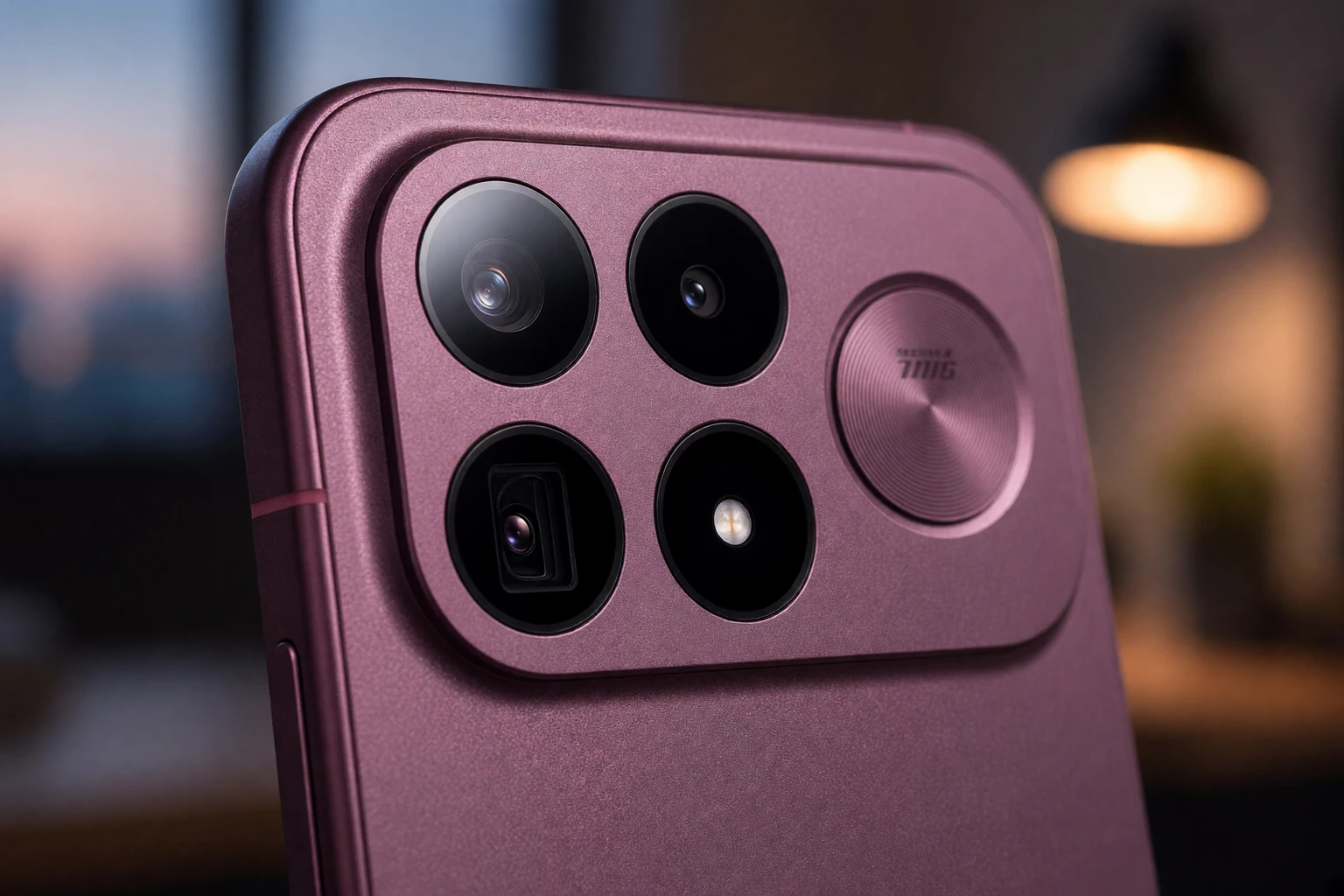
A Sensor Designed for Slimmer Phone Cameras
Samsung’s HP5 page describes the world’s first image sensor with 0.5µm pixels and a 1/1.56-inch format. Tetra²pixel can run at 200MP, at 50MP with 1.0µm wells, or at 12.5MP with 2.0µm wells, and the wide camera can crop to a 4x in-sensor zoom. Full-resolution readout is 7.5 frames a second. The array is 16,384 by 12,288.
HOW THE 200MP CHIP ARRIVED
- October 7, 2025: Samsung announces ISOCELL HP5 and says it is already in mass production.
- November 26, 2025: Poco ships the F8 Ultra with the larger 50MP 1/1.31-inch main camera and a 5x JN5 periscope.
- September 1, 2026: The F9 Ultra arrives with 200MP on the HP5, the same 5x telephoto class, and an 8,050mAh pack in an 8.74mm, 235g body.
The F8 Ultra’s black model was 7.9mm and 218g with a 6,500mAh battery. Poco used the smaller-format 200MP chip and still shipped a thicker phone, because the battery is the other headline. Samsung’s own brief for the HP5 was thinner camera hardware, not a bigger light bucket.
Premium devices, in particular, are moving toward thinner, sleeker camera modules.
Samsung Semiconductor, ISOCELL HP5 tech blog
The same blog says the 1/1.56-inch format is there to enable slim and compact camera modules while holding 200MP. Dual vertical transfer gates are rated for up to 66% more full-well capacity than a single-gate design, which is how Samsung argues tiny pixels can still hold a usable charge. Family flagships are already testing a different bet, and the Xiaomi 18 Ultra’s shift toward AI puts processing ahead of another sensor race.
Full-Resolution Shots Cost Time, Light, and Storage
At 1x in daylight, the default 12.5MP files already look strong. Dynamic range is wide, color saturation is easy to like, and sharpening stays in check. Portraits keep skin tones clean, and the blur is conservative. The 50MP 1x mode does not look sharper in a way that justifies the extra pixels. The 200MP files are the only path to more resolving power, and they are slow to capture.
Poco’s own 200MP post leans on cropping and “more to explore,” which matches the marketing, not the file sizes you actually store.
https://x.com/POCOGlobal/status/2094002188477431923
200MP MODE IN PRACTICE
- File weight: Typical 200MP stills land around 30MB to 50MB, and busy outdoor greenery can pass 70MB.
- The extra detail: Downscaling those files to about 24MP shows more texture than the default 12.5MP shot.
- The limits: You need good light and a still subject; action and dim scenes are the wrong job for full resolution.
- The 2x crop: Once you know the sensor holds that detail, the out-of-camera 2x frames are excellent, including headshots and a 3.1x portrait crop at 75mm equivalent.
Samsung rates HP5 remosaic at under two seconds, depending on the processor. On this phone the wait is still long enough to feel, and the 200MP path is a specialist tool, not the way most frames will be taken. Launch talk on X treated 200MP as a checkbox next to the 8,050mAh battery and the $799 sticker. The smaller optical format barely came up. Pro mode can write RAW, which is the other way to keep more of what the chip recorded without living in 70MB JPEGs.
The 5x Periscope Still Carries Zoom Duty
The telephoto is still a 50MP periscope with an f/3.0 lens, OIS, and 5x optical reach. Poco lists 120mm equivalent, 10x lossless zoom, 20x AI ultra zoom, and telemacro from 30cm. That is the same job the F8 Ultra already had, with a 115mm listing and a Samsung JN5-class sensor around 1/2.76-inch.
Daylight 5x stills have lots of detail, a little extra contrast, and color with a mild pop. Headshots compress nicely. Skin can run a touch hot outdoors, and Photo mode already separates the subject well before Portrait mode adds blur. The 50MP telephoto files take on a watercolor look and are not very useful. 10x stills often pick a different white balance than the 5x frame, with more sharpening and definition than those 50MP 5x shots, and they are fine rather than class-leading.
At night the 5x images are less grainy than the last generation, and they can look a bit plastic. Exposures run on the dark side. 10x at night pushes that plastic look further on grass and brick. If you stay off pixel-peeping, the results still hold. For close-ups, 2x on the main camera is the better balance of quality and reproduction. The 10x telephoto fills the frame from farther away, which helps with shy or unsafe subjects, but pixel-level quality at that distance is only average; native 5x is cleaner.
Why the Ultrawide Still Can’t Focus Close Up
The ultrawide is the weak corner of the triple. Specs match last year’s 50MP 1/2.88-inch unit (0.61µm to 1.22µm, f/2.4, fixed focus, 4K60). Poco now lists 17mm equivalent; the last phone listed 18mm and 102°. Distant subjects in good light have very good ultrawide detail. Nearby subjects go soft because there is no autofocus, and that miss is easier to see on this unit than on the F8 Ultra.
Full-resolution 50MP ultrawide files add no real detail. At night the module goes soft, flattens some shadows, and can miss color under mixed lamps. Selfies follow the same old 32MP, f/2.2, fixed-focus script and save 8MB to 10MB files that do not hold 32MP of texture. Dynamic range and skin tones are good if you downscale. The chosen focus distance covers short selfie range well enough that the missing AF is less of a problem than it is on the ultrawide.
WHAT DID NOT MOVE
- Ultrawide focus: The 50MP ultrawide is still fixed-focus, so near subjects stay out of focus.
- Selfie files: The 32MP front camera has no lower-res mode, so you store 8MB to 10MB frames for a 12.5MP-class look.
- 50MP extras: High-res modes on the telephoto and ultrawide do not repay the storage, and 50MP at 1x on the main camera is not sharper in a useful way.
- The periscope: 5x, OIS, and 30cm close focus are carry-over hardware, with tuning changes rather than a new lens.
Early-bird pricing on the 12GB/256GB Ultra is $729, with $799 and $1,059 on the 16GB/512GB and 16GB/1TB models. That is the pitch people compared with a Galaxy Ultra. The camera you get for that money is a very good 1x/2x/5x stills phone with a 200MP mode you will use when the light is right.
Video Adds 4K60, HDR10+, and Log
Every rear camera can record 4K60. The main camera adds 8K30. The front camera tops out at 4K30, or 1080p60 if you want more frames. There is no 24fps option, even in Pro video. The default codec is h.265, with h.264 as a switch. HDR10+ is available on all four cameras at every listed resolution and frame rate except main-camera 8K30. The HDR toggle lives in settings, not on the viewfinder.
Pro video includes Log with a few live LUTs and a slot for your own, plus audio meters, zebras, and a tiny histogram that can swap to a waveform. Electronic stabilization stays on for all resolutions and frame rates. Daytime clips from the main camera and the telephoto have wide dynamic range, clean white balance, and organic detail. 2x video can look a little dreamy. The ultrawide keeps the main camera’s color and range but not its sharpness. At night the main camera still nails white balance and range; 2x gets soft and noisy, 5x holds up, 10x is barely usable, and the ultrawide goes dark and soft.
VIDEO TOOLKIT
- Rear 4K: 4K60 on main, telephoto, and ultrawide, with 8K30 on the main camera only.
- Front video: 4K30 or 1080p60, no 24fps anywhere on the phone.
- Log and HDR: Log at 4K 30/60 in Pro mode; HDR10+ on all cameras except 8K30.
- Shake: Telephoto jitter from the last Ultra is reduced; locked-off shots are stable, pans are smooth, and walking shake on the main camera is still visible if you look for it.
Stabilization is the quiet improvement. The last Ultra’s telephoto had a nervous quality that is mostly gone. Point the main or ultrawide at a fixed scene and the frame holds. That is more useful day to day than 8K30, which most people will try once.
Frequently Asked Questions
What Sensor Is in the Poco F9 Ultra Main Camera?
Listings identify Samsung’s ISOCELL HP5, a 200MP chip with a 16,384 by 12,288 array, Super QPD autofocus, and a full-resolution still rate of 7.5 frames a second. It can also run as 50MP at 1.0µm or 12.5MP at 2.0µm, which is the path the phone uses for ordinary snapshots.
What Sensor Did the Poco F8 Ultra Use on the Main Camera?
Poco’s F8 Ultra FAQ names OmniVision for the main and ultrawide and Samsung for the telephoto, with LYT-950 (Light Fusion 950) on the wide camera at 1/1.31-inch and 1.197µm, OV50M on the ultrawide at 1/2.88-inch, and JN5 on the telephoto at 1/2.74-inch.
Does the Poco F9 Ultra Ultrawide Have Autofocus?
No. The 50MP ultrawide is fixed-focus, and the 32MP selfie camera is fixed-focus as well. Close-up work has to move to the main camera at 2x or to the periscope, which can focus from 30cm to infinity with PDAF and OIS.
Can the Poco F9 Ultra Record 24fps Video?
It cannot. Rear cameras offer 8K30 and 4K60, the front camera offers 4K30 or 1080p60, and Pro Log is 4K at 30 or 60 fps. ShootSteady, Poco’s extra-smooth mode, is listed at 2.8K30 and 1080p30 rather than at a film frame rate.
Does the Poco F9 Ultra Shoot RAW Photos?
Yes. Pro mode can save RAW stills alongside the usual JPEG pipeline, which is the practical way to keep more of the HP5’s data without filling a 256GB phone with 70MB 200MP frames. The 200MP JPEG mode remains a daylight, tripod-style option.
If you want extra detail, shoot still scenes in bright light, wait out the 200MP capture, and downscale the 30MB to 70MB files. For everything else, the F9 Ultra already looks like a finished stills phone at 1x, 2x, and 5x, with 4K60 waiting on the same three rear lenses.

-
 TECH1 year ago
Where Garmin Watches are Made and How They are Assembled
-

 AUTO3 months ago
Tesla’s Roadster Is ‘a Few Weeks Away,’ Says Its Chief Designer
-
 NEWS10 years ago
Samsung Releases Galaxy Note7 TV Ad as Reddit AMA Leaks Specs
-
 NEWS10 years ago
Android 7.0 Nougat Rolls Out To Nexus Devices With New Emoji, Features
-
 FINANCE9 years ago
Cardano Price Surges as ADA Enters the Crypto Top Ten List
-
 NEWS10 years ago
Pre-Order the First Camera Made for Facebook Live Streaming Video
-
 FINANCE1 year ago
Binance Suspends Trading and Withdrawals for a System Upgrade
-
 FINANCE9 years ago
RChain Price Jumps Nearly 150% to a New All-Time High of $2.03