
NEWS
Galaxy S26 FE Review Unit Shows Thin Hardware Gains
Samsung’s Galaxy S26 FE reaches reviewers with an Exynos 2500 and One UI 9, but frozen cameras, battery and a higher starting price stretch the Fan Edition formula.

GSMArena has the Samsung Galaxy S26 FE in for review, and the first impression is a familiar one. The 6.7-inch phone keeps the same screen, triple camera, 4,900 mAh battery and overall hand feel as the S25 FE, yet starts at $699 in the US, a $50 rise, while shipping with the newer Exynos 2500 and One UI 9.
That combination is the story. The Fan Edition once promised near-flagship daily performance at a clear discount. This year the discount is smaller and the hardware changes are thinner, even as the software arrives earlier than on the main S26 models.
The review unit therefore tests a narrower bet than earlier Fan Editions. Buyers are asked to pay more for a chip upgrade and day-one software while accepting last year’s cameras, display and battery package in full.
The Hardware That Barely Budged
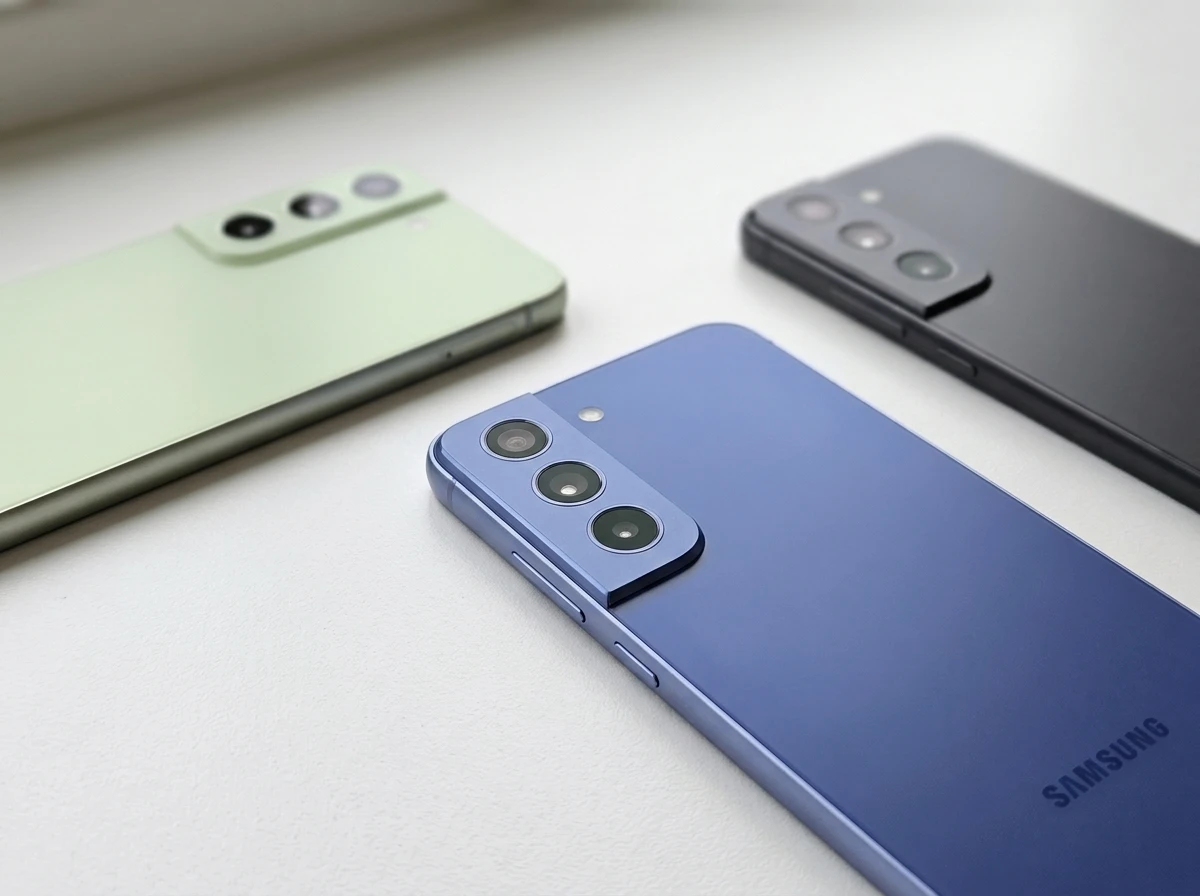
Open the box and you find a USB-C cable. No charger, no case. The phone itself measures 161.6 x 76.9 x 7.4 mm and weighs 193 g, with Gorilla Glass Victus+ on both sides, an aluminum frame and IP68 sealing. Colors are Blueberry, Pistachio and Graphite.
The 6.7-inch Dynamic AMOLED 2X panel still runs FHD+ at up to 120 Hz and peaks at 1,900 nits. The rear cameras remain a 50 MP wide with OIS, 12 MP ultrawide and 8 MP telephoto with 3x optical zoom and OIS. The front camera is still 12 MP. Battery capacity and charging stay at 4,900 mAh, 45 W wired and 15 W wireless.
Almost every daily-use specification is carried forward unchanged:
- 6.7-inch Dynamic AMOLED 2X, FHD+, 120 Hz, 1,900 nits peak
- 50 MP wide, 12 MP ultrawide and 8 MP 3x telephoto with OIS
- 12 MP front camera
- 4,900 mAh battery, 45 W wired and 15 W wireless charging
- Gorilla Glass Victus+ front and back, aluminum frame, IP68
The one visible hardware shift is the raised camera island. Last year’s sensors sat flush. Everything else that defines daily use is carried over. The full Galaxy S26 FE specifications read almost like a reprint of the S25 FE sheet.
That continuity keeps the hand feel familiar and limits surprise in the pocket. It also leaves the Exynos 2500 and One UI 9 as the only levers Samsung pulled to justify a new model year and a higher open price.
Exynos 2500 Delivers the Only Real Lift
Samsung switched the silicon completely. The S26 FE uses the Exynos 2500 on a 3 nm process across every market. There is no Snapdragon variant. The previous FE used the 4 nm Exynos 2400.
The 10-core CPU pairs a 3.3 GHz Cortex-X925 with pairs and clusters of A725 and A520 cores. The Xclipse 950 GPU is built on AMD RDNA 3. Samsung claims roughly 15% higher multi-core CPU performance, up to 28-33% better GPU work in ray tracing and related loads, and about 39-40% more NPU compute than the 2400. Independent Geekbench 6 samples put the 2500 around 2,285 single-core and 7,874 multi-core, versus lower mid-2,000s and mid-6,000s for the older chip. AnTuTu totals sit near 2.29 million versus about 2.05 million.
| Metric | Galaxy S26 FE | Galaxy S25 FE |
|---|---|---|
| Chipset | Exynos 2500 (3 nm) | Exynos 2400 (4 nm) |
| Peak multi-core (Geekbench 6 approx.) | ~7,874 | ~6,826 |
| NPU gain (Samsung) | +39% | baseline |
| Storage options | 128 / 256 / 512 GB | 128 / 256 / 512 GB |
| US starting price | $699 | $649 |
The NPU bump matters for the on-device AI features that arrive with One UI 9. Sustained gaming and generative edits should feel snappier. Thermals remain a question for the full review, since the 2500 lacks some later heat-management blocks found on the main S26 chips.
Because every market receives the same 3 nm Exynos part, performance expectations stay consistent worldwide. That removes the usual Snapdragon versus Exynos split that once complicated FE comparisons across regions. The trade-off is that the phone still trails the newer silicon inside the main S26 models, so the lift is real against the S25 FE and modest against current flagships.
One UI 9 Arrives First on the Fan Edition
This is the first Fan Edition to ship with One UI 9 on Android 17. The main Galaxy S26 models launched earlier on older software and will receive the update later. That timing reverses the usual cascade.
Galaxy S26 FE is purposefully designed to deliver the signature strengths of the Galaxy S series, ensuring that every feature makes a meaningful difference in users’ daily lives.
Jay Kim, Executive Vice President and Head of Customer Experience Office, MX Business, Samsung Electronics
Samsung’s own materials list the AI tools that benefit from the stronger NPU:
- Updated Now Brief with more personalized and customizable briefing cards
- Now Nudge that surfaces suggestions from select third-party apps and notifications
- Circle to Search that can identify multiple objects in one image
- Photo Assist that accepts natural-language edits, including adding or restoring elements
- Gemini Omni for creating and editing video clips from Gallery content (six-month Google AI Pro trial included)
- My FanCam that tracks a selected subject and keeps them centered
- Super Steady with Horizontal Lock for level, stabilized video
These features previously appeared on foldables or the main S26 series. Putting them on the FE at launch, together with the One UI 9 beta path for Galaxy S26, is the clearest software statement Samsung has made for this tier. The irony is that the same software will likely reach last year’s FE owners later, reducing the upgrade urgency created by the chip alone.
Early access still carries practical weight. Owners skip the waiting period that usually follows a main-series launch, and the stronger NPU is present from the first boot rather than arriving as a later software consolation. For buyers who live inside Samsung’s AI tools, that head start is the most tangible day-one difference.
Why the Starting Price Climbed $50
In the United States the 8 GB + 128 GB model is Galaxy S26 FE from $699.99. The 256 GB version is $799.99. The 512 GB option is not offered in the US. In the UK the range is £699 / £799 / £949. European pricing commonly opens at €799 for 128 GB and climbs to €1,099 for 512 GB.
| Market | Entry configuration | Entry price | Notes |
|---|---|---|---|
| United States | 8 GB + 128 GB | $699.99 | 256 GB at $799.99; no 512 GB |
| United Kingdom | 128 GB tier | £699 | £799 and £949 above |
| Europe | 128 GB tier | €799 | Up to €1,099 for 512 GB |
Last year the S25 FE opened at $649 in the US and held that mark. The year before, some markets saw smaller moves. Samsung has pointed to RAM and component pressure. The net result is a Fan Edition that now sits only $100-$200 below some base flagship configurations while carrying last year’s camera and display hardware.
On X the reaction landed hard on that gap. One widely liked post labeled the phone “slop” for repeating the same 8 MP telephoto, same battery and same base storage while adding fifty dollars. Others noted that at $699 the FE no longer feels like the automatic smart buy against discounted previous flagships or strong mid-rangers. The crowd reading is consistent: the value cushion that defined the line has shrunk.
Earlier coverage of earlier S26 FE battery and price details already flagged the same tension around capacity and cost.
Camera Island and the Same Triple Setup
The raised island is the only exterior cue that this is a new model. Inside the sensors and optics are unchanged: 50 MP f/1.8 wide with dual-pixel PDAF and OIS, 12 MP f/2.2 ultrawide, 8 MP f/2.4 3x telephoto with OIS, and a 12 MP f/2.2 front camera. Video reaches 8K at 24/30 fps and 4K at up to 120 fps with gyro-EIS and HDR10+.
Software processing receives the new tools. My FanCam and Horizontal Lock Super Steady are the two clearest camera additions borrowed from higher models. Nightography and Photo Assist receive the usual incremental claims. Review units will show whether the NPU and newer processing pipeline produce visibly cleaner results in low light or multi-object edits, or whether the sensors remain the ceiling.
Samsung’s official framing calls the package a latest flagship experience focused on what matters. For many buyers the cameras still matter a great deal, and they have not moved.
That leaves a split verdict path for the full review. If the new processing pipeline extracts cleaner night shots and more reliable multi-object edits from the same sensors, the island will mark more than a cosmetic refresh. If the output stays close to the S25 FE, the cameras will remain the clearest argument against paying the higher open price.
The Smaller Discount Changes Buyer Math
Earlier Fan Editions won shoppers with a wide gap under the main S series. This cycle compresses that gap. The US open price moves from $649 to $699 while base flagship configurations still land only $100-$200 higher in some setups, and the FE keeps the prior camera and display stack.
Against a discounted previous flagship or a strong mid-ranger, the automatic pick is less obvious than before. The Exynos 2500 and day-one One UI 9 restore some of the lost ground for buyers who want current AI tools without waiting. They do less for shoppers who care first about zoom quality, peak brightness headroom or raw battery capacity, all of which are unchanged.
Storage policy sharpens the choice in the US. The 128 GB and 256 GB tiers are available; the 512 GB option is not. Elsewhere the full 128 / 256 / 512 GB spread remains, with European pricing climbing to €1,099 at the top. Cross-market shoppers therefore face different ceilings even though the silicon is the same 3 nm Exynos 2500 everywhere.
How Long Ownership Shifts the Trade-Off
Seven years of major OS upgrades and seven years of security patches now match the main S26 series. That promise exceeds many competitors at this price and stretches past the support windows on earlier Fan Editions.
- Day one: One UI 9 on Android 17, ahead of the main S26 update wave
- Years one to two: Exynos 2500 performance and on-device AI features do the heavy lifting
- Years three to five: the long patch and upgrade clock becomes the main advantage over shorter-lived rivals
- Years six to seven: security maintenance keeps the device usable after most peers age out
A buyer who holds a phone four or five years captures more of that schedule. The frozen cameras and the $50 jump matter less when the software horizon is the deciding factor. A buyer on a two-year cycle sees mostly the chip step and the early AI pack, which is a thinner case against simply keeping an S25 FE until One UI 9 reaches it.
8 GB RAM and UFS 4.0 storage stay fixed across the lineup, with no microSD slot to extend capacity later. Dual Nano-SIM plus dual eSIM support, Wi-Fi 6E, Bluetooth 5.4 and 5G complete a connectivity sheet aimed at long service rather than yearly thrills.
Seven Years of Updates Change the Calculus
The S26 FE launches with a promise of seven major OS upgrades and seven years of security patches. That matches the main S26 series and exceeds many competitors at this price. Combined with One UI 9 on day one, the phone is built to stay current longer than earlier Fan Editions.
4,900 mAh battery with 45 W charging that reaches about 69% in 30 minutes remains the endurance story. 8 GB RAM and UFS 4.0 storage are fixed across the lineup. No microSD slot. Dual Nano-SIM plus dual eSIM support (two active at once) and Wi-Fi 6E, Bluetooth 5.4 and 5G round out the sheet.
For a buyer who keeps a phone four or five years, the software commitment and the early AI features may outweigh the frozen cameras and the $50 jump. For someone who upgrades every two years or who already owns a S25 FE, the case is thinner. The Exynos 2500 is a real step, yet it is still last year’s silicon relative to the main S26’s newer parts, and the rest of the phone feels like a 2025 device with a 2026 software skin.
Review testing will settle battery life under the new chip, sustained performance, camera processing gains and whether the glossy finishes and island change the in-hand feel. Until those numbers arrive, the Galaxy S26 FE stands as the clearest illustration yet of Samsung’s current Fan Edition bet: put the newest software and AI on the more accessible model first, keep the hardware steady, and raise the price enough to protect margins. The upside is immediate access to One UI 9. The downside is that the value story that once made the FE an easy recommendation is now harder to tell without a long software horizon attached.

-
 TECH1 year ago
Where Garmin Watches are Made and How They are Assembled
-
 AUTO3 months ago
Tesla’s Roadster Is ‘a Few Weeks Away,’ Says Its Chief Designer
-
 NEWS10 years ago
Samsung Releases Galaxy Note7 TV Ad as Reddit AMA Leaks Specs
-
 NEWS10 years ago
Android 7.0 Nougat Rolls Out To Nexus Devices With New Emoji, Features
-
 FINANCE9 years ago
Cardano Price Surges as ADA Enters the Crypto Top Ten List
-
 NEWS10 years ago
Pre-Order the First Camera Made for Facebook Live Streaming Video
-
 FINANCE1 year ago
Binance Suspends Trading and Withdrawals for a System Upgrade
-
 FINANCE9 years ago
RChain Price Jumps Nearly 150% to a New All-Time High of $2.03