
FINANCE
Warsh Flags Sticky Inflation as AI Boom Keeps Rates Loose
Fed Chair Kevin Warsh says underlying inflation trends have not improved enough at Jackson Hole.

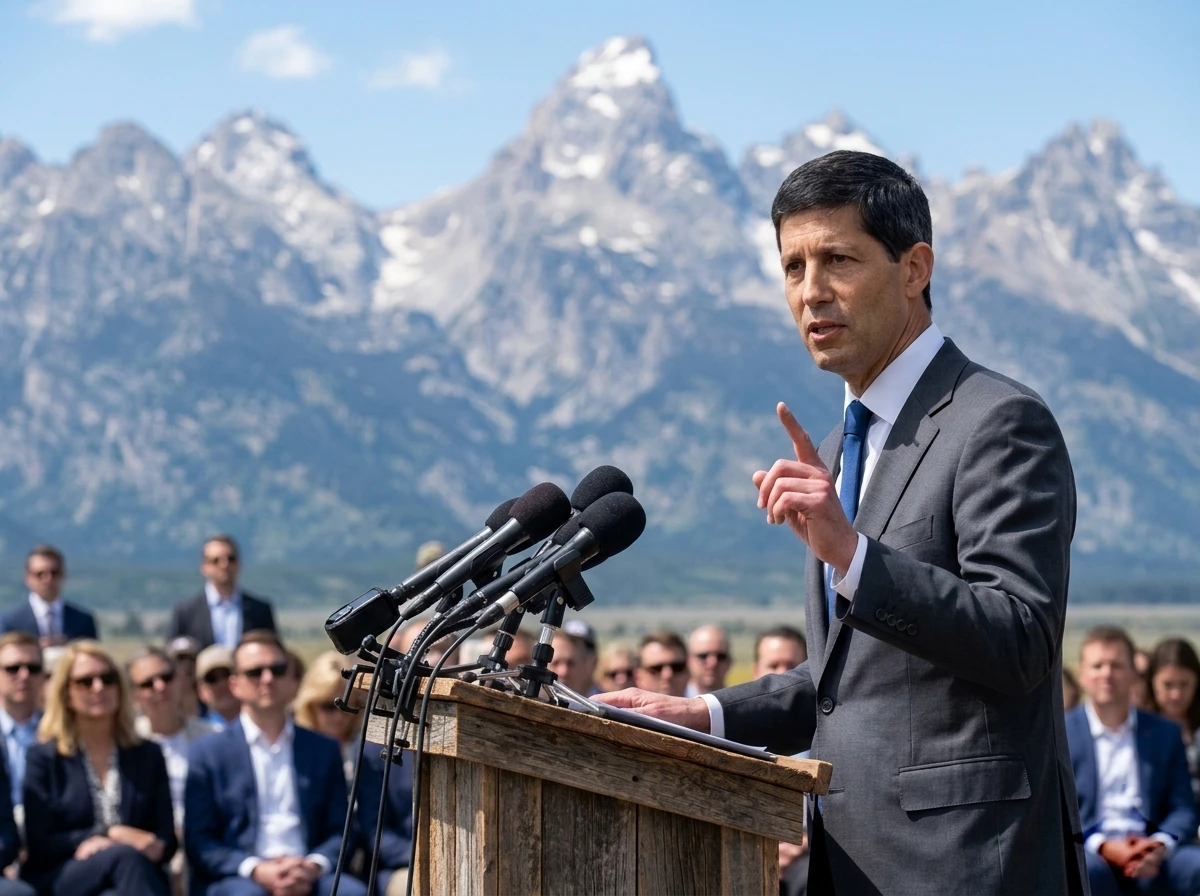
Federal Reserve Chair Kevin Warsh said Friday that recent U.S. inflation data remain “more concerning” than labor-market trends and fail to show underlying price pressures moving clearly toward the 2% target, lifting market odds of a September rate increase to roughly even. Speaking at the Kansas City Fed’s Jackson Hole symposium on his 100th day in the job, Warsh warned that without faster progress “we have work to do.”
The remarks came as the Fed’s preferred gauge held at 3.7% in July and as Warsh simultaneously described an economy powered by strong consumer spending and AI investment that shows few signs of restraint from current rates near 3.6%.
Warsh Draws a Line on Underlying Inflation
In his In Our Time remarks at Jackson Hole, Warsh acknowledged that summer PCE and CPI readings were better than expected after earlier energy spikes. He immediately added that they “do not tell me that underlying trends have meaningfully improved.”
Here is my standard: We must be confident that underlying inflation is moving to our objective, clearly and at sufficient speed. Otherwise, we have work to do. That’s our job… our mandate… and our charge to keep.
Kevin Warsh, Federal Reserve Chair, Jackson Hole 2026
The July PCE price index rose 3.7 percent year-over-year, matching June and staying well above the 2% goal. Core PCE, excluding food and energy, held at 3.3%. Warsh noted that more than half the goods and services in the basket still show price gains of 3% or more over the past year, down from pandemic peaks but still above the roughly one-third share seen in the two pre-pandemic decades.
| Measure | Latest Reading | Fed Objective / Benchmark |
|---|---|---|
| Headline PCE | 3.7% | 2% target |
| Core PCE | 3.3% | 2% target |
| Share of basket at 3%+ gains | More than half | Roughly one-third pre-pandemic |
| Months of elevated inflation | 65 | Central-bank responsibility |
He placed responsibility for 65 months of elevated inflation “squarely with the central bank.” Short-term rates remain the “predominant tool,” he clarified, after earlier confusion over measures and instruments. Inflation is “unlikely to return to the Fed’s target on its own.”
The gap between headline progress and underlying breadth is the core of his concern. A single soft print after energy spikes does not erase the fact that price gains remain common across the basket. That is why he framed confidence, speed, and clarity as the test rather than any one monthly release.
The Economy Shows Little Restraint
Warsh’s assessment of activity was distinctly upbeat and supplies the ironic core of the speech. Business capital expenditures on equipment and intangibles rose about 9% over four quarters, the strongest pace since 2021, with more than half the gain tied to AI infrastructure. S&P 500 profits grew more than 20% over the past year with elevated margins. Real consumer spending increased more than 2% over four quarters. Private domestic final purchases advanced nearly 3% so far this calendar year.
- Unemployment sits at 4.1%, low by historical standards and little changed for years.
- Credit spreads on corporate bonds and leveraged loans remain near historic lows, with strong issuance.
- Bank lending standards for commercial and industrial loans sit on the easier end of their range.
- AI token sales for the two leading labs run at more than $100 billion annualized, up over 500% from a year earlier.
Housing and agriculture show strains, yet “on balance, I would be hard pressed to describe broad financial conditions as restrictive,” Warsh said. Strong spending and AI build-out mean current policy is not slowing the economy enough to pull inflation down on schedule.
That resilience is the problem. The same forces lifting growth and asset prices keep demand firm and price increases broad, so the “work to do” may include higher rates.
Rates near 3.6% and a funds target of 3.50% to 3.75% have not chilled the channels that matter most for demand. Easy credit, strong profits, and heavy AI outlays leave little slack. The Fed therefore faces an economy that still absorbs current settings without the cooling needed for a clear path back to 2%.
Markets Reprice the September Meeting
Bond traders moved quickly. The two-year Treasury yield, which tracks near-term Fed expectations, rose from 4.22% to 4.30%. Longer-term yields barely budged, signaling little expectation of a prolonged high-rate regime.
| Metric | Before Speech | After Speech |
|---|---|---|
| CME FedWatch Sep hike odds | ~33-36% | ~55-57% |
| Two-year Treasury yield | 4.22% | 4.30% |
| Prediction markets (Kalshi/Polymarket) | Hold favored ~70% | ~48-51% hike (coin flip) |
| Tightening priced next 12 months | ~45 bp | ~53 bp |
U.S. stocks held steady overall while some AI-linked names sold off on the higher short-rate path. Economists including Jon Faust of Johns Hopkins, a former adviser to Jerome Powell, said Warsh conveyed willingness to support hikes if needed without the detailed path he has criticized. Michael Strain of the American Enterprise Institute noted the comments raise stakes for the September 15-16 meeting but still leave timing unclear.
The move in short-rate odds and the two-year yield, set against flat longer yields, shows traders heard a near-term risk shift rather than a multi-year tightening campaign. Prediction markets flipping to a coin toss capture the same message: September is live, but not locked.
No Forward Guidance by Design
Warsh used the platform to restate his break with regular forward guidance. He called the practice a crisis-era tool that has “overstayed its welcome” in normal times. Overcommitting to paths inhibits flexibility and creates a “hall-of-mirrors” problem in which markets and the Fed feed off each other rather than real data.
He rejected mechanical reaction functions or Taylor-rule simplicity. “I stand here today committed to a discipline, not to a decision.” Markets should form their own views from unfiltered signals: asset prices, Treasury volumes, the dollar, credit costs and commodities. The Fed will watch those same signals.
Adam Posen of the Peterson Institute criticized the approach on the sidelines, saying the absence of words like accountability and credibility leaves past mistakes unexamined. Supporters see it as restoring market focus on fundamentals instead of parsing every Fed syllable.
The full prepared text is available in the full prepared text of the speech.
By dropping path promises, Warsh transfers more of the forecasting burden to markets and to incoming prints. That choice raises the weight of each data release and reduces the chance that the Fed will feel boxed in by earlier words.
Trump Pressure Meets a Quieter Fed
Warsh took office in late May after Jerome Powell’s term ended, appointed by President Donald Trump. Trump has praised him personally while continuing to call for lower rates and criticizing other officials who lean hawkish. Trump has also renewed efforts to remove Fed Governor Lisa Cook, a Biden appointee, in a bid to shift board majorities; earlier attempts were blocked.
The current federal funds target range is 3.50% to 3.75%, held for several meetings. Warsh’s Jackson Hole tone reassures those who feared he would simply deliver the cuts the White House wants. It also leaves him exposed if inflation data improve and markets reverse, or if data worsen and hikes become unavoidable under political fire.
Longer-term yields had already climbed on deficit concerns and heavy tech borrowing for AI infrastructure. The 30-year yield hit a 19-year high recently, prompting Treasury Secretary Scott Bessent to buy back bonds in an unusual move to push yields lower.
The speech therefore walks a narrow line. It signals independence from calls for easier policy while still leaving the September decision data-dependent rather than pre-committed. Political noise around the board remains a backdrop, not the driver Warsh chose to emphasize.
Borrowers Feel the Next Move First
Warsh repeatedly returned to distributional stakes. If the Fed errs on inflation or growth, “hard-working Americans are the ones left to deal with inflation that is too high or jobs that suddenly appear less secure.” Financial high-fliers with assets are better positioned.
A September or later hike would hit revolving credit, HELOCs and adjustable-rate mortgages first. Fixed long-term mortgages would feel less immediate effect if the 10-year and 30-year stay anchored. Credit-card and floating-rate borrowers already face elevated costs after earlier cycles.
AI investment winners-chipmakers, cloud providers, energy firms-continue to enjoy strong demand and low credit spreads under the current stance. Their capex is itself part of the demand that keeps inflation sticky.
The contrast is sharp. Households on floating rates absorb higher policy costs quickly. Firms at the center of the AI build-out still fund expansion at spreads near historic lows. That split shapes who feels any next move first and who continues to drive the demand Warsh flagged as too firm.
Strong Demand and Sticky Prices Reinforce Each Other
The speech ties two strands that usually pull apart. Growth is firm, profits are elevated, and financial conditions are not restrictive. At the same time, underlying inflation has not made clear, fast progress toward 2%.
Those facts reinforce one another. Consumer spending up more than 2%, private domestic final purchases near 3%, and AI-linked capex leading a 9% rise in business equipment and intangibles all support broad demand. More than half the inflation basket still shows gains of 3% or more. Easy credit spreads and accommodative bank lending standards keep financing available for that spending.
Warsh’s point is mechanical rather than rhetorical. When activity absorbs rates near 3.6% without slowing enough, price pressures have little reason to narrow on their own. The “work to do” line follows directly from that loop: strong demand, broad price gains, and policy that has not yet broken the pattern.
- Demand side: consumer spending, AI capex, and final purchases still advance at solid rates.
- Price side: headline PCE at 3.7%, core at 3.3%, and majority of the basket above 3%.
- Financial side: low credit spreads, easier C&I lending standards, and unemployment at 4.1%.
Remove any one leg and the tension eases. With all three intact, the case for patience weakens and the case for possible further tightening stays live.
The September Calendar Turns on Fresh Prints
The path from Jackson Hole to the next FOMC decision is short and data-heavy. Warsh noted that a good majority of the committee preferred to wait for fresh information after the July meeting. He left open the possibility of action if underlying trends stay elevated.
- Early September: August jobs data arrive and test whether the labor market remains steady at 4.1% unemployment.
- Mid-September: CPI is released and offers another read on whether underlying pressures are easing.
- September 15-16: The FOMC meets with hike odds already near even and tightening priced for the next year a modest step higher.
Because forward guidance has been pulled back, these prints carry more of the load than any pre-set path. Markets already shifted September odds from roughly one-in-three to a coin flip and lifted the two-year yield from 4.22% to 4.30%. Further moves will track whatever the jobs and CPI numbers show.
The calendar does not force a hike. It does force a clear verdict on whether underlying inflation is finally moving toward the objective at sufficient speed. That is the standard Warsh set, and the next releases will be judged against it.
Data Now Carries the Load
With guidance stripped back, the next prints matter more. August jobs data arrive in early September, CPI mid-month, ahead of the Sept. 15-16 FOMC. Warsh said a good majority of the committee preferred to wait for fresh information after the July meeting. He left open the possibility of action if underlying trends stay elevated.
The speech does not lock in a hike. It does lock in a regime where markets price pure data risk and short rates swing harder on each release. The AI boom that Warsh celebrates keeps conditions loose enough that inflation progress stays slow. That loop is the tension he left the markets to resolve.
Two-year yields closed the week higher. Equity indexes held their ground. The September decision is now a live coin flip shaped by whatever the next numbers show.
On his 100th day, Warsh used Jackson Hole to draw a simple line: confidence in underlying progress, or more work with the predominant tool he still treats as central. Markets heard him. The data will decide whether the even odds hold or shift again.

-
 TECH1 year ago
Where Garmin Watches are Made and How They are Assembled
-

 AUTO3 months ago
Tesla’s Roadster Is ‘a Few Weeks Away,’ Says Its Chief Designer
-
 NEWS10 years ago
Samsung Releases Galaxy Note7 TV Ad as Reddit AMA Leaks Specs
-
 NEWS10 years ago
Android 7.0 Nougat Rolls Out To Nexus Devices With New Emoji, Features
-
 FINANCE9 years ago
Cardano Price Surges as ADA Enters the Crypto Top Ten List
-
 NEWS10 years ago
Pre-Order the First Camera Made for Facebook Live Streaming Video
-
 FINANCE1 year ago
Binance Suspends Trading and Withdrawals for a System Upgrade
-
 FINANCE9 years ago
RChain Price Jumps Nearly 150% to a New All-Time High of $2.03