NEWS
Xiaomi Sells iPhones the MagSafe Pack Apple Dropped
Xiaomi’s 98 gram UltraThin Magnetic Power Bank lands in India on September 8 as a MagSafe stand-in for iPhones, with wireless still capped at 7.5W.

Xiaomi will put a 98-gram magnetic power bank on sale in India on September 8, six days after locking the date. The Xiaomi UltraThin Magnetic Power Bank 5000 15W is 6 mm thick and snaps to iPhone 12 through iPhone 17 backs. Apple pulled its own MagSafe Battery Pack in September 2023 and never replaced it with a USB-C model for every iPhone.
Xiaomi India’s teaser puts the thin pack on an iPhone 17 Pro Max. The official 5000mAh spec sheet still limits iPhone wireless output to 7.5W.
Xiaomi Is Selling Apple’s Missing Battery Pack
On September 1, Xiaomi India said the UltraThin Magnetic Power Bank 15W and a thicker Magnetic Power Bank 45W would launch together. The line “Power of Attraction, refined to perfection” sat over a render of the slim pack. Get-notified traffic was sent to a Xiaomi India launch microsite.
https://x.com/XiaomiIndia/status/2094676470291714167
Sandeep Sharma, Associate Director of Marketing and PR at Xiaomi India, posted photos of the pack beside a pencil and a wallet. “Footprint like a compact wallet,” he wrote. The pitch only works if the pack can live on the phone in a pocket. At 98 g it is in that class, which most magnetic banks on Indian shelves are not.
Apple’s MagSafe Battery Pack sold for $99, used Lightning, and held about 1,460mAh at 7.62V, or about 2,920mAh in iPhone terms. It weighed about 4 ounces (113 g) and was 0.93 inches (23.6 mm) thick. Apple pulled it on September 12, 2023, the day iPhone 15 moved to USB-C. The store now sells a MagSafe battery made only for iPhone Air. Everyone else has been buying Belkin, Anker, and local snap packs.
THE MAGSAFE GAP XIAOMI IS WALKING INTO
- April 2023: The Wireless Power Consortium adds a Magnetic Power Profile in Qi2, so snap charging is no longer only Apple’s.
- September 12, 2023: Apple pulls the MagSafe Battery Pack and leaves no USB-C pack for every iPhone.
- February 24, 2026: Xiaomi puts the UltraThin Magnetic Power Bank 5000 15W on sale in Australia, Singapore, and Japan.
- September 1, 2026: Xiaomi India sets a September 8 launch for that pack and a 10,000mAh 45W sibling, both to be made in India.
- September 8, 2026: Both packs are due on sale.
The compatibility list on Xiaomi’s sheet opens with Xiaomi 12 through Xiaomi 15, then iPhone 12 through iPhone 17, then Galaxy S23 Ultra through S25 Ultra and Pixel 9 and Pixel 10. Width tells you who the thin pack was cut for. At 71.5 mm it matches iPhone 17 exactly. Xiaomi 17 is 71.8 mm. Galaxy S25 is 70.5 mm and needs a case. Pixel 10 is 72.0 mm.
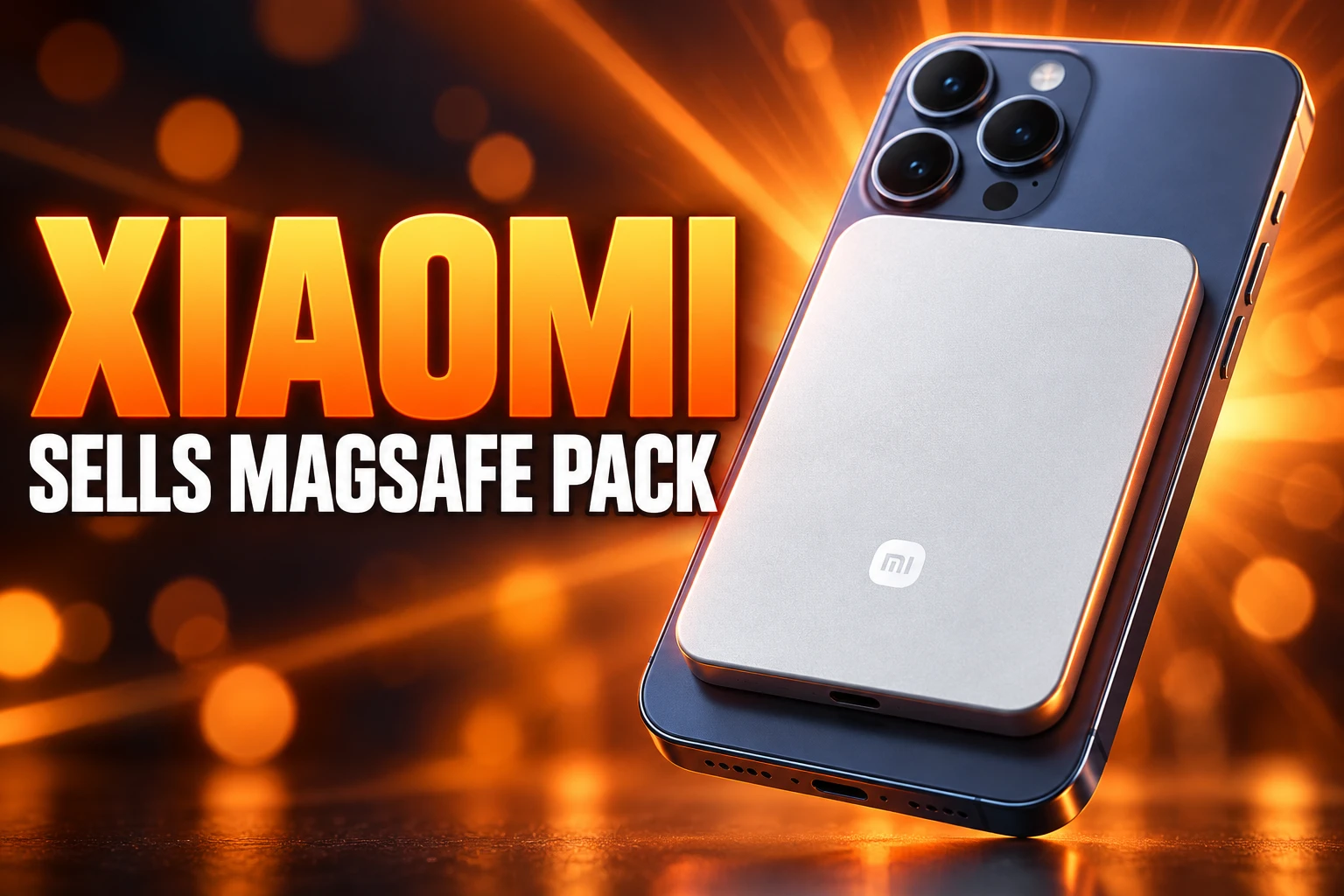
6 mm Thick, 98 Grams on the Scale
Model MDY-20-EB is a lithium-ion pack in an aluminum shell with a fiberglass face that touches the phone. Typical cell energy is 18.95Wh at 3.79V, billed as 5,000mAh. Rated energy is 18.58Wh and 4,900mAh. Rated output capacity is 3,000mAh at 5V 2A, which is the number that matters once voltage conversion and wireless loss eat the headline cell.
The cell is silicon-carbon with 16% silicon, the same chemistry Xiaomi uses to keep flagship phones thin. A 4,369 mm² graphite sheet sits over it, with dual NTC sensors watching heat. Magnetic hold is listed at 13N. Wireless output is 15W peak on phones that will take it, 7.5W on iPhone. The USB-C port on the bottom can push 22.5W (5V 3A or 9V 2.5A). Run both at once and the sheet drops to 7.5W wired plus 5W wireless. A tap on the power button starts that dual mode. The box holds the pack, a manual, and a warranty card. There is no cable.
THE THIN PACK ON PAPER
- Mass: 98 grams, which Xiaomi compares with two medium eggs at 100 to 120 g.
- Body: 98.5 x 71.5 x 6 mm, with 6 mm as the figure that lets it sit in a pocket on the phone.
- Cabin energy: 18.58Wh, well under the 100Wh aviation cap Xiaomi cites.
- Hold: 13N magnetic force, with cases thicker than 2.5 mm warned as a weak link.
Colors already sold abroad are Graphite Black, Glacier Silver, and Radiant Orange. India’s landing page has shown orange and silver. Operating frequency is 120 to 147 kHz, magnetic induction. Xiaomi 17 series can take the full 15W wireless. Xiaomi 17 itself has no magnets, so a magnetic case is required if you want the pack to stick. iPhone 12 and later already have the ring.
What the UltraThin Magnetic Power Bank Costs Overseas
India pricing is still blank. That is the question sitting under every launch post. One reply to Xiaomi India asked the company to keep it budget friendly. Overseas, the same MDY-20-EB already has tickets.
Xiaomi Japan listed it at 7,980 yen when it went on sale. Listings tracked in Australia and Singapore sat at AUD 69.50 and SGD 69.90. Those tickets put the pack in the same band as mid-range magnetic banks in India, not in Apple’s old $99 slot.
WHAT WE KNOW
- India date: Both packs launch on September 8, 2026, and Xiaomi says they will be made locally.
- Thin pack spec: 5,000mAh typical, 3,000mAh rated, 15W wireless, 7.5W to iPhone, 22.5W USB-C, 98 g, 6 mm.
- Overseas tickets: 7,980 yen in Japan at launch, AUD 69.50 in Australia, SGD 69.90 in Singapore.
WHAT IS UNCONFIRMED
- India price: No rupee figure, EMI plan, or first-sale window has been posted.
- India colors: Orange and silver are on the landing page; Graphite Black is not confirmed for this market.
- 10,000mAh sheet: Capacity, 45W wired, a built-in cable, and a lanyard are public. Wireless wattage for India is not locked in a spec table.
If Xiaomi India lands near the overseas tickets, the thin pack undercuts Apple’s vanished $99 MagSafe battery on weight and on cell size. If it lands with a brand tax, local 5,000mAh snap packs already on Flipkart will look cheaper even if they are thicker.
The 10,000mAh Sibling Brings Its Own Cable
Xiaomi is not asking every buyer to live on 3,000mAh rated output. The second pack is the Xiaomi Magnetic Power Bank 10000 with 45W wired charging, magnetic wireless charging, a built-in cable, and a lanyard. Launch art suggests Qi2 25W wireless, which would outrun the thin pack’s 15W ceiling, but that wattage is read from the image, not from a published India spec table.
Do not mix this sibling with Xiaomi’s China-only Jinshajiang 10,000mAh ultra-thin, which is a different 13.2 mm body. The India 45W model is the one with the cable. It is the pack you take when the 6 mm card is a top-up, not a full refill. Both are billed as Qi2-certified and aviation-safe. Both are due on the same day.
The split is the product. One pack disappears in a pocket on an iPhone. The other carries 10,000mAh and a cable so you are not hunting a lead in a bag. Xiaomi is pricing neither yet.
Why iPhone Wireless Tops Out at 7.5 Watts
Fifteen watts is the number on the box. Seven and a half is the number on an iPhone. Xiaomi writes that split into the footnotes, next to a line that the images are for compatibility only and that the pack is not affiliated with Apple.
iPhone series devices support a maximum of 7.5W magnetic wireless charging.
Xiaomi product notes, UltraThin Magnetic Power Bank 5000 15W
Qi2’s Magnetic Power Profile was built so a certified charger could match MagSafe’s 15W snap charge without Apple’s MFi program. iPhones that handshake as Qi2 can take 15W from a certified pad. Xiaomi’s own sheet still prints 7.5W for iPhone on this pack. Wired USB-C at 22.5W is the way around that cap, which is why the missing cable in the box is a real cut. You bring your own 3A USB-C lead if you want the fast path.
On a Xiaomi 17, the company says wired use of the pack adds about 9 hours of music, taking a 15.39-hour baseline to about 24.47 hours. That test is lab work, on Xiaomi’s phone, on a cable. It is not an iPhone 17 Pro Max wireless figure. Wireless charging wastes energy as heat, so the 3,000mAh rated number is the honest one for a full empty refill, and even that assumes a cable.
Cabin-Ready Cells, Made in India
Xiaomi’s product notes say the 18.58Wh cell sits under the 100Wh line used in international aviation rules, so the pack can travel in the cabin. Power banks count as spare batteries. They stay in carry-on, not in checked bags, which is the same cabin-only spare battery rules airlines already post for lithium packs. Xiaomi also says the India units will be made locally.
The thin pack is sold as flight-safe and as a ten-layer protection stack. Those layers are named, not waved at.
THE TEN CUT-OUTS ON THE BOARD
- Static: Electrostatic protection on the input path.
- Input voltage: Over-voltage cut on the USB-C inlet.
- Output voltage: Over-voltage cut on the way out.
- Heat: Over-temperature shutoff tied to the dual NTC sensors.
- Current: Output over-current trip.
- Undervoltage: Low-voltage cut so the cell is not drained dead.
- Shorts: Short-circuit protection.
- Discharge: Over-discharge block.
- Charge: Over-charge block.
- Foreign objects: Coil detection so a key or coin does not sit in the field.
The notes cite China’s CCC rules (GB 31241-2022 and GB 4943.1-2022) for the global design and say each market follows local marks. India buyers will want the BIS mark on the unit they are handed on September 8, which Xiaomi has not put in the teaser copy.
150 Grams Versus 98 Grams in the Same Aisle
Indian shops already sell magnetic 5,000mAh packs. A Belkin 5,000mAh MagSafe bank is listed at ₹2,999 against an MRP of ₹8,999. That Belkin unit is 150 g and 16.5 mm thick. Xiaomi’s pack is 52 g lighter and less than half as thick. Apple’s old pack was about 113 g and 23.6 mm thick, with a smaller cell.
5,000MAH MAGNETIC PACKS COMPARED
| Pack | Weight | Thickness | Wireless to iPhone | Cell (typical) |
|---|---|---|---|---|
| Xiaomi UltraThin 5000 15W | 98 g | 6 mm | 7.5W | 5,000mAh |
| Apple MagSafe Battery Pack (pulled 2023) | 113 g | 23.6 mm | 7.5W | about 2,920mAh equiv. |
| Belkin 5,000mAh MagSafe (India listing) | 150 g | 16.5 mm | MagSafe | 5,000mAh |
The table is why Xiaomi can tease an iPhone 17 Pro Max and still look serious. The hole Apple left is a pocket-thin snap pack, and the Western names that filled it in India are heavier. Xiaomi still has to print a rupee figure on September 8, and iPhone owners still have to live with 7.5W unless they plug in a cable the thin box does not include.
Until that price lands, the product is a 98 g, 6 mm MagSafe stand-in made in India for phones Xiaomi also competes with. The spec sheet already told iPhone owners how fast it will charge.

Police Tighten the Ring Around Gyanesh Kumar’s House

Ravi Shankar Calls Hanuman Ansh a Slap to Big Spenders

Microsoft Puts Nvidia in the Surface Laptop Ultra Flagship

Adult Fires on an Armed Juvenile at Longmont Dollar Tree

Jordan Absorbs Iranian Missiles Aimed at Parked US Jets

The iPhone 18 Pro Max Splits Apple’s Fall in Two

OpenAI Calls GPT-6 Astra AGI Then Locks Its Exploits

Russia Closes the Goethe-Institut Berlin Tried to Save

Trump Claims Hormuz Control as Oil Holds Near $96

Volkswagen’s Job Cuts Leave Four Plants Without Cars

 NEWS1 month ago
The iPhone 18 Pro Max Splits Apple’s Fall in Two
- NEWS1 month ago
OpenAI Calls GPT-6 Astra AGI Then Locks Its Exploits
- LIFESTYLE1 month ago
Russia Closes the Goethe-Institut Berlin Tried to Save
- BUSINESS1 month ago
Trump Claims Hormuz Control as Oil Holds Near $96
- AUTO1 month ago
Volkswagen’s Job Cuts Leave Four Plants Without Cars
- BUSINESS1 month ago
Cable Stocks Fall as UltraTech Copies the Paints Playbook
- NEWS1 month ago
Dyson Puts Nurovi Robots on Sale Without the UV Flagship
- BUSINESS1 month ago
Japan’s 3 Percent Yield Reprices Government Debt Worldwide