
ENTERTAINMENT
Cannes AI Film Festival Splits Cinema as 5,500 Films Flood WAIFF

Cannes hosted two film festivals in April 2026, and they refused to acknowledge each other. The official Festival de Cannes barred generative AI from Palme d’Or contention on April 9. Two weeks later, on April 21 and 22, the second World AI Film Festival (WAIFF) packed the Palais des Festivals with roughly 5,500 entries from more than 80 countries, screening photoreal pigs on golf carts, a heroine with a heart beating outside her body, and an AI-rendered short featuring characters that looked unmistakably like Wallace and Gromit. The jury quietly pulled that one for copying.
The split between the two events is no longer aesthetic. It is contractual, financial, and about who owns the data that trains the machines.
Two Festivals, Two Verdicts on the Future
The 79th Festival de Cannes ruled generative AI ineligible for its main competition in a press notice dated April 9, 2026. Scripts written by AI, principal performances synthesized by AI, and full visual generation are out. Sound restoration, image cleanup and conventional VFX remain allowed.
Festival President Iris Knobloch framed the decision as a defense of authorship. “A film is not an assembly of data; it is a personal vision,” she said, adding that the festival “refuses to let AI dictate its law to cinema.”
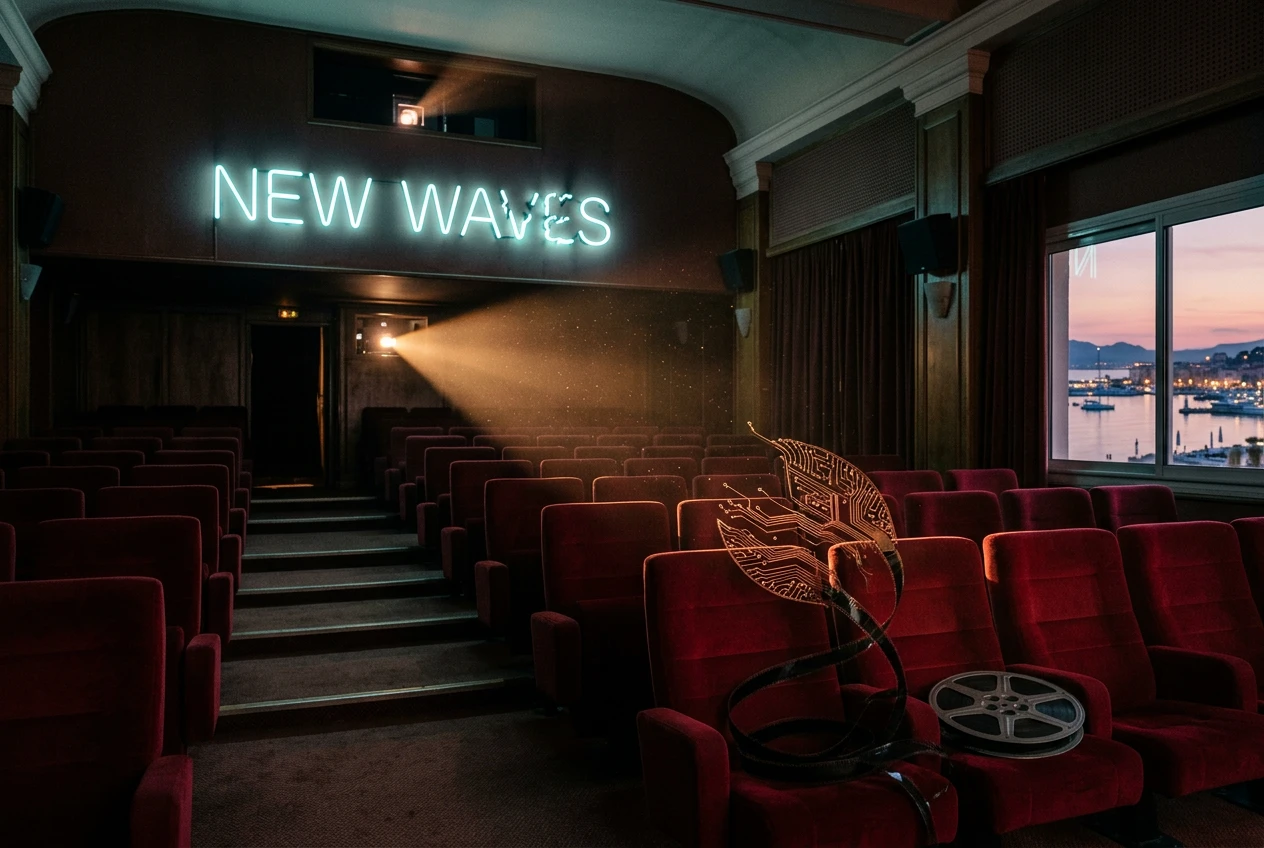
WAIFF, founded by former Apple Europe chief Marco Landi, took the opposite view. Its 2026 selection grew from 1,000 submissions in 2025 to 5,500. Its jury president was Chinese screen icon Gong Li. Its honorary president was Claude Lelouch, the 88-year-old Oscar winner behind Un Homme et une Femme. The slogan was “New waves of creation.”
The Math That Has Hollywood Listening
The reason the second festival exists, and the reason studios are paying attention, is cost. AI is collapsing the price of a film frame.
From €20,000 to €500
Swiss-Italian filmmaker Dario Cirrincione, 22, told the festival his AI-rendered sequence on dementia ran a budget of €500. The same effect through conventional CGI would have cost roughly €20,000. The arithmetic is brutal. So is the implication for thousands of mid-tier VFX jobs.
Director Mathieu Kassovitz, who shot the 1995 classic La Haine and is opening his own AI studio in Paris, pegged the savings even higher at the feature scale. A project that once needed $50 million to $60 million now sits closer to $25 million, he said in Cannes.
David Ellison’s “More Shots on Goal”
The savings are exactly what new Paramount Skydance owner David Ellison wants. Ellison’s August 2025 letter to staff committed Paramount to AI-assisted production and localization as a competitive lever. The studio currently has 15 films dated for theatrical release in 2026, up from eight in 2025.
Joanna Popper, a Los Angeles film and tech executive who served on the WAIFF jury, said studios are starting to ask whether four $50 million AI or hybrid films give them better odds than one $200 million tentpole. “More shots on goal” was the phrase she used in Cannes.
- 5,500 films submitted to WAIFF 2026, up from 1,000 the year before.
- 80+ countries represented in the entry pool.
- €500 cost of an AI dementia sequence that would have run €20,000 in CGI.
- $25M the new Kassovitz estimate for a film that once cost $50M to $60M.
When the AI Showcase Disqualified Its Own Finalist
The festival’s most uncomfortable moment was self-inflicted. A short film that reached the WAIFF shortlist contained two lead characters that bore a striking resemblance to Wallace and Gromit, the stop-motion duo created by Nick Park at Aardman Animations in 1989.
Kassovitz watched it and offered a one-line review unprintable in full. The festival jury announced it had spotted “a strong resemblance to an existing work” and pulled the film from screening and award contention. WAIFF added that it is “extremely committed to respecting copyright.”
The episode was a live demonstration of what generative-model critics have argued for two years. The training data that makes AI cinema possible was scraped from copyrighted human work, and the seams show. An AI film festival had to enforce the rules of conventional copyright on its own finalists, on the same week the official Cannes ruled AI scripts ineligible for the same reason.
Lelouch at 88, Reaching for a Camera Made of Code
The most poignant figure on the Croisette was Lelouch. After working with 8mm, 9mm, 16mm, 35mm, Super 35 and 70mm formats over six decades, he announced he was using AI for his 52nd feature. He framed it bluntly. “My last films didn’t do very well. Since I’m struggling to find money, I’m turning to AI,” he said.
“AI is a camera that gives you images even before you’ve filmed anything. I’ve got my childhood back.”
Claude Lelouch, honorary president, WAIFF 2026
Agnès Jaoui, the French actor and writer who chaired the WAIFF competition jury, was less sentimental. “Ever since I accepted, everyone has been yelling at me. Are you validating AI?” she said. She told reporters she felt “terrorised” by what AI represents, but accepted the post anyway.
Gong Li kept her opening-night remarks to three sentences. “AI can be controversial. But it can also open new ways to imagine stories. Let’s explore this together.”
Val Kilmer Returns, One Year After His Death
The week’s most discussed AI moment was not in competition. It was the trailer for As Deep as the Grave, a Western in which the late Val Kilmer plays a Catholic priest named Father Fintan. Kilmer was cast five years before his death in April 2025 but was too sick from throat cancer to ever appear on set. His character speaks and moves on screen for over an hour, generated.
The trailer launched at CinemaCon in Las Vegas on April 15 and is hosted on the official channel.
The producers say they followed SAG-AFTRA digital-replica guidelines and compensated Kilmer’s estate. “He always looked at emerging technologies with optimism as a tool to expand the possibilities of storytelling,” said Mercedes Kilmer, the actor’s daughter. The film is being weighed for a posthumous awards campaign.
The Films Themselves Were Strange
WAIFF 2026 was not a polished showcase. Several screenings drew open laughter at images that were never meant to be funny. A man got sucked into a launderette coin slot. A woman sliced and ate a raw liver. Photoreal bears reclined on sunbeds. Pigs drove golf carts.
One filmmaker, watching the credits roll, suggested a single new festival rule. “That should be a rule. No pigs on golf carts.”
The winner of best film was Costa Verde, a 12-minute short about childhood from French writer-director Léo Cannone, produced by the UK’s New Forest Films. The Emotion award went to Beginning by Jordanian director Ibraheem Diab. Artistic director Julien Raout said the bar had jumped in 12 months. Last year’s best entries, he said, would not have made the official selection of 54 films this year.
Marco Landi’s Warning to the Old Guard
The clearest articulation of the standoff came from Landi himself. The former Apple Europe boss has spent the past two years arguing that the established film industry is misreading the speed of the change.
“They can do what they want,” Landi said of the official Cannes festival. “But I would alert them. There’s a wave mounting and it is becoming big. You have two solutions. Stay there and the wave will destroy you, or you start to ask what can I do with this wave.”
The same investors are showing up on both sides. James Cameron, who joined the board of Stability AI in 2024, has argued blockbuster cinema cannot survive without cutting visual-effects costs roughly in half. His next film, Avatar: Fire and Ash, is expected to ship in December 2026 with an explicit on-screen card stating no generative AI was used. The contradiction is the point.
An AI film festival had to enforce the rules of conventional copyright on its own finalists, on the same week the official Cannes ruled AI scripts ineligible for the same reason.
Some festivalgoers noted that the strongest moment of the two days was not an AI film at all. It was an 80-piece human orchestra playing Ravel’s Boléro over a montage of human dancers at the opening ceremony. The reaction in the room was unmistakable. Human art, for now, is not done.
For broader context on how streaming platforms are folding AI into recommendation and production stacks, see our recent reporting on Netflix’s TikTok-style feed and AI push, and on the underlying model arms race in our coverage of the Claude Opus 4.7 leak.
Frequently Asked Questions
What Is the World AI Film Festival in Cannes?
WAIFF is an annual showcase founded in 2025 by former Apple Europe president Marco Landi. The second edition ran on April 21 and 22, 2026, at the Palais des Festivals in Cannes, with 5,500 submissions from over 80 countries, a jury chaired by Agnès Jaoui, and Gong Li as festival president.
Did the Official Cannes Festival Ban AI in 2026?
Yes. On April 9, 2026, the 79th Festival de Cannes ruled generative AI ineligible for its main competition. Scripts, principal performance synthesis, and full visual generation by AI cannot compete for the Palme d’Or. Standard VFX, sound restoration and image cleanup remain allowed.
Why Was a Wallace and Gromit Lookalike Disqualified?
WAIFF organizers said the shortlisted short showed “a strong resemblance to an existing work,” referring to Aardman Animations’ Wallace and Gromit characters. The film was withdrawn from screening and award contention. Director Mathieu Kassovitz publicly criticized the entry as a clear copy.
How Much Does an AI Film Cost Compared to a Conventional Film?
Filmmakers at WAIFF 2026 cited dramatic savings. A short AI dementia sequence cost €500 against an estimated €20,000 in conventional CGI. At feature scale, Kassovitz said projects that once needed $50 million to $60 million can now be made for around $25 million.
Is Val Kilmer’s AI Film Connected to WAIFF?
No. The trailer for As Deep as the Grave, in which Kilmer’s performance as Father Fintan was AI-generated after his death in April 2025, debuted at CinemaCon in Las Vegas on April 15, 2026. It screened in the same news cycle as WAIFF but is a separate Hollywood production.

-
 TECH1 year ago
Where Garmin Watches are Made and How They are Assembled
-

 AUTO3 months ago
Tesla’s Roadster Is ‘a Few Weeks Away,’ Says Its Chief Designer
-
 NEWS10 years ago
Samsung Releases Galaxy Note7 TV Ad as Reddit AMA Leaks Specs
-
 NEWS10 years ago
Android 7.0 Nougat Rolls Out To Nexus Devices With New Emoji, Features
-
 FINANCE9 years ago
Cardano Price Surges as ADA Enters the Crypto Top Ten List
-
 NEWS10 years ago
Pre-Order the First Camera Made for Facebook Live Streaming Video
-
 FINANCE1 year ago
Binance Suspends Trading and Withdrawals for a System Upgrade
-
 FINANCE9 years ago
RChain Price Jumps Nearly 150% to a New All-Time High of $2.03