
NEWS
Webb Detects Buried Methane on 3I/ATLAS, Pointing to Alien Chemistry
Webb’s first chemical fingerprint of 3I/ATLAS detected buried methane in ratios far above any solar system comet, pointing to a colder alien planetary disk as the origin.

NASA’s James Webb Space Telescope made the first direct detection of methane on an interstellar object in December 2025, capturing the chemical fingerprint of comet 3I/ATLAS as it departed our solar system for good. The paper, led by Caltech graduate student Matthew Belyakov and co-first author Ian Wong of the Space Telescope Science Institute (STScI), was published April 8, 2026 in The Astrophysical Journal Letters.
The methane arrived with numbers no solar system comet produces: its ratio to water far exceeds what our Oort Cloud bodies generate, and it came paired with a carbon dioxide surplus already flagged as extreme since August 2025. Both sets of ratios trace the comet’s origin to a colder, more distant region of another star’s planetary disk, in a system that may no longer exist.
The Instrument and the Observations
3I/ATLAS, discovered July 1, 2025, by the NASA-funded ATLAS (Asteroid Terrestrial-impact Last Alert System) survey telescope in Rio Hurtado, Chile, reached perihelion on October 29, 2025, at roughly 1.36 astronomical units from the Sun. Its closest approach carried it inside Mars’s orbit but no closer than about 270 million kilometers to Earth. By December the comet was heading back out.
Webb caught it on two separate observing dates as part of a coordinated NASA campaign that also deployed Hubble and SPHEREx alongside ground-based networks. The first MIRI (Mid-Infrared Instrument) session ran December 15 and 16, when the comet was about 329 million kilometers from the Sun, roughly 2.2 astronomical units. A second session followed December 27, when it had moved to approximately 379 million kilometers. MIRI operates at wavelengths about ten times longer than visible light, a regime that excites the vibrational signatures of volatile molecules sublimating off a comet’s surface.
Belyakov’s team used MIRI’s Medium Resolution Spectrometer (MRS), an integral field unit that provides a full spectrum at every point in a small patch of sky simultaneously. That design lets researchers identify which gases are present and map their spatial distribution around the nucleus in a single exposure, yielding the first chemical fingerprint ever obtained at mid-infrared wavelengths from an object that formed around another star.
‘Oumuamua in 2017 was too faint and too fast-receding for detailed chemical characterization by the instruments then available. Borisov in 2019, while cometary, lacked the brightness and favorable timing for mid-infrared follow-up at the sensitivity MIRI provides. Discovered four months before perihelion and notably bright, the 2025 visitor gave astronomers time to schedule observations and a chemically active nucleus to work with.
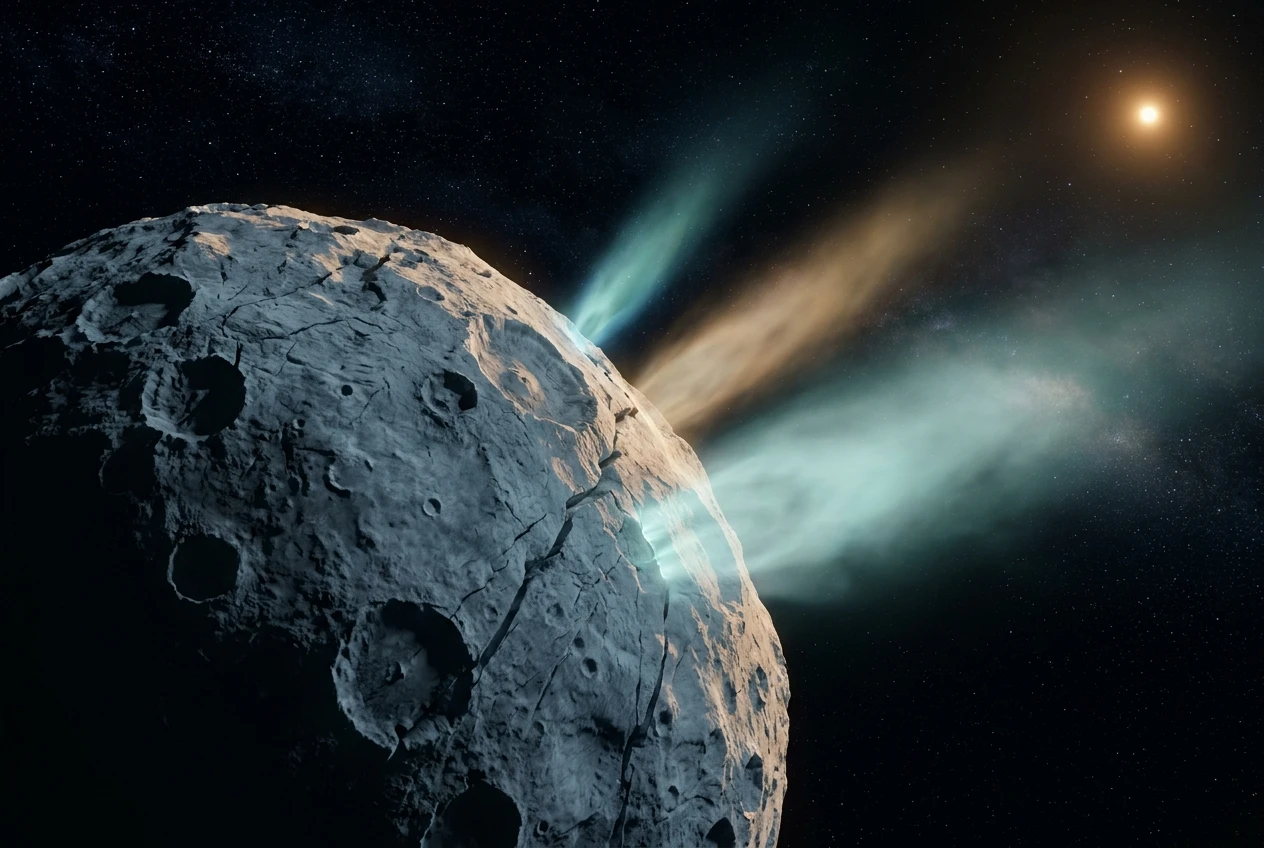
The December sessions confirmed methane, carbon dioxide, and water vapor in the comet’s coma, the cloud of gas and dust surrounding the solid nucleus. Each appeared in proportions with no solar system analog.
Methane That Waited for the Sun
Methane is among the most volatile compounds a comet can carry. It sublimates from ice at temperatures far lower than carbon dioxide, which is itself more volatile than water. If a comet contains methane, standard reasoning places it at the front of any outgassing sequence, active even when the comet is still far from the Sun and cold.
The 2025 visitor inverted that sequence. NIRSpec, the telescope’s Near-Infrared Spectrograph, observed the comet in August 2025 from roughly 3.3 astronomical units out and found no methane signal. Carbon dioxide dominated gas production throughout the inbound leg. Carbon monoxide appeared in observations before methane did. The surface looked entirely CO2-rich, with methane absent even as the comet warmed on its approach.
Belyakov’s team concluded from the December data that the methane was buried beneath a thick, processed outer shell. The comet’s surface had been irradiated by cosmic rays through what may be billions of years of transit between star systems. That bombardment breaks down volatile surface ices over extremely long timescales, stripping away whatever methane originally sat near the surface long before any telescope was pointed at the comet. Perihelion’s heat penetrated deeper and reached intact methane-rich interior ice. What emerged in December was the comet’s preserved interior.
Water’s behavior across the two December sessions adds evidence to that model. Water production fell more steeply between the December 15 and December 27 observations than methane or carbon dioxide did. That differential points to much of the water vapor coming from icy grains suspended in the surrounding coma rather than from the nucleus directly. As the comet cooled and moved farther from the Sun, those grains stopped sublimating faster than the still-warm nucleus kept releasing deeper volatiles, and water’s production decline was the steepest of the three.
Ratios Without a Solar System Precedent
The Carbon Dioxide Anomaly
The methane finding built on a chemical picture that had already been extreme. In August 2025, pre-perihelion NIRSpec observations found that carbon dioxide (CO2) carried roughly 87 percent of the total gas mass escaping from the comet, with water contributing about 4 percent and carbon monoxide about 9 percent. The CO2-to-water ratio came in at approximately 8:1, the highest ever recorded in any comet and six standard deviations above the typical value for long-period and Jupiter-family comets.
Japan’s Subaru Telescope followed up in January 2026, about two months after perihelion, and found a lower CO2-to-water ratio than the August figures. Researchers read that drop as confirmation that the nucleus’s exterior and interior have different compositions. As the comet heated during its closest approach, gas escaped from progressively deeper layers, each carrying its own chemistry. The August ratio captured the outer shell; post-perihelion data, as heat penetrated further inside, reflected a different layer entirely.
The Methane Dimension
December’s MIRI data added the methane to that picture. Its ratio to water is far above anything measured in solar system comets to date, including those that formed in the most distant reaches of our Oort Cloud. The comparison below shows where all three known interstellar visitors sit relative to the solar system baseline.
| Object | CO2 vs. Water | Methane Detected | Formation Inference |
|---|---|---|---|
| This comet (2025 interstellar visitor) | ~8:1, highest ever recorded (6 SD above typical) | Yes, post-perihelion only | Cold outer protoplanetary disk |
| Typical solar system comet | Well below 1:1; water-dominated | Trace or absent | Oort Cloud or scattered disk |
| 2I/Borisov (2019) | Elevated CO vs. water | Not reported | Carbon-rich originating system |
| 1I/’Oumuamua (2017) | N/A; no coma detected | No activity observed | Unknown; no volatile data available |
The European Space Agency (ESA) summarized what both the methane and carbon dioxide findings amount to:
Both these findings point to a very different formation environment and chemistry than the vast majority of comets that formed within our Solar System.
That statement accompanied the MIRI coma maps released by ESA alongside the paper, which showed where each gas was distributed spatially around the nucleus at the time of each observing session.
Mapping the Coma
The instrument’s spatial resolution let Belyakov’s team go beyond a chemical inventory. The December data included full coma maps showing where water, carbon dioxide, and methane were each distributed around the nucleus when the spectrometer was pointed at the comet.
Water vapor spread far from the nucleus across the surrounding cloud. Much of it wasn’t sublimating from the solid nucleus directly; it was being released from icy grains suspended in the coma at large distances from the core. Carbon dioxide and methane told a different story. Both were concentrated near the nucleus, consistent with direct outgassing from the comet’s interior rather than from grains distributed through the outer coma.
That spatial arrangement fits the burial model: grains in the outer coma supply water vapor across a wide region and stop quickly as the comet cools, while the nucleus, retaining heat from perihelion, continues releasing the deeper volatiles. Methane’s tight concentration near the core is a physical signature of the buried-interior origin, visible in the geometry of the gas cloud itself.
Chemistry from Another Star’s Disk
Comparing the Three Known Interstellar Objects
The 2025 interstellar visitor is the third confirmed object to pass through our solar system from outside it. All three show how varied these bodies can be:
- 1I/’Oumuamua (2017): no gas or dust coma detected; composition remains unknown. Its unusual elongated shape and anomalous non-gravitational acceleration generated years of debate about nitrogen ice, hydrogen ice, or something else entirely. No volatile chemistry was ever measured.
- 2I/Borisov (2019): showed conventional cometary activity but with elevated carbon monoxide relative to water compared to solar system baselines, pointing to a carbon-rich origin. Standard cometary molecules were present, but the CO enrichment flagged it as chemically unusual for a solar system object.
- 3I/ATLAS (2025): the largest and brightest of the three. Hubble imaging in late 2025 and early 2026 measured the nucleus at roughly 2.6 kilometers in effective diameter, making the comet approximately 40 times more massive than Borisov and orders of magnitude larger than ‘Oumuamua. Its carbon dioxide and methane enrichment relative to water is the most chemically extreme profile recorded in any comet.
Martin Cordiner of NASA’s Goddard Space Flight Center, whose team produced the August 2025 NIRSpec data on the interstellar visitor, summarized the shared pattern across both interstellar comets: “2I/Borisov and 3I/ATLAS both show a relatively carbon-rich composition compared to solar system comets. At the very least, this implies the abundant presence of carbon in the originating planetary system.”
What the Ratios Say About Formation
The December methane data and the August CO2 data both point toward the same type of formation environment. The carbon dioxide and methane enrichment relative to water is consistent with formation in a cold outer protoplanetary disk, far from the host star, where temperatures allow volatile ices to accumulate that would sublimate if they had formed much closer in. Our own Oort Cloud bodies formed at distances considerably smaller than the conditions this comet’s chemistry implies.
A kinematic age study placed the comet’s travel time, derived from its velocity relative to nearby stars, at somewhere between 3 and 11 billion years. At the upper range, the comet predates our solar system, and the host star may have long since exhausted its fuel.
A parallel analysis of the same JWST data measured the deuterium-to-hydrogen (D/H) ratio in the comet’s methane, finding it roughly 14 times higher than the same ratio in comet 67P/Churyumov-Gerasimenko, a solar system body well characterized by the European Space Agency’s Rosetta mission. A higher D/H ratio in methane points to formation in a colder environment with more vigorous molecular processing. The isotopic data were interpreted as evidence for an origin “in an ancient stellar system in a low metallicity environment with the presence of intense star formation and a high cosmic-ray ionization rate.” That description doesn’t identify a specific star. It describes a class of galactic environment and an era unlike the one our Sun occupies.
At publication, the team noted that a final Webb observation had been scheduled for spring 2026. “It’s already getting tough to observe,” the paper’s lead author said at the time. By April, the comet had cleared Jupiter’s orbit.
Those December sessions are the most complete chemical record ever assembled of material from another stellar system. The comet won’t provide another.

-
 TECH1 year ago
Where Garmin Watches are Made and How They are Assembled
-

 AUTO3 months ago
Tesla’s Roadster Is ‘a Few Weeks Away,’ Says Its Chief Designer
-
 NEWS10 years ago
Samsung Releases Galaxy Note7 TV Ad as Reddit AMA Leaks Specs
-
 NEWS10 years ago
Android 7.0 Nougat Rolls Out To Nexus Devices With New Emoji, Features
-
 FINANCE9 years ago
Cardano Price Surges as ADA Enters the Crypto Top Ten List
-
 NEWS10 years ago
Pre-Order the First Camera Made for Facebook Live Streaming Video
-
 FINANCE1 year ago
Binance Suspends Trading and Withdrawals for a System Upgrade
-
 FINANCE9 years ago
RChain Price Jumps Nearly 150% to a New All-Time High of $2.03