
NEWS
The Kid Landline Boom Runs on the Tech It Claims to Reject
Tin Can, Ooma’s MyPhone and Pinwheel Home sell screen-free calling for kids, but venture funding, apps and monthly fees power the whole trend.

Tin Can, the viral Wi-Fi landline built for kids, has pulled in $15.5 million from venture capitalists betting parents will keep paying to keep their children offline. Two direct rivals just joined it. Ooma launched a competing kids landline in May, and Pinwheel started shipping its own version this month, turning a novelty into a real product category with three funded companies fighting over it.
Parents buy these phones to keep their kids off apps, screens and subscriptions. The companies making them run on apps, screens and subscriptions of their own, just one layer removed, sitting in a parent’s pocket instead of a kid’s hand.
Three Rivals Turn a Dead Technology Into a Trend
A year ago, a kid-sized landline was a Seattle startup’s side project. Now it is a shelf category. Tin Can, Ooma’s MyPhone and Pinwheel Home all sell a version of the same idea: a corded-style phone that only makes voice calls, with no texting, no apps and no browser, managed by a parent through a companion app on their own smartphone.
The three devices are not identical, and the differences say a lot about who is selling them and why.
| Device | Hardware Price | Monthly Plan | Target Age | Who Backs It |
|---|---|---|---|---|
| Tin Can | $100 | $9.99 for outside calls; Tin Can to Tin Can is free | 4 to 13 | Venture-backed Seattle startup |
| Ooma MyPhone | $79.99 | $7.99 flat | No published age cutoff | Ooma, Inc., NYSE: OOMA |
| Pinwheel Home | $68 to $79 | $6.99 for five contacts; $9.99 unlimited | 5 to 10 | Austin kid tech company, also sells phones and watches |
Ooma’s version is the one worth watching for scale. It ships nationwide through Walmart.com, with in-store rollout following, giving a publicly traded telecom company retail shelf space that a startup could never buy on its own.
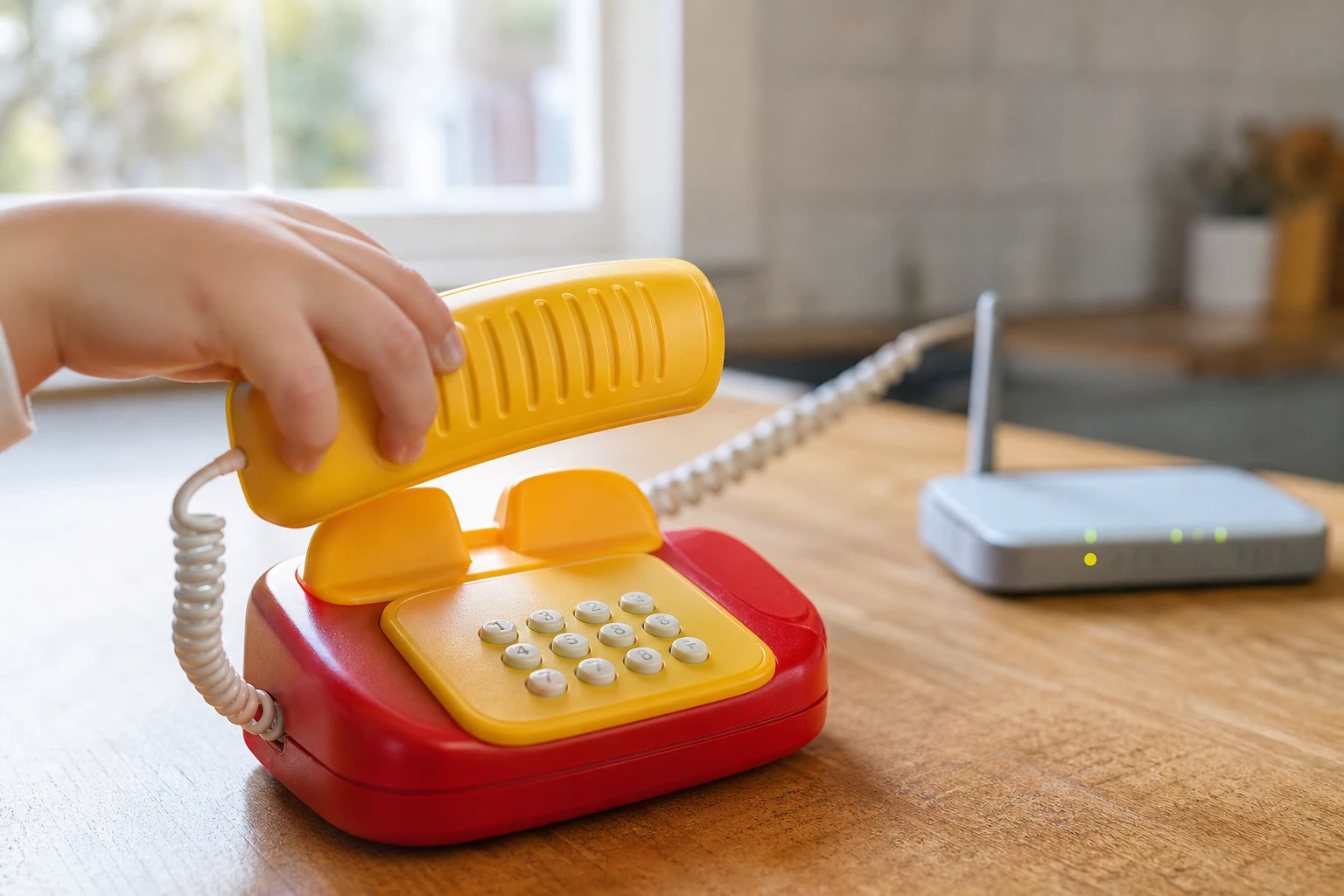
It Runs on Wi-Fi, Not Copper Wire
None of these devices are landlines in the technical sense. A real landline drew its own power off the phone line and often kept working straight through a blackout. Tin Can, MyPhone and Pinwheel Home all need home Wi-Fi and an electrical outlet to do anything at all.
Ooma’s own press materials make the contradiction explicit. The company describes MyPhone as built on a cloud-based home phone platform used by households across North America, the same underlying tech Ooma sells businesses to retire aging copper lines entirely. The nostalgia is real. The wiring is not.
That distinction matters because the National Center for Health Statistics, which tracks the data for the Centers for Disease Control and Prevention, found that more than 90% of American adults had a home landline in 2004, a figure that had fallen to about 20% by 2024. The category these three companies are reviving had already been declared dead by the agency that measures it. They just gave it a new power source.
Silicon Valley Bets on Analog Nostalgia
Tin Can’s investor list reads like any other consumer tech deal: PSL Ventures, Newfund Capital, Mother Ventures, Solid Foundations and later Greylock, according to Newfund Capital’s own portfolio page. The firm’s write-up describes a company managing parent-approved contacts and screen exposure through a mobile app, the exact software layer the product is marketed as replacing.
Greg Gottesman, managing director at PSL Ventures, put it plainly to a technology reporter last September.
I think you can legitimately say Tin Can is one of the fastest growing and most viral businesses I have seen in more than 25 years of venture investing.
That virality shows up in the price. Tin Can sold for $75 when it first raised money in September 2025. By this year it had climbed to $100, with the monthly plan holding near $9.99. Demand, not cost, set the new number.
- 2022: Chet Kittleson, Graeme Davies and Max Blumen found Tin Can in Seattle after their previous venture, a real estate startup called Far Homes, shuts down.
- September 2025: Tin Can closes a $3.5 million seed round from PSL Ventures, Newfund Capital, Mother Ventures and Solid Foundations.
- January 2026: Pinwheel unveils Pinwheel Home at CES, its third product line after kid smartphones and a smartwatch.
- May 2026: Ooma launches MyPhone nationwide through Walmart, built on its existing cloud communications platform.
- July 2026: Pinwheel Home begins shipping, putting three funded or publicly traded companies in the same market at once.
Tin Can founder and chief executive Chet Kittleson has told Forbes Vetted the company has sold hundreds of thousands of phones across all 50 states and Canada since its official launch in April 2025, with preorders now open in Australia, New Zealand and the United Kingdom.
Pinwheel Turns Its Landline Into a Funnel
Pinwheel already sold kid smartphones and, since last year, a smartwatch before it launched Pinwheel Home this month. That sequencing is deliberate. Every device runs through the same parent dashboard, and the company has said it plans to link phone numbers across the whole lineup as kids age up.
Dane Witbeck, Pinwheel’s chief executive and founder, framed the launch as filling a gap rather than starting something new: “Parents have been asking for a modern take on the ‘home phone’ landline experience we all grew up with.” He tied the timing to a specific number: 78% of Americans now live in cell-only households, he said, describing exactly the communication gap Pinwheel Home is built to fill.
- Ages 5 to 10: Kids start on Pinwheel’s screen-free home phone, voice calls only, no apps.
- Ages 6 and up: Families can add a Pinwheel smartwatch, managed through the same Caregiver Portal.
- Ages 8 to 14: Kids can move to a Pinwheel smartphone that still blocks browsers and social apps.
- Whenever a family is ready: a paid Pinwheel Home number can transfer to a Pinwheel phone, the company says, keeping the household inside one billing relationship the whole time.
A screen-free phone that plugs into a bigger paid phone lineup is not really an exit from connected kid tech. It is the entry point.
Does a Kid Landline Cut Screen Time?
Not on its own. These phones remove one specific risk, unsupervised smartphone and social media access, for a few years in early childhood. They do not touch tablets, school laptops, gaming consoles or a sibling’s hand-me-down phone, and every company selling one is already building a path to a fuller connected device down the line.
Catherine Price, author of a book on breaking phone habits who also owns a Tin Can for her 11-year-old, told Forbes Vetted that a landline lets parents give kids independence “because nothing bad is going to happen on that landline telephone,” adding that the risk sits elsewhere, on apps like Snapchat and Instagram rather than the phone itself. That is a case for delay, not abstinence. Pew Research Center’s 2025 survey found 12% of teens have used chatbots for emotional support, a habit no landline addresses. Gabb Wireless has built an entire business on the middle ground between the two positions, selling a kids smartwatch with calling and texting but no browser or app store, priced around $149.99 with a monthly plan on top, proof that plenty of parents want connectivity now rather than a screen-free phone that only buys a few years of runway.
Early Adopters Cluster in Wealthy Tech Suburbs
Reagan Maher, a tech industry mom in Livermore, California, told Forbes Vetted she and her neighbors bought Tin Cans because they were tired of arranging playdates and managing their kids’ social lives by group text. Her family logged 102 calls in a single month. Her neighborhood is affluent and full of tech workers, exactly the demographic with the disposable income and cultural fluency to spot a startup’s product before it hits Walmart’s shelves.
That pattern is not an accident of geography. A hardware purchase plus a recurring monthly fee is a bigger ask for a family choosing between a $100 gadget and a free hand-me-down phone than it is for a household already comfortable with subscription software. SafeWise’s 2026 parent survey found child safety concerns ranking abduction above getting lost, underscoring how much of this market is really selling peace of mind to parents who can afford to buy it early.
- $15.5 million: total raised by Tin Can since 2022, according to startup data tracker Tracxn.
- 25%: year-over-year revenue growth Ooma reported for its fiscal first quarter, a period that closed before MyPhone even launched.
- $68 to $100: the hardware price spread across Tin Can, Ooma MyPhone and Pinwheel Home.
- Hundreds of thousands: Tin Can units sold across all 50 states and Canada since April 2025, per Kittleson.
Preorders for Tin Can are now open in Australia, New Zealand and the United Kingdom, its first markets outside North America.
Frequently Asked Questions
What age is a kid landline actually built for?
Tin Can markets itself to families with kids roughly 4 to 13, Pinwheel Home is built specifically for ages 5 to 10 as a bridge before its watches and phones, and Ooma has not published a strict age range for MyPhone, framing it more broadly as a tool for families delaying smartphones.
Do these phones still work if the power or Wi-Fi goes out?
No. Unlike a true copper landline, which often kept running through a blackout because it drew power from the phone line itself, Tin Can, MyPhone and Pinwheel Home all depend on home Wi-Fi and a wall outlet, so an outage takes the phone down with everything else in the house.
How much does a kid landline cost over a full year?
Including the monthly plan, a Tin Can runs about $220 in its first year, Ooma’s MyPhone comes to roughly $176, and a Pinwheel Home Classic on the unlimited plan adds up to about $199, figures that make Ooma the cheapest of the three once the subscription is factored in.
Do school smartphone bans apply to these devices?
No. These are home phones tied to a Wi-Fi router, not something a child carries to class, so they sit outside the wave of classroom smartphone bans that hit large districts, including New York City, for the 2025 to 2026 school year.
Can a child keep the same number if a family switches brands?
Only within one company’s own lineup in most cases. Pinwheel says a paid Home number can move directly to a Pinwheel phone or watch later, but none of the three companies have said their numbers or contact lists transfer to a rival’s device.

-
 TECH1 year ago
Where Garmin Watches are Made and How They are Assembled
-

 AUTO3 months ago
Tesla’s Roadster Is ‘a Few Weeks Away,’ Says Its Chief Designer
-
 NEWS10 years ago
Samsung Releases Galaxy Note7 TV Ad as Reddit AMA Leaks Specs
-
 NEWS10 years ago
Android 7.0 Nougat Rolls Out To Nexus Devices With New Emoji, Features
-
 FINANCE9 years ago
Cardano Price Surges as ADA Enters the Crypto Top Ten List
-
 NEWS10 years ago
Pre-Order the First Camera Made for Facebook Live Streaming Video
-
 FINANCE1 year ago
Binance Suspends Trading and Withdrawals for a System Upgrade
-
 FINANCE9 years ago
RChain Price Jumps Nearly 150% to a New All-Time High of $2.03