NEWS
Anthropic’s Claude Opus 4.7 Surfaces in Code Leak as AI Race Reaches New Heights

A faulty software update accidentally exposed over 500,000 lines of Anthropic’s internal source code on March 31, 2026, revealing references to an unannounced model called Claude Opus 4.7. The discovery set developers racing to analyze the data just days before Anthropic launched Claude directly inside Microsoft Word, rattling the legal technology market to its core.
From a rumored full-stack app builder to a revamped coding tool, Anthropic is moving fast on multiple fronts. Rivals like OpenAI and open-source contenders are matching that pace, while Google I/O looms just weeks away with major announcements of its own.
At a Glance:
- Claude Opus 4.7 references surfaced in over 500,000 lines of leaked Anthropic source code
- OpenAI’s new $100/month Pro plan gives subscribers 5x more Codex than the Plus tier
- Google I/O 2026 is confirmed for May 19-20, with Gemini 4 widely expected to debut
- MiniMax M2.7 scored 56.22% on SWE-Pro but restricts all commercial use by license
Claude Opus 4.7: The Leak That Shocked Developers
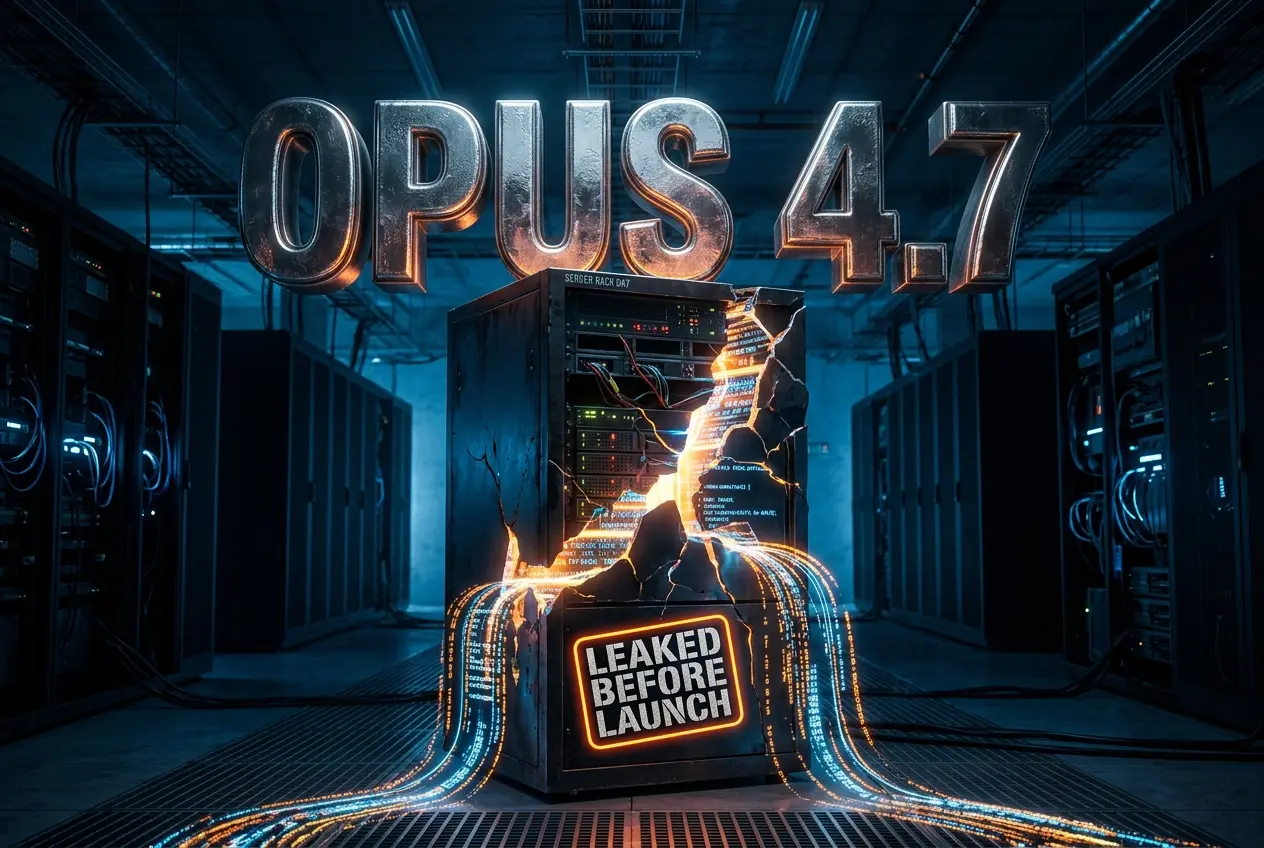
On March 31, 2026, a routine update to Claude Code’s npm package shipped with internal source files that should have been stripped before publication. Within minutes, developers on three continents had mirrored, forked, and begun analyzing the exposed data. Anthropic issued takedown requests quickly, but the code had already spread far beyond the company’s reach.
Inside the 500,000-line code dump, developers found references to “Opus 4.7” and “Sonnet 4.8” listed as “forbidden version strings” inside an internal testing mode called Undercover Mode. No model weights or live endpoints were attached, confirming these are planned rather than deployed models. Still, the references were enough to confirm that Anthropic’s development roadmap extends well beyond what is currently on the market.
The existence of Claude Opus 4.7 suggests Anthropic is already building past its current flagship, Claude Opus 4.6, which already supports a one-million-token context window and up to 128,000 output tokens. According to Anthropic’s official Claude 4.6 API documentation, Opus 4.6 delivers top results in reasoning, coding, and multilingual tasks. A successor would need to push those capabilities significantly further to earn a new version number.
500,000+ lines of Anthropic source code accidentally exposed in the March 2026 npm update
1 million token context window supported by the current Claude Opus 4.6
80.9% SWE-bench Verified score earned by Claude Opus 4.5 when it launched in November 2025
5.1 million views on X for leaked screenshots of Anthropic’s rumored full-stack app builder
Claude Steps Into Word and a New App Builder Takes Shape
Anthropic placed Claude directly inside Microsoft Word on April 10, 2026, releasing a native sidebar add-in for Mac and Windows through the Microsoft AppSource marketplace. Every AI-generated edit appears as a native tracked change, keeping the review process familiar for document professionals. Per Anthropic’s Claude for Word help page, the feature is available to Claude Team and Enterprise subscribers and completes the company’s integration across the full Microsoft Office suite.
Legal contract review tops the list of official example use cases. The tool can summarize commercial terms, flag off-market provisions, and identify clauses that deviate from a firm’s standard playbook positions. Those capabilities put Claude directly in competition with specialized legal AI software that firms have paid premium prices to use for years.
Markets felt the impact immediately. Thomson Reuters fell 16%, RELX dropped 14%, and Wolters Kluwer declined 13% in a single trading session on February 3, 2026, when Anthropic first moved into legal AI. The Claude for Word launch in April added fresh competitive pressure to the same providers.
“Meaningfully compress pricing and reduce demand for legal AI tools,” said Nick West, Chief Strategy Officer and AI Lead at law firm Mishcon de Reya, describing Anthropic’s legal AI expansion in comments reported by the Financial Times.
The legal tech disruption is not just a competitive footnote; it has already wiped significant market value from established providers and forced a rethink of how legal services are priced. West’s warning reflects how seriously seasoned legal technology executives are taking Claude’s arrival in their market. For legal professionals, the question is no longer whether AI will change their workflows but how fast.
Beyond Word, leaked screenshots that gathered 5.1 million views on X suggest Anthropic is building a full-stack app builder inside Claude, designed to compete directly with platforms like Lovable, Bolt, and v0. Anthropic has not officially confirmed the feature, but the screenshots show what appears to be a complete development environment inside the Claude interface. If real, it would put Anthropic in direct competition with the fast-growing no-code and low-code app creation market.
OpenAI Fires Back with a New Model and a $100 Pro Plan
OpenAI released GPT-5.3 Instant Mini on April 9, 2026, a new fallback model inside ChatGPT built for more natural conversation, stronger writing, and better contextual awareness. On the same day, the company launched a $100 per month Pro subscription tier. As TechCrunch reported, OpenAI designed the plan specifically to challenge Anthropic, which had long held a $100 per month option for Claude.
The Pro plan gives subscribers five times more access to Codex, OpenAI’s agentic coding tool, compared to the Plus tier. Through May 31, 2026, early subscribers receive ten times the Codex usage of Plus plan members as a launch promotion. This heavy emphasis on Codex reflects how central agentic coding tools have become to the premium AI subscription market in 2026.
Codex itself launched as a dedicated macOS app in February 2026, moving beyond line-by-line code generation into multi-task agentic workflows. It can orchestrate multiple agents in parallel, run background jobs, and handle instructions that span hours rather than seconds. Those resource-intensive demands are precisely why OpenAI built a premium tier to support them.
The $100 per month price point has become the unofficial benchmark for premium AI subscriptions, with both OpenAI and Anthropic anchoring their top consumer tiers at that exact figure. Competition at this level signals that professional developers are willing to pay for deeper capabilities, not just basic access. It also confirms that agentic coding is the most commercially contested battleground in consumer AI right now.
Open Source Contenders: MiniMax M2.7 and Gem Opus 426B
MiniMax released its M2.7 model as an open-weight offering in April 2026, but with a key caveat: commercial use requires a separate license agreement. That is a sharp departure from earlier models in the M2 series, which launched under permissive MIT terms in October 2025 and February 2026. Despite that restriction, the benchmark numbers are striking; M2.7 scored 56.22% on SWE-Pro, matching GPT-5.3-Codex, and posted an ELO of 1,495 on GDPval-AA, the highest of any open-source model at release.
What sets M2.7 apart is how it was built. Over more than 100 autonomous rounds of self-optimization, the model analyzed its own failures, modified its own code, ran evaluations, and decided what to keep and what to discard, all without human direction at each step. That process produced a 30% performance improvement, making M2.7 one of the first public demonstrations of AI actively shaping its own development at scale.
Gem Opus 426B takes a different approach to open alternatives. It is a fine-tuned version of Google’s Gemma 426B model, trained to replicate the reasoning style of Claude Opus 4.6. Performance is strong on reasoning tasks but falls short on complex coding and debugging, which limits its appeal for developers seeking a full-featured Claude replacement.
- MiniMax M2.7 scored 56.22% on SWE-Pro, matching GPT-5.3-Codex on the benchmark
- Its ELO of 1,495 on GDPval-AA is the highest score recorded among open-weight models
- MiniMax raised approximately $620 million and listed on the Hong Kong Stock Exchange in January 2026
- Earlier MiniMax models M2 and M2.5 launched under permissive MIT terms before M2.7 changed course
Ethical Alarms and a Big Week Ahead at Google I/O
Workers in an Indian garment factory were filmed on April 12, 2026 wearing head-mounted cameras while completing manual assembly tasks. Researchers and commentators quickly identified the footage as AI training data collection, with the cameras recording hand movements to teach industrial robot systems. The video gathered millions of views within hours and reignited a sharp debate about how AI training affects vulnerable workers.
Reaction online was immediate and heated. One widely shared post on X declared: “Technology should elevate human work, not study it just to eliminate it.” Critics argued that the workers were unknowingly helping build the very systems designed to replace them, raising urgent questions about informed consent, transparency, and fair compensation in AI data collection.
Regulatory pressure is growing alongside the public outcry. Policymakers in the European Union have already flagged AI training data practices as a priority area for oversight, and India has begun consultations on data governance rules that could restrict how companies collect training data domestically. The factory footage gave those policy discussions a vivid and human face.
Key Takeaway: April 2026 is one of the most active months in AI’s short history. Anthropic is developing Claude Opus 4.7 while expanding into enterprise tools, OpenAI is competing dollar for dollar on premium subscriptions, open-source challengers are closing benchmark gaps, and Google I/O approaches with announcements that could shift the competitive order entirely.
Industry analysts widely expect Google to unveil Gemini 4 at Google I/O 2026, confirmed for May 19 and 20 at Shoreline Amphitheatre in Mountain View, California. Demis Hassabis, CEO of Google DeepMind, stated in January 2026 that his team is focused on Gemini 4 as its next major milestone. Android 17 is also expected to debut at the event, and full event details are confirmed on the official Google I/O 2026 developer blog.
Frequently Asked Questions
What is Claude Opus 4.7 and when will it be released?
Claude Opus 4.7 is an unconfirmed upcoming model from Anthropic, referenced in internal code accidentally leaked in March 2026. Anthropic has not set an official release date.
What can Claude for Word do?
Claude for Word is a native sidebar add-in for Microsoft Word that allows users to draft, edit, and review documents using AI. Legal contract review is listed first among its official example use cases, and all edits appear as native tracked changes.
How does MiniMax M2.7 compare to GPT-5.3-Codex?
MiniMax M2.7 matched GPT-5.3-Codex with a 56.22% score on the SWE-Pro benchmark, though its commercial use is restricted by license while GPT-5.3-Codex is available through OpenAI’s paid plans.
What does the new ChatGPT $100 Pro plan include?
The $100 per month ChatGPT Pro plan offers five times more access to OpenAI’s Codex agentic coding tool compared to the Plus tier. Through May 31, 2026, new subscribers receive ten times the Codex usage as a promotional bonus.
What announcements are expected at Google I/O 2026?
Google I/O 2026 is scheduled for May 19 and 20 in Mountain View, California. Industry analysts widely expect Google to unveil Gemini 4 and Android 17 at the event.
Why are AI ethics concerns rising around factory worker data collection?
A viral video from April 12, 2026 showed Indian garment workers wearing head-mounted cameras to record their movements for AI training. Critics argue this practice raises serious questions about informed consent and fair compensation for workers who may unknowingly be training systems designed to replace them.
The weeks ahead will test whether Anthropic can convert its leaked roadmap into real products before rivals close the gap. With over 500,000 lines of internal code already in the wild, the pressure to deliver Claude Opus 4.7 is no longer just internal. Between Google I/O, OpenAI’s expanding Pro ecosystem, and the ethical debates that will not go away, the AI industry in mid-2026 is moving at a pace that leaves little room to pause. Share your thoughts on these developments in the comments below.

-
 TECH1 year ago
Where Garmin Watches are Made and How They are Assembled
-

 AUTO3 months ago
Tesla’s Roadster Is ‘a Few Weeks Away,’ Says Its Chief Designer
-
 NEWS10 years ago
Samsung Releases Galaxy Note7 TV Ad as Reddit AMA Leaks Specs
-
 NEWS10 years ago
Android 7.0 Nougat Rolls Out To Nexus Devices With New Emoji, Features
-
 FINANCE9 years ago
Cardano Price Surges as ADA Enters the Crypto Top Ten List
-
 NEWS10 years ago
Pre-Order the First Camera Made for Facebook Live Streaming Video
-
 FINANCE1 year ago
Binance Suspends Trading and Withdrawals for a System Upgrade
-
 FINANCE9 years ago
RChain Price Jumps Nearly 150% to a New All-Time High of $2.03