
NEWS
Astronomers Turn a Black Hole’s Ringing Into a Precision Tool
More than 70 physicists say black hole ringdown spectroscopy can already test Einstein’s gravity, and next-generation detectors aim to find where it breaks.

Black holes ring like bells when they collide, and a sweeping new 316-page review says physicists can now read those notes well enough to test Einstein’s gravity itself. The assessment, led by physicists at the University of Birmingham, Johns Hopkins University and the Instituto Superior Técnico in Lisbon, pulls together more than 70 researchers’ work on what scientists call black hole spectroscopy and was published in the journal Classical and Quantum Gravity with the Institute of Physics.
Every ringdown tone measured since the first gravitational-wave detection in 2015 still matches Einstein’s math exactly. What has changed is the sheer amount of data now available to look for the moment it stops matching.
The Bell That Rings After Every Black Hole Merger
During the ringdown phase following a collision and merger, a newly formed black hole emits characteristic gravitational-wave vibrations known as quasinormal modes. By measuring these frequencies, scientists can determine the black hole’s mass and how fast it is spinning, as well as investigate whether Einstein’s theory is correct.
The reason this took decades to become useful is physical, not just technical. Black hole collisions generate intense gravitational fields that cannot be recreated in laboratories on Earth. Gravitational-wave detectors are the only instruments that can catch the signal at all.
Once caught, that signal behaves like a struck bell fading into silence, a wave that decays as it oscillates. Two numbers describe each tone: how fast it vibrates, and how quickly it dies out. Under general relativity, both numbers are supposed to be fixed entirely by the black hole’s mass and spin. Any tone that does not fit would be the first hard evidence that Einstein’s equations break down somewhere.
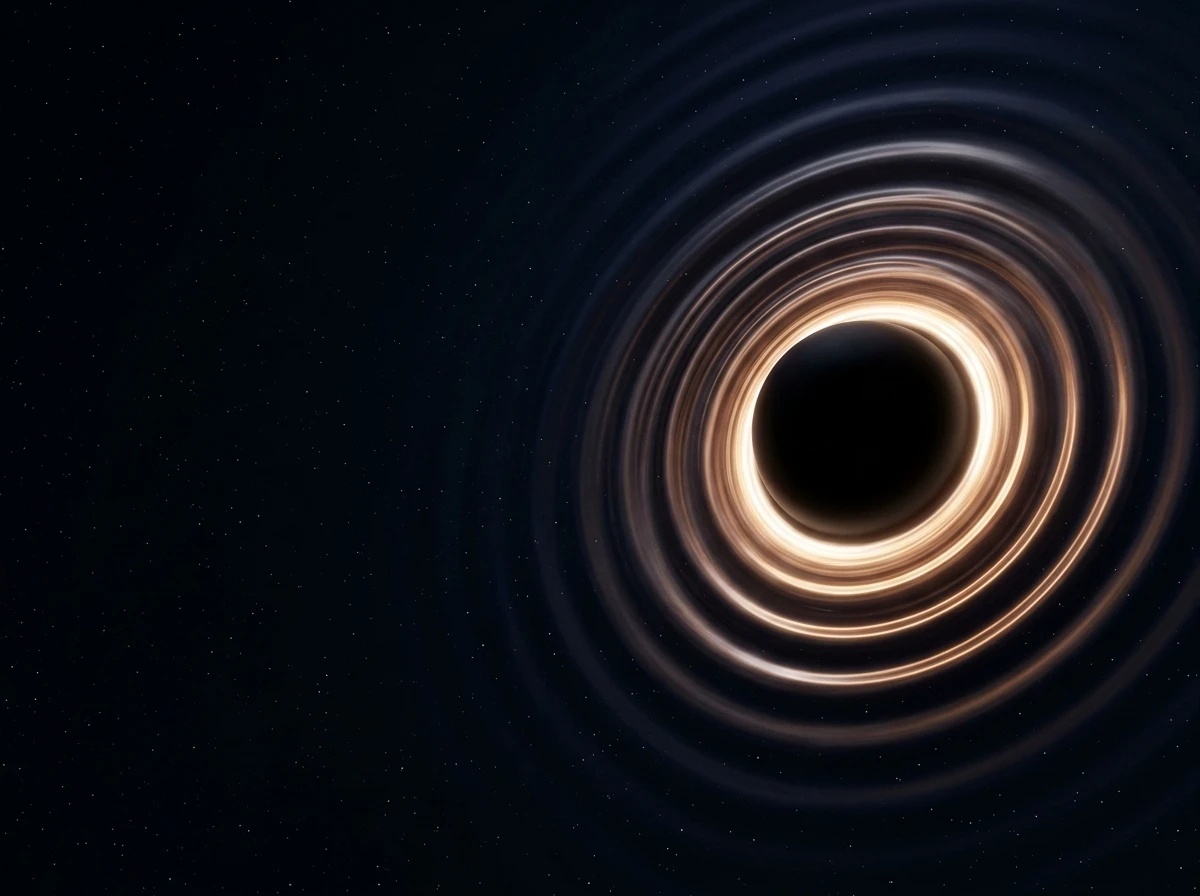
Seventy Physicists Behind One Giant Reassessment
The review did not start as a quick update. It began at the Ringdown Inside and Out conference and grew into a community effort with 68 coauthors, 316 pages and 80 figures by the time it was submitted, a massive update of the same team’s 2009 review of the field. By publication, the author list had grown past 70.
Johns Hopkins University physicist Emanuele Berti described the scale of the undertaking in a 316-page update spanning 68 coauthors, a rewrite of what the field looked like the last time anyone attempted a full survey. The gap between the two reviews tells its own story: sixteen years ago, ringdown detection was a proposal. Now it has a body of confirmed measurements behind it.
Among the review’s findings, researchers cataloged several complications layered on top of the simple ringing bell picture:
- Overtones – additional ringing tones stacked on the fundamental frequency, similar to harmonics in musical instruments
- Mode interactions – vibrations that influence one another rather than ringing in isolation
- Exceptional points – rare mathematical spots where separate vibrational modes converge into one
- Long decay tails – signals that linger longer than expected in crowded cosmic environments
Each of those complications matters because they are exactly where deviations from Einstein’s predictions would first show up.
By listening to the ringing of newly formed black holes, we are turning gravitational waves into a tool for exploring some of the deepest questions in physics, from the nature of gravity itself to the possibility of discovering entirely new forms of matter and energy.
Review co-lead Dr Gregorio Carullo, from the University of Birmingham, said that in describing why the field has shifted from math exercise to laboratory.
Three Hundred Mergers and Counting
The raw material behind that shift is a rapidly growing catalog. The LIGO-Virgo-KAGRA network has collectively observed more than 200 black hole mergers in its fourth run, and about 300 in total since the start of the first run in 2015. LIGO is the Laser Interferometer Gravitational-Wave Observatory, the US-funded twin detector system in Louisiana and Washington state that made the first direct detection.
| Milestone | Date | Key Figure | Why It Mattered |
|---|---|---|---|
| GW150914 | September 14, 2015 | Final black hole: 62 solar masses | First confirmed gravitational-wave and ringdown detection |
| GW231123 | November 23, 2023 | Final black hole: about 225 solar masses | Heaviest merger ever measured by gravitational waves |
| GW250114 | January 2025 | Two distinct ringdown tones resolved | Clearest overtone detection to date |
| GWTC-4 catalog | March 2026 | More than double a prior 90-event catalog | Gives spectroscopy studies a far larger sample |
That fourth row is not a single event but a data dump. The newest catalog release more than doubles the size of the gravitational-wave catalog, which previously contained 90 candidates, according to MIT’s account of the expanded catalog. More events means more ringdowns to test.
GW231123 is the row that broke records outright. The powerful merger produced a final black hole approximately 225 times the mass of our sun, detected during the fourth observing run of the network on November 23, 2023. The two progenitor black holes were also spinning unusually fast, which is why a merger topping 225 solar masses immediately drew scrutiny from the collaboration.
This is the most massive black hole binary we’ve observed through gravitational waves, and it presents a real challenge to our understanding of black hole formation, says Mark Hannam of Cardiff University and a member of the LVK Collaboration. It will take years for the community to fully unravel this intricate signal pattern and all its implications, says Gregorio Carullo of the University of Birmingham and a member of the LVK.
A separate pair of detections, GW241011 and GW241110, added another wrinkle. Both detected mergers point toward the possibility of second-generation black holes, among the most novel events among the several hundred that the LIGO-Virgo-KAGRA network has observed, says Stephen Fairhurst, professor at Cardiff University and spokesperson of the LIGO Scientific Collaboration. Second-generation, in this context, means black holes that were themselves built from an earlier merger rather than forming directly from a collapsing star.
GW250114 Rings a Second, Unmistakable Note
GW250114 became known in January when researchers spotted it with LIGO, the Laser Interferometer Gravitational-Wave Observatory, using instruments in Livingston, Louisiana, and Hanford, Washington. Unlike most prior detections, this one gave a signal clean enough to argue about with confidence.
Although the ringing phenomenon had been faintly observed before, GW250114 returned a signal with two modes, a fundamental mode and an overtone, with much more clarity. Gravitational-wave researcher Isi, who worked on the analysis, compared the effect to a familiar object. “If you have a bell and you strike it with a hammer, it will ring,” Isi said, according to a report confirming decades-old Einstein and Hawking predictions. Isi explained that the pitch and duration of that ring reveal what the bell is made of, and that black holes work the same way, radiating gravitational waves that expose their own structure.
Another scientist quoted in that same report called the second tone’s detection especially significant, adding that it shows LIGO’s ongoing sensitivity upgrades are paying off and that gravitational-wave data can now test fundamental physics in ways that were not possible before.
Is the First Overtone Really There?
Not every claimed overtone detection has survived scrutiny. In 2022, a team including Carullo and collaborator Roberto Cotesta reported statistically significant evidence for an overtone buried in the original 2015 GW150914 signal, a full decade after that merger was first detected. A year later, two other researchers published a technical challenge to that finding, and the original team defended its analysis in reply.
The dispute is narrow but real, and it shows the field arguing with itself in public rather than pretending consensus where none exists.
- Cotesta, Carullo, Berti and Cardoso (2022) reported statistically significant evidence for a first overtone in GW150914’s ringdown, published in Physical Review Letters
- Isi and Farr (2023) published a comment arguing the evidence for that overtone was not solid, reopening questions about how the detector noise was modeled
- Carullo, Cotesta, Berti and Cardoso (2023) replied the same year, standing by their original result and the statistical methods behind it
A separate line of research goes further, arguing that fitting overtones too close to the merger’s peak produces numbers that look meaningful but are not physical at all, and that spectroscopy may work better using additional gravitational-wave multipoles instead of stacking more overtones. The debate has not been settled by data yet. It is exactly the kind of disagreement next-generation detectors are built to resolve.
Next-Generation Detectors Will Hear Thousands of Mergers a Year
Current detectors have already answered the easy questions. The harder ones need instruments that do not exist yet.
Cosmic Explorer, the proposed US facility, is designed to detect merging stellar-mass black holes out to redshifts of roughly 20 and will detect hundreds of thousands of black-hole mergers each year, measuring their masses and spins. That is a jump of several orders of magnitude over the current annual haul, and it comes from detecting hundreds of thousands of mergers yearly rather than a few hundred.
Europe’s Einstein Telescope is being designed alongside it, and together the two ground-based observatories are expected to reach roughly ten times today’s sensitivity by the 2030s. LISA, the space-based Laser Interferometer Space Antenna, will hunt a different quarry entirely: massive black holes with masses ranging from 100,000 to 1 billion times the mass of the sun, hosted at the centers of galaxies.
That is the same category of object anchoring the Milky Way’s own core, whose outward wind astronomers only recently confirmed, though LISA will listen for one merging with another rather than watching one sit quietly at the center of a galaxy.
None of these instruments exist today. All of them are aimed at the same target: catching a ringdown tone that does not fit the mass-and-spin script general relativity has written for it.
Frequently Asked Questions
What is a black hole ringdown?
A ringdown is the final of three phases after two black holes merge, following the inspiral and the violent merger itself. In the ringdown, the newly formed black hole sheds its distortions as gravitational waves shaped like a decaying, oscillating wave, the same basic pattern as a struck bell fading into silence.
What are quasinormal modes?
Quasinormal modes are the specific frequencies a black hole rings at during that ringdown. Each mode has two defining features: the frequency it oscillates at, and how quickly that oscillation fades. Under general relativity, both should be fixed entirely by the remnant black hole’s mass and spin, nothing else.
Has anyone actually detected an overtone in a black hole ringdown?
Yes, most convincingly in GW250114, detected in January 2025, which resolved a fundamental tone and an overtone with far more clarity than any earlier signal. An earlier claimed overtone in the 2015 GW150914 event remains disputed among researchers, with one team defending the finding and another questioning whether the statistical evidence holds up.
Does this prove Einstein’s theory is completely correct?
Not completely, only within the range current detectors can measure. So far every observed ringdown tone matches general relativity’s predictions, but today’s ground-based detectors are limited in sensitivity and can only catch the loudest, closest mergers with enough precision to check more than one or two tones at once.
What would it mean if a ringdown didn’t match Einstein’s prediction?
A mismatch would point toward physics beyond the Standard Model, the framework covering known particles and forces. Researchers say the leading candidates would involve modifications to gravity itself, interactions with dark matter, or violations of Lorentz invariance, the principle that physics looks the same in every direction, in the extreme region right at a black hole’s horizon.
When will the next generation of detectors be ready?
The Einstein Telescope and Cosmic Explorer are both targeted for the 2030s, with Cosmic Explorer’s design built around a 40-kilometer detector arm, roughly ten times longer than LIGO’s current instruments. LISA, the space-based mission, is on a similar timeline and will fly clear of Earth’s seismic noise entirely.

-
 TECH1 year ago
Where Garmin Watches are Made and How They are Assembled
-

 AUTO3 months ago
Tesla’s Roadster Is ‘a Few Weeks Away,’ Says Its Chief Designer
-
 NEWS10 years ago
Samsung Releases Galaxy Note7 TV Ad as Reddit AMA Leaks Specs
-
 NEWS10 years ago
Android 7.0 Nougat Rolls Out To Nexus Devices With New Emoji, Features
-
 FINANCE9 years ago
Cardano Price Surges as ADA Enters the Crypto Top Ten List
-
 NEWS10 years ago
Pre-Order the First Camera Made for Facebook Live Streaming Video
-
 FINANCE1 year ago
Binance Suspends Trading and Withdrawals for a System Upgrade
-
 FINANCE9 years ago
RChain Price Jumps Nearly 150% to a New All-Time High of $2.03