
NEWS
India’s First Hydrogen Train Debuts in Haryana as Key Parts Stay Imported
India’s first hydrogen fuel cell train began passenger service on an 89-km Haryana route on July 17, though several key components are still imported.

Prime Minister Narendra Modi flagged off India’s first hydrogen-powered train on Friday, sending a 10-car set down an 89-kilometer stretch of track between Jind and Sonipat in Haryana. The train runs on fuel cells instead of diesel or overhead wires, producing little more than water vapor as exhaust.
Indian Railways is calling the technology indigenous. Much of what actually makes the fuel cells work still arrives from overseas, and part of that global supply chain is now retreating from the hydrogen rail business rather than expanding into it.
India’s First Hydrogen Train Leaves the Station in Haryana
The service runs under Northern Railway, connecting Jind Junction, Gohana Junction and Sonipat, with a dozen smaller halts in between, from Jind City to Sonipat New.
India has become one of the select group of nations that have such trains. This will go a long way in ensuring that India adopts clean technology in the railway sector.
Narendra Modi, the prime minister, wrote on X ahead of the launch.
Hydrogen fuel cells generate electricity onboard by combining hydrogen with oxygen from the air, and the main by-product is water vapor rather than diesel soot. That lets the train run on stretches of track Indian Railways has never strung with overhead wires.
Railway Minister Ashwini Vaishnaw has called it the longest and most powerful hydrogen train running on broad gauge track anywhere. The launch puts India alongside Germany, Japan, China, France, the UK and the United States as countries that have tested or run hydrogen-powered passenger trains. Indian Railways has framed it as a pilot, meant to test the technology before deciding whether to expand it further.
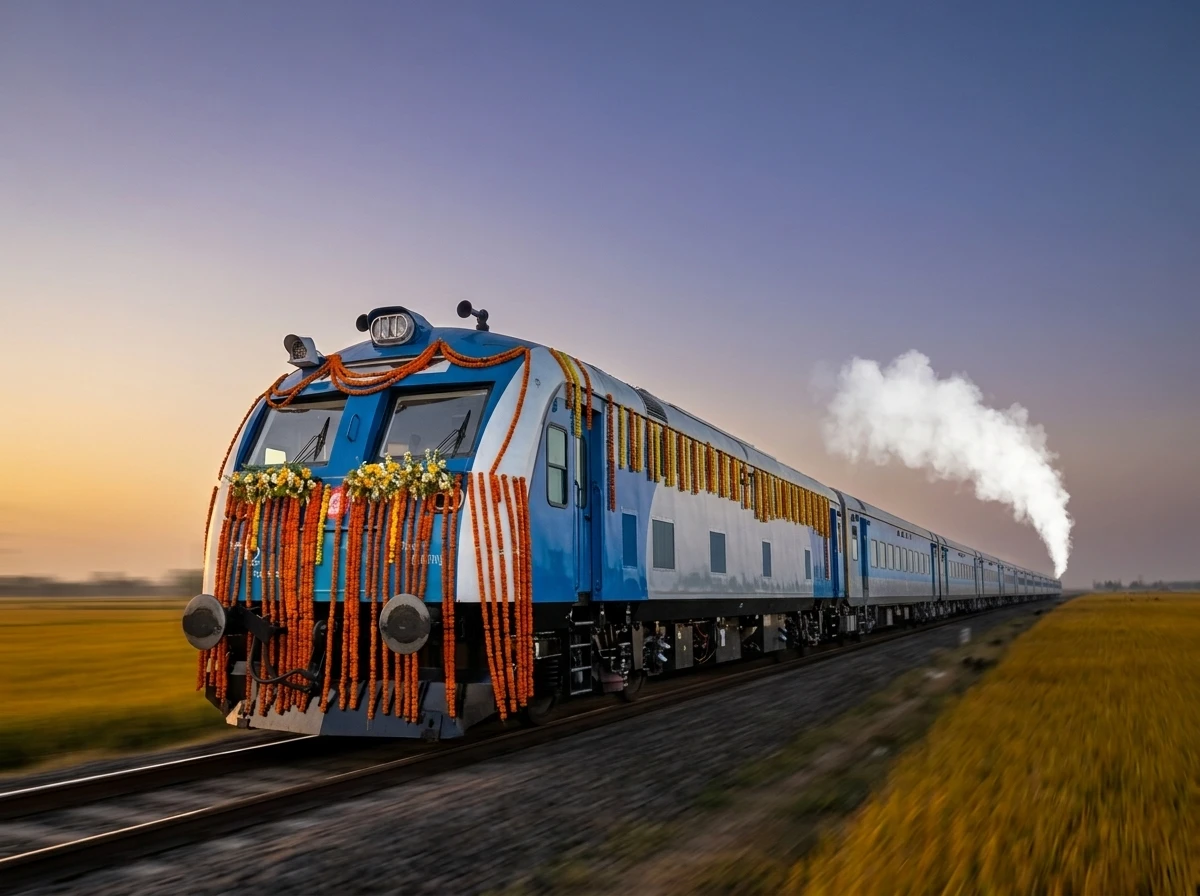
Inside the Jind-Sonipat Trainset
The numbers behind Friday’s launch show a project built for real passenger service, not a one-off demonstration.
- 89 kilometers – the length of the Jind-Sonipat corridor, covered twice daily for 356 kilometers of total running.
- 2,600 passengers – the trainset’s approximate capacity across its ten cars.
- ₹111 crore (roughly $13 million) – the most-cited estimate of the pilot’s cost so far, covering the train’s conversion and a new refuelling plant at Jind; other accounts put the figure as high as ₹136 crore.
The trainset was engineered by the Research Designs and Standards Organisation (RDSO) in Lucknow and assembled at the Integral Coach Factory (ICF) in Chennai. Hyderabad-based Medha, which already supplies propulsion equipment to Indian Railways elsewhere, won the tender for the train’s traction and control systems. Two Driving Power Cars carry the fuel cells, batteries and hydrogen storage cylinders; the other eight cars carry passengers.
The Indigenous Label Has an Asterisk
Indian Railways and government messaging have repeatedly tied the launch to Atmanirbhar Bharat, the government’s self-reliant India campaign. The trainset’s body and assembly were designed and built domestically, start to finish.
Where the Fuel Cells Come From
The fuel cell stacks at the center of the system tell a different story. The Core, an Indian business publication, reported that Cummins sold off its low-pressure fuel cell business this year. The American engine maker took a charge of roughly $199 million, with the rail piece going to French manufacturer Alstom, citing weaker than expected demand for hydrogen.
The unit Cummins gave up made the same class of stacks used in Alstom’s Coradia iLint. That German train pioneered hydrogen passenger rail in Europe years earlier. A company retreating from that market now sits inside the supply chain behind India’s own “indigenous” debut.
Imported stacks carry a service tail beyond the sticker price: replacement modules sourced from abroad, foreign exchange exposure on every overhaul, and lead times set by a supplier’s order book rather than Indian Railways’ own schedule. A wider rollout would multiply that exposure across dozens of trains instead of one.
What India Did Build at Jind
Indian Railways did build its own hydrogen production plant at Jind rather than trucking in fuel made elsewhere. That is a real point in the project’s favor, since most hydrogen worldwide is still produced through natural gas reforming, a process that emits greenhouse gases of its own.
Who Built India’s Hydrogen Train?
Indian Railways designed and assembled the physical trainset at home, but the fuel cell technology inside it still leans on foreign partners. A handful of Indian companies are now working to close that gap, though most of that effort is still paperwork and pilot plants rather than production lines.
- Adani and Canada’s Ballard Power Systems – signed a memorandum of understanding to explore building proton exchange membrane fuel cells inside India.
- Hyundai – is building a research center at IIT Madras focused on localizing the hydrogen value chain.
- BHEL and Singapore’s Horizon Fuel Cell Group – entered a ten-year agreement aimed at commercializing fuel cell locomotives.
Each of those arrangements is a memorandum, a research center or a licensing deal, not a working factory. Companies do not typically sign decade-long licensing agreements for technology they can already build competitively.
How the Fuel Cell Guards Against a Leak
Hydrogen is highly flammable, and Indian Railways built the train around that fact. The system uses a proton exchange membrane fuel cell, which generates power through a chemical reaction between hydrogen and oxygen across a polymer membrane instead of combustion.
Storage carries its own engineering burden. Hydrogen holds far less energy per liter than diesel, so it has to be compressed above 350 bar for storage to fit onboard in usable amounts, which raises both the cost of the storage vessels and the energy spent compressing the gas.
Indian Railways layered in leak detectors, fire and flame sensors, and an automatic shutoff that can cut hydrogen supply the moment something looks wrong, without waiting on a person to react. Continuous ventilation keeps any stray hydrogen from pooling inside the train, and the loco pilot’s cabin carries a screen showing the health of the whole system in real time.
India Joins a Small, Uneven Global Club
Germany got there first, and everyone else is catching up at a different pace.
| Country | Train or Program | Route or Status | Notable Fact |
|---|---|---|---|
| Germany | Alstom Coradia iLint | Bremervorde route, Lower Saxony | Completed a 1,175-km run on a single tank in 2022 |
| Germany | Sudostbayernbahn fleet | Muhldorf-Tuebling-Burghausen, 32.2 km | Three more trains due this year with roof-mounted fuel cells and lithium-ion batteries |
| Japan | “Hybari” hydrogen hybrid | Tsurumi and Nambu lines, Kanagawa Prefecture | Expected by the end of fiscal 2027 |
| United States | Zemu | San Bernardino, California | The country’s first hydrogen passenger train, introduced in 2024 |
| India | Jind-Sonipat trainset | Haryana, 89 km | Launched July 17, 2026, with a 10-car formation among the longest built for hydrogen service |
France, Italy and China are running smaller pilots of their own, typically with two to four coaches built for regional service. India’s 10-car set is a bigger bet than most of what has come before it.
The Next Test Is the Kalka-Shimla Climb
Indian Railways has already named its next candidate: the Kalka-Shimla heritage line. The narrow-gauge route climbs through the Himalayan foothills and is currently worked by diesel locomotives.
Officials have said they will draw on what the Jind-Sonipat pilot teaches them about safety, refuelling and reliability before pushing hydrogen technology onto routes like it.
A bigger number sits behind that one line. India’s Hydrogen for Heritage program has earmarked roughly ₹2,800 crore for 35 hydrogen trains, plus another ₹600 crore for supporting infrastructure, aimed largely at heritage and hill routes unlikely to ever get overhead wires.
That plan sits inside the National Green Hydrogen Mission. The government approved the ₹19,744 crore initiative in January 2023 to cut India’s import bill on crude oil, natural gas and coal.
More than 99 percent of India’s broad-gauge network is already electrified, according to the railway’s own account of the launch, which is why hydrogen is being aimed at the sliver left over rather than the network as a whole.
A peer-reviewed review of hydrogen transport’s sustainability trade-offs, published in July 2025, found the same tension playing out worldwide: hydrogen mobility promises lower emissions, but the supply chains and costs behind it remain immature almost everywhere the technology has been tried.
Whether that spending is worth it now hinges on how one 10-car train performs on 89 kilometers of Haryana track over the coming months.
Frequently Asked Questions
How much hydrogen does the Jind-Sonipat train carry, and is it safe?
The trainset stores about 440 kg of hydrogen onboard across roughly 27 high-pressure cylinders, using an estimated 300 kg per day of service. Indian Railways has paired that storage with leak detectors, automatic shutoff systems and continuous ventilation designed to disperse any stray hydrogen before it can collect.
What time does the hydrogen train run between Jind and Sonipat?
The service operates as train number 74010 from Jind, departing at 07:40 and arriving in Sonipat at 09:40, then returns as train number 74009, leaving Sonipat at 10:40 and reaching Jind by 13:00, giving passengers two round trips a day.
How much does a ticket cost?
Fares on the route are set low, ranging from roughly Rs 5 to Rs 25, keeping the pilot priced in line with existing local train services rather than as a premium product.
How long did the hydrogen train take to build?
Work on the ground infrastructure began around April 2022, and the Railway Board did not clear the trainset for commercial operational sanction until May 22, 2026, putting the project at roughly four years from groundbreaking to passengers.
Does India have other clean-fuel transport plans beyond hydrogen trains?
Yes. Indian policymakers are also working on a draft ethanol and biogas mandate for car emissions, part of a wider push to cut fossil fuel dependence across road and rail transport at the same time.

-
 TECH1 year ago
Where Garmin Watches are Made and How They are Assembled
-
 AUTO3 months ago
Tesla’s Roadster Is ‘a Few Weeks Away,’ Says Its Chief Designer
-
 NEWS10 years ago
Samsung Releases Galaxy Note7 TV Ad as Reddit AMA Leaks Specs
-
 NEWS10 years ago
Android 7.0 Nougat Rolls Out To Nexus Devices With New Emoji, Features
-
 FINANCE9 years ago
Cardano Price Surges as ADA Enters the Crypto Top Ten List
-
 NEWS10 years ago
Pre-Order the First Camera Made for Facebook Live Streaming Video
-
 FINANCE1 year ago
Binance Suspends Trading and Withdrawals for a System Upgrade
-
 FINANCE9 years ago
RChain Price Jumps Nearly 150% to a New All-Time High of $2.03