
AUTO
India’s CAFE-III Draft Gives Ethanol and Biogas a Role in Car Emissions
India’s Ministry of Power released a third CAFE-III draft letting ethanol and biogas count as carbon-neutral, with automaker feedback due by August 6.

India’s Ministry of Power circulated a third draft of the Corporate Average Fuel Efficiency, or CAFE-III, norms on Thursday, opening a comment window that runs to August 6. The rules govern how fuel-efficient new cars must be from 2027, and for the first time they let ethanol, compressed biogas and other biofuels count as carbon-neutral in that math.
That detail outweighs the yearlong fight between Maruti Suzuki and Tata Motors over vehicle weight that dominated coverage of the earlier drafts. India’s sugarcane and biogas producers now have a formal stake in whether carmakers hit Delhi’s climate targets, and critics already warn the tradeable credit market built around the rule could let some manufacturers buy their way past real engineering fixes.
A Compromise That Barely Moved From April
The third draft leaves most of April’s compromise untouched. It keeps a flatter weight-adjustment curve than the one first proposed in September 2025, cutting the compliance edge heavier SUVs used to enjoy while giving lighter cars an easier target.
The slope of that curve now starts at 0.00158 in the rule’s first year and eases to 0.00131 by the fifth, instead of a flat 0.002 for all five years under the original plan. Overall fleet-wide targets have been relaxed by roughly 21% from that first draft, a concession to industry pushback on cost.
One narrower carve-out did not survive. A distinct 3 gram-per-kilometre relaxation for petrol cars under 909 kilograms and 1,200cc, a rule that had sharpened the divide between small-car and big-car makers, is gone from this version.
The rules apply to M1 category vehicles, personal-use passenger cars carrying up to eight people that cover hatchbacks, sedans and SUVs alike, sold or manufactured in India from 2027-28 through 2031-32. They replace CAFE-II, which lapses March 31, 2027. Compliance gets checked twice, once over an initial three-year block and again over the final two years, rather than annually.
Ethanol and Biogas Earn Their Own Discount
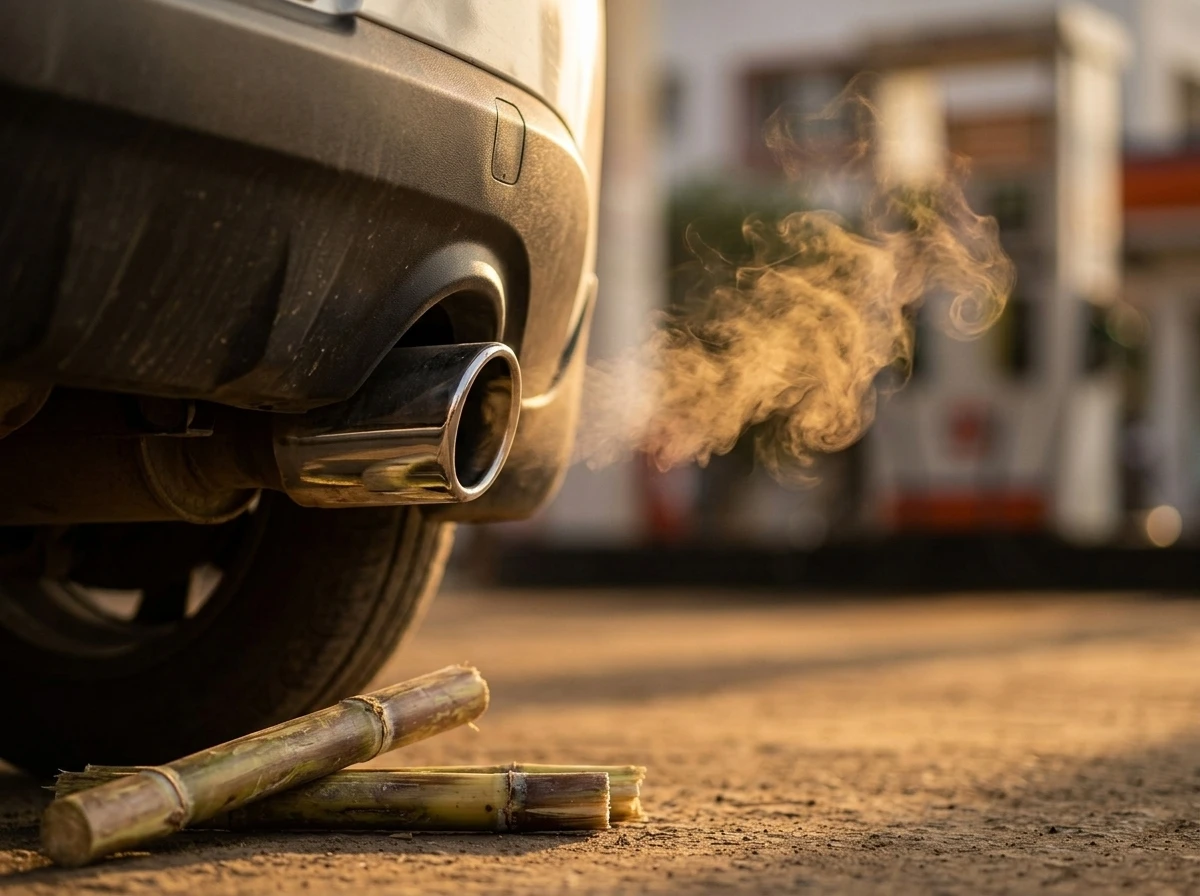
Carbon Neutrality Factors, or CNFs, are the draft’s genuine first for India. They let a manufacturer subtract a percentage from a car’s declared tailpipe CO2 before regulators weigh it against the fleet target, based on the fuel or blend that car actually runs on.
At today’s ethanol blending levels, E20-compatible petrol cars, strong hybrids and plug-in hybrids earn an 8% cut. Flex-fuel ethanol vehicles and flex-fuel strong hybrids, built to run on much higher ethanol blends, earn 22.3%, the largest benefit anywhere in the draft. CNG cars get a 5% cut or more, tied to the government’s notified compressed biogas blending percentage, and diesel vehicles get a benefit pegged to notified biofuel blending levels.
Electric and hybrid vehicles keep a separate credit called volume derogation, or super credits, that counts each vehicle as more than one car in a manufacturer’s fleet average.
| Technology or Fuel | Compliance Benefit | How It Counts |
|---|---|---|
| Battery electric and range-extended EVs | 3.0x multiplier | Each vehicle counted as three for fleet averaging |
| Plug-in hybrids and flex-fuel strong hybrids | 2.5x multiplier | Cuts fleet average faster than a standard sale |
| Strong hybrids | 1.6x multiplier | Smaller volume boost than plug-ins |
| Flex-fuel ethanol vehicles | 1.1x multiplier plus 22.3% CNF | Combines a volume boost with a carbon-neutrality discount |
| E20-compatible petrol and hybrids | 8% CNF | Applied to declared tailpipe CO2 before the compliance check |
| CNG vehicles | 5% CNF or higher | Rises with the notified CBG blending level |
Manufacturers can also stack a separate technology credit, worth up to 9 grams of CO2 per kilometre in total, for approved fuel-saving hardware:
- Automatic engine start-stop systems
- Tyre pressure monitoring systems
- Regenerative braking
- Six-speed or higher transmissions
- High-efficiency alternators and LED lighting
- Advanced glazing and solar-reflective paint
- Efficient air conditioning systems
None of those require touching the powertrain itself, and manufacturers can combine them with ethanol or electrification credits on the very same car.
Why Are Maruti Suzuki and Tata Motors Still Fighting?
Maruti Suzuki wants weight-based relief for small cars, arguing regulators elsewhere already offer the same treatment. Tata Motors calls that carve-out arbitrary and unsafe, since no car under 909 kilograms currently earns a Bharat NCAP safety rating. The April draft split the difference: it eased the weight formula without eliminating it, and this draft keeps that split intact.
Maruti Suzuki has pushed back hard against critics of the small-car concession.
Incorrect facts and narratives are being pushed in a very irresponsible manner by the makers of some large gas guzzlers to divert attention from their own large gas-guzzlers.
Rahul Bharti, senior executive officer for corporate affairs at Maruti Suzuki, made that argument while defending the weight-based relief, pointing to China, the United States, Europe, Japan and South Korea as markets that already relax targets for smaller cars.
Tata Motors rejects the comparison. Shailesh Chandra, managing director and chief executive of Tata Motors Passenger Vehicles, said “We see absolutely no justification for any special concession for this specific category of cars.” Maruti Suzuki’s chairman, R.C. Bhargava, told The Hindu BusinessLine the formula was tilted the other way: “As weight decreases, the norms become less and less favourable for smaller cars.”
- Maruti Suzuki – says weight-based relief for small cars is standard practice worldwide, no different from rules already in place in China, the US, Europe, Japan and South Korea.
- Tata Motors – calls the weight carve-out arbitrary and warns it could undercut safety, since no sub-909 kilogram car currently holds a Bharat NCAP rating.
- SIAM – the Society of Indian Automobile Manufacturers, has stayed publicly split, unable to issue one unified industry position on the weight formula.
The safety objection is not unique to India. Similar arguments dogged early US fuel economy rules decades ago, and a Consumer Reports review examined safety concerns about smaller cars among other criticisms and found them overstated.
How CAFE Cut Its Target From 130 Grams to 79
CAFE rules are not new. The government introduced the first phase in 2017 under the Energy Conservation Act of 2001, requiring fleets to average 5.5 litres per 100 kilometres and stay under 130 grams of CO2 per kilometre.
CAFE-II arrived in 2022 and tightened that to 4.7 litres per 100 km with a 113 gram cap. CAFE-III pushes further, starting at 94.76 grams in 2027-28 and ending at 78.90 grams by 2031-32, a target manufacturers get five years and two compliance blocks to reach.
| Phase | Effective Period | Fuel Consumption Target | CO2 Cap |
|---|---|---|---|
| CAFE I | From 2017 | 5.5 L/100km | Below 130 g/km |
| CAFE II | From 2022 | 4.7 L/100km | 113 g/km |
| CAFE III (draft) | 2027-28 to 2031-32 | 3.996 to 3.3273 L/100km | 94.76 to 78.90 g/km |
Each phase has squeezed harder than the last. CAFE-III is the first to let alternative fuels soften the landing rather than demanding efficiency gains from the engine alone.
The Credit Market Nobody Fully Trusts
Manufacturers that beat their targets earn tradeable compliance credits, denominated in units of one gram of CO2 per kilometre. Those that fall short have four options: carry credits forward within a compliance block, pool compliance with another automaker, buy credits from a manufacturer with a surplus, or purchase them straight from the Bureau of Energy Efficiency (BEE), the agency that will run the scheme under the Ministry of Power.
BEE credits start at Rs 2,500 each (roughly $30), rising by Rs 500 every year the scheme runs. Unused credits expire at the end of each compliance block, and manufacturers that still fall short face penalties under the Energy Conservation Act.
Critics call the structure a loophole waiting to be used. Buying credits, they argue, lets a manufacturer keep selling less efficient cars instead of investing in engineering that actually cuts emissions. Tata Motors has separately objected to BEE selling credits directly to manufacturers, rather than leaving trades strictly between automakers.
The US is moving the opposite direction. A proposed SAFE III rule there would cut required fuel economy for American cars to 34.5 mpg by 2031, a bar automakers already cleared back in 2024, according to InfluenceMap, a corporate-accountability research group tracking the rule.
What Carmakers Must Decide Before April 2027
Carmakers already have one clock running separate from the weight fight. From April 2026, manufacturers must report fuel performance under both the older Modified Indian Driving Cycle and the tougher Worldwide Harmonised Light Vehicles Test Procedure (WLTP). The government has not yet said how it will convert WLTP results into CAFE compliance figures, leaving that formula for a later notification.
Manufacturers selling fewer than 1,000 passenger vehicles a year stay exempt from the fleet-average rules entirely, a carve-out untouched since the first draft.
A Ministry of Power official said the phased tightening “will provide OEMs with a clear and predictable regulatory pathway,” according to Business Standard, which first reported the official’s comments.
Stakeholders have until August 6 to file objections. After that, the ministry finalizes the rule, and the countdown to April 1, 2027, when CAFE-III takes effect and ethanol officially starts counting toward a car’s carbon math, begins in earnest.
Frequently Asked Questions
What is CAFE-III?
CAFE-III is the third phase of India’s Corporate Average Fuel Efficiency rules for passenger cars, covering M1 category vehicles sold between 2027-28 and 2031-32. It replaces CAFE-II, which has regulated fleet efficiency since 2022, and is administered by the Bureau of Energy Efficiency under the Ministry of Power.
What are Carbon Neutrality Factors?
Carbon Neutrality Factors are percentage discounts applied to a car’s declared tailpipe CO2 before regulators check it against the fleet target, based on the ethanol, biogas or biofuel content of the fuel it runs on. They are separate from the super credits given to electric and hybrid vehicles, and the two can be combined on the same car.
How much do compliance credits cost?
BEE credits are priced at Rs 2,500 each in the first year, rising by Rs 500 annually for as long as the scheme runs. The rising price is designed to make delaying compliance more expensive over time, pushing manufacturers toward earlier fixes rather than later credit purchases.
Are small carmakers exempt from CAFE-III?
Yes. Manufacturers selling fewer than 1,000 passenger vehicles a year are exempt from the fleet-average obligations entirely. That threshold has stayed unchanged since the very first CAFE-III draft in September 2025, making it one of the few uncontested parts of the framework.
Does CAFE-III cover trucks and buses?
No. CAFE-III applies only to M1 category passenger vehicles built for personal use. The Bureau of Energy Efficiency is working on a separate set of proposed fuel efficiency norms covering heavy, medium and light duty commercial vehicles, though that framework has not been finalized.
When does CAFE-III take effect?
The rules are proposed to start April 1, 2027, the same day CAFE-II lapses, and run for five years through March 31, 2032. Stakeholder comments on the current draft are due by August 6, 2026, before the ministry notifies a final version.

-
 TECH1 year ago
Where Garmin Watches are Made and How They are Assembled
-

 AUTO3 months ago
Tesla’s Roadster Is ‘a Few Weeks Away,’ Says Its Chief Designer
-
 NEWS10 years ago
Samsung Releases Galaxy Note7 TV Ad as Reddit AMA Leaks Specs
-
 NEWS10 years ago
Android 7.0 Nougat Rolls Out To Nexus Devices With New Emoji, Features
-
 FINANCE9 years ago
Cardano Price Surges as ADA Enters the Crypto Top Ten List
-
 NEWS10 years ago
Pre-Order the First Camera Made for Facebook Live Streaming Video
-
 FINANCE1 year ago
Binance Suspends Trading and Withdrawals for a System Upgrade
-
 FINANCE9 years ago
RChain Price Jumps Nearly 150% to a New All-Time High of $2.03