
BUSINESS
US Strikes Hit Qeshm as Trump Talked Up a Deal
US jets struck Qeshm on November 2 as Trump sold a deal and oil fell nearly 7%, a dual-track raid kept off the midterm ballot.

The United States hit Iran’s Qeshm Island on November 2, hours after President Donald Trump said a deal with Tehran “could happen.” Iranian state news agency IRNA reported five explosions in rapid succession and said some residents saw two aircraft. Brent crude had already fallen $7.85 to $105.60 a barrel on the day’s diplomacy talk, with midterm voting set for November 3.
US officials described the raid as a limited defensive strike on surface-to-air missiles after Iran fired at an American aircraft, and said it was not a return to major combat. They also kept it unannounced, so the first picture of Election Day would not be a new American war.
Five Blasts Hit Qeshm After a Missile Shot
Three US officials said American forces struck Qeshm late on Monday after the Islamic Revolutionary Guard Corps shot at a US aircraft over the Strait of Hormuz. One official said a US fighter then destroyed a surface-to-air missile launcher on the island. “This was a defensive measure for Iranians using surface to air missiles against US assets,” another official said.
The Pentagon sent questions to US Central Command, which did not comment. Officials who described the raid said the White House wanted it kept small and quiet so no one would read it as the start of a wider campaign. Iranian outlets were less shy. IRNA counted five blasts. Fars said they were also heard on Hengam Island and in Bandar Abbas, about 14 miles from Qeshm, and from the sea toward Bandar Lengeh.
WHAT WE KNOW
- The trigger: US officials said IRGC crews fired a surface-to-air missile at an American aircraft, and a US jet destroyed a launcher on Qeshm.
- The scale: Officials called the raid limited and said it was not a resumption of major combat operations.
- The silence: CENTCOM issued no public confirmation, and the White House did not announce the strikes.
- The local report: IRNA reported five explosions and two aircraft; Fars said the blasts carried to nearby islands and ports.
WHAT IS UNCONFIRMED
- Damage and casualties: Iranian authorities had not issued a public damage or casualty tally.
- A wider campaign: Officials said other unannounced raids had run for weeks, without a target list or a public tally.
- The drone claims: The IRGC said it captured reconnaissance drones south of Qeshm with electronic warfare and destroyed an MQ-9 east of the strait; those claims were not independently confirmed.
Qeshm is Iran’s largest island in the strait and has been hit earlier in this war. It holds an underground missile site, a naval base and a major desalination plant, which is why a “limited” raid there still lands on the waterway that prices the world’s oil.
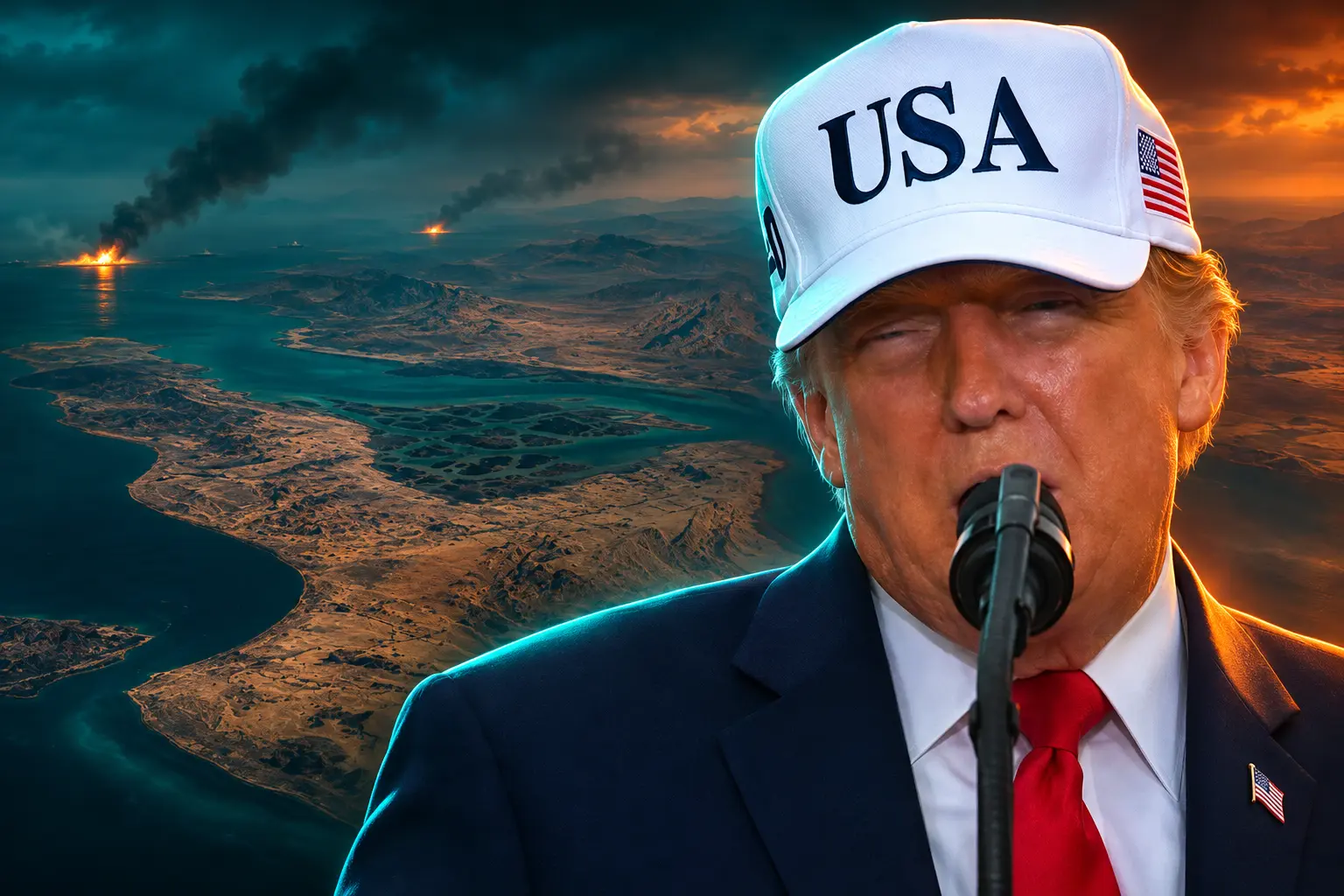
Trump Told Voters the Fighting Had Stopped
Hours before those explosions, Trump was selling the opposite story. On Truth Social he wrote that oil prices were “DROPPING LIKE A ROCK, down almost $10 a Barrel, A RECORD, because people feel that there will not be a War with Iran,” and that Tehran wanted a settlement “as soon as possible. It could happen!”
At the Lincoln Memorial Reflecting Pool he said the talks were “coming together very nicely” and that “we won,” with “very little fighting” lately. Asked by reporters whether he was considering strikes after the midterms, he replied, “No.” In a Fox interview that aired Monday night, he went further, and did not address the Qeshm reports.
We’re not fighting a war. Everyone says you’re at war! Well, when was the last time we fired anything? There’s no war raging. It could happen if they don’t make a deal, but they want to make a deal very badly and there’s a very good chance we make a deal.
Donald Trump, US president, Fox interview, November 2
He still left a door open. He said the United States “might have to go after” Pickaxe Mountain, the suspected underground nuclear site, and that “we can do that in one hour… as soon as we want, at any time we want.” Vice President JD Vance, speaking the same day, said he and Trump felt “pretty good” about a negotiated settlement and that “we’ve certainly made some progress,” while stressing that the president “retains kinetic options.”
The louder problem is the calendar. A president who asked when America had last fired anything had jets over Qeshm that night, and he said the war was a “very soft war” on the last evening before Americans voted. Gasoline and diesel were still on course to be the most expensive of any US Election Day on record, which is the political fact the quiet raid was built around.
The Island That Guards the Oil Route
Qeshm sits at the mouth of the Strait of Hormuz, the channel between Iran and Oman that funnels Gulf crude into the Arabian Sea. The International Energy Agency records an average of 20 million barrels a day in 2025 of crude and products through that gap, about a quarter of seaborne oil trade. At its narrowest the strait is only 21 nautical miles wide, with two-mile inbound and outbound channels and a two-mile buffer.
Energy trackers list the waterway as closed to normal traffic since February 28, the day US and Israeli strikes opened this war. Iran has demanded permits and fees through a strait authority. Washington has blockaded Iranian ports since July 14. Attacks on merchant ships have not stopped. The UK Maritime Trade Operations centre logged a projectile strike in the strait on November 1, then a separate Sunday hit: two unknown projectiles struck a tanker’s port side at 23:47 GMT, 72 nautical miles east of Ras Al Khafji. The crew was accounted for, with no reported spill.
Saudi Arabia and the United Arab Emirates can move some crude around the choke. The US Energy Information Administration puts Saudi and UAE pipelines together at about 4.7 million barrels a day of bypass capacity, a fraction of the pre-war flow. Iraq, Kuwait, Qatar, Bahrain and Iran still need the strait for almost all of their seaborne oil. That is why a launcher on Qeshm is not a side show. It is a gun on the toll gate.
Crude Fell While the Island Burned
Monday’s oil drop was the market version of Trump’s speech. Charles Kennedy, writing for Oilprice.com, put Brent at $105.60, down $7.85, and West Texas Intermediate at $96.92, down $7.20, a slide of nearly 7% that erased part of October’s war premium. Trump’s “almost $10” line overshot the tape. The trade was still the sharpest one-day break in weeks.
Traders had been bracing for a post-vote escalation. Brent had briefly reached $118 in October, and a tanker fire in the strait had pushed it to $117. Goldman Sachs put about $27 a barrel of that rally on geopolitical risk, raised its December Brent forecast to $105 from $90, and lifted its 2027 average to $88 from $80. Daan Struyven, the bank’s oil researcher, said the premium would come off quickly only with “a diplomatic solution that market participants see as sustainable.” Seven OPEC+ producers, including Saudi Arabia and Russia, left December output targets unchanged on Sunday.
OIL AND THE STRAIT SINCE FEBRUARY
| Measure | Figure | As of |
|---|---|---|
| Brent, Monday trade | $105.60, down $7.85 | November 2 |
| WTI, Monday trade | $96.92, down $7.20 | November 2 |
| Brent wartime peak | $126 | April 30 |
| Brent, week of February 23 | $72.48 | Pre-crisis baseline |
| US diesel, national average | $6.35 a gallon, up 67% | Week of October 26 vs February 23 |
| Hormuz oil flow, 2025 | about 20 million barrels a day | IEA |
Monday’s $105.60 print was still more than $33 above that February baseline, and more than $20 below the April peak. Early Tuesday, after the Qeshm reports moved, oil ticked up in Asia. The tape had priced the Reflecting Pool. Then it priced the island.
Netanyahu Wants Strikes After the Ballots
Israeli Prime Minister Benjamin Netanyahu has been pushing the other half of the dual-track. One Israeli source and one US source said he pressed Trump, in a Saturday phone call, to strike Iran as soon as the American midterms ended. The Israeli source called the conversation “tough.” The US source called it “direct.” The White House and the prime minister’s office declined to comment. Trump later told reporters he had had a “very good talk” and that Iran was among the subjects.
Netanyahu’s own election on October 27 left his bloc without a clear Knesset majority. Regional officials said a return to full-scale war could help him argue for an emergency government. He had already tried to move earlier. US officials said Israel drew up a broader target set for around October 10, including nuclear sites and infrastructure, and that Trump blocked a restart before November 3 after fellow Republicans pushed back.
Secretary of State Marco Rubio said on Saturday that no decision had been made on new strikes and that Trump preferred a diplomatic resolution. That preference is not a freeze. Officials said CENTCOM had been moving more missile defenses and munitions into the region, and that Admiral Brad Cooper, the command’s chief, briefed Trump at the White House last week. Gulf officials said Washington had warned them that larger strikes could come as early as November 4.
Weeks of Quiet Raids the Pentagon Would Not Name
The Qeshm raid was the first publicly known US strike on Iran in weeks, not the first strike. Officials said American forces have been hitting Iranian missile launchers in self-defense whenever the Guards shoot at manned or unmanned aircraft, and that Iran had tried again before Monday’s raid. In a separate incident the same day, US forces said they intercepted an IRGC missile that came out of Qeshm and was aimed at commercial shipping.
That pattern is the dual-track in uniform. Keep enough pressure on the strait to stop Iran treating it as a free-fire zone. Keep the raids small enough, and unnamed enough, that the president can still say the war is over. Iran has been willing, so far, to take the hits without a matching public retaliation, which is how both sides have been able to argue they are not restarting the war while they still shoot at each other.
FROM THE FEBRUARY WAR TO THE QESHM RAID
- February 28, 2026: US and Israeli strikes open the war; the Strait of Hormuz is effectively closed to normal commercial traffic.
- April 2026: Trump halts the major US-Israeli air campaign after weeks of combat, while leaving a residual fight over the strait.
- April 30, 2026: Brent peaks at $126 as Gulf energy sites take damage and tanker traffic stalls.
- October 27, 2026: Israel’s election leaves Netanyahu’s bloc short of a majority.
- October 31, 2026: Netanyahu and Trump speak by phone; Israeli and US sources say the prime minister wants strikes right after the American vote.
- November 1, 2026: UKMTO logs a projectile hit in the strait; Qatari mediators meet Iranian officials for a third straight day.
- November 2, 2026: Oil falls nearly 7% on deal talk; US jets hit Qeshm after a SAM shot at a US aircraft.
The February campaign had a name, Operation Epic Fury. Monday’s raid does not. That gap is the policy.
Iran’s Two-Day Offer Still Comes With Terms
Tehran spent Monday feeding the same market Trump was feeding. President Masoud Pezeshkian said Supreme Leader Mojtaba Khamenei had granted the government “certain authorities” over peace talks and that Iran “will try to resolve the problem with dialogue.” Foreign Minister Abbas Araghchi said Qatari mediators were working on a plan that could reopen Hormuz in as little as two days if Washington met a list of conditions, and that Iran was not holding direct talks with the United States.
Foreign Ministry spokesman Esmaeil Baghaei said the offer had been “condensed and can be implemented within two days.” “If Iran’s demands are met, it is possible that both security will be restored to the Strait of Hormuz and the negotiation process will begin within a short period of time,” he said. Vance had sent a letter in the last week of October to Mohsen Rezaei, Iran’s national security chief, the highest-level American outreach in months. Araghchi’s public test for Washington was “enough rationality to choose diplomacy over other paths.”
WHAT TEHRAN SAYS A HORMUZ REOPENING WOULD COST
- The blockade: An end to the US naval blockade of Iranian ports that has been in force since July 14.
- The oil sanctions: A lifting of oil sanctions, including the curbs that have choked official Iranian crude sales.
- The fighting: A halt to combat on all regional fronts, not only a pause over Qeshm.
Those terms collide with the other American track. Trump said on Saturday that Iran is “not very reliable” and that “they make a deal and then they back out,” even as he said talks were “going fine” and he was “not in much of a hurry.” Khamenei, as recently as Saturday, told military chiefs that any new US or Israeli attack should be answered “without geographical limitations.” A senior security official in Tehran said Iran would try to hit infrastructure beyond oil, including AI sites, if the war widened.
By the time polls opened on November 3, CENTCOM still had not put its name on the Qeshm raid. Gulf officials were already holding a different date: November 4, the first morning after the vote, as the earliest they had been warned larger strikes could come. The deal talk and the missiles are not a contradiction in this war. They are the two tools Trump is still using at once.

ADNOC Ship Hit in Hormuz Leaves One Crew Missing

SpiceJet’s Rs 5,500 Crore Plan Follows a Rescue That Failed

Hasina’s Return Fight Sets Fire to Yunus’s Bank

Bancroft Recants the 2018 Inquiry and Names the Team

Adhikari Ties the Saffron Saree Row to School Licences

Clancy Juror Says the Holdout Never Cited Evidence

The iPhone 18 Pro Max Splits Apple’s Fall in Two

OpenAI Calls GPT-6 Astra AGI Then Locks Its Exploits

Trump Claims Hormuz Control as Oil Holds Near $96

Russia Closes the Goethe-Institut Berlin Tried to Save

 NEWS2 months ago
Clancy Juror Says the Holdout Never Cited Evidence
- NEWS3 months ago
The iPhone 18 Pro Max Splits Apple’s Fall in Two
- NEWS3 months ago
OpenAI Calls GPT-6 Astra AGI Then Locks Its Exploits
- BUSINESS3 months ago
Trump Claims Hormuz Control as Oil Holds Near $96
- LIFESTYLE3 months ago
Russia Closes the Goethe-Institut Berlin Tried to Save
- AUTO3 months ago
Volkswagen’s Job Cuts Leave Four Plants Without Cars
- NEWS3 months ago
Dyson Puts Nurovi Robots on Sale Without the UV Flagship
- BUSINESS2 months ago
US Destroys Five Iranian Tankers as the Shock Hits Jordan










