
NEWS
Spain’s Second High-Speed Crash in Nine Months Kills 68
Spain began three days of mourning after a Renfe AVE rear-ended a stopped Iryo train near Urda, killing 68, nine months after Adamuz.

A Renfe AVE rear-ended a stopped Iryo train near Urda, Toledo, on October 28, killing 68 people. Castilla-La Mancha president Emiliano García-Page put serious injuries at 15 and lesser injuries at 53.
Spain began three days of official mourning on October 29, nine months after 46 people died on the same Madrid-Seville high-speed line. Transport Minister Óscar Puente said an Adif controller in Madrid had cleared the AVE to run at normal speed after the LZB safety system failed, a choice he called inexplicable.
Seventeen Minutes at Line Speed After LZB Failed
Both trains had left Madrid Atocha for Seville Santa Justa. Iryo service 6076 departed at 7:54 with 147 people on board, including one infant. Renfe’s AVE 2080, a Siemens Series 103 Velaro, left at 8:00 with 397 passengers. Together that is 544 people. The Iryo set was a Hitachi ETR1000 Frecciarossa. Iryo said its train was struck from behind.
The hit came at 8:53 at kilometre 118, on the stretch between Los Yébenes and Urda. Several carriages left the rails. At least two from the Iryo went down an embankment. One coach caught fire. Witnesses described passengers trapped in seats, people bleeding, and smoke in the cars.
García-Page said 24 of the dead had been on the Renfe train and 44 on the Iryo. He also said crews had not yet reached the bottom of some carriages, so the count could still move. Renfe said circulation interrupted between Madrid and Andalusia and sent president Álvaro Fernández Heredia to the site.
FROM THE LZB OUTAGE TO THE IMPACT
- 8:30: Wayside LZB protection at Urda fails after a communications fault in three computers, and trains stop on a 63-kilometre stretch as the fail-safe design requires. Puente said six trains came to a halt.
- 8:36: Adif’s 24-hour control centre at Atocha authorizes the Renfe AVE to resume at normal speed, despite a red signal and the Iryo still occupying the line ahead.
- 8:48: The Iryo driver tells Atocha she is still stopped at Urda’s entry signal because she cannot restart LZB.
- 8:53: The AVE, after about 25 kilometers and 17 minutes, hits the Iryo from behind.
When LZB drops, Spanish running rules require “marcha a la vista,” a line-of-sight cap of 40 km/h so a driver can stop for anything on the track. Puente said the AVE was instead cleared for normal running, which on the backup ASFA system can mean up to 200 km/h. He did not confirm the speed at impact, and said the train may have reached 200 km/h.
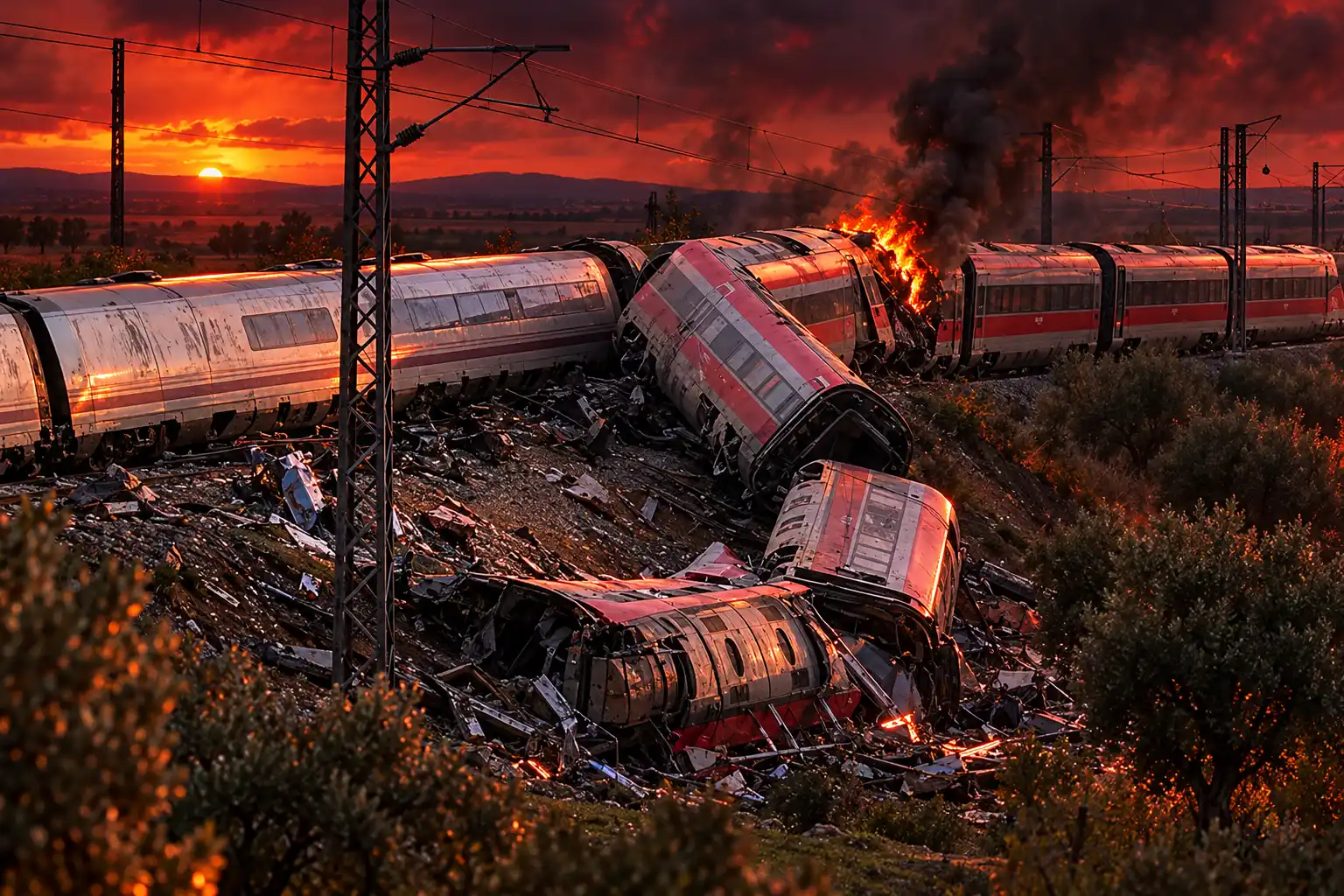
The Same Two Operators, Nine Months Apart
This is the second time in 2026 that an Iryo train and a Renfe train have been in a mass-casualty crash on the Madrid-Andalusia high-speed corridor. On January 18, near Adamuz in Córdoba province, an Iryo derailed and a Renfe Alvia hit the wreckage. That crash killed 46 people and injured 292.
The mechanics differ. Investigators into Adamuz have pointed to a broken rail at a weld. Urda, on the minister’s first account, is a control-room order after a computer outage. The common ground is the line, the two operators, and Adif as the infrastructure manager that owns the signalling.
THE TWO CRASHES ON THE MADRID-SEVILLE LINE
| Crash | Adamuz, January 18 | Urda, October 28 |
|---|---|---|
| Province | Córdoba | Toledo, kilometre 118 |
| Trains | Iryo and Renfe Alvia | Iryo 6076 and Renfe AVE 2080 |
| Dead | 46 | 68 |
| Working account | Broken rail at a weld | Normal-speed order after LZB failed |
Prime Minister Pedro Sánchez, speaking at the Urda command post, said it was not acceptable for Spain to suffer two such accidents in the same year. He promised a full inquiry and said that if there had been negligence, it would come out. He also said safety would be reinforced if that was what it took to rebuild trust in the rail system.
Why the Madrid-Seville Line Still Runs on LZB
LZB is a German continuous train-control system that has run the Madrid-Seville high-speed line since the route opened more than 30 years ago. It watches occupation and speed by block, and it is built to stop trains if it fails. That is what it did at 8:30. The next layer is human: Adif’s Atocha centre takes over, and drivers are supposed to crawl on sight until the system is back.
A European replacement, ERTMS, was meant to take over. The migration contract went to Thales about five years ago; that business later moved to Hitachi. The job was due to be live by early 2026. It is still in testing, and those tests can run only when there are no commercial trains on the line. Until it is finished, a 63-kilometre LZB hole puts six trains in the hands of radio orders and a backup signalling system, ASFA Digital, that reads lineside lights.
Sector engineers have already asked why ASFA did not brake the AVE. One account circulating among rail staff is that, given the layout, the Renfe train may not have met another stop signal between the order to move and the Iryo’s tail. That is a hypothesis for the Orgaz court and the technical inquiry, not a finding.
Spain opened this corridor to private high-speed operators after EU market rules. Iryo, owned by Trenitalia, Air Nostrum and Globalvia, began running the southern corridor on March 30, 2023. By 2024 it held 21% of the high-speed market. Ouigo, the SNCF low-cost unit, held 13%. Both deadly crashes this year put an Iryo train and a Renfe train on the same Adif tracks, under the same Atocha desk.
Drivers Had Already Flagged Degraded Running
The Spanish Union of Railway Drivers, Semaf, did not call Thursday’s strike after Urda. It called the 24-hour stoppage on October 16, after talks with the transport ministry, and said safety deals struck after Adamuz had stalled. About 6,000 traction staff across the Renfe group were due out from 00:01 to 23:59 on October 29. The union confirmed the action would go ahead, and told drivers to take extra care.
Semaf secretary general Diego Martín had already described a pattern that matches the morning’s first hour: LZB drops, trains run in a degraded mode, and that degraded mode starts to look normal.
Degraded operation cannot become a habitual way of working when the line’s main system fails, which lately is happening more often, and this way of operating cannot be normalised.
Diego Martín, secretary general, Semaf
WHAT THE UNION SAYS WAS ALREADY BROKEN
- Degraded mode: When LZB fails, drivers depend on verbal clearance from Adif and lose automatic emergency-brake supervision.
- Blind stretches: Drivers have warned of sections where that fallback is thin, including on the Madrid-Andalusia corridor.
- Stalled deals: Semaf says agreements on rail safety signed after Adamuz were not being carried out, which is why the October 29 strike was called.
The ministry set minimum services at 73% of high-speed and long-distance trains and 65% of medium-distance trains. Renfe told passengers that even guaranteed services could be hit and that it would not provide substitute transport. High-speed ticket sales on the Madrid-Andalusia corridor were blocked into December. Ouigo said its trains would stay cancelled at least through November 2.
What Adif Authorized With the Signal at Red
Puente briefed reporters from the Atocha control centre and put the blame on the decision to restart, not on the drivers. He said a rear-end crash on the Spanish network was barely believable. He also said the facts were not a system fault. Civil Guard officers questioned the Adif operator who had been regulating traffic between Urda and Los Yébenes. The CSIF public-workers’ union demanded Puente resign and said the traffic chief was entitled to a presumption of innocence.
There was a red signal prohibiting movement, yet the train was authorized to proceed. It is a decision made under inexplicable circumstances.
Óscar Puente, transport minister, Adif Atocha control centre
Puente said the centre had more than enough time to see the error and did not fix it. He said one driver among the stopped trains had to point out that the restart had to be line-of-sight, not normal speed, and that this correction never reached the AVE. Data journalist Kiko Llaneras, reconstructing speeds, wrote that the crash points to two failures in a chain: the LZB drop, then the order to resume at normal speed. Other trains, he wrote, got the same order, challenged it, and had it changed to line-of-sight. Speed traces on the AVE show it moved, accelerated past 200 km/h, and stopped dead at 8:53.
That gap, other drivers catching a bad order while one train did not, is the part of the morning that will be hardest for Adif to file as a single slip. The investigating court is Juzgado de Instrucción number 2 in Orgaz. Black boxes, the radio tape, and the Iryo driver’s report that she could not bring LZB back up will sit at the centre of that file.
Spain Starts Mourning as the Safety Strike Proceeds
Sánchez declared official mourning for October 29, 30 and 31, as he did after Adamuz. European Union flags flew at half-mast in Brussels. Most parties paused campaigning for the coming elections. Vox did not. Leader Santiago Abascal said his party would not join what he called an attempt to use mourning to silence criticism of the rail network. People’s Party leader Alberto Núñez Feijóo said Spain had a right to know what was happening with its infrastructure.
About 1,500 people gathered outside the transport ministry in Madrid on the night of October 28. Police used tear gas after bottles and flares were thrown. No injuries or arrests were reported from that crowd. Calls for Puente and Sánchez to resign were already in the street before the three days of mourning began.
The Civil Guard opened missing-person desks in Madrid, Toledo, Seville and Córdoba and asked first-degree relatives to give DNA. By 20:30 on October 28 those desks had taken 29 reports: 13 in Madrid, 9 in Toledo, 7 in Seville. Spokesman Ramón Cuevas said parents or siblings should come as soon as they could, with a physical description, clothing, and any tattoo, scar or jewellery.
WHERE FAMILIES CAN GIVE DNA
- Madrid: Guardia Civil, Calle Batalla del Salado 32, Arganzuela.
- Toledo: the provincial command on Avenida Barber 42.
- Seville and Córdoba: the provincial commands, kept open overnight with Madrid and Toledo.
Renfe activated its victim-assistance plan and published a 900 10 10 20 helpline. Iryo published 900 001 403. Castilla-La Mancha’s 112 service is on 900 122 112. The regional high court is routing identifications through 925 317 020 and atencionvictimas.trenorgaz@justicia.es.
January’s Broken Rail Has No Final Report
On the same morning the country went into mourning for Urda, the judge in the Adamuz case was still circulating CIAF notes about gaps in Adif’s weld paperwork. The transport ministry still hosts an open Adamuz investigation file, opened as expediente 08/2026, with updates running from January through March and no closing report. CIAF’s working hypothesis in late January was that the rail had already fractured before the Iryo passed, at an aluminothermic weld. Laboratory work on the broken section was still under way months later. The commission later told the Montoro court the two trains showed no prior defect, and that its conclusions stayed provisional until a final report.
Urda is a different failure on the same corridor. A computer drop, a red signal, a stopped private train, a state AVE cleared at line speed, and 17 minutes in which nobody pulled that clearance back. Spain’s worst rail disaster in the past decade remains the 2013 Angrois derailment, which killed 80 people after a curve where the new European control system was not in use. The Madrid-Seville line was supposed to have left LZB behind by the start of this year. It had not. Families in four cities are still being asked for DNA, and the line that carries them south is shut.

ADNOC Ship Hit in Hormuz Leaves One Crew Missing

SpiceJet’s Rs 5,500 Crore Plan Follows a Rescue That Failed

Hasina’s Return Fight Sets Fire to Yunus’s Bank

Bancroft Recants the 2018 Inquiry and Names the Team

Adhikari Ties the Saffron Saree Row to School Licences

Clancy Juror Says the Holdout Never Cited Evidence

The iPhone 18 Pro Max Splits Apple’s Fall in Two

OpenAI Calls GPT-6 Astra AGI Then Locks Its Exploits

Trump Claims Hormuz Control as Oil Holds Near $96

Russia Closes the Goethe-Institut Berlin Tried to Save

 NEWS2 months ago
Clancy Juror Says the Holdout Never Cited Evidence
- NEWS3 months ago
The iPhone 18 Pro Max Splits Apple’s Fall in Two
- NEWS3 months ago
OpenAI Calls GPT-6 Astra AGI Then Locks Its Exploits
- BUSINESS3 months ago
Trump Claims Hormuz Control as Oil Holds Near $96
- LIFESTYLE3 months ago
Russia Closes the Goethe-Institut Berlin Tried to Save
- AUTO3 months ago
Volkswagen’s Job Cuts Leave Four Plants Without Cars
- NEWS3 months ago
Dyson Puts Nurovi Robots on Sale Without the UV Flagship
- BUSINESS2 months ago
US Destroys Five Iranian Tankers as the Shock Hits Jordan










