
NEWS
The Starshield Speed Cap Returns During Moscow Talks
Ukraine’s Starshield terminals are again capped at 161 km/h during U.S.-Russia talks in Moscow, a repeat of the October limit that slowed jet-drone intercepts.

Ukraine’s military Starlink terminals on the Starshield service are again capped at 161 kilometers per hour, President Volodymyr Zelensky said on November 12, as U.S. envoys sat down with Vladimir Putin in Moscow. He said the limit is systematic, not a glitch, and that jet-powered Russian drones have already scored hits because interceptor systems cannot catch them in time.
The 161 km/h Cap Is Back Along the Front
Zelensky wrote that he had just been briefed by Defense Minister Yevhenii Khmara and Commander-in-Chief Mykhailo Drapatyi. Units had been logging Starshield failures for several days along the whole front and in occupied areas, with the service cutting out at 161 kilometers per hour (100 miles per hour).
The Ukrainian military, he said, had already checked the pattern. “These are not random errors but systematic speed restrictions.” The first cost, he added, is “a significant complication in intercepting Russian jet-powered drones,” and “this is helping the Russians kill more Ukrainians and carry out more accurate strikes against Ukraine.” Kyiv, he said, is “trying to establish all the circumstances with the American side.”
Received briefings from Minister of Defense of Ukraine Yevhenii Khmara and Commander-in-Chief of the Armed Forces of Ukraine Mykhailo Drapatyi. Unfortunately, our units have been recording significant disruptions to Starshield’s operations over the territory of Ukraine for…
— Volodymyr Zelenskyy / Володимир Зеленський (@ZelenskyyUa) November 12, 2026
A corps-level commander in Donetsk Oblast, speaking anonymously, said the same limit was still in force there, which also makes Ukraine’s own mid-range strike drones easier to catch or dodge. The number is not a new invention. It is the same 100 mph policy that landed overnight on October 13 to 14, was lifted on October 24, and has now been pulled a second time.
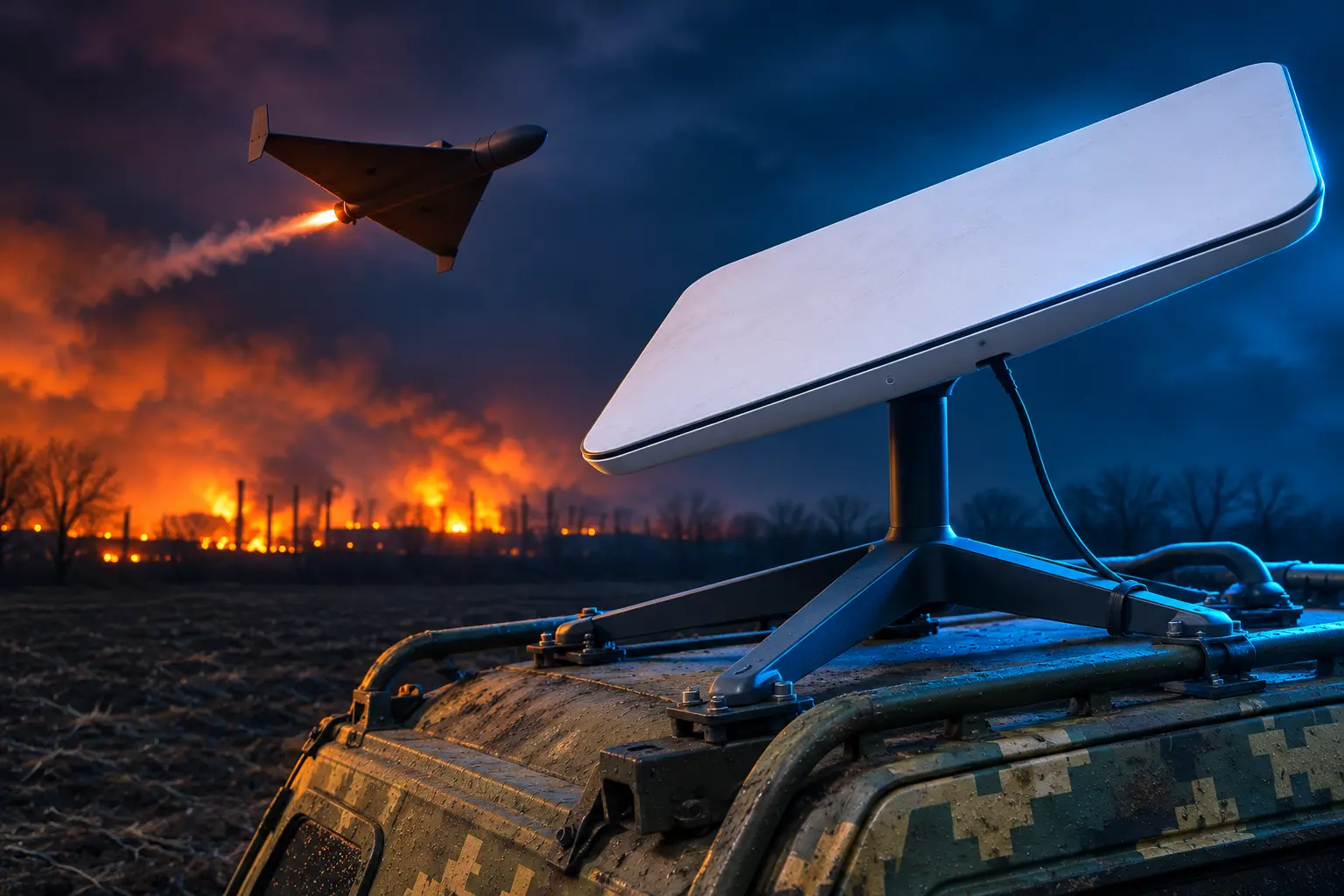
Why Interceptor Drones Stall at 100 mph
Starshield is SpaceX’s military service on the Starlink constellation, sold to the U.S. government and licensed for moving platforms. A 161 km/h cap does not black out the front. It takes the cheap, fast layer of air defense offline, because a terminal that drops the link cannot steer a jet interceptor into a target that is already flying faster than 400 km/h.
Civilian Starlink and the military service share satellites, but they do not share the same license. The encrypted government network behind those terminals is what lets a dish ride on a drone, a truck, or a boat. When that license is rewritten as a 100 mph rule, the hardware is still on the roof. The chase is over.
SPEEDS THE 161 KM/H CAP COLLIDES WITH
| What is flying | Speed | What the cap does |
|---|---|---|
| Starshield cap now in force | 161 km/h (100 mph) | Moving terminals lose the link |
| Starshield after the Oct 24 restore | Above 400 km/h | Terminals stayed connected |
| Russian jet-powered Shaheds, per Zelensky | Faster than 400 km/h | Interceptors cannot close |
| Geran-4 and Geran-5 | Up to 600 km/h | Same chase problem, faster target |
Zelensky said in October that once speeds exceed 161 km/h, the link dies after about two minutes and the drone is lost. Mike Orliuk, spokesman for the Ukrainian firm Wild Hornets, said some interceptors carry a terminal on board and have to fly fast with it, and that in those cases the limit makes the flight impossible. The company’s Sting interceptors, he said, had destroyed more than 15,000 Shaheds and Gerberas in a year. Sting’s current sorties were still flying. An air-launch project that needs a high-speed terminal was under review.
WHAT STOPS WORKING ABOVE THE CAP
- Jet interceptors: The cheap drones that have to outrun jet Shaheds lose steering once the dish hits the cap.
- Mid-range strikes: Zelensky said the same limit blocked shots at military targets in occupied areas during the October episode.
- Frontline resupply: He said troops who live on food and water flown in by dish-equipped drones lose that run when the terminal is throttled.
Oleg Kutkov, a Kyiv electronics engineer who publishes Starlink firmware research, wrote that the Starshield kits in Ukraine are ordinary dishes given a government service profile, not a secret hardware hack, and that a flag such as MOVING_TOO_FAST_FOR_POLICY is a network rule. That is why a software limit can idle a whole class of aircraft without anyone touching the front.
October Already Proved the Switch Works
The first cap arrived with no warning, in the middle of a political fight over Ukrainian strikes on Russian refineries and a U.S. plan to buy Russian diesel. Zelensky said Russia launched more than 850 Shaheds from October 14 through 9 a.m. on October 15, “precisely at a time of an artificial speed restriction on our defensive capabilities.” Some were shot down. Dozens of hits still landed.
THE FIRST THROTTLE AND THE LIFT
- October 13 to 14, 2026: Overnight, Starshield terminals lose connectivity around 100 mph. Serhiy Beskrestnov, a defense-tech adviser to Zelensky, says several missions fail with no notice.
- October 14, 2026: Elon Musk writes that Starshield systems are owned and controlled by the U.S. government and that limits are set by the U.S. military and, ultimately, the president.
- October 15, 2026: Zelensky reports more than 850 Shaheds in roughly a day and a half, with dozens of hits while the cap is on.
- October 16, 2026: Zelensky tells reporters in Brussels that Starlink is used to intercept jet Shaheds that kill civilians, not for strikes inside Russia, and that the tool was slowed, not switched off.
- October 22, 2026: Sen. Richard Blumenthal opens an inquiry and asks SpaceX to brief his subcommittee by November 12.
- October 24, 2026: Ukraine’s defense ministry says the connection is stable again above 400 km/h. Hours later, Musk writes that “Ukraine military violated Starlink terms of service and used it for offensive drone strikes to kill people. That loophole was closed last week.”
The Institute for the Study of War, reading Ukrainian air-force tallies, found that the share of jet-powered drones shot down fell from 77% to 74% from October 14 to 24, a drop of 3 percentage points. ISW did not claim the cap alone caused the change. Fighter jets with missiles and guns carried a larger share of the work, which burns scarce airframes and ammunition to replace a drone that costs a fraction of a missile. That is the bill the October test sent Kyiv, even when the headline miss rate barely moved.
Beskrestnov said Ukraine cannot use commercial Starlink for medium- or long-range attack drones because the service does not run over Russia and has, for months, carried its own low speed limits. The military’s high-speed channel is Starshield. Musk’s terms-of-service charge and Kyiv’s geography argument are talking about different networks.
Who Can Throw the Switch
Publicly, nobody owns the order. Musk pointed at the Pentagon and the president. President Donald Trump said he did not do it and did not think Musk did either. Secretary of State Marco Rubio called reports of a White House role “categorically false” and said Zelensky did not know “what he’s talking about.” Zelensky, on Meet the Press, said the message “came from government” and that SpaceX carried it out. Separate accounts have said Musk proposed the cap and Trump agreed, or that Musk ordered it after talking to the president. The Pentagon has not settled the record.
WHAT WE KNOW
- The tool: A speed policy on Starshield, not a total blackout of the constellation.
- The notice: Ukrainian units got none before the October drop, and they are again asking Washington what changed.
- The operator: SpaceX builds and runs the network; the U.S. government buys Starshield and, Musk says, controls it.
WHAT IS UNCONFIRMED
- The author: White House, Pentagon, SpaceX, or some mix of the three.
- The legal switch: Who, under the contracts, may geofence, throttle, or shut a partner off, and on what notice.
- The motive this week: No official has tied the second cap to the Moscow meetings, and none has denied a link either.
Musk’s October 14 line still sits over the argument. He wrote that Starshield is “owned and controlled by the US government” and that any limits on speed or usage are “decided by the US military and ultimately POTUS.” If that is true, the November cap is a U.S. policy choice during a U.S.-run peace shuttle. If it is not, SpaceX can still rewrite a partner’s air defense from California. Either version is a single point of failure.
The events in Ukraine show how a single point of control can be turned against the forces that depend on it. A decision to degrade service, applied quickly and without notice, has disabled missions across an entire military theater.
Richard Blumenthal, U.S. Senator, letter to Defense Secretary Pete Hegseth
Blumenthal asked who holds authority to activate, restrict, geofence, or shut off Starshield, whether SpaceX can do it without Pentagon leave, and what notice partners get. He asked for answers by November 5 and for a SpaceX briefing by November 12, the same date Zelensky reported the cap was back and Jared Kushner and Steve Witkoff were in Moscow. A single point of control can be turned into an inquiry. It has not yet been turned into an answer.
Kushner and Witkoff Go From Putin to Zelensky
Kushner and Witkoff, President Trump’s envoys, went to the Kremlin on November 12 after two days of U.S.-mediated talks in Abu Dhabi that ended on November 11 with no ceasefire. An AFP journalist saw their motorcade arrive shortly after 1:00 p.m. (1000 GMT). Kremlin aides Yuri Ushakov, Kirill Dmitriev, and Vladimir Medinsky were listed as present. After Moscow, the pair were due in Dublin to brief Zelensky, who was already in Ireland for a November 13 informal meeting of EU leaders.
Kushner said they would go over the Abu Dhabi file with Putin “because we see some openings and some opportunities.” He also said he would ask Putin to bless a European seat at later talks, and he urged Europe to pick one person to speak. Medinsky, who led the Russian delegation in Abu Dhabi, said the sides had “moved closer to achieving peace,” then added that a lot now depends on Ukraine, on the United States, and on “whether Europe comes to its senses.” Moscow has treated Europe’s support for Kyiv as a reason to keep Europeans out of the room.
Zelensky, arriving in Dublin, called the moment a “window of opportunity” to end the war before 2027 and said he was still “sceptical.” “What’s important is that the Americans flew to Putin with specifics. I would very much like them to return to Dublin with specifics.” He welcomed talk of a large prisoner swap, which he said could involve 1,000 or 1,200 captured soldiers from each side. Davyd Arakhamia, on the Ukrainian team in Abu Dhabi, spoke of “good momentum” toward a deal by the New Year. None of those lines mentioned Starshield. The terminals on the front did not wait for the communiqué.
No One Answered Kyiv on the Last Blackout
Denys Sienik, Ukraine’s chargé d’affaires in Washington, told the Defense Writers Group on November 5 that Kyiv still had no explanation of the October cap from the Pentagon, the White House, or SpaceX. “Nobody provided answers,” he said. The good news, he added, was that service had been restored so the army could work. “Do we want another situation like that? Definitely not.”
THE STARSHIELD FILE
- Terminals on contract: Space Systems Command tied about 2,500 dishes already in Ukraine to Starshield and shipped 500 more, a total of 3,000 terminals, in a December 2024 account.
- Earlier award: A one-year Starshield contract valued at $70 million ran through September 30, 2024, with an option to serve 54 military mission partners.
- Expiry: Sienik said the current access deal ends in mid-2027 and that talks on a successor need to start now.
“The contract expires next year for Starshield. And we understand that it requires time to negotiate a new one,” Sienik said. “Now is actually the time.” He wanted “clarity” on whether Ukraine can proceed and on the terms. He said those talks were starting with Pentagon leaders. Seven days later, the cap he said had been fixed was back, and the briefing date Blumenthal had put on SpaceX was the same date as the Moscow meeting.
Ukraine is already trying to own a slice of the pipe. HIMERA and Denmark’s GomSpace said on October 27 that OBRIA NANO, a first test satellite rather than a network, was in orbit. That is a prototype, not a substitute for 3,000 frontline dishes. For the rest of this war, and through the mid-2027 renewal, the interceptors still log in through SpaceX and the U.S. government.
Rassvet Gives Russia Its Own Hour in Orbit
While Kyiv argues over a speed flag, Russia is lighting its own low-orbit service. Ukrainian military intelligence said on November 6 that the Rassvet network is already carrying military traffic over Ukraine, with more launches planned by the end of 2026, in a bid to make strike drones more accurate and harder to jam. GUR spokesman Andrii Yusov said that, over time, it could help strike and reconnaissance drones adjust to moving targets and slip electronic warfare. Mykola Zientsev, a Kyiv security analyst, wrote that Russia already has at least two strong satellite-communications windows each day, each lasting more than an hour.
The October test showed what a 100 mph policy costs even when the shoot-down rate only slips a few points: jets and missiles fill in, interceptor projects get redesigned, and mid-range shots in occupied areas get cancelled. The November cap puts that cost back on the table while Kushner and Witkoff carry a peace file from Putin to Zelensky. Sienik asked for terms. He still does not have the last outage explained, and the terminals that have to catch the jet drones are running on a known limit again.

ADNOC Ship Hit in Hormuz Leaves One Crew Missing

SpiceJet’s Rs 5,500 Crore Plan Follows a Rescue That Failed

Hasina’s Return Fight Sets Fire to Yunus’s Bank

Bancroft Recants the 2018 Inquiry and Names the Team

Adhikari Ties the Saffron Saree Row to School Licences

Clancy Juror Says the Holdout Never Cited Evidence

The iPhone 18 Pro Max Splits Apple’s Fall in Two

OpenAI Calls GPT-6 Astra AGI Then Locks Its Exploits

Trump Claims Hormuz Control as Oil Holds Near $96

Russia Closes the Goethe-Institut Berlin Tried to Save

 NEWS2 months ago
Clancy Juror Says the Holdout Never Cited Evidence
- NEWS3 months ago
The iPhone 18 Pro Max Splits Apple’s Fall in Two
- NEWS3 months ago
OpenAI Calls GPT-6 Astra AGI Then Locks Its Exploits
- BUSINESS3 months ago
Trump Claims Hormuz Control as Oil Holds Near $96
- LIFESTYLE3 months ago
Russia Closes the Goethe-Institut Berlin Tried to Save
- AUTO3 months ago
Volkswagen’s Job Cuts Leave Four Plants Without Cars
- NEWS3 months ago
Dyson Puts Nurovi Robots on Sale Without the UV Flagship
- BUSINESS2 months ago
US Destroys Five Iranian Tankers as the Shock Hits Jordan










