
NEWS
Sintaphu Burst Repeats a Familiar Himalayan Flood Script
A listed Bhutan glacial lake burst on 29 October, wrecked Gasa Tshachu again, and emptied Sankosh villages in India.

A listed glacial lake in Bhutan’s Gasa district burst on the evening of 29 October 2026 and sent a debris flood down the Mo Chhu. By Friday morning the Gasa Tshachu hot springs were gone, a slice of the Punakha-Gasa highway had been washed out, and districts in West Bengal and Assam had moved thousands of people away from the Sankosh River. No deaths had been reported in Bhutan or in India.
The National Center for Hydrology and Meteorology records the lake as Sintaphu, also written Shintaphu Tsho, below Wakila Mountain in Lungo, Laya Gewog. It sits on Bhutan’s 2019 list of 17 dangerous lakes. That list is why a night flood in a highland gewog became a red alert on an Indian river that changes its name at the border.
Sintaphu Burst After Dark on the Mo Chhu
Water left the lake on Thursday evening and reached Taktsemakhang at about 8.15 pm, tearing up the road that serves Laya, one of Bhutan’s most remote highland settlements. Tshering Dorji, teacher-in-charge at Lungo Extended School, the nearest school to the lake, said the ground shook and that the roar at the source later died down. People in exposed spots were moved. Sirens went on along the Mo Chhu and farther down the Punatsangchhu. India was told.
NCHM said it was watching the Mo Chhu at Tashithang, and later at Yebesa as well. An NCHM official said the water-level station at Taktsimakhang had not thrown an alert when the first reports came in. The flood still arrived there.
A glacier lake outburst flood (GLOF) which has originated from the Sintaphu lake at Mochu subbasin Gasa has been reported.
The NCHM is currently monitoring the water level along the Mochu river at Tashithang. India has been informed. pic.twitter.com/ArS7S73wd2
— The Bhutanese (@thebhutanese) October 29, 2026
THE NIGHT THE MO CHHU ROSE
- Evening of 29 October 2026: A sudden release is reported from Sintaphu Lake in Laya Gewog, Gasa.
- About 8.15 pm: Floodwater reaches Taktsemakhang and cuts the road toward Laya.
- Thursday night: Sirens start on the Mo Chhu and the Punatsangchhu. NCHM tells India. The Central Water Commission warns that water may hit the border in 6 to 8 hours.
- Overnight: Gasa Tshachu is destroyed. Debris hits the Punakha-Gasa highway. A solar irrigation scheme in Punakha stops.
- Morning of 30 October 2026: No deaths are reported. The highway’s 31.85-kilometre point is closed. Alipurduar police say the flow has eased a little and keep a red alert on the Sankosh.
The cause of the release, how much water left the lake, and whether the basin is still unstable were not settled by Friday morning. Field teams, gauge data and satellite pictures still have to answer those questions.
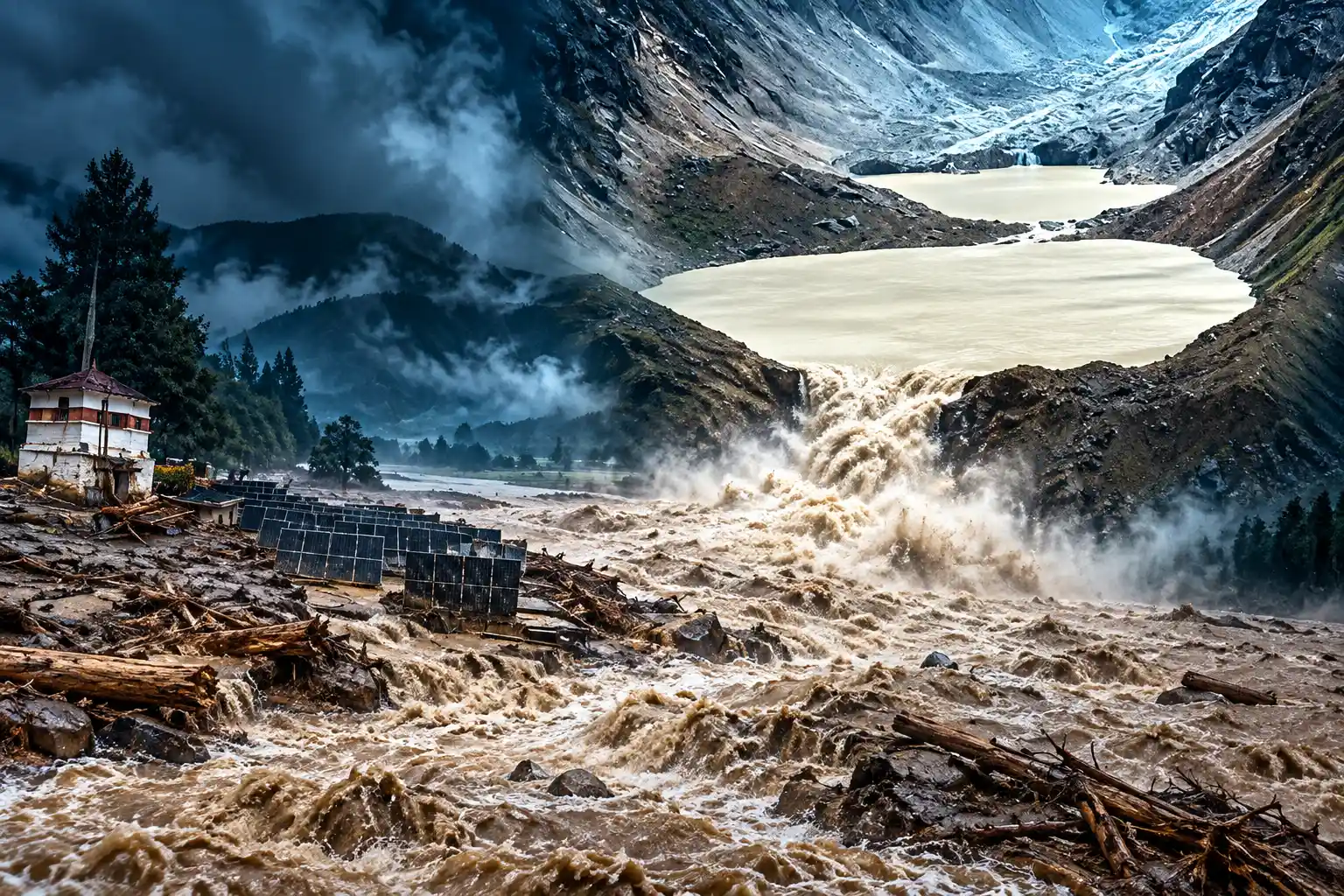
Gasa Tshachu Is Gone for the Second Time
Friday’s first hard damage report was not a village death toll. It was a tourist site. Floodwater washed away Gasa Tshachu, the hot-spring complex on the Mo Chhu that draws visitors into northern Gasa. Night and the force of the current stopped anyone from measuring the wreck in the dark. Two Bailey bridges may have gone with it; that had not been confirmed.
The same springs were wrecked on 26 August 2021, when the Mo Chhu changed course and ran through the site. Rebuild, then lose the place again, is now the record for Gasa Tshachu. Kuensel’s road note, relayed through later accounts, said the track toward Laya was impassable and closed with no reopening time. Daily Bhutan’s update named the washout on the Punakha-Gasa Secondary National Highway at the 31.85-kilometre point and told travellers to wait.
Farther down, the Solar Irrigation Lifting System in Dochhukha-Dzomlingthang-Ritsa Chiwog, Guma Gewog in Punakha, was partly smashed and stopped working. The tshogpa for that chiwog said the scheme had been put in this year because the hamlet did not have enough water. Debris also landed on the Punakha-Gasa highway near Dzomlingthang. A chiwog that lacked water in the planting season lost its new pumps to a pulse of glacial melt.
This River Has Flooded From Listed Lakes Before
Sintaphu is not an unknown pond that surprised a map. NCHM’s 2019 reassessment, which cut an older set of 25 listed lakes to 17, treats Mo_gl 234 as Sintaphu Tsho. Teams surveyed the main lake, the upper lake, the moraine and the feeding glacier in May and June 2023, and monitoring kit is already in the area. Two of the 17 listed lakes sit in the Mo Chhu headwaters. Nine more sit on the Pho Chhu. Together those 11 make the Punatsangchhu the most loaded basin in the country.
That is why a Darjeeling MP, Raju Bista, told people a GLOF had been reported at Lemthang, and why a West Bengal minister used the same place name. Lemthang is the last outburst this sub-basin already had.
GLOFS ALREADY ON THIS SYSTEM
| Date | Lake | Sub-basin | What it did |
|---|---|---|---|
| 7 October 1994 | Lugge Tsho | Pho Chhu | About 18 million cubic metres released; 20 people killed; Punakha Dzong and scores of houses damaged |
| 28 June 2015 | Lemthang Tsho | Mo Chhu | About 0.37 million cubic metres; lake emptied; four cantilever bridges and horse trails wrecked |
| 29 October 2026 | Sintaphu Tsho | Mo Chhu | Gasa Tshachu destroyed; Laya road and Punakha-Gasa highway cut; Punakha irrigation stopped; Sankosh alerts in India; no deaths reported |
The 1994 flood is still the national memory. NCHM says the partial collapse of Lugge’s moraine sent about 18 million cubic metres down the Pho Chhu, killed 20 people and tore into Punakha Dzong. A 2009 outburst from Tshojo, also on the Pho Chhu, is in the scientific record. Then came the 2015 Lemthang Tsho outburst, a smaller emptying of a listed Mo Chhu lake after two days of rain opened a path through ice. Compared with 1994 it was modest. It still took bridges. Sintaphu is the next name on that list, in the same headwaters, with the same downstream towns in the way.
Why the Punatsangchhu Dams Opened Their Gates
Indian flood alerts on Thursday night said the surge had reached the Punatsangchhu-II dam, that the reservoir had been emptied and that sluice gates were open. The 1,020 MW plant, which began running in December 2024, sits on the river formed when the Mo Chhu meets the Pho Chhu at Punakha. Punatsangchhu-I, at 1.2 GW, is still being built on the same stretch. Both are India-Bhutan projects. Both sit below the densest cluster of listed lakes in the country.
Rinzin Gyeltshen, joint managing director at Punatsangchhu-II, said the flood would carry logs, branches and other floating debris. That is the load a spillway is least able to treat as ordinary water. Opening gates can pass a pulse. Trees, boulders and concrete can choke intakes, tunnels and gates, which is why a plant that is designed for an extreme flood can still go offline when a glacial lake lets go.
Hydropower makes up 12 to 15 percent of Bhutan’s GDP. Electricity is about 40 percent of exports and 36 percent of government revenue. After Punatsangchhu-II came on, 2025 power sales to India reached BTN 24.3 billion (USD 285 million). A GLOF on this river is not only a highland road story. It is a hit on the export that pays the bills.
The lake everyone has drilled for is not Sintaphu. It is Thorthormi, on the Pho Chhu, with Raphstreng below it. Researchers have already run a 2024 model of a Thorthormi breach that sends a peak of 16,360 cubic metres a second down the Pho Chhu within four hours, covering 245 hectares of farmland and more than 1,277 buildings, and putting both Punatsangchhu plants in the wet zone. NAPA work lowered Thorthormi by 3.68 metres and released about 17 million cubic metres, short of the original target. Siphon trials are still going on. Sintaphu, a smaller listed lake on the sister river, burst first.
Alipurduar Moved Thousands Before the Water Arrived
Once the Mo Chhu and Pho Chhu join, the Punatsangchhu runs south and enters India as the Sankosh, then the Brahmaputra. The Central Water Commission’s Flood Forecast Monitoring Directorate issued a special advisory on 29 October after the Indian Embassy in Bhutan reported the outburst. It said floodwater would travel downstream, reach the border in 6 to 8 hours, and could hit Alipurduar in West Bengal and Dhubri in Assam. Gauge sites at Barobisha, Sankosh LRP, Golakganj and Baladoba were told to watch the river.
West Bengal also warned the Darjeeling hills, Jalpaiguri and Cooch Behar. NDRF and SDRF teams went to Tufanganj and Boxirhat in Cooch Behar, both on the Sankosh near the Assam line. Manoj Kumar Oraon, West Bengal’s forest minister and the MLA for Kumargram, told people along the Sankosh in Alipurduar to leave, saying a surge could reach Kumargram in one to one-and-a-half hours. Raju Bista asked people in the Darjeeling hills, Terai and Dooars to stay alert. Some of those messages named Lemthang. The lake that burst was Sintaphu. The river they were pointing at was the right one.
WHAT INDIA STOOD UP OVERNIGHT
- The CWC line: A special advisory on 29 October warned of a sudden rise on the Sankosh and a 6 to 8 hour run to the India-Bhutan border, naming Alipurduar and Dhubri.
- The West Bengal belt: Alipurduar, Jalpaiguri, Cooch Behar and the Darjeeling hills were told to watch the river; NDRF and SDRF went to Tufanganj and Boxirhat.
- The shelters: Kumargram block put people in 18 centres, using schools, community halls, religious buildings and tea-garden rooms, with dry food, drinking water and toilets.
Alipurduar Superintendent of Police Amit Kumar Shaw said about 4,000 to 5,000 people had been moved into school shelters and more than 6,000 had been taken to safer ground. Those are two counts, not one sum. He said the pulse from Bhutan had eased a little and that a red alert still sat on the Sankosh, which could carry dead fish, timber and chunks of concrete.
First of all, I would like to tell the residents of the district that there is absolutely no need to panic. The situation is currently under control. We are in constant touch with the authorities in Bhutan.
Amit Kumar Shaw, Superintendent of Police, Alipurduar
He said police, the district magistrate’s office and civil defence were working together, SDRF was on the ground, and an NDRF team was on the way. By Friday, officials said the dangerous window on the Indian side had passed and that people in the warned belts, including pockets of Assam, were safe. The red alert did not come off with that sentence.
The Warning Came After Water Hit Taktsemakhang
Bhutan does have a GLOF warning net on this basin. The Punatsangchhu system, built under the National Adaptation Programme of Action between 2009 and 2013, uses 10 upstream hydro-met and water-level stations and 18 sirens, with a 24-hour room in Wangdue. For a Thorthormi burst, planners still quote six hours to Punakha Dzong, 5.3 hours to Samdingkha and two hours to Lhadi. Seventy-seven communities, 1,196 households and 11,921 people are listed as exposed from Gasa through Punakha and Wangdue Phodrang to Tsirang.
Sintaphu showed the other face of that net. Kit is in the catchment. Sirens did sound. India was informed in time to empty riverbank hamlets. The station at Taktsimakhang, though, had not thrown an alert when the first word went out, and the flood was already at the road. Detection still depends on water rising at a gauge. A forecast that uses rain, heat and lake change, which NCHM has wanted since at least 2017, is not what ran on Thursday night. In June 2026 a USD 22 million concept to upgrade climate information and multi-hazard warnings won Green Climate Fund approval. The old sirens were what Gasa had.
WHAT WE KNOW
- The lake: Sintaphu Tsho, a listed dangerous glacial lake on the Mo Chhu in Gasa, released water on the evening of 29 October 2026.
- The human toll: No deaths or injuries had been reported in Bhutan or in the Indian districts on alert by the morning of 30 October.
- The wreckage: Gasa Tshachu is gone, the Laya road and the Punakha-Gasa highway’s 31.85-kilometre point are closed, and a new solar irrigation scheme in Punakha has stopped.
WHAT IS UNCONFIRMED
- The breach: Whether the lake fully burst, partly burst, or overtopped, and what set it off.
- The kit: How the automated monitors behaved, and whether two Bailey bridges were actually lost.
The volume: How much water left the lake, and whether the basin is still unstable.
Accounts on Friday morning said floodwater had crossed Srigang in Kabesa Gewog, about eight kilometres below Punakha Dzong. That is a downstream marker, not a finished survey. Until bathymetry and satellite stills are public, the night is a confirmed flood with an unmeasured tank behind it.
Sixteen Other Lakes Remain on Bhutan’s Watch List
NCHM counted 567 glacial lakes in an earlier inventory. A 2026 count puts the total at 620. The Pho Chhu sub-basin, already the hotspot, went from 157 lakes to 187. The extra water is not abstract. It is new ponds on debris, old ponds getting wider, and a watch list that still has 16 names on it after Sintaphu.
Prime Minister Tshering Tobgay has called the Punatsangchhu headwaters the country’s most dangerous, with 11 listed lakes, nine of them on the Pho Chhu. The nightmare on that side is still a Thorthormi failure that cuts into Raphstreng. Worst-case planning has used a combined dump of more than 53 million cubic metres, several times the 1994 flood. Lunana is where the siphon crews go. Gasa, on Thursday, is where the water actually went.
In early October, glaciologist Karma Toeb was at Thorthormi again, his 32nd visit since 1997, and said the place was changing faster than the work. “The environment is changing so fast,” he said. “We are not contributing anything to the impact of climate change, but still we have to face this burden.”
Thursday’s flood did not kill anyone. It did take a hot-spring complex that had already been rebuilt once, a highland road, a new irrigation scheme, and a night of sleep from thousands of people on the Sankosh. Sixteen listed lakes are still on the books, most of them above the same dams, dzongs and border gauges that just ran the drill.

ADNOC Ship Hit in Hormuz Leaves One Crew Missing

SpiceJet’s Rs 5,500 Crore Plan Follows a Rescue That Failed

Hasina’s Return Fight Sets Fire to Yunus’s Bank

Bancroft Recants the 2018 Inquiry and Names the Team

Adhikari Ties the Saffron Saree Row to School Licences

Clancy Juror Says the Holdout Never Cited Evidence

The iPhone 18 Pro Max Splits Apple’s Fall in Two

OpenAI Calls GPT-6 Astra AGI Then Locks Its Exploits

Trump Claims Hormuz Control as Oil Holds Near $96

Russia Closes the Goethe-Institut Berlin Tried to Save

 NEWS2 months ago
Clancy Juror Says the Holdout Never Cited Evidence
- NEWS3 months ago
The iPhone 18 Pro Max Splits Apple’s Fall in Two
- NEWS3 months ago
OpenAI Calls GPT-6 Astra AGI Then Locks Its Exploits
- BUSINESS3 months ago
Trump Claims Hormuz Control as Oil Holds Near $96
- LIFESTYLE3 months ago
Russia Closes the Goethe-Institut Berlin Tried to Save
- AUTO3 months ago
Volkswagen’s Job Cuts Leave Four Plants Without Cars
- NEWS3 months ago
Dyson Puts Nurovi Robots on Sale Without the UV Flagship
- BUSINESS2 months ago
US Destroys Five Iranian Tankers as the Shock Hits Jordan










