
BUSINESS
Sensex Rallies 1,233.25 Points as Costly Oil Still Bites
Sensex gained 1,233.25 points on a Reliance surge, even as $110 oil left India’s import bill and the rupee under strain.

The Sensex closed 1,233.25 points, or 1.66%, higher on November 2, 2026, at 75,692.78. Reliance Industries jumped 11.64% after a record quarter, and the Nifty 50 settled at 23,440.80, up 387.70 points, or 1.68%.
Brent crude eased on Qatar-mediated talks aimed at ending the U.S.-Iran war. The rupee still fell 21 paise to 94.97, and India’s crude bill is already 46.3% higher this half-year.
Sensex Adds 1,233.25 Points as Reliance Jumps 11.64%
Gift Nifty had risen 189 points to 23,275 before the bell, and the cash market followed through. The Sensex opened at 75,178.24 against a previous close of 74,459.53. The Nifty 50 opened at 23,222.30 against 23,053.10, dipped to 23,207.05, then closed on its session high.
It was the third straight advancing session and the Sensex’s highest close since September 7. Both benchmarks finished at the day’s peak. Analysts had warned that early gains could fade if funds booked profits. They did not. Buying held into the close.
The tape was not a broad risk-on melt-up in every pocket. Energy, metals and the index heavyweight did the lifting. Banks lagged that move, and listed IT stocks finished lower, in line with the overnight selloff in U.S. technology names that some desks still treat as a bid for Indian assets.
Dr. V.K. Vijayakumar, chief investment strategist at Geojit Investments, said a weakening trend in the AI trade “is beneficial for India which is widely regarded as a counter AI play.” He added, “For now, it is advantage bulls.”
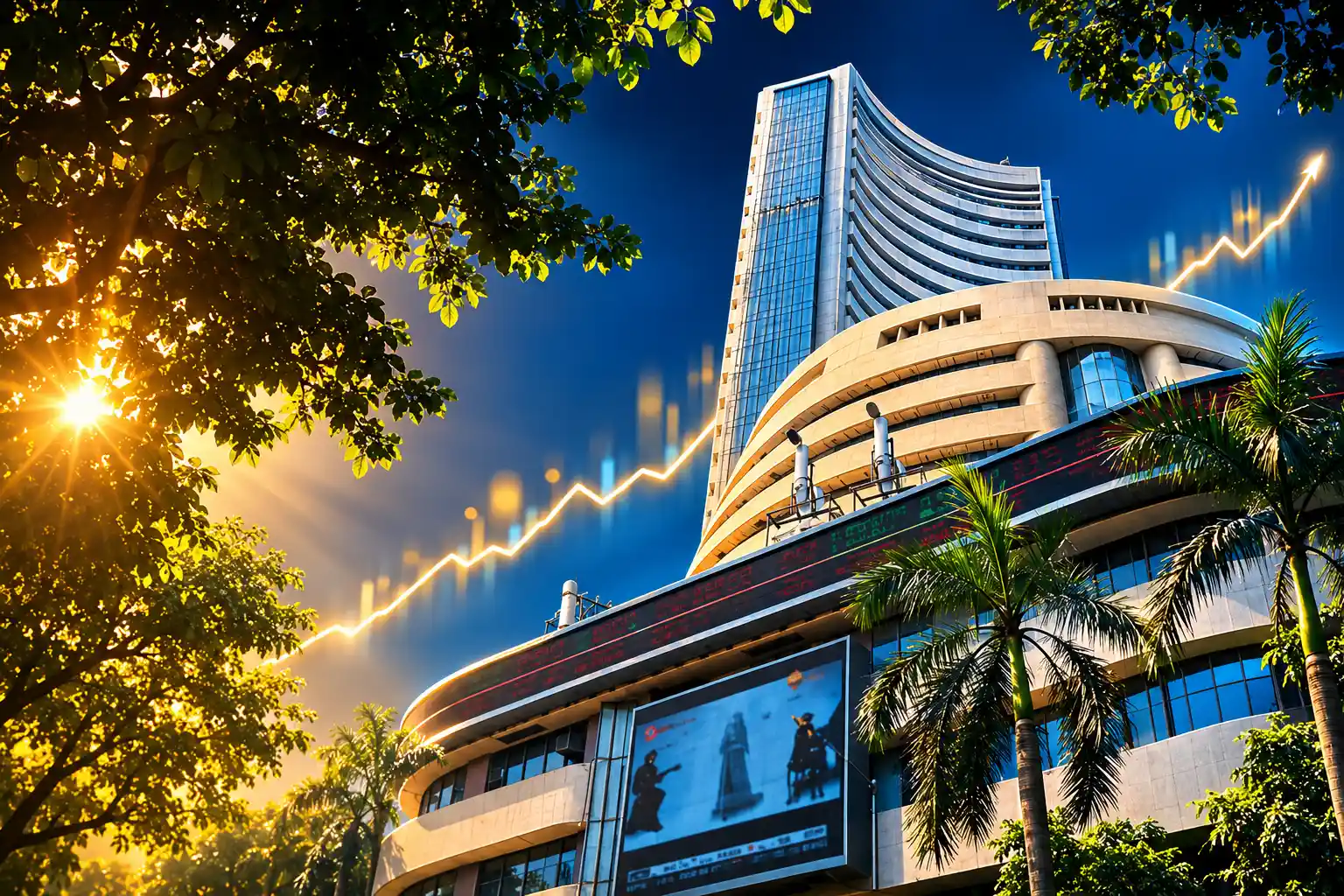
Reliance’s Record Profit Came From Fuel Cracks
Reliance’s stock, which had closed at ₹1,164.90 in the previous session, led the Nifty 50 after the company reported results on October 30 for the quarter ended September 30, 2026. The release put a record quarterly profit of ₹29,550 crore ($3.1 billion), up 33.8% from a year earlier.
Gross revenue rose 27.8% to ₹362,268 crore ($37.8 billion). EBITDA rose 23.9% to ₹62,409 crore. The oil-to-chemicals arm did the heavy work. Segment revenue rose 44.2%. Segment EBITDA rose 67.9% to ₹25,203 crore.
WHAT FED THE O2C PRINT
- Fuel cracks: Transportation fuel cracks rose 3 to 3.7 times from a year earlier in a tight global refining market.
- Crude and fuels: Crude prices for the quarter rose 40.6%, and transportation fuel prices were up 50 to 78%.
- Chemicals: Most downstream chemical product prices rose 25 to 35%, and polyester-chain margins improved 33%.
Higher crude premiums, freight, SAED-related costs and under-recoveries in domestic fuel retail still ate into that capture. Retail EBITDA fell 8.6% to ₹6,228 crore, with the festive calendar shifted into the next quarter. Jio Platforms reported revenue of ₹47,485 crore, up 11.3%, and EBITDA of ₹21,879 crore, up 16.6%. Profit after tax there rose 13.7% to ₹8,387 crore.
Our O2C business delivered a particularly strong performance this quarter, led by tight fuel markets, improved downstream petrochemical deltas and firm domestic demand.
Mukesh D. Ambani, Chairman and Managing Director, Reliance Industries Limited, Q2 results statement
That is the hinge in Monday’s rally. The same war-premium cracks that fattened refining earnings are the costs India still pays on the barrels it must import. A one-day 11.64% jump also prices a lot of an oil-to-chemicals beat at once. Refining profits usually command a lower multiple than the telecom arm, and the stock’s move leaves little room if cracks cool as fast as they ran hot.
Why $110 Oil Still Hits India’s Import Bill
During Indian hours, Brent traded at $110.01 a barrel, down 3.02%, and U.S. West Texas Intermediate was at $100.94, down 3.05%. That is a pullback from late October, when Brent hovered near $118 and ended the month at a six-month high. It is not cheap oil for an economy that still buys most of its crude abroad.
By 8:40 a.m. ET, after Mumbai’s close, Brent for January delivery was at $106.37, down 6.2%, with WTI at $97.63, also down 6.2%. The later drop helps Tuesday’s open. It does not rewrite the bill already booked for April to September.
The Petroleum Planning and Analysis Cell, the oil ministry’s data arm, puts the crude import bill of $90.6 billion in the first half of FY27 against $61.9 billion a year earlier. Volumes barely moved. Almost all of the extra outlay is price.
INDIA’S CRUDE BILL IN THE FIRST HALF
| Measure | April-September 2026 | April-September 2025 | Change |
|---|---|---|---|
| Crude import bill | $90.6 billion | $61.9 billion | +46.3% |
| Import volume | 122.7 million tonnes | 121.8 million tonnes | +0.8% |
Imports still covered 88.1% of crude needs in the half-year. September’s Indian crude basket averaged $116.09 a barrel. Product exports earned more dollars even as export volumes fell, but the net energy bill still tracked the wider goods-trade gap. A simple rule of thumb used on those PPAC volumes is that every $10 a barrel adds about $1.5 billion a month to the crude bill if volumes and the rupee hold still.
Forex Reserves Slip to $719.748 Billion
The rupee opened at 94.90 on November 2 and traded at 94.97 in early dealing, 21 paise weaker than Friday’s close of 94.76. Softening crude and a firm equity tape limited the slide. They did not reverse it. Other Asian currencies were also weaker, which kept dollar demand firm.
Anindya Banerjee, head of commodity and currency research at Kotak NEO, said dollar-rupee was likely to trade between 94.40 and 95.60 after October ended near 94.95. Anil Kumar Bhansali, head of treasury at Finrex Treasury Advisors LLP, said exporters would sell upticks and importers would buy dips, while watching foreign portfolio flows and the Reserve Bank of India.
From October 12 the RBI has been selling dollars directly to Indian Oil, Hindustan Petroleum and Bharat Petroleum so those firms meet crude payments off the spot market. Foreign institutional investors were net buyers of Indian equities worth ₹3,598.54 crore on Friday, exchange data showed. That bid did not stop the rupee from opening the new week softer.
THE RESERVE DRAWDOWN INTO LATE OCTOBER
- September 4, 2026: Reserves stand at a record $785.706 billion after a special concessional swap pulled in diaspora deposits.
- October 12, 2026: The RBI opens a special dollar window for Indian Oil, HPCL and BPCL to cover daily crude-related needs.
- October 16, 2026: Reserves stand at $721.016 billion after a $5.011 billion weekly drop.
- October 23, 2026: The weekly supplement shows foreign exchange reserves of $719.748 billion, down $1.269 billion on the week and $65.958 billion below the September 4 peak.
Gold holdings fell $2.650 billion to $103.150 billion in that latest week, more than offsetting a $1.358 billion rise in foreign currency assets to $593.205 billion. The headline stock is still large. The direction is down, and oil-linked dollar demand is one reason the RBI is in the market.
Infosys Falls as Metals and Energy Lead
Thirty-eight of the Nifty 50 stocks finished higher and 12 finished lower. On the wider NSE tape, 2,443 stocks advanced, 1,167 declined and 99 were unchanged out of 3,709 traded. Breadth favoured buyers. Leadership did not spread evenly.
HOW THE NIFTY 50 SPLIT ON NOVEMBER 2
- Reliance Industries: Closed 11.64% higher and was the largest positive contributor to both benchmarks.
- Tata Steel: Gained 5.64% as metals caught a bid with lower crude and a softer dollar-yield backdrop.
- Other gainers: UltraTech Cement rose 2.75%, State Bank of India 2.71%, NTPC 2.37% and Maruti Suzuki 2.16%.
- Infosys: Fell 1.61% and was the biggest laggard among the major index names, with Kotak Mahindra Bank down 0.65%, ICICI Bank 0.63%, Sun Pharma 0.58% and Axis Bank 0.47%.
That split matches the overnight cue from Wall Street, where AI and technology stocks were sold on valuation worries. Indian IT often tracks that tape. Indian refiners, metal producers and rate-sensitive cyclicals trade the oil and yield tape instead. Monday’s index print is a Reliance-and-commodities story with a firm market breadth underneath it, not a clean all-sectors melt-up.
Qatar-Mediated Talks Cut Only the Immediate Heat
Oil’s drop on November 2 followed a third straight day of talks between Iranian and Qatari officials on a deal to end the war. Iranian Foreign Minister Abbas Araqchi said the discussions were “ongoing and progressing” and that Tehran was prepared for “both defence and diplomacy.” U.S. Secretary of State Marco Rubio said President Donald Trump prefers not to use military force and would like to resolve the war “diplomatically,” while adding that Trump “hasn’t made a decision.”
WHAT WE KNOW
- The talks: Iranian and Qatari officials met for a third day, and a draft proposal was being circulated with a possible follow-up meeting.
- The price: Brent was $110.01 during Indian hours and $106.37 by 8:40 a.m. ET, after ending October at a six-month high near $118.
- The freight risk: Attacks on tankers in the Strait of Hormuz are still lifting shipping and insurance costs even as some Gulf exports have held up.
WHAT IS UNCONFIRMED
- A durable ceasefire: No signed deal is in hand, and U.S. officials have discussed possible military action after the November 3 midterm elections.
- A lasting cap on Brent: Tim Waterer, chief market analyst at KCM Trade, said rhetoric could still push Brent toward $120 after those elections.
Tamas Varga of PVM Oil Associates said attacks on ships and refineries in the Middle East “continue, doing little to inspire confidence in the prospects for lasting ceasefires,” then added, “hope springs eternal.” Indian importers are still buying dips. The Sensex can close on a seven-week high at 75,692.78 while the rupee prints 94.97 and the crude bill stays a price story. That is the session that actually posted.
Disclaimer: This article is news reporting and analysis of market, currency and commodity moves, and is for information only. It is not investment, trading, currency or commodity advice and should not be read as a recommendation to buy or sell any security, rupee position or oil contract. Readers should consult a SEBI-registered investment adviser or another qualified financial professional before acting on index levels or stock moves. Figures for the Sensex, the Nifty 50, Reliance, Brent, the rupee and RBI reserves reflect the company, exchange and central-bank data cited for the dates named and can change.

ADNOC Ship Hit in Hormuz Leaves One Crew Missing

SpiceJet’s Rs 5,500 Crore Plan Follows a Rescue That Failed

Hasina’s Return Fight Sets Fire to Yunus’s Bank

Bancroft Recants the 2018 Inquiry and Names the Team

Adhikari Ties the Saffron Saree Row to School Licences

Clancy Juror Says the Holdout Never Cited Evidence

The iPhone 18 Pro Max Splits Apple’s Fall in Two

OpenAI Calls GPT-6 Astra AGI Then Locks Its Exploits

Trump Claims Hormuz Control as Oil Holds Near $96

Russia Closes the Goethe-Institut Berlin Tried to Save

 NEWS2 months ago
Clancy Juror Says the Holdout Never Cited Evidence
- NEWS3 months ago
The iPhone 18 Pro Max Splits Apple’s Fall in Two
- NEWS3 months ago
OpenAI Calls GPT-6 Astra AGI Then Locks Its Exploits
- BUSINESS3 months ago
Trump Claims Hormuz Control as Oil Holds Near $96
- LIFESTYLE3 months ago
Russia Closes the Goethe-Institut Berlin Tried to Save
- AUTO3 months ago
Volkswagen’s Job Cuts Leave Four Plants Without Cars
- NEWS3 months ago
Dyson Puts Nurovi Robots on Sale Without the UV Flagship
- BUSINESS2 months ago
US Destroys Five Iranian Tankers as the Shock Hits Jordan










