
BUSINESS
Trump’s Third Iran Option Leaves the Land Gates Open
Marco Rubio told the G7 that Trump chose a no-end-date squeeze on Iran, even as a 20-person land task force and open neighbor crossings leave the cutoff leaky.

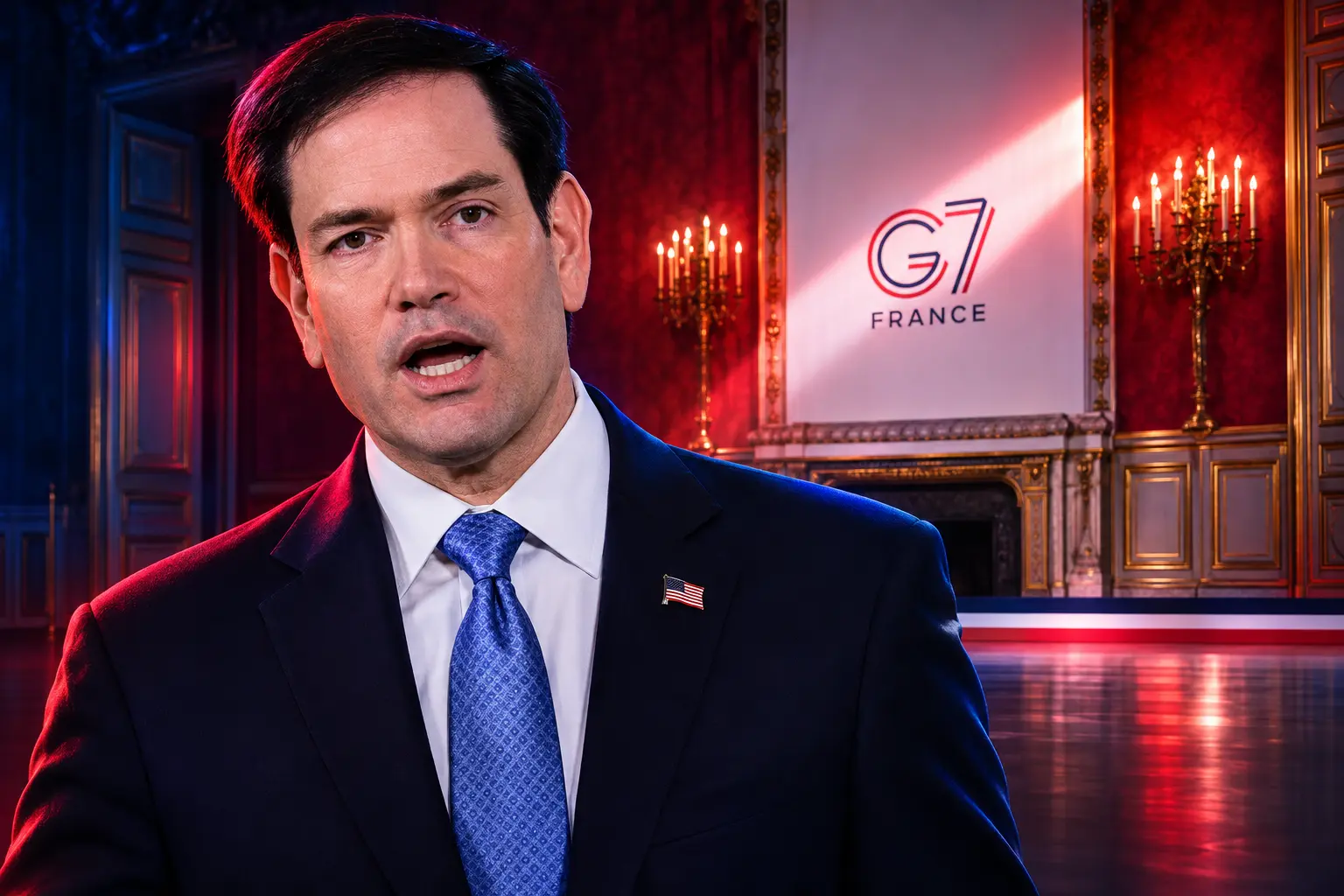
Secretary of State Marco Rubio told Group of Seven ministers in Paris on Tuesday that President Donald Trump had chosen a third path on Iran, a squeeze with no end date. Trump had weighed going back to bombing or taking a deal. Rubio said the White House would do neither.
The land half of that choice is Task Force Iron Gate, a Tampa staff of about 20 people stood up on November 7. The sea half is a naval cutoff that Central Command says has already kept more than $25 billion of Iranian crude off the market. The hole is the map: Iraq reopened a crossing this week, the Caspian is a sea no Western navy patrols, and Iran’s new supreme leader has told his government to end the freeze.
Rubio Tells the G7 the Squeeze Has No Clock
People in the closed G7 session said Rubio laid out the menu as war, a deal he called ridiculous, or the campaign already underway. He told the room the third option was to keep doing what Washington is doing now, and that the president was not under false time pressure because Iran was inflicting the damage on itself.
The President doesn’t just have two options. It’s not just return to war or sign a ridiculous peace deal. We won’t do a stupid deal. The third option we have is to continue to do what we do now.
Marco Rubio, secretary of state, to G7 foreign ministers in Paris
After the meeting he was blunter with reporters. Iran would love a deal, he said, but the conditions it keeps attaching are absurd and not serious. “Eventually you have to eat,” he said. “Eventually the economic realities penetrate the skull of even the most radical lunatic.”
He also told allies there was no need for major combat operations because the economic campaign was already doing the work. On Monday, after seeing Qatari Prime Minister Sheikh Mohammed bin Abdulrahman Al Thani at the White House, Trump had previewed the same line. A new round of strikes was “quite unlikely” and “doesn’t seem to be necessary.” He said Iran was, militarily, “effectively over,” that U.S. forces were still “locked and loaded,” and that neighbors preferred the current mix of a naval cutoff and Iron Gate.
U.S. officials say Rubio pushed that mix inside the building with Treasury Secretary Scott Bessent, CIA Director John Ratcliffe, and Jared Kushner, the president’s adviser and son-in-law. That group opposed a return to war, did not believe Iran’s present terms would produce a deal that served U.S. interests, and argued for pressure with no sunset. Bessent’s department has spent the autumn on Operation Economic Outcast, a campaign he announced on August 24 as Economic D-Day, aimed at starving the regime of the money it uses to wage war.
Israel had favored renewed strikes. Most Gulf governments had opposed them. The third option is the compromise those camps can live with in public. It is also the option that asks Turkey, Iraq, and Pakistan to do the work the U.S. Navy cannot do on land.
Twenty Staff in Tampa Against a Northern Lifeline
Adm. Brad Cooper, the Central Command chief, directed Iron Gate on November 7 as an internal staff of approximately 20 civilian and military personnel at headquarters in Tampa. The team is supposed to work with other U.S. agencies to stop advanced weapons, dual-use gear, sanctioned goods, and illegal revenue from moving across Iran’s land borders and the Caspian Sea. Cooper said the shop would reinforce “our ironclad blockade against Iran at sea” and make it harder for Tehran to finance armed groups, rebuild weapons plants, and refill its military.
CENTCOM did not name a crossing, a Caspian port, or a partner government. It did not announce troops on any border. It released no tally of shipments stopped. Trump wrote on November 8 that Iron Gate was in full force and that, with the naval cutoff he called the largest in history, virtually nothing was getting in or out. On Monday he told reporters, “We have the new Iron Gate. Iron Gate deals with land, so we’re operating on land and at sea.”
The naval half is the part with a number attached. CENTCOM says the cutoff has prevented Iran from exporting more than $25 billion in crude in recent months, and that enforcement continues against ships entering or leaving Iranian ports. That campaign has a history. A first blockade ran from April 13 to June 18. A second began on July 14 and is still in force.
SEA CUTOFF VERSUS IRON GATE
| Channel | When it started | What it is | Claimed result | What still moves |
|---|---|---|---|---|
| Naval cutoff (current) | July 14, 2026 | Ships into and out of Iranian ports on the Persian Gulf and the Gulf of Oman | More than $25 billion in crude kept off the market | Northern ports, now more than 30% of imports |
| Task Force Iron Gate | November 7, 2026 | About 20 staff in Tampa on land borders and the Caspian | No intercept figures released | Neighbor crossings and Russian Caspian traffic |
The southern squeeze is what pushed cargo north. More than 30 percent of Iran’s imports now move through northern ports, which have about 30 million tonnes of yearly capacity against about 300 million tonnes across all Iranian ports. Trade still fell 25 percent as the cutoffs clogged the system. The leftover traffic is the problem Iron Gate was stood up to police.
The Sea Blockade Already Forced Trade North
Customs and shipping records reviewed in late October showed a network of more than 5,000 entities tied to Iranian military buying that had imported equipment, explosives, and heavy trucks worth at least $2 billion since January 2025. The goods moved on cargo ships from Russia across the Caspian, on trucks through Central Asia, and on freight aircraft from China. A June study by the Center for Strategic and International Studies had already flagged the likely substitutes once Gulf re-exports dried up: Pakistan and the Caspian Sea routes, plus direct sourcing from China.
Those corridors are growing, not shrinking. Imports through the Gurbulak crossing with Turkey jumped 250 percent in the five months to August 12. Rail freight from China rose about tenfold, an Iranian lawmaker said in September. Khazar Sea Shipping Lines, the Caspian arm of Iran’s state shipping group, lifted monthly sales 275 percent in the month to September 22. Astara, on the Azerbaijani border, can now handle about 6,000 tonnes a day.
The Caspian is the hardest piece. It is a landlocked sea Iran shares with Russia, Azerbaijan, Kazakhstan, and Turkmenistan. A European government paper earlier this year described more than two dozen vessels carrying Russian ammunition, TNT, and drone parts to Iran on a route no Western navy can interdict. On Tuesday, Iranian Deputy Foreign Minister Kazem Gharibabadi said he had discussed Iron Gate with Russia’s ambassador in Tehran, Alexey Dedov, and that both sides wanted to protect Caspian security and the interests of the states that border it.
Hossein Mohebbi, spokesman for the Islamic Revolutionary Guard Corps, called Iron Gate “merely wordplay” and said the Americans could not collapse Iran’s economy this way. Foreign Ministry spokesman Esmaeil Baghaei mocked a 20-member group trying to finish a job he said had already failed, and tied the announcement to the midterm defeat. The IRGC is not required to be right for the gap to be real. A staff in Florida can map trucks. It cannot board them at Bazargan or stop a Russian-flagged ship at Anzali.
The bombing campaign this squeeze is meant to replace was much larger. In 38 days of major combat under Operation Epic Fury, U.S. forces flying with Israel ran more than 10,200 sorties and over 13,500 strikes. Cooper told the Senate that those strikes damaged or destroyed over 85 percent of Iran’s ballistic missile, drone, and naval plants, and that the Iranian air force went from 30 to 100 sorties a day to zero. That is the war voters punished. Iron Gate is the substitute.
Open Crossings in Iraq, Turkey and Pakistan
Bessent said in October that Washington was working with Turkey and Pakistan to cut off all the land routes. The U.S. Treasury also asked Iraq to close every crossing with Iran except two, one of them in the Kurdistan region. The neighbors are where the third option becomes someone else’s domestic problem.
THE THREE LAND GATES WASHINGTON CANNOT CLOSE ALONE
- Iraq: Foreign Minister Fuad Hussein said closing the crossings could punish Iran and would also hurt Iraq, because trade and movement would stop, and that talks with Washington were still going. Al-Sheeb, shut on October 21, reopened on November 10. Mandali is due to close on November 13 for technical work. Iran’s national football team crossed on land on November 10 after Iraq refused a direct flight into Basra.
- Pakistan: Islamabad suspended commercial trade at the Taftan and Gabd-Rimdan crossings on October 16 and 17. Passenger traffic continued, both governments called the step temporary, and no reopening date was set. Iranian drivers at Rimdan have faced waits of 20 to 25 days, and the nearby Mirjaveh crossing has been closed.
- Turkey: Freight from Turkish ports to Iran rose from about $1,500 to about $8,000 in under two months, and about 8,000 trucks were stranded at the Bazargan crossing. Sanctioned Iranian airlines kept landing in Istanbul, Ankara, and Izmir after a Treasury deadline, and Washington later designated a Turkish ground handler, Fugo Ground Services, for serving those carriers.
Hussein’s warning is the clearest on-record objection from a government the squeeze needs. “Closing the border crossings could be a punishment for Iran, but it would also hurt Iraq,” he said. U.S. officials say Turkey, Iraq, and Pakistan all worry that orders to halt flights and seal borders will feed unrest at home. For Baghdad, the crossings are livelihoods and a pressure valve. For Islamabad, they are a fuel-and-goods trade that does not stop because a Tampa task force draws a line on a map. For Ankara, they sit next to a fight over landing rights, F-35s, and how far a NATO ally will go to isolate a neighbor.
That is the design flaw in a no-end-date land campaign. The Navy can sit on the Gulf of Oman. The Treasury can list a shipping agent. The people who have to lock the gates live next door to Iran, and they keep finding technical reasons to leave a lane open.
Why the Midterms Closed the Bombing Track
The third option is also a domestic product. Democrats took the House and the Senate on November 3 after an eight-month war that drove fuel prices up and left Republicans defending a fight voters had tired of. Vice President JD Vance put the cause in one line on X: “The reason we lost is the war.” He added that anyone who wanted to argue it was worth losing the Senate for the next six years should at least say so honestly.
Trump did not dispute the core of that. He said Iran was a piece of the result, that the war had pushed gasoline higher in the short run, and that he would still do it again to keep Iran from a nuclear weapon. In a later interview he said history might judge the choice well even if it was a bad one “for today and tomorrow.” A survey of voters found 74% called the Iran war a crucial or major factor in their vote for Congress, and 62% said using military force against Iran had been the wrong decision.
Florida Gov. Ron DeSantis, speaking as Iron Gate was being stood up, said the second round of strikes never shared a clean definition of victory. Israel and the United States killed the old supreme leader expecting the system to buckle, he said, and the people who remain may now be stronger, with less reason to sign. Rubio, Vance, and Defense Secretary Pete Hegseth had described the aim differently when the war opened, and that split is still the policy problem. You cannot sell infinite patience as strategy when the last offensive had no agreed finish line.
FROM THE FIRST STRIKES TO IRON GATE
- February 28, 2026: The United States and Israel open the war. Supreme Leader Ali Khamenei is killed in the strikes.
- March 8, 2026: The Assembly of Experts names his son Mojtaba Khamenei as supreme leader. He has not appeared in public since taking the post.
- April 13 to June 18, 2026: The first U.S. naval blockade of Iranian ports runs, then lifts.
- July 14, 2026: A second blockade begins and remains in force after a memorandum of understanding collapses.
- August 24, 2026: Bessent announces Operation Economic Outcast, branded Economic D-Day, against the regime’s remaining money lines.
- November 3, 2026: Democrats win the House and the Senate. Vance says the war is why Republicans lost.
- November 7, 2026: Cooper stands up Task Force Iron Gate in Tampa.
- November 9 to 10, 2026: Trump, after seeing Qatar’s prime minister, calls further strikes quite unlikely. Rubio takes that line to the G7 in Paris.
Inside the administration, the midterm loss did not produce a deal. It produced a pause on new bombs and a louder claim that time is on Washington’s side. The political constraint is real: another campaign of strikes would land in a Congress the president no longer holds. The operational claim is thinner. A freeze that needs months to bite is being sold to allies who can see Iraq reopening a gate and Russia talking Caspian coordination in the same week.
The Supreme Leader’s Order to End the Pause
Mojtaba Khamenei was chosen on March 8, eight days after his father was killed, and he has stayed off camera. The civilian government and the IRGC are both reading his written orders, and they are not reading them the same way.
On October 31 he told commanders to meet any threat with an immediate, geographically unrestricted response and to put all U.S. and Israeli assets, “tangible and intangible,” on the target list. It was his first reported meeting with the top brass, including armed forces chief Ali Abdollahi, army chief Amir Hatami, and IRGC commander Ahmad Vahidi. On November 9, President Masoud Pezeshkian said the supreme leader had ordered an end to the country’s “neither war nor peace” state with the United States. Pezeshkian said Iran could negotiate with dignity and would not surrender to force.
Those two readings can live in one capital for a while. They cannot live there forever. Iran’s civilian officials took the stalemate order as room to talk, with conditions that still include ending the port cutoff, lifting sanctions, unfreezing assets, and reopening the Strait of Hormuz before any nuclear discussion. The IRGC can take the same order, plus the October 31 targeting instruction, as a brief to raise the cost of the squeeze until Washington blinks.
Iran has no intention of simply accepting this situation indefinitely. Tehran may conclude that increasing the economic and security costs for Washington and its regional partners is the only way to force a change in American policy. The danger is obvious: Iran escalates, Washington responds, and both sides find themselves in another military confrontation that neither necessarily wanted.
Danny Citrinowicz, Iran expert, Atlantic Council
Vali Nasr, a Johns Hopkins professor of Middle East studies, made the same point in plainer sequence. Trump sat on war plans he was not comfortable ordering, was not ready to make the concessions a deal would require, and defaulted to the pressure track Rubio and Bessent prefer. That track only works if Iran accepts the freeze. The supreme leader has said it will not. If Tehran tries to break the cutoff, the third option collapses back into the first.
The eight-month war already showed how that spiral looks. Iran answered the opening strikes by hitting Gulf states and throttling traffic in the Strait of Hormuz, which is what sent fuel prices into the midterms. Cooper’s command later tried to hold a defensive umbrella over a southern passage while still sealing Iranian ports. A long squeeze that keeps oil tight is the policy Gulf governments say they want instead of new bombs. It is also the policy that keeps the same lever in Iran’s hands.
Qatar Brings Mediation Without a First Step
Al Thani briefed the G7 after seeing Trump, and he told ministers he came away thinking there was more room to talk. He wants China and European governments in as guarantors, because Iranian officials suspect Trump would pocket a deal and start shooting again in a few months. The remaining fight is who moves first, and which confidence steps each side will take.
Washington has rejected Iran’s present package. Tehran still wants the port cutoff lifted, sanctions eased, frozen funds released, and regional fighting, including in Lebanon, wound down before it discusses the nuclear file. Rubio’s public line is that those terms are not serious. Trump’s public line is that the naval cutoff stays. Qatar cannot guarantee a deal the White House has already called stupid and the supreme leader has already said must end the pause.
So the third option is the policy as of Paris: no new major combat, no deal Rubio will own, a sea cutoff with a $25 billion claim, a land task force of about 20 people, and a request that neighbors close gates they keep reopening. On Tuesday, Iran’s deputy foreign minister sat with Russia’s ambassador to talk about that land task force and the Caspian. The squeeze has no clock. The routes around it are still open.

ADNOC Ship Hit in Hormuz Leaves One Crew Missing

SpiceJet’s Rs 5,500 Crore Plan Follows a Rescue That Failed

Hasina’s Return Fight Sets Fire to Yunus’s Bank

Bancroft Recants the 2018 Inquiry and Names the Team

Adhikari Ties the Saffron Saree Row to School Licences

Clancy Juror Says the Holdout Never Cited Evidence

The iPhone 18 Pro Max Splits Apple’s Fall in Two

OpenAI Calls GPT-6 Astra AGI Then Locks Its Exploits

Trump Claims Hormuz Control as Oil Holds Near $96

Russia Closes the Goethe-Institut Berlin Tried to Save

 NEWS2 months ago
Clancy Juror Says the Holdout Never Cited Evidence
- NEWS3 months ago
The iPhone 18 Pro Max Splits Apple’s Fall in Two
- NEWS3 months ago
OpenAI Calls GPT-6 Astra AGI Then Locks Its Exploits
- BUSINESS3 months ago
Trump Claims Hormuz Control as Oil Holds Near $96
- LIFESTYLE3 months ago
Russia Closes the Goethe-Institut Berlin Tried to Save
- AUTO3 months ago
Volkswagen’s Job Cuts Leave Four Plants Without Cars
- NEWS3 months ago
Dyson Puts Nurovi Robots on Sale Without the UV Flagship
- BUSINESS2 months ago
US Destroys Five Iranian Tankers as the Shock Hits Jordan










