
NEWS
Nvidia’s Spy Probe Leaves the Company With No Backup
Nvidia fell 4.27% as the Nasdaq rose, with an FBI thread and no succession plan sitting on Jensen Huang.

Nvidia stock closed at $178.67 on November 9, down $7.97, or 4.27%, a $192 billion hit that landed while the Nasdaq Composite rose 2.7%. The night before, the board had opened a probe into whether founder and chief executive Jensen Huang had been the target of a Chinese intelligence operation. President Donald Trump said he phoned Huang, believed his denial, and that the FBI is looking into a related matter.
The tape treated it as a one-name event. The company underneath still has no chairman, no named successor, and a chief executive who is now both irreplaceable and under federal review.
Trump Backed Huang After a White House Call
On November 8 the Nvidia board said it was opening an independent investigation into foreign intelligence reporting that Huang, 63, had been targeted. A committee of independent directors, with outside counsel, will run it. The board said it “has no reason to believe that either national security or NVIDIA secrets were compromised,” then added that the inquiry will still “examine all available information.” It also said it has confidence in Huang and his leadership team.
That sequence is the governance tell. The board put the finding in the same note that launched the fact-finding. Huang remains chief executive. John Rizzo, who heads public policy communications, said the news “will not slow NVIDIA” and that Huang “is committed to continuing to lead NVIDIA as CEO without interruption.”
Huang sent staff a memo the same day. He did not name the other person. He wrote, “I was unfaithful to my wife. My actions hurt her and our children. There is no excuse for what I did.”
Regarding the national security concerns raised in news reports, NVIDIA’s Board of Directors has initiated an independent investigation. I support the investigation and will cooperate fully. I love our country and our company. I am committed to protecting NVIDIA and supporting America’s national security.
Jensen Huang, founder and CEO, memo to Nvidia staff, November 8, 2026
Intelligence reporting circulating since late October identified the woman as Alice Huang, also known as Huang Le, a Chinese citizen who is not related to the Nvidia chief. She was a senior executive at Megaspeed, a Singapore data-center firm that bought Nvidia hardware. U.S. officials concluded she had been recruited by China’s Ministry of State Security. Her whereabouts are unknown. The FBI declined to comment when asked about the matter.
Trump took questions on November 9 in the Brady Briefing Room, after a call he said he placed to see if Huang was “feeling alright.”
“I asked him that question: ‘Did you have any idea that she was a spy?’ He said, ‘I had no idea that she was a spy,’ and I really believe him,” Trump said. He added, “We’ll look into it. I know the FBI is looking into it in terms of something else, and I think that he’ll be in good shape.” He called Huang “a very honorable man” who had “built a great company.” Asked about an intelligence memo that circulated last spring, Trump said it “could have been mentioned” and “didn’t make much of an impact on me.”
Chinese Foreign Ministry spokesperson Guo Jiakun called the spy claim “purely unsubstantiated and directed at smearing China.” A Justice Department criminal inquiry into whether Megaspeed diverted advanced chips into China sits beside the FBI thread Trump described. Those are separate files. They now share a protagonist.
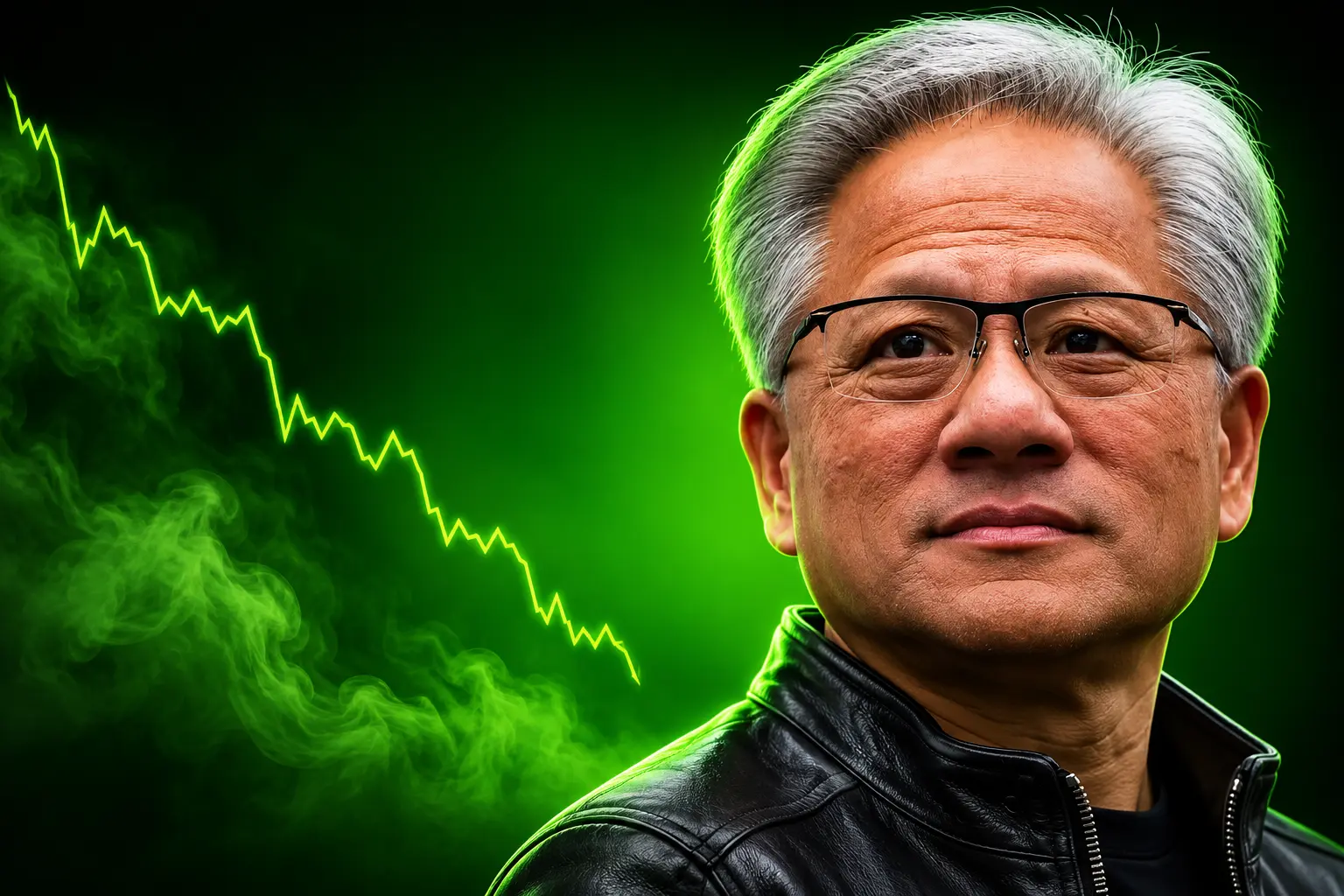
The 4.27% That Did Not Match the Tape
November 9 was a risk-on session everywhere except the name at the center of the story. The S&P 500 gained 2.35%, its best day since April. The Dow added more than 1,000 points. Nvidia opened at $173.07, traded as low as $170.24, and finished at $178.67 after an intraday slide of as much as 8.8%. Volume hit 462.7 million shares, about four times the 30-day average of 115.6 million.
MONDAY’S SPLIT
| Name | November 9 | Session move |
|---|---|---|
| Nvidia | Closed $178.67 | Down $7.97, or 4.27% |
| Nasdaq Composite | Best day since July | Up 2.7% |
| S&P 500 | Best day since April | Up 2.35% |
| Dow Jones | Broad rally | Up more than 1,000 points |
That gap is the cleanest read of what the market made of the news. On a down day for the whole AI trade, a 4.27% slide would have been noise. On a day the Nasdaq rose 2.7%, it was a single-stock verdict: the scandal is Huang’s, not the chip cycle’s.
The longer chart is harsher. Nvidia peaked at $243.37 on October 6, when the company was valued at about $5.88 trillion. Monday’s close left it at about $4.31 trillion, 26.6% below that high, a $1.57 trillion drawdown in a little over a month. The 52-week range now runs from $164.27 to $243.37. Jim Cramer told clients to prepare for a “Jensen-less Nvidia,” and said that if Huang leaves, the “own it, don’t trade it” rule that has governed the CNBC Investing Club’s holding no longer binds.
Chip peers did not follow Nvidia down. Broadcom and AMD led the bounce, with Amazon, Alphabet, Tesla, and Microsoft. The affair is easier to talk about than an empty org chart. That is why the isolated print can look small while the unpaid bill is still the job that has no deputy.
Nvidia Has No Chairman and No Named Heir
Nvidia is a $4.31 trillion company that does not have a board chair. Equilar data put that structure in about 1% of Russell 3000 firms. Huang and Stephen Neal, the lead independent director, together set the agenda, decide what directors see, and run the meetings. Neal joined the board in 2019. He is chairman emeritus and senior counsel at Cooley, and was that firm’s chief executive from 2001 to 2008. He schedules sessions Huang does not attend. Doug Chia, former corporate secretary of Johnson & Johnson, put it plainly: when you see that setup, “it’s pretty clear that Jensen Huang is the chair.”
The board has 11 directors. All but Huang are classed as independent. Several have been there since the 1990s. They are now asked to investigate the person who has sat with them for decades, after already telling the public they do not expect to find a national-security breach.
THE GOVERNANCE HOLE
- No chair: Huang and Neal share the functions a chairman would hold, a structure Equilar finds in about 1% of the Russell 3000.
- Flat command: Huang has said he does not believe in succession planning and runs the firm with roughly 60 direct reports.
- Filed warning: The annual report for the year ended January 25, 2026, says Nvidia is “highly dependent on the services of our longstanding executive team” and that failed succession planning could “hinder our strategic planning, execution, and long-term success.”
- Pre-cleared probe: The same board note that opened the inquiry said directors had no reason to believe secrets or national security were compromised.
David Larcker, a Stanford professor of corporate governance, said that if it is true they “really don’t have much of a succession plan, then that’s a problem,” and that he expects the board to bring in outside advisers. The 10-K already told shareholders the same thing in quieter language. The spy file made that sentence tradeable.
San Jose Gets the First Shareholder Suit
Mark Kistenmacher, an individual investor, filed a federal securities class action on November 9 in the U.S. District Court for the Northern District of California, San Jose division, case number 5:26-cv-13448. Laurence M. Rosen of Rosen Law Firm brought it. The complaint names Nvidia and Jen-Hsun Huang. Kistenmacher made seven purchases totaling about $20,500 this year. The proposed class is anyone who bought Nvidia securities from October 9, 2025, through November 8, 2026. Investors who want to seek lead-plaintiff status face a January deadline for lead plaintiff of January 8, 2027.
The suit does not have to prove Alice Huang was a spy. It has to prove Nvidia’s public answers about Megaspeed were false or incomplete while the stock traded on them. The complaint points at three lines: Rizzo’s claim that Huang’s dealings with Alice Huang were “not unusual or unexpected,” the company’s claim that it found “no evidence of diversion” of chips, and Huang’s October 30 remark that Megaspeed business was “normal and not unusual.” Had buyers known the rest, the filing says, they would not have paid “the artificially inflated prices that they did, or at all.”
HOW THE FILE BUILT
- October 9, 2025: Proposed class period opens, the date the complaint treats as the start of public reporting on Huang’s social contact with the Megaspeed executive.
- May 2026: A classified memo warning that Alice Huang was a Chinese intelligence asset circulates among administration officials; Culper Research publishes a short report flagging Megaspeed and an “uncomfortably close relationship.”
- October 6, 2026: Nvidia shares hit $243.37, the 52-week high.
- October 8, 2026: Trump awards Huang the National Medal of Science.
- October 29, 2026: Intelligence reporting lands that Trump had been briefed and chose not to act, in part to protect chip sales and the China trade truce.
- November 8, 2026: Huang’s staff memo and the board probe; class period closes.
- November 9, 2026: Shares fall 4.27% to $178.67; Trump says the FBI is looking; the San Jose complaint is filed.
Export controls only work if the seller knows the end user. A personal tie between the chief executive and an executive at a customer already in a diversion probe is the control problem. The romance is how the public learned the names. The suit is how that problem gets a damages theory.
Who Runs Nvidia If Huang Cannot?
Unlike Meta or SpaceX, Nvidia has no dual-class stock. Huang beneficially owns 3.58% of the shares, one vote each. BlackRock holds 7.43% and Vanguard 7.31%. The board, not the founder, decides who runs the company if he is forced out. Yale’s Jeffrey Sonnenfeld put Huang’s odds of keeping the job at “about a 50-50.” Bernstein called it “key man risk” and said it is “not immediately clear who would or could step in.” Dan Ives of Yorkville Ives & Co. said there is “clearly risk that Jensen could be removed as CEO,” and that the stock will carry that risk because “he is so important to the Nvidia story and strategy globally.”
The officers listed in the filings are finance, operations, legal, and sales. They are not a published succession slate.
THE NAMED OFFICERS
| Officer | Role | Joined Nvidia |
|---|---|---|
| Jensen Huang | Co-founder, president, and CEO | 1993 |
| Colette Kress | Chief financial officer | 2013 |
| Debora Shoquist | Operations chief | 2007 |
| Tim Teter | General counsel | 2017 |
| Nick Parker | Worldwide field operations | 2026 |
Kress is 58. Shoquist is 71. Teter is 59. Parker, who replaced Jay Puri this year, is 55. Co-founder Chris Malachowsky remains an Nvidia Fellow, not an officer. Engineering and chip-architecture leaders who report to Huang are not listed as executive officers. There is no public heir in product, and no public heir in the boardroom. A company that spent three decades teaching the market to buy the founder now has to show it can operate if the founder is the case.
CoreWeave Reports Into a 16% Bond Market
The second place Huang’s name still functions as collateral is the neocloud stack. CoreWeave, which rents Nvidia clusters, had $35.1 billion of debt and $5.5 billion of cash at June 30. Yields on some of its bonds maturing in 2031 have jumped above 16%. The spread on its five-year credit default swaps, insurance against default, rose above 1,240 basis points, up 50% in a month. Nvidia is a supplier, a customer of last resort, and a shareholder all at once. It invested $2 billion in January at $87.20 a share, holds roughly a 10% stake, and has a $6.3 billion commitment to buy unused CoreWeave capacity through April 13, 2032.
Huang said in October that CoreWeave does not need a backstop and that its cost of capital was falling. The bond market did not agree. CoreWeave publishes third-quarter results on November 10 at 5 p.m. ET, with Nvidia’s own quarter due November 17. A chief executive under an FBI thread and a board probe is a weaker implicit guarantor than the same man was in October, even if not one contract clause has changed.
Nvidia’s own five-year default swaps had already been climbing before the affair broke, to around 139 basis points, up 76% in a month by early November. Credit traders were pricing the phone call from CoreWeave to Santa Clara. They now have a second reason to keep that line open.
Huang is still in the job. Trump says he believes him. The board says it has confidence. The stock’s 4.27% isolation on a green tape is how equity holders registered that view. The empty chair, the San Jose complaint, and the 16% CoreWeave paper are how the rest of the file will be marked, whether or not Alice Huang is ever charged.
Disclaimer: This article is news reporting and analysis for general information only. It is not investment advice, a recommendation to buy or sell Nvidia, CoreWeave, or any other security, and it is not legal advice about the San Jose complaint, the board probe, or any government inquiry. Readers should consult a licensed financial adviser and, if they have a legal question about the case, a qualified securities attorney before making any decision. Share prices, credit spreads, lawsuit status, and the scope of the FBI and board reviews reflect the public record as of the dates named above and can change.

ADNOC Ship Hit in Hormuz Leaves One Crew Missing

SpiceJet’s Rs 5,500 Crore Plan Follows a Rescue That Failed

Hasina’s Return Fight Sets Fire to Yunus’s Bank

Bancroft Recants the 2018 Inquiry and Names the Team

Adhikari Ties the Saffron Saree Row to School Licences

Clancy Juror Says the Holdout Never Cited Evidence

The iPhone 18 Pro Max Splits Apple’s Fall in Two

OpenAI Calls GPT-6 Astra AGI Then Locks Its Exploits

Trump Claims Hormuz Control as Oil Holds Near $96

Russia Closes the Goethe-Institut Berlin Tried to Save

 NEWS2 months ago
Clancy Juror Says the Holdout Never Cited Evidence
- NEWS3 months ago
The iPhone 18 Pro Max Splits Apple’s Fall in Two
- NEWS3 months ago
OpenAI Calls GPT-6 Astra AGI Then Locks Its Exploits
- BUSINESS3 months ago
Trump Claims Hormuz Control as Oil Holds Near $96
- LIFESTYLE3 months ago
Russia Closes the Goethe-Institut Berlin Tried to Save
- AUTO3 months ago
Volkswagen’s Job Cuts Leave Four Plants Without Cars
- NEWS3 months ago
Dyson Puts Nurovi Robots on Sale Without the UV Flagship
- BUSINESS2 months ago
US Destroys Five Iranian Tankers as the Shock Hits Jordan










