
NEWS
Nithya Raman Wins Los Angeles as India Keeps Mayors Weak
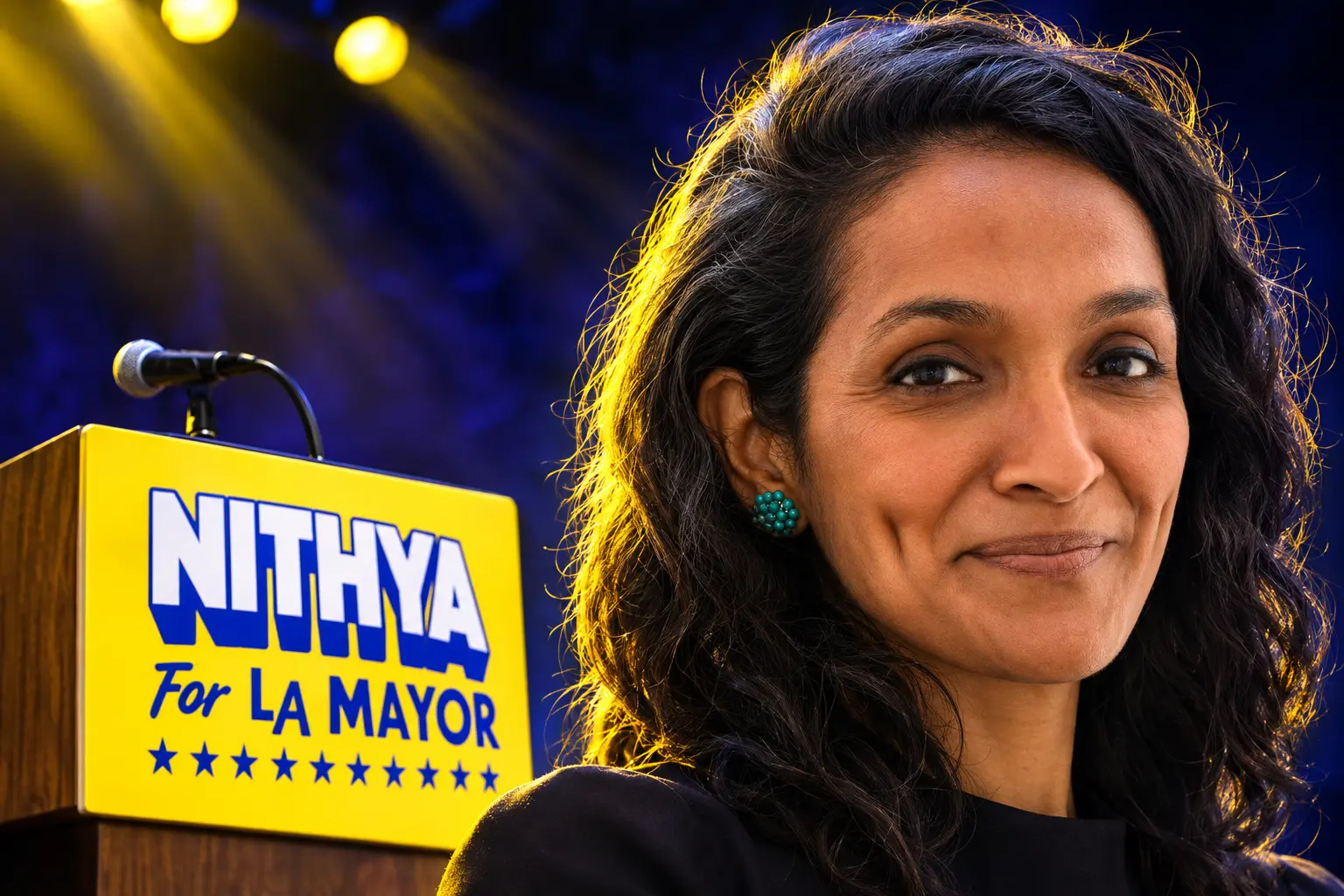
Nithya Raman unseated Karen Bass to become Los Angeles mayor-elect, and Shashi Tharoor used the win to show how little power Indian mayors still hold.

Nithya Raman, 45, unseated Los Angeles Mayor Karen Bass on November 5, taking 52.7 percent of the latest tally and becoming the city’s first Indian-American and South Asian mayor. Bass, 73, called her and conceded. Congress MP Shashi Tharoor, who represents Raman’s birthplace, used the result to argue that mayors in India still cannot govern.
Raman is mayor-elect, not yet seated. She inherits a charter that lets her write a budget, hire chiefs and veto the council. Her counterparts in Indian cities inherit a chain of command that stops at a state-appointed commissioner.
Nithya Raman Unseats Karen Bass in Los Angeles
The runoff was on November 3. Bass led on election night. Late mail ballots flipped the race, and by November 5 the Los Angeles County tally had Raman at 460,772 votes (52.7 percent) and Bass at 413,519 (47.3 percent). Bass said the people had spoken and promised a smooth handover.
Raman is the first challenger to unseat a sitting Los Angeles mayor since 2005. She told supporters the city had had enough of establishment politics, and that the campaign had made clear “the days of our broken status quo are over.” On her campaign site she wrote, “Los Angeles, I am deeply honored to be your next mayor.”
THE 2026 MAYOR TALLY
| Round | Nithya Raman | Karen Bass | Spencer Pratt |
|---|---|---|---|
| June 2 primary | 247,781 (29.0%) | 292,593 (34.3%) | 217,977 (25.5%) |
| November 3 runoff | 460,772 (52.7%) | 413,519 (47.3%) | Eliminated |
The June 2 primary was a nonpartisan top-two contest with 853,892 ballots. Bass finished first. Raman entered hours before the February 7 filing deadline, then climbed past reality-television figure Spencer Pratt for the second spot. Every council colleague had opposed her mayoral bid. Business and labor money had lined up behind Bass.
Bass took hits over the 2025 wildfires, Olympics costs and street conditions. Raman, a Democratic Socialists of America member, ran on housing, homelessness and basic city work: lights, potholes, permits. Street homelessness fell 49 percent in her council district while it rose 8 percent citywide, her campaign said.
The Office She Won Comes With a Budget and a Veto
Los Angeles is not New York, and the mayor does not run the schools. Inside city hall the job is still an executive post. The 2025-26 city budget is about $14 billion. Charter Section 231 makes the mayor the manager of city departments.
WHAT THE LA MAYOR CAN DO
- The budget: The mayor drafts the annual spending plan and can veto, restore or trim council changes to it.
- The chiefs: The mayor may appoint and remove department heads, including police, fire, housing and water and power, subject to council confirmation.
- The veto: Council ordinances can be vetoed; 10 of 15 members must vote to override.
- The emergency: The mayor can declare a local emergency, issue binding directives and sit on the Metro board.
That is the toolkit Raman will pick up in December. It is also the toolkit Tharoor said Indian mayors are denied. Critics in Los Angeles spent the year calling her a risk on crime and tents. The charter still gives her the pen on the budget those fights will be paid from.
Indian Mayors Still Do Not Run Their Cities
In most Indian cities the mayor is the political face of the municipal corporation and not its chief executive. A municipal commissioner, usually a senior IAS officer named by the state, runs daily administration and large parts of the civic budget. Praja Foundation chief executive Milind Mhaske has put the limit in plain terms: the mayor cannot draw up the budget, hire and fire department chiefs, or veto policy.
WHO HOLDS THE CITY
| Power | Los Angeles mayor | Typical Indian mayor |
|---|---|---|
| Budget | Proposes a city budget of about $14 billion | Cannot draw up the budget |
| Staff | Appoints and can remove department heads | Cannot hire or fire chiefs |
| Veto | Vetoes council items, subject to a two-thirds override | No veto |
| Day-to-day run | Charter chief executive of city departments | Ceremonial; the commissioner runs the administration |
The Constitution’s 74th Amendment, in force from June 1, 1993, was meant to make urban local bodies institutions of self-government. It listed 18 functions in the Twelfth Schedule, from town planning and water to fire services and slum work. Article 243W does not hand those tasks over by itself. Each state has to pass its own law, so the real power still sits where state governments want it.
The Commissioner Still Holds the Pen
A 2024 Comptroller and Auditor General review of 393 urban bodies across 18 states found that 17 of the 18 functions had been devolved on paper. Only 4 of the 18 came with complete autonomy: burial grounds, public amenities, prevention of cruelty to animals, and regulation of slaughter houses. Urban planning and fire services were the least devolved. Nine states had transferred all 18 functions in law. Even there, state agencies often still did the work.
Own taxes made up 32 percent of municipal revenue. Staff vacancies averaged 37 percent, and urban bodies in 16 states had little or no say over hiring. On November 3, two days before Bass conceded, NITI Aayog member Rajiv Gauba told an urban conclave in Odisha that Indian cities should not be governed from state capitals and called for directly elected mayors with five-year terms, stronger city finances and a real handover of duties.
Four Functions With Real Autonomy
A separate CAG audit of the amendment in the states has made the same point for years: parastatal boards still perform urban planning, land-use control, water supply, public health and roads, which hollows out the elected house. Mumbai’s corporation still runs on an 1888 Act. The commissioner answers to the state. The mayor cuts ribbons.
So the comparison Tharoor reached for is not a vibe. It is a job description. Raman will argue with a 15-member council over a $14 billion plan. A mayor in Chennai, Delhi or Bengaluru argues with a commissioner who does not report to her.
From Thiruvananthapuram to the Los Angeles Council
Nithya V. Raman was born on July 28, 1981, in Thiruvananthapuram to a Tamil family. She moved to Louisiana at six, then to Burlington, Massachusetts. She became a US citizen at 22. She studied social studies at Harvard and took a master’s in urban planning from MIT in 2008.
Her senior thesis watched how people walk away from offices that only work for some of them. In Tamil Nadu, a village official told the undergraduate to leave her shoes and her politics at the door. She kept the shoes on and left. MIT professor Balakrishnan Rajagopal, who advised her master’s work, later called her path from housing research to city politics “a straight line.”
RAMAN’S PATH TO CITY HALL
- July 28, 1981: Born in Thiruvananthapuram, Kerala.
- About 1987: Moves to the United States at age six.
- 2008: Completes a master’s in urban planning at MIT, after Harvard.
- 2010: Founds Transparent Chennai, a civic-data group on sanitation.
- 2013: Moves to Los Angeles and works in the city administrative officer’s shop.
- 2017: Co-founds the SELAH Neighborhood Homeless Coalition.
- December 14, 2020: Seated on the City Council after beating incumbent David Ryu, 52.9 percent to 47.1 percent, the first such council ouster in 17 years.
- March 2024: Wins re-election outright with 50.6 percent.
- February 7, 2026: Files for mayor hours before the deadline, after backing Bass weeks earlier.
- November 5, 2026: Bass concedes the runoff.
She went back to India in her twenties, worked on slum rights in Delhi and Chennai, then followed her husband, television writer Vali Chandrasekaran, to Los Angeles. SELAH’s name is the neighbourhoods it serves: Silver Lake, Echo Park, Los Feliz, Atwater Village and Hollywood. In 2020 a volunteer operation knocked on 83,000 doors and made her the council’s first South Asian member and first Asian-American woman.
She has not hidden the Harvard credential. “It helps you get your foot in the door,” she said. “Everything else I do is on me.” Her own account of why she entered the race points to the January fires, stalled housing, slow 911 times and streetlights left dark. Politics, she has said, was a means to service.
New York Already Has an Indian-Origin Mayor
Tharoor’s post paired Raman with Zohran Mamdani, who won New York City’s mayoral race in 2025. America’s two largest cities will now be run by people of Indian origin. Mamdani also came up through a Democratic Socialists of America-backed coalition of younger renters. Raman’s runoff coalition looked similar: tenants, volunteers, a late ballot surge.
The American argument about Raman is whether a councilmember who built her name on rent caps and outreach can run a city that just punished a sitting mayor over fires and broken basics. The Indian argument is older and smaller. It is whether a mayor who cannot hire, fire or write a budget is a mayor at all.
Her critics tried to paint her as a newcomer from India. Pratt said she grew up there and had only lived in Los Angeles a few years. She left Kerala at six. She has lived in the city since 2013 and has held a council seat since 2020. The smear was about origin. The job she won is about a charter.
What the British-Era System Still Blocks
Tharoor, the Congress MP for Thiruvananthapuram, posted on November 5 while the LA count was still moving. He called Raman a daughter of his city and then turned the congratulations into a brief on Indian municipal law.
A daughter of Thiruvananthapuram, @nithyavraman, is the new Mayor of Los Angeles! And with @ZohranKMamdani in New York, America’s two biggest cities will be run by people of Indian origin! I’m sure they will do a far better job than their counterparts back in India, who are reduced to powerlessness by a British-era system that disperses authority and budgets, leaving Mayors here without any real means to govern their cities effectively…
Shashi Tharoor, Congress MP, on X, November 5, 2026
A daughter of Thiruvananthapuram, @nithyavraman, is the new Mayor of Los Angeles! And with @ZohranKMamdani in New York, America’s two biggest cities will be run by people of Indian origin!
I’m sure they will do a far better job than their counterparts back in India, who are… pic.twitter.com/ThfoKZzrlp
— Shashi Tharoor (@ShashiTharoor) November 5, 2026
He is right about the split of authority, even if “British-era” is a political label for a living design. Independent India kept the commissioner model. The 1992 amendment gave cities constitutional status and then left the handover to state legislatures. Thirty-plus years later the auditor is still counting slaughterhouses and burial grounds as the functions cities fully control.
Indian-origin mayors in New York and Los Angeles do not fix that. They make the gap harder to clap away. The diaspora story is a win. The domestic story is a job that still is not a job.
The Gavel Passes on December 14
Raman is due to take office on December 14, the same calendar date she joined the council in 2020. Bass has said she will help with the transition. The new mayor will walk into fights over housing production, film jobs, fire recovery and a council that did not want her in the office.
She will at least walk in with a budget, a veto and the power to name the people who run the departments. Indian mayors, on the CAG’s numbers, still walk in with four functions of their own and a commissioner who answers elsewhere.

ADNOC Ship Hit in Hormuz Leaves One Crew Missing

SpiceJet’s Rs 5,500 Crore Plan Follows a Rescue That Failed

Hasina’s Return Fight Sets Fire to Yunus’s Bank

Bancroft Recants the 2018 Inquiry and Names the Team

Adhikari Ties the Saffron Saree Row to School Licences

Clancy Juror Says the Holdout Never Cited Evidence

The iPhone 18 Pro Max Splits Apple’s Fall in Two

OpenAI Calls GPT-6 Astra AGI Then Locks Its Exploits

Trump Claims Hormuz Control as Oil Holds Near $96

Russia Closes the Goethe-Institut Berlin Tried to Save

 NEWS2 months ago
Clancy Juror Says the Holdout Never Cited Evidence
- NEWS3 months ago
The iPhone 18 Pro Max Splits Apple’s Fall in Two
- NEWS3 months ago
OpenAI Calls GPT-6 Astra AGI Then Locks Its Exploits
- BUSINESS3 months ago
Trump Claims Hormuz Control as Oil Holds Near $96
- LIFESTYLE3 months ago
Russia Closes the Goethe-Institut Berlin Tried to Save
- AUTO3 months ago
Volkswagen’s Job Cuts Leave Four Plants Without Cars
- NEWS3 months ago
Dyson Puts Nurovi Robots on Sale Without the UV Flagship
- BUSINESS2 months ago
US Destroys Five Iranian Tankers as the Shock Hits Jordan










