
NEWS
Nagpur’s Green Crackers Carry Fake Stamps and Dead QR Codes
Nagpur issued 888 Diwali stalls while CSIR-NEERI’s own QR check fails in the city that invented green crackers and still prints the stamp.

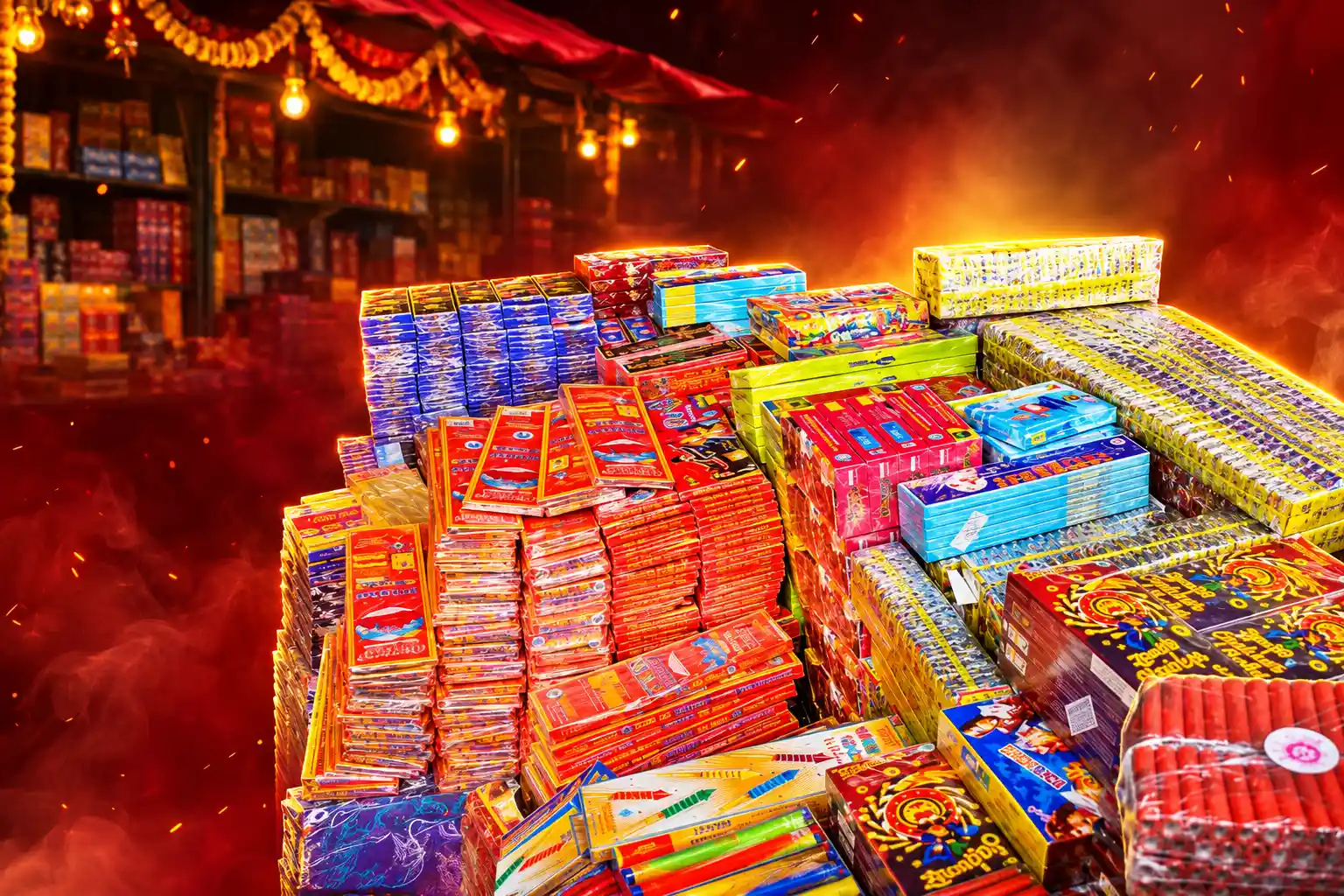
Nagpur Municipal Corporation issued 888 stall permissions for Diwali 2026, and most of those stalls cannot show a working green-cracker QR code. A November 4 check of city markets found few retailers who could say what a green firecracker is, and many boxes carried a CSIR-NEERI mark without the rest of the paperwork.
The same city houses the lab that invented the product and the explosives regulator that licences the factories. Shoppers are still being asked to trust a stamp that a scanner cannot read.
Nagpur’s 888 Stalls Sell the Stamp, Not the Check
Green firecrackers are supposed to carry CSIR-NEERI approval, a Petroleum and Explosives Safety Organisation (PESO) licence, a registration number, and a QR code that opens the maker, the mix, and the test report. Several packs on Nagpur counters had the CSIR-NEERI logo and none of the other three. Other packs had a QR code printed on them, and most of those codes did not work.
The Supreme Court has said only certified green crackers may be burst this Diwali, and CSIR-NEERI in Nagpur is the lab that wrote the mixes. The civic body still signed off a record 888 temporary stalls. NMC’s fire wing charges Rs 1,000 as an environment fee and Rs 3,000 toward safety for a no-objection certificate, which is a paper trail for the stall, not a test of what sits inside the box.
Green packs are meant to use a smaller shell than the old kind. That is a clue you can see. A printed logo is not. CSIR-NEERI signed agreements with hundreds of factories to use its mixes, and the institute’s own list is the check that still works when a code does not.
Both Certifying Bodies Are Headquartered in Nagpur
CSIR-NEERI developed the low-emission mixes in 2019 and still runs the testing desk. On December 2, 2025, CSIR opened the National Centre of Excellence for Green Firecrackers at the Nagpur campus, with a sister centre at CSIR-CECRI in Karaikudi. Director General N. Kalaiselvi said the centres were meant to speed up testing after court orders that only CSIR-NEERI-certified stock may be sold, and to keep Sivakasi’s firework jobs intact; she noted that more than 80 percent of livelihoods in that Tamil Nadu cluster still depend on the trade.
PESO, which licences manufacture, storage, and sale of explosives under the Explosives Act, 1884, also keeps its headquarters in Nagpur. A factory cannot even register with NEERI unless it already holds a PESO manufacturing licence or a district magistrate’s equivalent. The two stamps the court treats as proof were designed to work as a pair in this city.
R.J. Krupadam, Scientist G and coordinator of the Nagpur centre, has been clear that NEERI is a research body, not a shop inspector. The lab writes mixes, tests samples, and publishes the registered-maker list. Police, PESO, and pollution boards are supposed to walk the stalls.
NEERI Already Dropped the QR After Codes Were Copied
Krupadam told fireworks traders in Kolkata at the end of October that about 1,700 makers now hold NEERI and PESO papers, and that the QR system had been pulled because it was being stolen.
Earlier, we found that many manufacturers copied QR codes from others who received valid QR codes from us. QR codes meant for one manufacturer were being used by others without our knowledge. Therefore, we decided to discontinue the QR code mechanism.
R.J. Krupadam, coordinator, National Centre of Excellence for Green Firecrackers, CSIR-NEERI, speaking to fireworks traders in Kolkata
A CSIR-NEERI note on green fireworks says the same thing in quieter language: the institute issues registration letters and does not issue QR or bar codes. Factories are told to print a product-specific code that names the NEERI registration and the PESO licence, and PESO, the Central Pollution Control Board, and other agencies are supposed to verify those codes. In practice the code became a copyable sticker, the old Green QR app fell off some phone stores, and a scan often opened a dead page, a factory phone number, or a video of a burst.
The Supreme Court still ordered the opposite for Delhi-NCR. In an October 29 order made public on November 2, Justices M.M. Sundresh and Prasanna B. Varale said every box must carry a product-specific, non-transferable QR code with the maker, NEERI registration, PESO or district licence, mix, and test certificate. Selling those codes, the bench said, should cost a factory its registration. On November 3, Justice Sundresh pointed to a market report and told the Centre to enforce its own order.
They say that in the market every other cracker, licensed, unlicensed, QR code, or no QR code, everything is available.
Justice M.M. Sundresh, Supreme Court of India, November 3, 2026
House-to-house checks on Diwali night are not a serious plan. The stall is the only place a buyer can still refuse a box, and that is the place where the codes are dead, copied, or missing. A 30 to 40 percent cut in dust means little if the pack in the bag was never the certified mix.
HOW THE RULES STACKED UP
- October 23, 2018: The Supreme Court in Arjun Gopal allows improved and green crackers and bars the worst conventional stock.
- 2019: CSIR-NEERI, Nagpur, issues low-emission mixes and begins registering factories that already hold PESO licences.
- 2021: Nagpur markets already show NEERI logos on boxes with no PESO number, no registration, and no working code, the same pattern seen on November 4, 2026.
- December 2, 2025: CSIR opens the National Centre of Excellence for Green Firecrackers at NEERI, Nagpur.
- October 29, 2026: The court permits certified green crackers in Delhi-NCR on November 7 and 8, with mandatory QR codes, and restores the full ban from November 9.
- November 3, 2026: Justice Sundresh flags shops selling licensed, unlicensed, coded, and uncoded stock side by side.
- November 4, 2026: Nagpur’s 888 stalls are open, and a market check finds fake stamps and codes that do not scan.
Kolkata’s police and traders, after four years of dead tags, shifted to printing the approved-maker list outside the bazi bazaars. Nagpur’s buyers were still being told to scan a code the lab no longer treats as proof.
What a Genuine Green Cracker Pack Must Show
A phrase such as eco-friendly or pollution-free on the wrapper is advertising. CSIR-NEERI has also warned against fake registration letters and test reports. The working test is the maker’s name against the institute’s published list, plus PESO details on the pack, plus a code that actually opens those records. Registration is product-specific registration with CSIR-NEERI, issued once, with no renewal, and only after a PESO manufacturing licence is in hand. Sample tests at the Nagpur centre cost Rs 7,000 for air emissions, Rs 2,500 for noise, and Rs 3,000 for banned chemicals, GST extra.
CHECKS THAT STILL MEAN SOMETHING
| Check | What should be there | What showed up in Nagpur stalls |
|---|---|---|
| CSIR-NEERI mark | Green fireworks logo on a pack from a maker on the live NEERI list | Logo printed on boxes whose makers were not backed by the other papers |
| PESO licence | Licence number of a factory authorised to make explosives | Many boxes had no PESO number at all |
| Registration number | NEERI product registration tied to that factory | Often missing beside the logo |
| QR code | Product-specific code that opens maker, licences, mix, and test report | Missing, copied, or printed and dead |
| Shell and seal | Smaller shell, box sealed so conventional stock cannot be mixed in | Buyers had no way to confirm the seal matched a tested batch |
Buy from a licensed stall and keep the bill. A roadside crate with a green sticker is the pattern the 2021 Nagpur round already caught, and it is the pattern still on the counter.
SWAS, STAR and SAFAL Are Built to Cut Dust
Conventional mixes lean on potassium nitrate, barium nitrate, aluminium powder, sulphur, and charcoal. CSIR-NEERI cut the toxic metals and added dust-catchers such as zeolite and iron oxide. Barium, lead, arsenic, and mercury are out. CSIR’s December 2025 note puts the commercial cut at about 30 to 40 percent less particulate matter than the old stock. That is a smaller plume, not a clean one, and Krupadam has said the word green does not mean zero pollution.
THREE MIX FAMILIES ON THE BOOKS
- SWAS (Safe Water Releaser): A polymer hydrogel throws out water vapour that holds dust down, with about 30 to 35 percent less particulate matter and a bang in the 105-115 dBA band.
- STAR (Safe Thermite Cracker): Iron oxide, about 40 percent of the mix in the thermite version, is meant to burn the fuel more completely and cut both dust and some of the noise.
- SAFAL (Safe Minimal Aluminium): Zeolite-type fillers replace part of the aluminium, which trims the metal load that turns into soot.
On November 3, Krupadam said the mixes already given to factories cut emissions by about 25 to 30 percent, and that newer lab work has reached 45 to 60 percent, with 12 to 13 low-smoke variants aimed at next Diwali, not this one. Joint crackers, the ladis and garlands, still make up an estimated 20 to 30 percent of the trade and are still banned in the court order because a 1,000-shell garland has been measured at about 130-140 decibels against a legal cap of 125 dB(AI) sound cap at 4 metres, or 145 dB(C) peak.
Ten Sellers Face Cases as Ladis Stay on Counters
Nagpur is not Delhi-NCR, and the two-day Supreme Court window of November 7 and 8, from 6 a.m. to 7 a.m. and 8 p.m. to 10 p.m., with a 300-metre no-cracker ring around hospitals, old-age homes, and schools, is the capital-region rule. The complete ban there returns on November 9, and Delhi’s air was already in the very poor band, 324 on November 2 and 332 on November 3, before a cracker has been lit under that order. Maharashtra’s overlay is older and wider: the Bombay High Court has barred bursting on public roads, streets, and footpaths year-round, and silence zones of 100 metres around hospitals, schools, courts, and government offices stay off limits.
NAGPUR’S LIVE COUNT
- Stall paper: 888 NMC permissions, the highest the civic body has issued for this festival.
- Factory paper: about 1,700 makers on the NEERI-PESO track, which is the list a buyer can still check when a code fails.
- Police cases: 10 sellers booked under Section 223 of the Bharatiya Nyaya Sanhita for licence breaches, with DCP Sandeep Pakhale’s compliance affidavit before the High Court.
- No-licence roads: temporary sale licences refused on 15 major roads and sensitive stretches, including Gokulpeth Market and Sadar Residency Road.
On November 3, a division bench of Justice Urmila Joshi-Phalke and Justice Raj Wakode again said only green crackers may be used, and even those may not be burst on public roads. The judges wanted a clearer account of how licensing conditions are being watched on the ground and listed the matter again for November 4. Municipal commissioner Vipin Itankar had already written to the police commissioner on October 30 about temporary outlets crowding footpaths near schools, colleges, religious places, and hospitals. At Fataka Bazaar, shops were still selling uncertified bombs and ladis after those directions.
The next mixes Krupadam described will not reach a stall until the following Diwali. The 888 permissions already issued will have expired by then, and the boxes on sale now are the ones that will be lit on November 8.

ADNOC Ship Hit in Hormuz Leaves One Crew Missing

SpiceJet’s Rs 5,500 Crore Plan Follows a Rescue That Failed

Hasina’s Return Fight Sets Fire to Yunus’s Bank

Bancroft Recants the 2018 Inquiry and Names the Team

Adhikari Ties the Saffron Saree Row to School Licences

Clancy Juror Says the Holdout Never Cited Evidence

The iPhone 18 Pro Max Splits Apple’s Fall in Two

OpenAI Calls GPT-6 Astra AGI Then Locks Its Exploits

Trump Claims Hormuz Control as Oil Holds Near $96

Russia Closes the Goethe-Institut Berlin Tried to Save

 NEWS2 months ago
Clancy Juror Says the Holdout Never Cited Evidence
- NEWS3 months ago
The iPhone 18 Pro Max Splits Apple’s Fall in Two
- NEWS3 months ago
OpenAI Calls GPT-6 Astra AGI Then Locks Its Exploits
- BUSINESS3 months ago
Trump Claims Hormuz Control as Oil Holds Near $96
- LIFESTYLE3 months ago
Russia Closes the Goethe-Institut Berlin Tried to Save
- AUTO3 months ago
Volkswagen’s Job Cuts Leave Four Plants Without Cars
- NEWS3 months ago
Dyson Puts Nurovi Robots on Sale Without the UV Flagship
- BUSINESS2 months ago
US Destroys Five Iranian Tankers as the Shock Hits Jordan










