BUSINESS
Modi’s Solar Shield Meets a $90.6 Billion Oil Bill
Modi said a decade of clean energy blunted India’s West Asia shock, yet the crude import bill hit $90.6 billion and the $220 billion ask targets the oil gap.

Prime Minister Narendra Modi told investors a decade of solar factories had blunted India’s West Asia energy shock. He was opening the Bharat Renewable Energy Summit and Expo 2026 at Bharat Mandapam in New Delhi on November 2.
Petroleum Planning and Analysis Cell figures show the crude import bill still rose to $90.6 billion in April-September, from $61.9 billion a year earlier, a 46.4 percent jump on volumes that barely moved. The speech treated clean power as crisis insurance. The invoice for the war in the Gulf is still written in oil.
Modi Ties India’s Growth to a Decade of Clean Power
The four-day meeting, themed Invest. Innovate. Inspire., runs through November 5 and sits alongside the ninth International Solar Alliance assembly and the fourth International Conference on Green Hydrogen. Organisers expect people from more than 130 countries, 13 partner states, and more than 400 exhibitors.
Modi said the gathering was taking place under global energy shocks, and that 140 crore Indians could take pride in having kept growth up through the pandemic and the West Asia crisis. He then offered the line the rest of the afternoon hung on.
If India had not invested in clean energy and created new systems for this over the past decade, then our crisis could have been much more severe than the rest of the world.
Narendra Modi, Prime Minister, Bharat Renewable Energy Summit, New Delhi
The Prime Minister’s Office carried the same warning: India would have been hit harder than other countries if it had not invested in clean energy over a decade. He added that energy security is economic security, that fossil reserves sit in a few regions, and that “the future of Energy Security lies in Clean Energy.”
He posted the speech himself from the hall.
Speaking at the Bharat Renewable Energy Summit in Delhi. Watch my speech. https://t.co/09hT8k2qmU
— Narendra Modi (@narendramodi) November 2, 2026
Union minister Pralhad Joshi, who holds the new and renewable energy portfolio, told the same room that the International Monetary Fund had put India’s 2026-27 growth at 7 percent, and that rising demand is why the build must continue. He summed the last dozen years as scale, speed and aatma nirbhata, then asked global money to invest, innovate and grow with India.
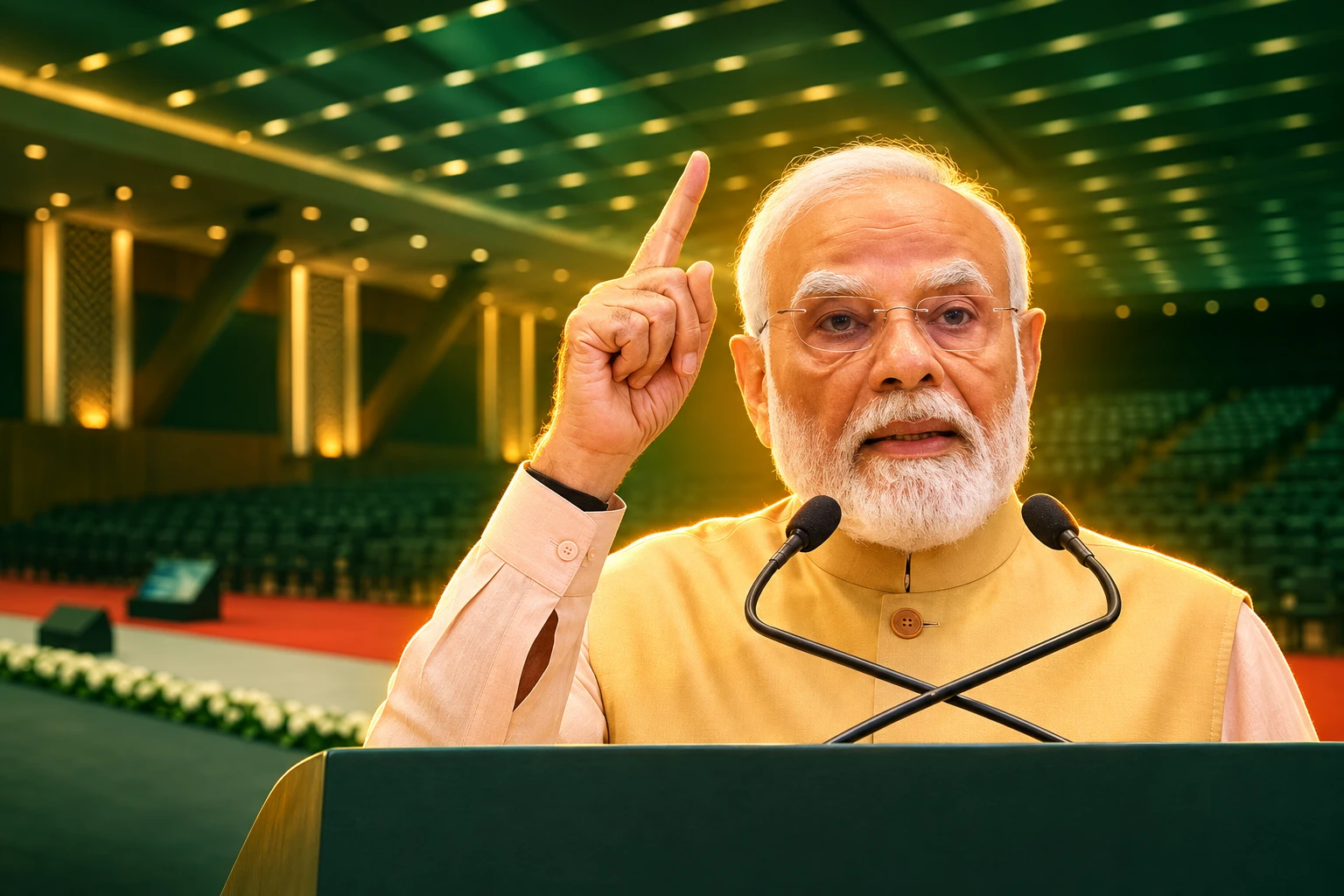
India’s Crude Bill Hit $90.6 Billion on Almost Unchanged Volumes
The West Asia conflict began in February 2026 and squeezed shipping through the Strait of Hormuz, the route that has long carried a large share of Gulf crude and gas toward Asia. That is an oil-and-freight shock. It is not a shortage of sunshine on Indian rooftops.
Cell data put the April-September crude bill at $90.6 billion, or ₹8.53 lakh crore, against $61.9 billion a year earlier. April to September crude import volumes were little changed, so almost the entire extra cost is price. In September alone the bill was $15.4 billion against $10.5 billion a year earlier, on 21.7 million tonnes of crude. The Indian basket averaged $116.09 a barrel that month, against $69.61 a year before. The net oil and gas bill, after product exports, rose to $81.1 billion from $60.2 billion.
THE GULF INVOICE SOLAR DID NOT ISSUE
| Measure | Latest | Comparison |
|---|---|---|
| Crude import bill | $90.6 billion (Apr-Sep 2026) | $61.9 billion a year earlier |
| Change in the bill | 46.4 percent | Volumes barely higher |
| September crude bill | $15.4 billion | $10.5 billion a year earlier |
| Indian basket, September | $116.09 a barrel | $69.61 a year earlier |
| Net oil and gas bill, Apr-Sep | $81.1 billion | $60.2 billion a year earlier |
| Crude import dependence | 88.7 percent (FY26) | Oil still 30 percent of primary energy |
An October note from HDFC Mutual Fund, drawing on MoSPI, CEA and PPAC, put crude import dependence at 88.7 percent in FY26 and natural gas near half. The Middle East’s share of India’s crude did fall, from 64 percent in FY22 to 49 percent in FY26, while Russia’s share rose from 2 percent to 30 percent. That is a different kind of buffer: more sellers, not more panels. Strategic petroleum reserves at three sites hold 5.33 million tonnes, about 9.5 days of crude need. Ethanol blending in petrol has held near 20 percent since October 2025.
Diesel and petrol make up 55 percent of the oil products India uses, most of it on the road. Electric vehicles on Indian roads replaced about 89,000 barrels a day in 2025, around 4 percent of oil demand, the same note said. The electric share of two-wheeler sales rose from 6.7 percent in January to 10.7 percent in August 2026 after the conflict began. Those are the channels that would actually cut the Gulf bill. They are still small.
Why 55 Percent of Capacity Still Leaves Oil in Charge
India did hit a climate pledge early. Non-fossil sources crossed half of installed power capacity in 2025, five years ahead of the 2030 Paris timeline, and stood at 55 percent by September 2026. The Ministry of New and Renewable Energy’s own ledger lists 308 GW of non-fossil capacity at end-September: 299.25 GW of renewables and 8.78 GW of nuclear, with solar at 171.05 GW and wind at 59.20 GW. Joshi said the total had been 80.3 GW a dozen years earlier.
Installed capacity is a nameplate. It is not the fuel that moved ships, trucks, cooking gas and aircraft through the shock. Renewables were 88 percent of new power plants added in FY26, yet they were only 3.8 percent of primary energy in FY25, up from 2.4 percent in FY16. Oil was 30 percent. Coal was 59 percent. Gas was 7 percent. Coal is mostly mined at home. Oil is not.
THREE WAYS TO COUNT THE SAME BUILD
| Layer | Clean share | What the figure hides |
|---|---|---|
| Installed power capacity | 55 percent, September 2026 | Nameplate watts, including plants that sit idle after dark |
| Electricity generated | 32 percent, April-August 2026 | Coal still supplies most of the kilowatt-hours |
| Primary energy | 3.8 percent renewables, FY25 | Oil 30 percent, coal 59 percent, gas 7 percent |
BloombergNEF’s India Transition Factbook found that non-fossil plants supplied a third of power in the first seven months of 2026, in line with that 32 percent generation share, and that coal still provided the majority. The same research says an economics-led shift could cut energy imports from 5.3 percent of GDP in 2025 to 3.1 percent by 2035. That is a decade away from the invoice India is paying now.
So the Prime Minister is not inventing the build. He is asking a power-sector success to answer an oil-sector shock. The two stacks barely overlap.
Domestic Module Capacity Reached 225 Gigawatts
The factory story is the part of the speech that does not need a Gulf war to stand up. Joshi said solar module lines had grown from 2 GW a decade ago to 225 GW, cell lines from zero to 45 GW, and wind turbine making from 10 GW to 24 GW. Solar plants themselves went from 2.8 GW to 171 GW. Wind went from 21 GW to 60 GW. Solar tariffs, he said, had fallen from ₹10-11 a unit in 2011-12 to ₹2.15 in 2024-25.
Modi described the same arc as proof of Make in India: India once imported even small solar parts and now makes modules at home, with work starting on other components. He put past spending at more than ₹15 lakh crore, or $164 billion, over the decade, including more than ₹6 lakh crore, or $63 billion, in the two years since the 2024 RE-INVEST summit. Joshi put foreign direct investment in the sector at $6.2 billion over those two years.
Those lines will keep running whether or not tankers queue outside Hormuz. They cut the need to import panels. They do not fill a diesel tank.
The $220 Billion Pitch Starts After 2027
The crisis line was also a fundraising line. Modi told the hall it would be hard to find India’s scale, scope and demand, or its political and policy stability, in any other market. He put the remaining opportunity at more than ₹20 lakh crore, about $220 billion, by the end of the decade.
MNRE secretary Santosh Sarangi had already dated the cheque. Briefing before the summit, he said India had 308 GW of non-fossil plant and that the 500 GW target would take about $220 billion needed from 2027 to 2030, plus storage, stronger wires and more local making. That window is the gap after the decade Modi just celebrated.
Modi also said India would try to add another 500 GW of non-fossil capacity over the next 10 to 11 years, on top of the 500 GW by 2030 still on the books. “This target is somewhat difficult, but I have faith in the capability of my country; therefore I say, We will do it!”
WHERE THE NEXT MONEY HAS TO WORK
- Wires: Joshi said the Prime Minister had approved Green Energy Corridor Phase-III at ₹1.86 lakh crore, to connect 135 GW of renewable plant inside states by March 2033.
- Storage: Modi asked for Indian battery hardware and new storage capacity so solar can run after sunset, and called that a job machine for young engineers.
- The oil gap: He wants rooftop solar to cook meals, cutting imported gas, and to charge scooters, bikes and cars so middle-class families “save thousands of rupees every year.”
- Hydrogen: The National Green Hydrogen Mission is aiming at 5 million tonnes a year by the end of the decade. Modi said India’s first green hydrogen train had started a few months earlier.
- Water and farms: The PM Surya Sarovar scheme, with an outlay of more than ₹5,000 crore, is meant to put 5,000 MW of panels on reservoirs and lakes. He also wants panels on unused farm edges, not only on irrigation pumps.
Read that list against the $90.6 billion crude bill. The money is being asked to do the work the last decade of modules did not do: move households and vehicles off imported molecules.
Rooftops, Irrigation Pumps and a Contest Among States
If there is a domestic politics in the speech, it is here. Modi wants every government building, school, college, hospital and street-light network on solar, fast, and he wants states and local bodies to compete on who gets there first. The pitch is pride and a leaderboard, not a new central law.
THE HOUSEHOLD AND STATE LEDGER
- PM Surya Ghar: More than 65 lakh homes (6.5 million) have joined since the rooftop scheme launched in February 2024, at a stated pace of one lakh homes every six days, toward a target of one crore. Modi said a study found bills down about 76 percent, with lakhs of families at zero and some selling surplus to the grid.
- Government roofs: More than 44,000 government buildings now run on solar, saving about ₹700 crore a year.
- Farms: The KUSUM scheme has put solar irrigation with more than 30 lakh farmers, saving each pump user nearly ₹1 lakh a year, he said.
- Rooftop stock: Grid-connected rooftop solar had reached 33.41 GW by September 30, inside the 171.05 GW solar total.
He also offered India as a template abroad, including a $200 million Africa Solar Facility. Those are exportable schemes. They still leave the tanker bill with PPAC.
September Curtailment Showed the Grid’s Limit
Even the power-sector half of the shield has a crack. JMK Research, using Grid-India data, found 118.6 GW of renewable capacity affected by curtailment in September, 96.9 GW of it solar and 21.7 GW wind, equal to 1.28 percent of renewable generation that month. The causes were familiar: demand and generation out of step, thin wires, little storage, and a season when solar output is high and load is not. A rule due in July 2027 would make new solar and wind projects bring batteries with them.
That is why the ₹1.86 lakh crore corridor and the storage plea sit at the centre of the $220 billion ask. Extra modules without wires and batteries become unused nameplate, which is the 55 percent story in another form.
Indian markets on November 3 still treated cheaper crude, not a new rooftop, as the relief, as oil fell on hopes of diplomacy around the strait. Modi is not wrong that India built a huge solar industry, or that more of daily life could run on it. He is asking that industry to stand in for an oil shock it has not yet been built to absorb, and he is asking investors for $220 billion to close the gap the last decade left on the dock.

ADNOC Ship Hit in Hormuz Leaves One Crew Missing

SpiceJet’s Rs 5,500 Crore Plan Follows a Rescue That Failed

Hasina’s Return Fight Sets Fire to Yunus’s Bank

Bancroft Recants the 2018 Inquiry and Names the Team

Adhikari Ties the Saffron Saree Row to School Licences

Clancy Juror Says the Holdout Never Cited Evidence

The iPhone 18 Pro Max Splits Apple’s Fall in Two

OpenAI Calls GPT-6 Astra AGI Then Locks Its Exploits

Trump Claims Hormuz Control as Oil Holds Near $96

Russia Closes the Goethe-Institut Berlin Tried to Save

 NEWS2 months ago
Clancy Juror Says the Holdout Never Cited Evidence
- NEWS3 months ago
The iPhone 18 Pro Max Splits Apple’s Fall in Two
- NEWS3 months ago
OpenAI Calls GPT-6 Astra AGI Then Locks Its Exploits
- BUSINESS3 months ago
Trump Claims Hormuz Control as Oil Holds Near $96
- LIFESTYLE3 months ago
Russia Closes the Goethe-Institut Berlin Tried to Save
- AUTO3 months ago
Volkswagen’s Job Cuts Leave Four Plants Without Cars
- NEWS3 months ago
Dyson Puts Nurovi Robots on Sale Without the UV Flagship
- BUSINESS2 months ago
US Destroys Five Iranian Tankers as the Shock Hits Jordan