
BUSINESS
KOSPI Closes at Record 6,615 as AI Chip Rally Lifts Korea

South Korea’s KOSPI closed at a record 6,615.03 on Monday, April 27, 2026, up 139.4 points or 2.15 percent on the day, lifted by an artificial intelligence-fueled rally in chip and power equipment stocks. Foreign and institutional investors bought a combined 1.99 trillion won of equities. Korean retail traders sold almost exactly the same amount. The won firmed to 1,472.5 against the dollar, up 12 won from Friday.
The new high arrived just two trading days after the previous peak of 6,475.81 on Thursday. Volume was heavy at 835.6 million shares worth 33 trillion won, about $22.4 billion. Winners outnumbered losers 495 to 357.
Two engines are driving the run: record HBM memory profits at SK hynix and Samsung Electronics, and a sudden boom in Korean power transformer orders tied to U.S. AI data center buildout. Five of the Magnificent Seven report earnings this week, which will test how durable the trade is.
The Numbers Behind Monday’s Record Close
The KOSPI’s two-day move from 6,475.81 to 6,615.03 added roughly 140 points, but the bigger headline is the index has now gained more than 50 percent year to date. Heavy turnover and a lopsided buyer mix tell the real story.
- 6,615.03. KOSPI closing level on April 27, 2026, a fresh all-time high.
- 33 trillion won. Day’s trade value, roughly $22.4 billion.
- 1.99 trillion won. Combined net buying by foreigners and institutions.
- 1.97 trillion won. Net selling by South Korean retail investors on the same day.
The big movers came from two clusters. Samsung Electronics rose 2.28 percent to 224,500 won. SK hynix added 5.73 percent to 1,292,000 won. LS Electric jumped 12 percent to 255,500 won. Hyosung Heavy Industries climbed 10.95 percent to 3,941,000 won, holding its place among Korea’s so-called emperor stocks priced above one million won a share.
Battery names lagged on profit-taking. LG Energy Solution dropped 3.53 percent to 464,000 won. Samsung SDI slipped 0.94 percent to 635,000 won. Bond prices firmed: three-year Korean Treasury yields fell 0.4 basis points to 3.492 percent, and five-year yields fell 0.7 basis points to 3.676 percent.
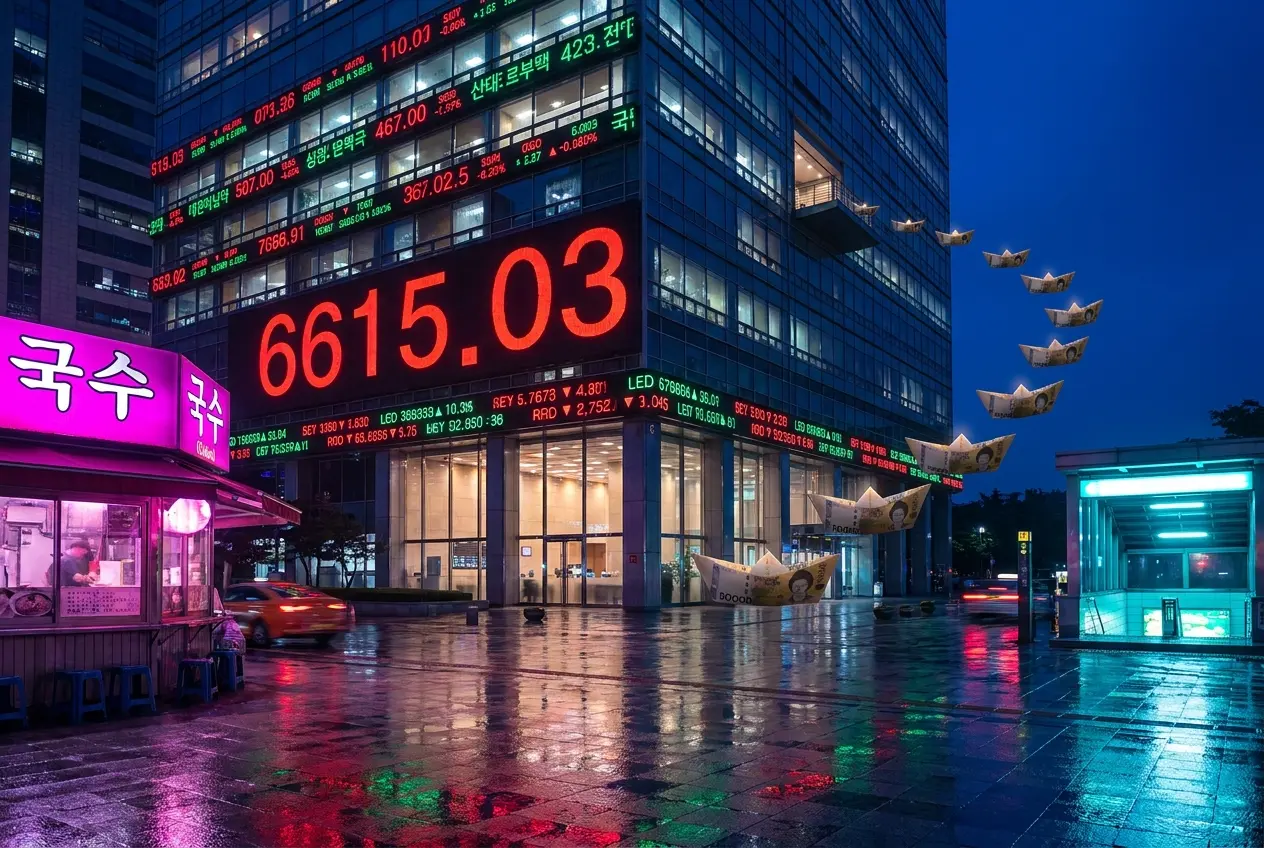
Foreigners Buy, Korean Retail Cashes Out
The most striking pattern in Monday’s tape was who sat on each side of the trade. Foreign and institutional desks together absorbed nearly 2 trillion won of stock. Korean retail investors, the so-called ant investors, sold almost the same amount. The KOSPI is at an all-time high, and Koreans are the ones cashing out.
That pattern has held all month. CNBC’s April 24 reporting on Korean retail flows into U.S. equities documented record outbound retail money, encouraged by a friendlier overseas capital gains threshold and a long-running grumble that Samsung and SK hynix never reward shareholders the way Nvidia or Microsoft do.
Why the divergence keeps widening:
- Profit-taking after a 50 percent year-to-date rally. Many ant investors bought Samsung at 50,000 to 60,000 won during 2024 and 2025 and are locking in multi-bagger gains.
- Tax arbitrage. Capital gains on KOSPI shares above 5 billion won face a domestic levy. Overseas gains receive a separate threshold that retail desks see as friendlier.
- Currency hedge instinct. With the won soft at 1,472.5 to the dollar, dollar-denominated U.S. stocks act as a built-in FX hedge.
- The Korea discount complaint. Korean investor forums grumble that chaebol governance still suppresses minority shareholder returns despite record chip earnings.
The flip side is that foreign holders now own a near-record share of Samsung and SK hynix free float. That is why both stocks reacted so sharply to Intel’s first-quarter beat reported last Friday. Outside money, not Korean retail, is now setting the marginal price.
SK Hynix’s $27 Billion Profit Quarter Resets the Bar
SK hynix reported Q1 2026 net profit of about 40.3 trillion won, roughly $27.2 billion, with operating margin at 72 percent, the strongest in the company’s history. Revenue hit 52.6 trillion won, up 198 percent year on year, according to the company’s official Q1 2026 business results disclosure. Operating profit was up 405 percent year on year.
The driver is high-bandwidth memory. SK hynix holds about 57 percent of the global HBM market, the stack of DRAM dies that sits next to every Nvidia, AMD and Google AI accelerator. On the company’s April 23 earnings call, management put the supply problem starkly:
“Customer demand for HBM4 over the next three years already exceeds our supply capacity.”
Samsung Electronics filed a similarly outsized quarter on April 7. Operating profit of 57.2 trillion won, around $43 billion, exceeded the company’s entire 2025 operating profit of 43.6 trillion won, KED Global’s reporting on Samsung’s first-quarter operating profit showed. HBM revenue tripled year on year as Samsung ramped its first major Nvidia HBM3E shipments.
Power Equipment Becomes Korea’s Sleeper Trade
The chip rally made headlines. The transformer rally is what made Monday’s session different. With U.S. utilities racing to wire up new AI data centers and replace 1960s-era grid hardware, Korea’s three biggest power equipment makers are running back orders that European competitors cannot match.
Combined order backlog for Hyosung Heavy Industries, HD Hyundai Electric and LS Electric crossed 27 trillion won earlier this year, Asia Business Daily’s tally of Korea’s power equipment Big Three reported. More than half of those orders are concentrated in North America. LS Electric in April alone announced a $114 million switchgear deal with a U.S. Big Tech firm, and a separate $46 million hyperscale AI data center contract documented by Data Center Dynamics.
| Company | Monday move | Recent share price | Key AI data center wins |
|---|---|---|---|
| LS Electric | +12.00% | 255,500 won | $114M U.S. switchgear, $46M U.S. hyperscale |
| Hyosung Heavy Industries | +10.95% | 3,941,000 won | $225M HVDC transformer plant, Changwon |
| HD Hyundai Electric | +5.37% | Listed on KRX | U.S. capacity expansion, North American backlog |
Hyosung is doubling its U.S.-focused transformer output. LS Electric is enlarging its Busan plant to feed both U.S. and European transmission demand. The order book is now long enough that Korean brokerages have started flagging power equipment as a multi-year, not cyclical, theme.
That is a striking shift. Two years ago, the same names were treated as legacy industrial cyclicals. Today they trade like AI infrastructure picks, on AI multiples, with AI duration.
The Won, the Dollar and the Big Tech Earnings Test
The won closed at 1,472.5 per dollar on Monday, up 12 won from Friday, a small but notable reversal after weeks of pressure from outflows to U.S. equities. Bond yields slipped, signaling that Korean fixed-income desks see no Bank of Korea rate cut imminent. Roughly 60 percent of South Korean economists polled this year expect the central bank to hold its policy rate at 2.5 percent through year-end, citing 3.4 percent March CPI and a soft won, in line with the latest Bank of Korea statistical and policy releases.
The bigger near-term test is American, not Korean. Microsoft, Alphabet, Amazon and Meta report Wednesday this week. Apple reports Thursday. Their AI capital spending guidance will set the tone for HBM order flow into the second half. CNBC’s earnings playbook for the busiest week of the season notes the five U.S. tech giants reporting this week represent close to $16 trillion of market capitalization, around a quarter of the S&P 500.
How April 2026 Got to a Record
The April rally did not happen overnight. Korean equities have climbed every week this month on a mix of geopolitical relief, earnings beats and chip-cycle tailwinds.
- April 4. Foreigners return as net buyers after a 12-day selling streak. KOSPI rises 2.74 percent on the session.
- April 7. Samsung pre-announces Q1 operating profit of 57.2 trillion won, beating the entire 2025 figure.
- April 9. KOSPI surges 6.87 percent in a single session as Iran ceasefire signals ease oil risk.
- April 23. SK hynix posts record Q1 with 72 percent operating margin and 405 percent year-on-year operating profit growth.
- April 24. KOSPI sets a record close of 6,475.81 on Intel’s Q1 beat.
- April 27. Index breaks 6,600 intraday for the first time, closes at 6,615.03.
“We are seeing anticipation over companies related to AI data centers, particularly those in the AI value chain, such as semiconductor and power equipment companies,” said Lee Kyoung-min, an analyst at Daishin Securities, in remarks to Yonhap on Monday.
Through it all, two deeper currents kept compounding. Foreign capital chased Korean AI exposure that costs less than U.S. peers. Korean retail capital sailed the other way toward Nasdaq.
Frequently Asked Questions
Why did the KOSPI close at a record on April 27, 2026?
The KOSPI closed at 6,615.03, up 2.15 percent, on a chip and power equipment rally tied to AI data center demand. Samsung Electronics rose 2.28 percent and SK hynix climbed 5.73 percent after Intel’s Q1 beat. LS Electric jumped 12 percent on U.S. transformer orders. Foreigners and institutions bought 1.99 trillion won of stock.
What is HBM and why does it matter for Korean stocks?
High-bandwidth memory is a vertically stacked DRAM package used in AI chips from Nvidia, AMD and Google. SK hynix supplies about 57 percent of the global market, and Samsung is its main rival. SK hynix told its April 23 earnings call that HBM4 customer demand already exceeds three years of forward production capacity.
Are foreign investors really buying while Koreans are selling?
Yes. On April 27, foreigners and institutions bought a combined 1.99 trillion won of KOSPI shares while retail investors sold a net 1.97 trillion won. Korean ant investors are rotating into U.S. equities for tax and currency reasons even with the home market at all-time highs.
Will the Bank of Korea cut interest rates in 2026?
About 60 percent of South Korean economists polled expect the Bank of Korea to hold its policy rate at 2.5 percent through 2026. March 2026 inflation came in at 3.4 percent, well above the 2 percent target, and the won remains soft at 1,472.5 to the dollar. Both factors argue against a near-term cut.
Which Magnificent Seven companies report this week?
Microsoft, Alphabet, Amazon and Meta report on Wednesday, April 29, 2026. Apple reports on Thursday, April 30. Combined, the five represent close to $16 trillion of market cap, about a quarter of the S&P 500. Their AI capital spending guidance will dictate orders for Korean HBM chips and U.S.-bound transformers into the second half.
Which Korean power equipment stocks benefit from U.S. AI data centers?
LS Electric, Hyosung Heavy Industries and HD Hyundai Electric are the three most exposed names. Their combined order backlog crossed 27 trillion won earlier this year, with more than half tied to North America. LS Electric alone announced $114 million and $46 million U.S. data center contracts in April 2026.
The 6,615.03 close confirms Korea is now the most direct Asian proxy for U.S. AI capital spending, but the buyer mix is fragile. If foreign desks pause and Korean retail keeps shipping money to U.S. brokerages, the index can crack as fast as it climbed. Wednesday’s Microsoft and Alphabet numbers will be the first real stress test.

-
 TECH1 year ago
Where Garmin Watches are Made and How They are Assembled
-
 AUTO3 months ago
Tesla’s Roadster Is ‘a Few Weeks Away,’ Says Its Chief Designer
-
 NEWS10 years ago
Samsung Releases Galaxy Note7 TV Ad as Reddit AMA Leaks Specs
-
 NEWS10 years ago
Android 7.0 Nougat Rolls Out To Nexus Devices With New Emoji, Features
-
 FINANCE9 years ago
Cardano Price Surges as ADA Enters the Crypto Top Ten List
-
 NEWS10 years ago
Pre-Order the First Camera Made for Facebook Live Streaming Video
-
 FINANCE1 year ago
Binance Suspends Trading and Withdrawals for a System Upgrade
-
 FINANCE9 years ago
RChain Price Jumps Nearly 150% to a New All-Time High of $2.03