
NEWS
Apple’s Demand Surge Meets Chip Squeeze as Cook Exits
Apple posted record June-quarter sales yet warned of significant supply constraints on Mac, iPhone and iPad as AI demand rations chips and memory.

Apple reported $109.4 billion in revenue for its fiscal third quarter, up 16 percent, and $2.02 in diluted earnings per share, yet shares fell more than 6 percent after hours after CEO Tim Cook warned of “very significant” supply constraints that will hit Mac, iPhone and iPad availability. The drop came on Cook’s final earnings call before John Ternus takes over as CEO on September 1.
Investors focused on the softer outlook even as iPhone sales jumped 22 percent and Mac climbed 29 percent on demand that outran Apple’s own forecasts. The gap between record results and a cautious guide defined the session. Strong unit pull met a supply chain already stretched by competing claims on the same advanced silicon.
Record Sales Across Phones, Macs and Services
The June quarter set company records for total revenue and EPS. Products brought in $78.7 billion. Services reached $30.7 billion, a June-quarter high, up 12 percent despite foreign-exchange headwinds.
iPhone revenue hit $54.3 billion. Mac delivered $10.4 billion. Wearables, Home and Accessories rose 6 percent to $7.9 billion. iPad slipped to $6.2 billion on a tough year-ago comparison.
| Category | Q3 FY2026 Revenue | YoY Change |
|---|---|---|
| iPhone | $54.3 billion | +22% |
| Mac | $10.4 billion | +29% |
| Services | $30.7 billion | +12% |
| Wearables, Home & Accessories | $7.9 billion | +6% |
| iPad | $6.2 billion | -6% |
| Total | $109.4 billion | +16% |
Gross margin reached 50.1 percent, lifted by roughly 2 percentage points from tariff refunds that added about $0.11 to EPS. Net income was $29.8 billion. Apple’s board declared a $0.27 quarterly dividend. The company pointed to June quarter records for revenue and EPS in its official release and posted the full detailed product and segment sales figures.
Every geographic segment set a June-quarter revenue record. Greater China rose 22 percent to $18.8 billion, led by iPhone and an all-time Mac high there. Americas remained the largest region.
The product mix tells a clear story. iPhone and Mac together drove the bulk of the upside, while Services kept its steady climb even with currency pressure. Wearables added another layer of growth. Only iPad lagged, and that shortfall traced to a difficult comparison rather than a collapse in interest. The breadth of records across both products and regions left little doubt that demand was broad, not concentrated in a single hit SKU.
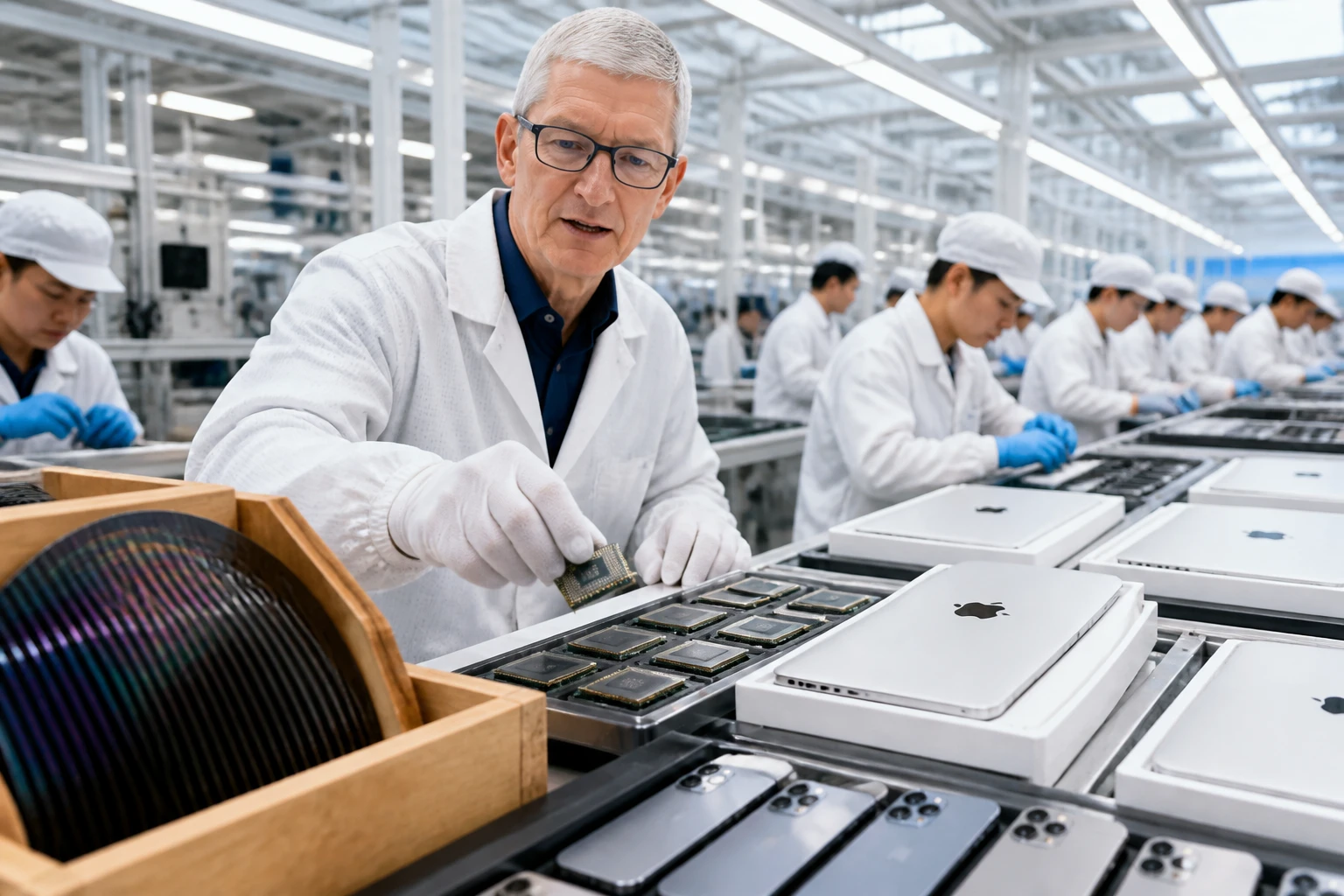
Demand Outran the Forecast, Not the Suppliers Alone
Cook was blunt: the core problem is a demand forecast miss. “This is not a regular supply issue, it’s a demand forecast issue to be candid,” he said. “We’ve got a quarter ahead where we’ll be scrambling on the supply side.”
iPhone and Mac both grew far ahead of internal expectations. Apple had already been pulling supply forward. Flexibility in the chain is now limited. Constraints first showed in Mac availability and are expected to spread to iPhone and iPad.
We’re seeing some very significant constraints currently with limited flexibility in the supply chain to remedy it.
Cook said those words on the call. The primary bottleneck is advanced-node capacity for Apple’s systems-on-chip, produced mainly at TSMC. Memory costs have risen for three quarters and will climb further. Cook called the memory situation difficult and not good for consumers. Apple has already raised prices on Macs and iPads; iPhone pricing remains under review in most markets.
The sequence matters. Apple did not simply under-order. It accelerated deliveries when early signals turned hot, then ran into a hard ceiling once those pull-ahead options were exhausted. That leaves the company with less room to smooth the next quarter. Mac felt the pinch first because its M-series volumes and configurations draw heavily on the same leading-edge lines that AI accelerators also claim. iPhone and iPad follow as the same capacity pool stays tight.
How AI Data Centers Are Rationing the Chips
The squeeze is not unique to Apple. AI infrastructure has pulled manufacturing capacity toward high-bandwidth memory and advanced logic at the expense of conventional DRAM, NAND and some consumer-grade nodes. Industry analysts at IDC have tracked the AI-driven reallocation of memory capacity that began in late 2025 and is expected to keep supply growth below historical norms through 2026 and into 2027.
- Advanced nodes for Apple’s A-series and M-series chips face tight TSMC allocation as AI accelerators compete for the same leading-edge lines.
- Memory pricing continues higher beyond September, Cook warned, with limited ability to offset fully through inventory or other component savings.
- Pull-ahead limits mean Apple can no longer simply accelerate deliveries from suppliers without hitting a hard ceiling.
Cook noted the company expects to pay even higher memory costs and wants the market to expand beyond its three primary suppliers. The same dynamic that powers record Mac AI workloads and on-device intelligence is now constraining the devices themselves.
In practice, the rationing works through allocation priority. Foundries and memory makers favor the highest-margin, longest-commitment buyers. Hyperscale AI build-outs often fit that profile. Consumer device ramps, even large ones, compete for residual wafers and bits once those contracts are filled. Apple’s scale still commands attention, yet the company itself acknowledges limited flexibility once the forecast miss became clear. Expanding the supplier base is a longer-cycle fix, not a September solution.
Guidance Misses and the Margin Path
CFO Kevan Parekh guided September-quarter revenue growth of 9 to 11 percent, below the roughly 12 percent Wall Street had modeled. Foreign exchange is expected to cut about 2.5 percentage points from the growth rate. iPhone revenue should still rise in the mid-teens. Gross margin is projected at 47 to 48 percent, including roughly one percentage point of remaining tariff-refund benefit.
High demand for iPhones continues, Parekh said, but supply constraints and FX will weigh on the reported numbers. Services growth is expected to look similar to the June quarter after adjusting for the currency hit.
| Metric | June Quarter | September Guide |
|---|---|---|
| Revenue growth | +16% | +9% to +11% |
| Gross margin | 50.1% | 47% to 48% |
| Tariff-refund lift | ~2 percentage points | ~1 percentage point |
| FX impact on growth | Headwind present | ~2.5 percentage points |
The guide does not signal weak demand. It signals that reported growth will be capped by what Apple can ship and by currency translation. Mid-teens iPhone growth would still be robust if achieved. The margin step-down largely reflects the fading tariff-refund tailwind rather than a sudden collapse in product profitability. Services, adjusted for FX, is framed as steady rather than accelerating or stalling.
Cook Hands Off to Ternus Amid the Scramble
This was Cook’s last earnings call as CEO. He becomes executive chairman. John Ternus, the longtime hardware engineering chief, assumes the top job on September 1. Cook called the transition seamless and said Ternus will lead future calls. Ternus spoke briefly, noting opportunity in the space and focus on existing plans.
The timing puts the new chief immediately into a quarter of supply firefighting while preparing the next iPhone cycle and broader Siri AI rollout. Apple’s installed base hit a new all-time high across categories. Paid subscriptions reached 1.5 billion.
Handing the CEO role to the hardware engineering lead during a component crunch is not accidental. Ternus already knows the product roadmaps and the supplier relationships that feed them. Cook’s move to executive chairman keeps institutional continuity while the operating seat shifts. The installed-base and subscription figures give the incoming chief a large, monetizable foundation even if near-term unit shipments are constrained by silicon.
Tariff Refunds Flow Back Into US Manufacturing
The 2-percentage-point margin boost came from tariff refunds after certain levies were struck down. Apple said it intends to reinvest those refunds in the United States. The company had already outlined plans for $600 billion in domestic manufacturing commitments over four years. China remains the largest manufacturing base for its products.
Cook framed the refunds as fuel for the US build-out rather than pure profit. Operating cash flow set a June-quarter record.
The accounting effect is temporary. Roughly half the June margin lift from refunds is expected to remain in the September guide, then fade further. The strategic choice is longer-lived: channel the cash into the multi-year US manufacturing plan already on the books. That does not relocate the bulk of assembly overnight. It does signal where incremental investment will land while China continues to anchor current production volume.
Siri AI and the On-Device Bet Still Ahead
At WWDC the company unveiled a fully reimagined Siri AI now in public beta. Cook called it part of an enormous opportunity and described on-device capability as a competitive weapon. Early user response has been strong, he said. Negotiations with European authorities continue with the goal of a simultaneous global release.
Apple continues to stress private, personal, on-device intelligence running on its Neural Engine and unified memory architecture. That same silicon focus that differentiates the Mac for local AI inference is also the capacity under pressure. The all-new Siri AI unveiled at WWDC remains central to the software story even as hardware supply tightens. Separately, the company keeps testing Mac’s growing pitch for gaming and creative work with titles that lean on Apple silicon.
The tension is structural. On-device AI needs capable Neural Engines and ample unified memory in every unit shipped. Those are precisely the advanced-node and memory resources now hardest to secure. A strong beta response and a push for global timing raise the stakes on hardware availability. Software ambition and component scarcity are moving on the same calendar.
Greater China Strength Underscores Broad Demand
Greater China’s 22 percent rise to $18.8 billion stood out even inside a quarter when every region set a June record. iPhone led the gain. Mac reached an all-time high in that market. Americas stayed the largest region by revenue, yet the China print showed the upcycle was not confined to one geography.
That breadth complicates the supply problem. When demand spikes in multiple large regions at once, allocation decisions grow harder. Units steered to one market tighten shelves in another. The all-time Mac high in Greater China also confirms that Apple silicon’s local-AI and performance story is landing with buyers, which feeds the same advanced-node competition already described.
- Regional records arrived together, leaving no soft geography to absorb reallocated supply.
- iPhone and Mac drove China’s gain, the same two categories now facing the tightest constraints.
- Americas scale still anchors the company, so any prolonged shortage there would weigh heavily on totals.
The geographic picture therefore reinforces Cook’s forecast-miss diagnosis. Strength was wide enough that prior supply plans, even with pull-aheads, could not keep pace everywhere at once.
Subscriptions and the Installed Base Buy Time
Paid subscriptions reached 1.5 billion while the installed base hit a new all-time high across categories. Those figures sit behind the Services revenue of $30.7 billion and its 12 percent growth. They also matter for the supply-constrained stretch ahead.
A larger base and a thicker subscription layer give Apple recurring revenue that does not depend on shipping every incremental hardware unit on time. Services growth is guided to look similar to June after FX adjustment, which implies the engine keeps running even if product revenue is capped by component availability. The installed-base high also means more devices eligible for the reimagined Siri AI once the rollout widens, linking the software story to an already expanded customer pool.
None of that erases the hardware scramble. It does cushion the financial profile while Ternus works through the September quarter and the next iPhone cycle. Momentum in Services and the base is a buffer, not a substitute for resolving advanced-node and memory tightness.
Price Tags, Margins and the Next Ninety Days
Apple already lifted Mac and iPad prices at the end of the quarter. Further memory and node pressure could push more adjustments. Consumers face higher costs or longer waits. Suppliers of conventional memory and trailing-edge capacity may gain as Apple seeks alternatives. Hyperscalers that locked in HBM and leading-edge wafers earlier sit in a stronger position.
For Apple the near-term task is clear: scramble on supply while defending the product momentum that created the shortage. Gross margin will normalize lower without the full tariff boost. Revenue growth decelerates on paper even if unit demand stays hot. Ternus inherits both the strongest product cycle in years and the tightest component market in recent memory.
The June numbers proved the demand. The September guidance and the after-hours slide showed the cost of running into the AI capacity wall.
Over the next ninety days the company must convert strong order intent into shipped product, absorb higher memory costs, and keep the Services and subscription flywheel intact. Price reviews on iPhone remain open in most markets. Mac and iPad already carry higher tags. How far those moves offset component inflation without cooling the demand that caused the miss will shape the first full quarter under new leadership. The records are real. So are the constraints.

-
 TECH1 year ago
Where Garmin Watches are Made and How They are Assembled
-

 AUTO3 months ago
Tesla’s Roadster Is ‘a Few Weeks Away,’ Says Its Chief Designer
-
 NEWS10 years ago
Samsung Releases Galaxy Note7 TV Ad as Reddit AMA Leaks Specs
-
 NEWS10 years ago
Android 7.0 Nougat Rolls Out To Nexus Devices With New Emoji, Features
-
 FINANCE9 years ago
Cardano Price Surges as ADA Enters the Crypto Top Ten List
-
 NEWS10 years ago
Pre-Order the First Camera Made for Facebook Live Streaming Video
-
 FINANCE1 year ago
Binance Suspends Trading and Withdrawals for a System Upgrade
-
 FINANCE9 years ago
RChain Price Jumps Nearly 150% to a New All-Time High of $2.03