NEWS
Sairang Express Leaves the Rails on a Line Without Kavach
The 13125 Kolkata-Sairang Express derailed at Digaru while yielding the line. Four people were hurt. NFR says Kavach is still not on the section.

The locomotive and five coaches of the 13125 Kolkata-Sairang Express left the rails at Digaru at 6.54 a.m. on November 11. Northeast Frontier Railway said the train was being received to let another train pass, and the loco pilot could not control the speed.
Assam Chief Minister Himanta Biswa Sarma later said four passengers had minor injuries and were receiving care. No one died. The same railway confirmed Kavach is not installed on the section.
The Express Left the Rails While Giving Way
NFR Bulletin 1, issued from Maligaon and signed by Kapinjal Kishore Sharma, the zone’s chief public relations officer, fixed the time at 06:54 hrs. Train No. 13125, running from Kolkata toward Sairang near Aizawl, was being received at Digaru railway station in Kamrup (Metro) when the locomotive and five coaches derailed.
Digaru sits about 44 km from Guwahati, on the approach into the state’s busiest rail pinch point. Sharma said the train was being stopped so another service could go first. “Another train had to be given way, so this train was stopped to let that train pass,” he said. The speed, he added, was not very high because the train was entering the station, which is why there was no death and no major injury.
The first bulletin said all passengers were safe and no injuries had been reported. Sarma’s later update, posted on his official account after he quoted NFR, revised that to four people with minor injuries at Sonapur Primary Health Centre, with food, water and an alternative train arranged for everyone still stranded.
Update 👇🏽
All passengers are safe. 4 sustained minor injuries and are receiving care. We're working closely with @RailMinIndia on this situation.
All stranded passengers have been provided with basic necessities and alternative travel train has been arranged for the journey. https://t.co/SaBxz0T3OP
— Himanta Biswa Sarma (@himantabiswa) November 11, 2026
Sharma said the train had been carrying about 900 people and that a special train had already left Guwahati for Digaru to take them on toward Sairang. A passenger described the moment inside a coach: staff had gone to sell tea, the train began to shake, people hit fittings in the compartment, and then the engine went over with a loud sound.
We were sitting and talking when a staff member left to sell tea. We too were about to move when the train started shaking on the tracks. We collided with parts of the train inside the compartment. Then, with a loud sound, the engine derailed. We don’t know anything more. Nobody was injured; everyone is safe.
A passenger at Digaru, November 11, 2026
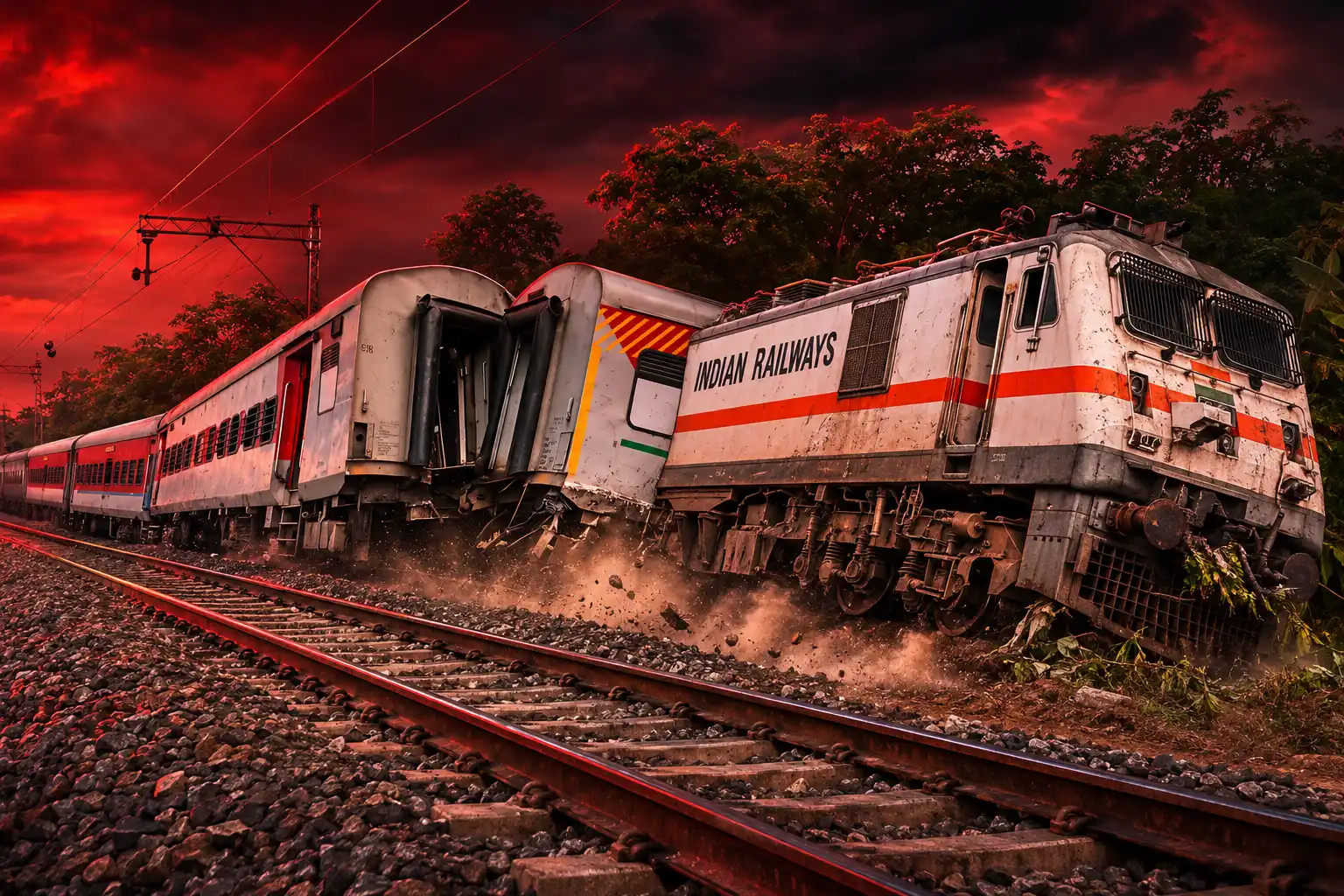
What Happened at Digaru Station?
The train being given the road was the 12067 Guwahati-Jorhat Town Jan Shatabdi Express. Sharma said 13125 had to cut speed so that Jan Shatabdi could be given priority at Digaru. The speed could not be brought down in time, and the engine and five coaches left the tracks.
Jan Shatabdi did not get a clean run either. After the derailment blocked Digaru, NFR listed 12067 as controlled at Panbari. Train No. 15627, the Coimbatore-Silchar Express, was held at Panikhaiti. The train that 13125 had slowed to protect was then stuck anyway, a few kilometres back, because the station it was meant to sweep through had just lost a locomotive and five coaches to the ballast.
Sharma would not name a cause beyond the failed stop. “Why the train did not stop in time is something we will have to look into during the investigation. Once the proper investigation is done, it will become clear exactly why the train could not be stopped on time,” he said. “Many people have been saying many things, but we cannot say anything without a proper investigation.”
General Manager-level officers went to the site from Maligaon. Relief work started at once, the bulletin said, with passengers to be moved by an alternate train. Both tracks through Digaru were stopped in the first hours, which left other services stranded along the Guwahati approaches.
Mizoram’s Flagship Train Was Already Over Capacity
This was not an anonymous passenger working a quiet branch. The Kolkata-Sairang Express is the train Prime Minister Narendra Modi flagged off on September 13, 2025, when he opened the 51.38 km Bairabi-Sairang line and put Aizawl on the national railway map. It is the direct Kolkata link Mizoram did not have, a tri-weekly run of more than 31 hours, packed from the first weeks.
A Press Information Bureau note on the line’s first anniversary, dated September 13, 2026, said the new services had already completed more than 1,100 trips and carried over 15 lakh passengers. Ticket sales were put at Rs 54 crore. The Kolkata train itself was recorded at more than 140 percent occupancy. The daily Sairang-Guwahati service sat above 110 percent, and the Sairang-Anand Vihar Rajdhani over 145 percent.
THE SAIRANG LINE AFTER ONE YEAR
- Station footfall: Sairang handled more than 5.54 lakh passenger movements, about 3,300 people a day.
- Kolkata train: Average occupancy on the tri-weekly Sairang-Kolkata service stayed over 140 percent.
- Tunnels: The 51.38 km alignment runs through 45 tunnels stretching almost 16 km.
- Freight: More than 2,500 wagons reached Sairang in the first year, alongside the passenger surge.
Those loads matter at Digaru because this train is now a regular through the same Kamrup throat that already carries Guwahati, Rajdhani and Silchar traffic. A prestige service running over capacity, received on a station stop to give another express the road, is ordinary NFR operating practice. On November 11 it was also the setting in which the locomotive and five coaches came off.
Kavach Is Meant to Brake a Train the Pilot Cannot
Asked whether Kavach, the indigenous automatic train protection system, was in place on the Digaru section, Sharma said it was not. Work, he said, has been sanctioned and has started on the Malda-New Jalpaiguri stretch, and is to be extended onward toward Dibrugarh.
Kavach system is not yet in place in this section. Kavach Project has already been sanctioned, work has been started in the Malda-New Jalpaiguri section. It will be extended all the way up to Dibrugarh in the near future.
Kapinjal Kishore Sharma, CPRO, Northeast Frontier Railway
Indian Railways describes Kavach as a system that helps a loco pilot keep a train inside set speed limits and can automatically apply brakes when required if the pilot does not. The official briefing on version 4.0 lists prevention of signal passing at danger, tighter location accuracy, and a direct interface with electronic interlocking. South Central Railway’s Kavach note also lists loop line speed control as a Kavach function, the exact class of station move 13125 was making when it overran.
None of that equipment was on this section. Sharma’s own account is that the train was being received, the speed was not brought down in time, and the engine and five coaches left the rails. That is the failure Kavach is sold as catching. Whether it would have caught this one depends on a fact the railway has not established: if the brakes themselves were dead, an automatic command to those same brakes would have found the same empty pipe.
After Kanchanjunga, the Zone Is Still Waiting
NFR has had this argument before. On June 17, 2024, a goods train rear-ended the Sealdah-bound Kanchanjunga Express between Rangapani and Chattar Hat in the Katihar division. Ten people were killed and 43 were injured. Kavach was not on that route either. The Commissioner of Railway Safety called it an accident waiting to happen, an avoidable crash caused by lapses at several levels after automatic signals failed, including the wrong paper authority issued to crews.
The zone’s later Assam incidents did not kill passengers, which is why they faded faster. They still put locomotives and coaches on the ground on the same network that now carries Mizoram’s new long-distance trains.
NFR INCIDENTS ON THE SAME NETWORK
| Date | Train | What broke | People |
|---|---|---|---|
| June 17, 2024 | 13174 Kanchanjunga Express, Rangapani | Goods train rear-end after signal failure, Kavach absent | 10 dead, 43 injured |
| October 17, 2024 | Agartala-Lokmanya Tilak Express, Dibalong near Lumding | Eight coaches derailed | No casualties reported |
| December 20, 2025 | 20507 Sairang Rajdhani, Hojai | Hit a herd; locomotive and five coaches derailed | Seven elephants killed; no passenger injuries |
| November 11, 2026 | 13125 Kolkata-Sairang Express, Digaru | Failed station stop for precedence; Kavach absent | Four minor injuries, no deaths |
Kavach was adopted as the national automatic train protection system in July 2020. Version 4.0 specifications were approved on July 16, 2024, a month after Kanchanjunga. The hardware has been going onto the Delhi-Mumbai and Delhi-Howrah spines first. Sharma’s answer on November 11 was that the Guwahati approach, and the rest of the run toward Dibrugarh, is still a future extension from a Malda-New Jalpaiguri start.
The Sairang trains did not wait for that extension. They have been running over capacity since September 2025 through a zone whose last fatal crash was already written down as a failure of rules, paper authorities and missing protection.
The Cab Video the Railway Will Not Discuss
By mid-morning the speed-control bulletin was no longer the only account. A recording from the cab, circulated with the wreck photographs, has the crew saying the emergency brakes were not working as the train came in. Sharma would not discuss it. “Loco pilot has shared the video, but it won’t be possible to comment on it at the moment. After detailed investigation, the facts can be ascertained,” he said.
That gap is now the inquiry. If this was a late brake application on a live system, the missing Kavach is the live issue, because the system exists to apply those brakes when a pilot does not. If the brake pipe did not dump, the first bulletin’s wording, that the loco pilot could not control the speed, describes the result and skips the machine. Filming the cab is also the obvious defence for a crew that expected to be blamed, and the first official note still put the failure on the pilot.
WHAT WE KNOW
- The stop: 13125 was being received at Digaru at 6.54 a.m. to let the Jan Shatabdi pass, and the locomotive and five coaches derailed.
- The injuries: Sarma said four passengers had minor injuries; NFR reported no deaths and no major injury.
- The shield: Sharma said Kavach is not on this section, with work begun on Malda-New Jalpaiguri.
WHAT IS UNCONFIRMED
- The brakes: The cab recording has not been verified by NFR, and Sharma refused to comment on it.
- The cause: The railway has opened an inquiry into why the train did not stop in time and has not issued a finding.
- Kavach’s reach: Even a working Kavach unit applies the locomotive brakes; a dead brake system would still have to be proved or ruled out.
Until that work is done, the public file contains two stories that cannot both be complete: a pilot who did not bring the speed down, and a cab that says nothing on the brake handle was answering.
One Track Reopened Before the Coaches Did
Around 11 a.m., nearly four hours after the derailment, NFR restored movement on the unaffected track at Digaru. Clearance on the affected line continued. Sharma said food and water had been given to passengers and that senior officers were on the ground. The special train from Guwahati was sent to lift the 13125 load toward Sairang rather than leave about 900 people sitting in a blocked station.
TRAINS HELD OR CUT AFTER DIGARU
- 12067 Jan Shatabdi: Guwahati-Jorhat Town service, the train given precedence, later controlled at Panbari.
- 15627 Coimbatore-Silchar Express: Controlled at Panikhaiti.
- 15769 Alipurduar-Mariani Intercity: Short-terminated at Kamakhya.
- 75727 and 75728: Guwahati-Haibargaon pair, cancelled.
The coaches were still in the ballast while that traffic was being unpicked. Sharma’s last useful sentence on the morning was the one that left the cause open. The railway knows the train did not stop in time at a station stop it had been ordered to make. It has not said whether the handle was late, the pipe was dead, or both. Kavach, which is built to intervene in the first of those failures, was not on the section. The inquiry now has a cab tape it would not discuss on November 11, and a bulletin that already named the pilot.

ADNOC Ship Hit in Hormuz Leaves One Crew Missing

SpiceJet’s Rs 5,500 Crore Plan Follows a Rescue That Failed

Hasina’s Return Fight Sets Fire to Yunus’s Bank

Bancroft Recants the 2018 Inquiry and Names the Team

Adhikari Ties the Saffron Saree Row to School Licences

Clancy Juror Says the Holdout Never Cited Evidence

The iPhone 18 Pro Max Splits Apple’s Fall in Two

OpenAI Calls GPT-6 Astra AGI Then Locks Its Exploits

Trump Claims Hormuz Control as Oil Holds Near $96

Russia Closes the Goethe-Institut Berlin Tried to Save

 NEWS2 months ago
Clancy Juror Says the Holdout Never Cited Evidence
- NEWS3 months ago
The iPhone 18 Pro Max Splits Apple’s Fall in Two
- NEWS3 months ago
OpenAI Calls GPT-6 Astra AGI Then Locks Its Exploits
- BUSINESS3 months ago
Trump Claims Hormuz Control as Oil Holds Near $96
- LIFESTYLE3 months ago
Russia Closes the Goethe-Institut Berlin Tried to Save
- AUTO3 months ago
Volkswagen’s Job Cuts Leave Four Plants Without Cars
- NEWS3 months ago
Dyson Puts Nurovi Robots on Sale Without the UV Flagship
- BUSINESS2 months ago
US Destroys Five Iranian Tankers as the Shock Hits Jordan