
BUSINESS
Indian Households Still Pay Almost as Much as the Government
Out-of-pocket health spending in India fell to 42.7% of the national bill, but household rupees still nearly match government outlays.

Indian households’ share of national health spending fell to 42.7% in 2023-24, the Union health ministry said on 15 November 2026. Families still paid ₹4,06,197 crore from their own pockets, almost matching government health spending of ₹4,14,196 crore.
The ministry treated the falling share as evidence that public money is shielding patients. Per person, household out-of-pocket spending was ₹2,901, next to government spending of ₹2,959.
Households Still Pay Almost as Much as the Government
The National Health Accounts estimates for 2023-24, prepared by the National Health Accounts Technical Secretariat at the National Health Systems Resource Centre, put India’s total health spending at ₹9,52,122 crore, or 3.29% of GDP and ₹6,801 per person. Out-of-pocket payments were 1.40% of GDP. Government health spending was 1.43% of GDP and 4.83% of general government spending.
Those two near-equal ratios are the plain reading of the new accounts. The household share of the national bill dropped 21.5 percentage points from 64.2% in 2013-14, and it eased again from 43.4% in 2022-23. Government spending, counted in rupees, rose from ₹1,29,778 crore to ₹4,14,196 crore over the same decade, a threefold increase the ministry called a structural shift toward public finance.
🇮🇳 Affordable Healthcare, Greater Financial Protection!
National Health Accounts 2023–24, released today, highlights a significant decline in the share of Out-of-Pocket Expenditure in India's total health spending — from 64.2% in 2013–14 to 42.7% in 2023–24, a reduction of 21.5… pic.twitter.com/Rqo3OnSOaB
— Ministry of Health (@MoHFW_INDIA) November 15, 2026
State governments still write most of the public cheque. The Union’s share of government health spending was 32.1%; states accounted for 67.9%. A lower household share of a larger national bill can sit beside a family bill that has not shrunk in rupees, which is what the per-person figures show.
THE DECADE IN THE HEALTH ACCOUNTS
| Indicator | 2013-14 | 2023-24 |
|---|---|---|
| Government health spending | ₹1,29,778 crore | ₹4,14,196 crore |
| Per person government health spending | ₹1,042 | ₹2,959 |
| Government share of total health spending | 28.6% | 43.5% |
| Social security share of total health spending | 6% | 11% |
| Private insurance share of total health spending | 3.4% | 10.2% |
| Government health spending as share of GDP | 1.15% | 1.43% |
The government’s slice of total health spending rose 14.9 percentage points. Social security financing, which includes Ayushman Bharat-Pradhan Mantri Jan Arogya Yojana, state schemes, social health insurance and medical spending on government employees, rose 5 percentage points. Private health insurance rose from 3.4% to 10.2% of the total. None of those shifts made the household rupee line small.
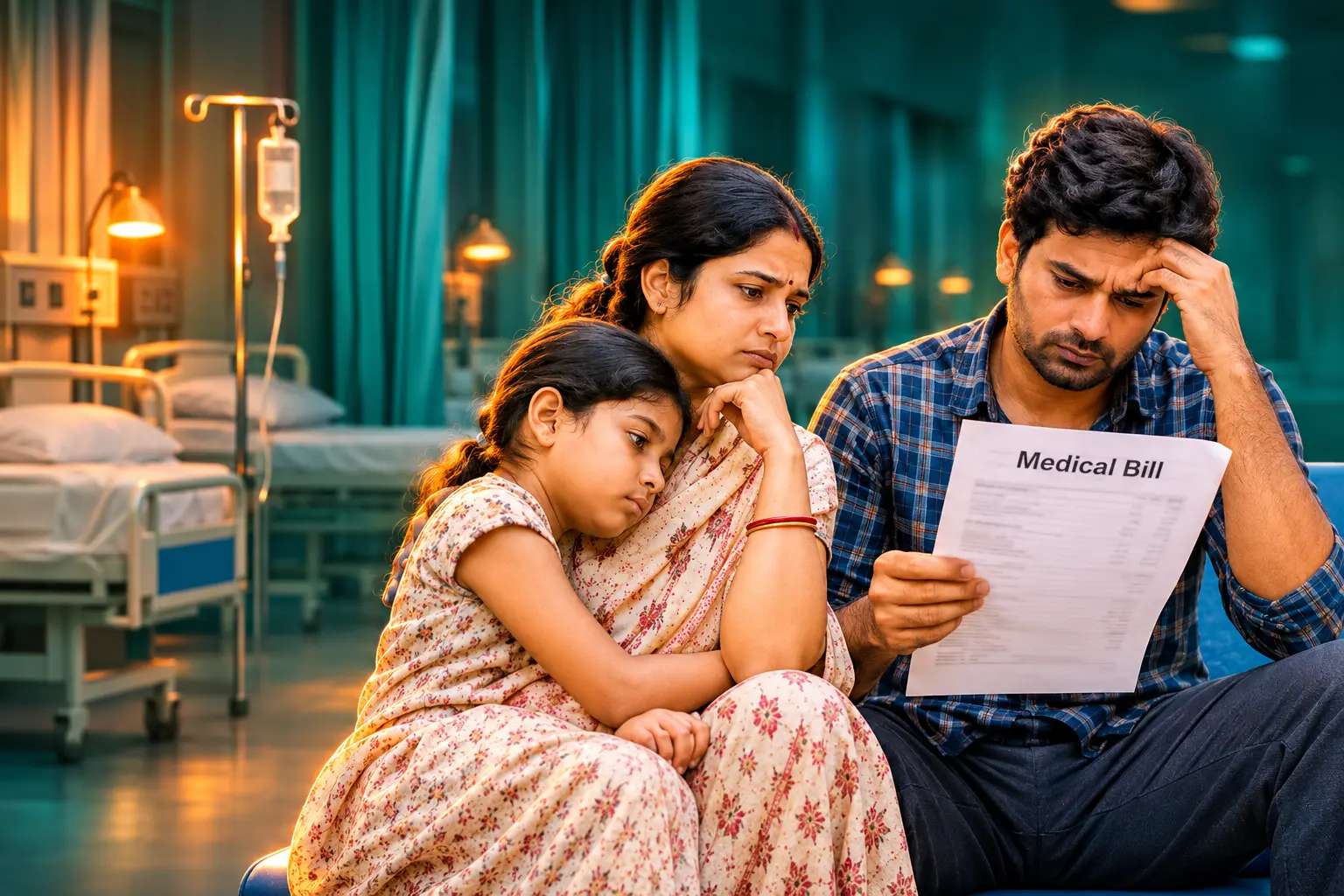
A Falling Share Can Hide a Steady Bill
Out-of-pocket share is a slice of total health spending. When the government spends more, that slice can fall even if families keep paying large sums at clinics, pharmacies and private hospitals. Per person government spending rose about 2.8 times, from ₹1,042 to ₹2,959. Household spending per person in 2023-24 was only ₹58 lower than that public figure.
The ministry used the nominal tripling as its headline. Indranil Mukhopadhyay, professor in the school of government and public policy at O.P. Jindal Global University in Sonipat, said the price-adjusted rise is smaller.
Adjusted for inflation, the increase will be lower.
Indranil Mukhopadhyay, professor of public policy, O.P. Jindal Global University
A health ministry official said that, even after adjusting for inflation, government health spending had risen 1.94 times over the decade. That is a real increase, and it is not a tripling. The same official said an exceptional GDP jump of about 11% between 2022-23 and 2023-24 produced a slip in the GDP ratio even though spending rose from ₹3,85,332 crore to ₹4,14,196 crore.
So the share metric can improve in a year when the economy grows faster than the health budget. It can also improve in a decade when public spending rises fast in rupees and household spending stays large. The accounts measure who financed the national bill. They do not measure whether a fever, a scan or a month of diabetes medicine emptied a household’s cash.
Why Ayushman Bharat Misses the Pharmacy Counter
The ministry linked the falling share to free hospitalisation cover, free medicines and free diagnostics in public facilities, and to cashless hospital care under Ayushman Bharat-PM-JAY. The scheme, launched in 2018, offers about ₹5 lakh per eligible family per year for secondary and tertiary hospitalisation across empanelled public and private hospitals, and the paper on publicly funded insurance puts the eligible pool at about 120 million households, or about 500 million people.
PM-JAY is built as a hospitalisation product. The ministry’s own 15 November statement described it as cashless hospitalisation benefits. Routine doctor visits, clinic fees and medicines bought for treatment at home sit outside that design. Tests done with no admission usually sit outside it too.
WHAT THE INSURANCE CARD STILL LEAVES OUT
- Clinic visits: Outpatient consultations and follow-ups that do not end in a hospital admission are generally not paid by PM-JAY.
- Home medicines: Drugs bought after an OPD visit, including regular treatment for long-term illness, are typically paid by the family.
- Standalone tests: Diagnostics ordered without a listed hospital procedure are generally not covered, even when the bill is large.
- Linked extras: Pre-admission and post-admission costs tied to a covered stay can be included, which is a narrower window than everyday care.
The NHA estimates put pharmaceutical spending at 30.2% of current health spending, covering prescribed drugs, over-the-counter medicines and drugs used in inpatient and outpatient treatment. That is the part of the bill a hospitalisation card is least built to catch. Publicly funded insurance can cut the cost of a listed package in an empanelled ward and still leave the monthly pharmacy run untouched.
Catastrophic Bills Persist Among the Insured
Catastrophic health expenditure is spending that crosses a set share of a household’s capacity to pay, and it is the measure that tracks borrowing, asset sales and cuts to other essentials. Sekhar Bonu of IIT Bombay and Indu Bhushan of Johns Hopkins University, writing in BMJ Open in May 2026, analysed a survey of 302,086 Indian households from the Comprehensive Annual Modular Survey, run by the National Statistical Office between July 2022 and June 2023 (173,096 rural and 128,990 urban).
CATASTROPHIC SPEND AMONG FAMILIES WHO USED CARE
- Outpatient users: 38% of households that used outpatient care faced catastrophic health spending.
- Inpatient users: 46% of households that used inpatient care faced the same shock.
- Publicly insured outpatients: 39% of publicly insured households using outpatient care faced it, against 38% of uninsured households using the same care.
Those two outpatient rates are the hole in the success story. A card that is meant to stop ruin does not, on this evidence, separate insured clinic patients from uninsured ones. At a 20% threshold, Bonu and Bhushan found that publicly funded cover was linked with lower odds of catastrophic spending for outpatient care (adjusted odds ratio 0.869) and inpatient care (0.790), and with higher use of both kinds of care. The rupee saving was larger for inpatient bills (Heckman coefficient -0.205) than for outpatient bills (-0.047).
At a 10% threshold, Ayushman Bharat or state insurance showed no significant link with outpatient catastrophic spending (adjusted odds ratio 1.048). Employer schemes such as ESIC and CGHS did show a reduction. The published conclusion is blunt about where the residual burden sits.
Yet, outpatient care remains a glaring gap, with persistently high OOPE driving catastrophic expenditures even among insured households.
Sekhar Bonu and Indu Bhushan, BMJ Open, May 2026
The authors call for expanding publicly funded benefits to outpatient services and for stronger primary care through Ayushman Arogya Mandirs. Until that happens, a rising insurance enrolment rate can coexist with a clinic bill that still breaks the month.
The 2.5% of GDP Clock Ran Out in 2025
The public health expenditure of 2.5% of GDP was the financing target in the National Health Policy, 2017, which started from 1.15% and set 2025 as the year to reach it. The 2023-24 accounts, released after that year had closed, put government health spending at 1.43% of GDP.
THE SPEND PATH TO THE 2025 TARGET
- March 2017: The Union Cabinet approves the National Health Policy, aiming to lift government health spending to 2.5% of GDP by 2025.
- 2018: Ayushman Bharat-PM-JAY begins, replacing the older Rashtriya Swasthya Bima Yojana cover of ₹30,000 per family with about ₹5 lakh for hospitalisation.
- 2021-22: National Health Accounts record government health spending of 1.84% of GDP in the pandemic years, the high point in the official series cited in Parliament.
- 2022-23: Government health spending is ₹3,85,332 crore, or 1.48% of GDP on the new series with base year 2022-23.
- 2023-24: Spending rises to ₹4,14,196 crore while the GDP ratio slips to 1.43%.
- 15 November 2026: The ministry releases the eleventh round of health accounts and presents the falling household share as the main proof of protection.
Mukhopadhyay said the 1.43% ratio is still far from the 2.5% target set years ago. The ministry’s explanation for the latest dip is arithmetic: output grew about 11%, spending grew less, so the percentage eased even as the rupee total rose. That explanation can be true and still leave the 2017 promise unmet. The target was a share of GDP, not a nominal cash total, and 2025 has passed.
Primary Clinics Took a Larger Slice of Public Money
The same accounts show where public money did move. Government spending on primary care reached about ₹1.53 lakh crore in 2023-24. The ministry tied that outlay to Ayushman Arogya Mandirs, which it said are expanding screening, essential medicines, diagnostics and other first-contact care. Free drugs and diagnostics in public facilities, the Pradhan Mantri National Dialysis Programme, Jan Aushadhi generic pharmacies, AMRIT pharmacies and price controls by the National Pharmaceutical Pricing Authority are the other tools named in the 15 November release.
Those programmes are the reason the household share of the national bill can fall without a contradiction in the accounts. They are also why the remaining ₹4,06,197 crore still matters. Primary centres and generic pharmacies reduce some bills. They do not, on the CAMS evidence, stop two in five outpatient-using households from crossing a catastrophic line, including households that already hold a public insurance card.
Private insurance’s jump to 10.2% of total health spending is a parallel story among households that can buy cover. Publicly funded schemes remain a hospital product for the families the 2017 policy was written to protect. The next design choice is whether outpatient visits and medicines join that product, or whether the share of the national bill keeps doing the work of a hardship measure it cannot do.
A composition statistic can look like relief while the counter at the pharmacy still has to be cleared in cash. That is the reading the 2023-24 accounts and the 2022-23 household survey will support until the clinic bill is inside the same cover as the hospital bed.
Frequently Asked Questions
What Do India’s National Health Accounts Measure?
They track who pays for health care and where the money goes, using the System of Health Accounts 2011, an OECD and World Health Organization framework applied in India by the National Health Accounts Technical Secretariat. The 2023-24 edition is the eleventh round. It covers current spending and capital spending by government, households, insurers and other financiers, which is why a falling household share can appear even when household rupees remain large.
Does Ayushman Bharat PM-JAY Cover Outpatient Visits and Medicines?
The core benefit is cashless hospitalisation for listed secondary and tertiary packages at empanelled hospitals, up to about ₹5 lakh per eligible family per year. Standalone clinic visits, home medicines and tests that do not lead to admission are generally excluded. Costs immediately before and after a covered admission can be included when they are tied to that stay, which is a narrower window than everyday outpatient care.
What Counts as Catastrophic Health Expenditure in These Studies?
Researchers treat a health bill as catastrophic when it crosses a set share of household consumption or of capacity to pay, commonly 10% of total consumption or 40% of non-food spending, with some papers also using a 20% cut-off. Bonu and Bhushan report their main insurance results at the 20% threshold and test a 10% threshold as well. Crossing the line is associated with borrowing, selling assets or cutting other essential spending, which is why it is a hardship measure rather than a share of the national bill.
Do States or the Centre Pay More of India’s Public Health Bill?
State governments paid 67.9% of government health spending in 2023-24, and the Union paid 32.1%. The 2.5% of GDP target in the 2017 policy is a combined public figure, not a Union-budget figure alone, so state budgets decide most of whether the ratio moves. That split also means a Union insurance scheme can expand while the larger public system, which runs clinics and drug supplies, still depends on state allocations.
The 2023-24 accounts close the books on a decade in which public rupees rose fast and the household share of the national bill fell. They leave the clinic counter, where 39% of publicly insured outpatient-using households still hit a catastrophic line, as the unfinished item on that ledger.
Disclaimer: This article is news reporting and analysis of official National Health Accounts figures and of published research on household medical costs. It is for information only and is not medical advice, insurance advice or guidance on how any household should pay for treatment. Readers who need care, face a hospital or pharmacy bill, or have a coverage dispute should consult a qualified doctor and, where relevant, a licensed insurance adviser or a legal-aid service. The spending totals, shares and survey results reflect the cited 2023-24 accounts and 2022-23 household data and may be revised in later official editions.

ADNOC Ship Hit in Hormuz Leaves One Crew Missing

SpiceJet’s Rs 5,500 Crore Plan Follows a Rescue That Failed

Hasina’s Return Fight Sets Fire to Yunus’s Bank

Bancroft Recants the 2018 Inquiry and Names the Team

Adhikari Ties the Saffron Saree Row to School Licences

Clancy Juror Says the Holdout Never Cited Evidence

The iPhone 18 Pro Max Splits Apple’s Fall in Two

OpenAI Calls GPT-6 Astra AGI Then Locks Its Exploits

Trump Claims Hormuz Control as Oil Holds Near $96

Russia Closes the Goethe-Institut Berlin Tried to Save

 NEWS2 months ago
Clancy Juror Says the Holdout Never Cited Evidence
- NEWS3 months ago
The iPhone 18 Pro Max Splits Apple’s Fall in Two
- NEWS3 months ago
OpenAI Calls GPT-6 Astra AGI Then Locks Its Exploits
- BUSINESS3 months ago
Trump Claims Hormuz Control as Oil Holds Near $96
- LIFESTYLE3 months ago
Russia Closes the Goethe-Institut Berlin Tried to Save
- AUTO3 months ago
Volkswagen’s Job Cuts Leave Four Plants Without Cars
- NEWS3 months ago
Dyson Puts Nurovi Robots on Sale Without the UV Flagship
- BUSINESS2 months ago
US Destroys Five Iranian Tankers as the Shock Hits Jordan










