
NEWS
COP31 Opens on a 2.8°C Path the UN Just Confirmed
COP31 opens in Antalya after UNEP found a 2.8°C current-policy path and said 1.5°C overshoot can no longer be avoided.

Current climate policies still point to 2.8°C of warming this century, the UN Environment Programme found, just before COP31 opens in Antalya. Even if every national climate plan is met in full, the path is 2.6°C.
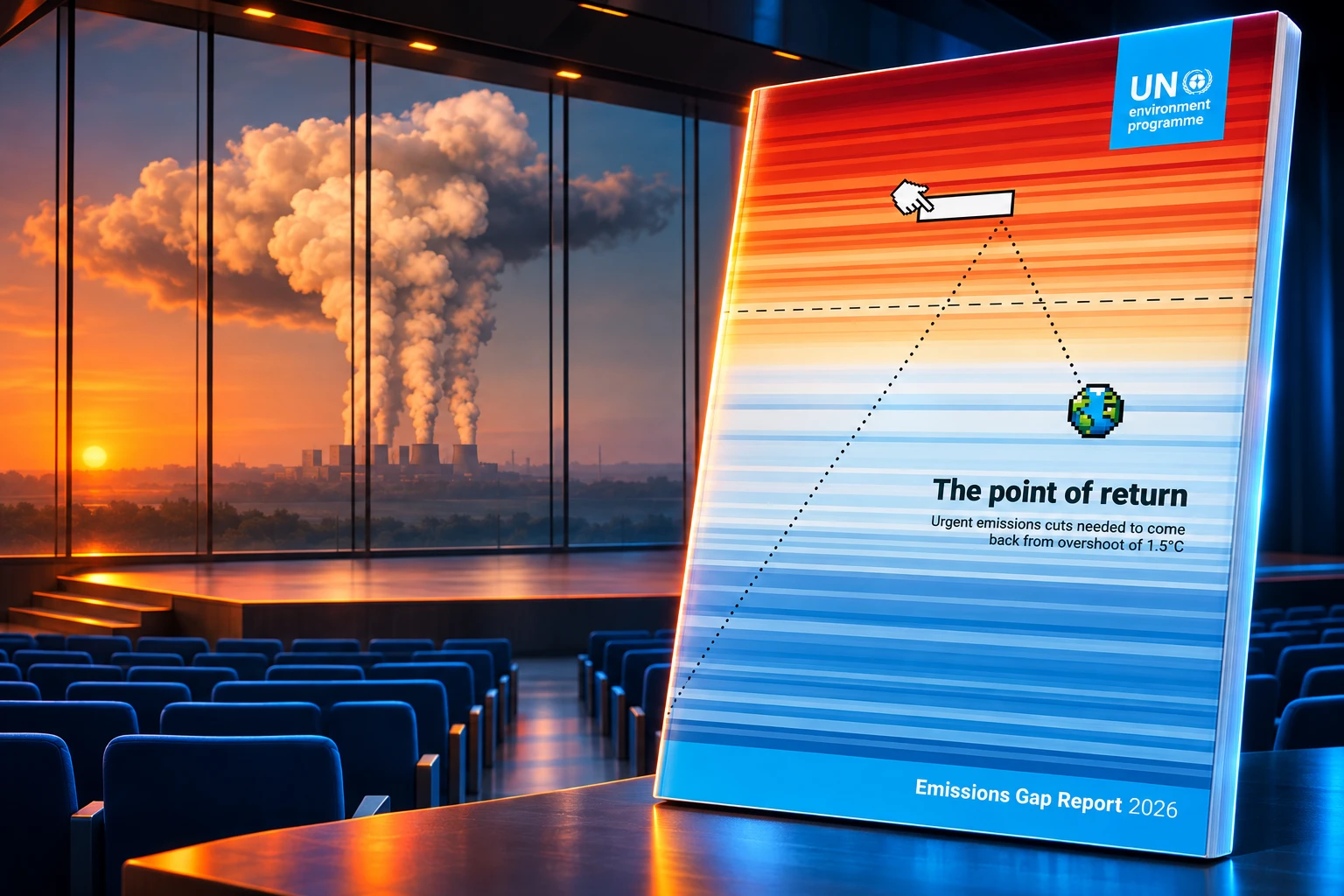
UNEP’s Emissions Gap Report 2026, released on 21 October and titled The Point of Return, says the chance of holding warming below 1.5°C with no or limited overshoot is gone. The Antalya conference, from 9 to 20 November, is the first UN climate summit that has to work from that finding.
UNEP Puts Current Policies on a 2.8°C Path
The report’s central range is blunt. If governments keep doing what they are already doing, warming could reach 2.8°C this century and keep rising after that. Full delivery of Nationally Determined Contributions, the climate plans filed under the Paris Agreement, would limit warming to 2.6°C if similar effort continues. Add every extra net-zero target on top of those plans, and the figure falls to 2.1°C. None of those tracks is 1.5°C.
UNEP still sketches a lowest possible 1.5°C overshoot scenario. In that case, peak warming around mid-century stays at 1.7 to 1.8°C, and the world has about a 50 per cent chance of being back at or below 1.5°C by 2100. That is now the optimistic benchmark, not the old Paris floor.
WARMING THIS CENTURY UNDER UNEP SCENARIOS
| Scenario | Projected warming |
|---|---|
| Current policies | 2.8°C this century, then rising |
| All national climate plans delivered | 2.6°C |
| Plans plus net-zero targets | 2.1°C |
| Lowest possible 1.5°C overshoot | Peak 1.7 to 1.8°C mid-century; about 50% chance of 1.5°C by 2100 |
UN Secretary-General António Guterres, in a message with the report, said, “Overshoot is not surrender.” He added that the overshoot can still be kept small and short, with temperatures brought back below 1.5 degrees by the end of the century. Inger Andersen, UNEP’s executive director, said every extra fraction of a degree, and every extra year above 1.5°C, raises the toll from floods, heatwaves and wildfires. UN Deputy Secretary-General Amina J. Mohammed called the 2.8°C current-policy path a warning and said the tools already exist.
UNEP’s own launch film puts the same choice in one line: start the deep cuts now, or watch the peak climb.
Why This Year’s Projection Got Worse
This edition is worse than last year’s, UNEP says, for two stated reasons. The United States has withdrawn from the Paris Agreement, so the US is now counted on current policy rather than on a Paris plan. Historical emissions were also revised up. New national climate plans filed since the last report made a negligible difference to the temperature paths.
That last point is the quiet one. Governments did file fresh NDCs. The modelled century-end numbers barely moved. The gap is no longer a missing document problem. It is a delivery problem, plus a missing large emitter.
Global greenhouse gas emissions reached 58.4 gigatonnes of CO2 equivalent in 2025, the report’s executive summary says, within a range of plus or minus 5.5. Preliminary figures put that about 0.1 gigatonnes below 2024. UNEP refuses to call it a peak. The move is small next to the uncertainty band, and fossil CO2, nitrous oxide and fluorinated gases still rose. A drop in land-use CO2 offset those increases. After a decade in which emissions grew about 0.8 per cent a year, one flat year is not a turn.
The curve has bent from the hotter century-end tracks that defined the years just after Paris, which is why a return story is still on the table at all. Solar and wind grew far faster than 2015 models assumed. Climate rules have cut emissions in specific sectors and countries. UNEP’s warning this autumn is narrower, and harder: the remaining bend is still too small, and this year’s projection is worse than the one delegates carried into last year’s talks.
The Cuts Required to Limit the Overshoot
To get onto the lowest overshoot path, UNEP says the world would have to cut emissions 18 per cent by 2030, 45 per cent by 2035 and 69 per cent by 2040, all against 2025 levels. Full delivery of current NDCs would cut only 5 to 8 per cent by 2030 and 11 to 15 per cent by 2035. That implies average annual cuts of 5.7 per cent from 2025 to 2035, steeper than the old IPCC AR6 pathways of about 5 per cent a year.
EMISSION CUTS VERSUS CURRENT PLEDGES
| Year | Cut needed vs 2025, lowest overshoot | If current NDCs are fully met |
|---|---|---|
| 2030 | 18% | 5 to 8% |
| 2035 | 45% | 11 to 15% |
| 2040 | 69% | Not given |
The same pathway also needs the removal and permanent storage of about 320 gigatonnes of CO2 this century, equal to roughly eight years of 2024’s global CO2 output. UNEP says social and technical limits make that scale uncertain. Every five years of CO2 emissions at today’s level pushes peak warming up by around 0.1°C. Delay is not free; it buys a higher peak.
There is a record of cuts that already worked, and it is narrower than the speeches. More than 220 policy evaluations sit behind the report. Rules in the power sector cut emissions by an average of 9 per cent in the periods studied. Carbon markets and carbon taxes cut 5 to 13 per cent across sectors. Those results cluster in certain countries, certain years, certain industries. They have not yet been copied at the speed the 18 per cent by 2030 line requires.
Since Paris, global renewable electricity capacity has grown three times faster than expected, and solar photovoltaics seven times faster. UNEP says a continuation of that build-out, with extra policy, could still triple renewable capacity by 2030. Extending the first Global Stocktake’s energy goals would mean at least tripling renewable electricity capacity by 2035 against 2025, and reaching 4.5 times that 2025 level by 2040. Primary energy intensity of GDP would need to fall at least 30 per cent by 2035 and 40 per cent by 2040.
Fossil shares would have to drop fast. Against 2025, coal, oil and gas in total energy supply would need to fall at least 55, 15 and 5 per cent by 2035, then at least 75, 30 and 35 per cent by 2040. Coal power would need to fall at least 75 per cent by 2035 and be phased out worldwide by 2040. Methane would need to be at least 25 per cent below 2025 levels by 2035 and 40 per cent lower by 2040. UNEP says recent rates of change on absolute greenhouse gases, including energy CO2, road transport and methane, are still heading the wrong way.
COP31 Opens as the First Overshoot Summit
COP31 runs from 9 to 20 November at the Antalya Expo Center. Türkiye hosts. Murat Kurum, the environment, urbanization and climate change minister, is COP president. Chris Bowen, Australia’s climate and energy minister, is president of negotiations, a split set after both countries bid for the meeting. The Antalya Leaders’ Summit is scheduled for 11 and 12 November under the heading “Towards a Sustainable, Resilient and Equitable Future.”
On 5 November, Kurum did not dress the science up. In the UN Climate Change preview comments he said this is the first COP of a 1.5°C overshoot, and that Antalya has to answer that fact without dropping the old target.
This is the first COP where it is clear beyond reasonable doubt that the world will overshoot the 1.5-degree target. We will not look away, and we will not lower our ambition. The 1.5-degree target remains our compass, and our duty is to do everything in our power to return to it. In Antalya, we must start to respond to the new realities of overshoot.
Murat Kurum, COP31 President-Designate, UN Climate Change preview, 5 November 2026
He tied that response to money, pointing to the Baku deal to mobilise at least $300 billion a year by 2035 for developing countries, and to a presidency agenda built around electricity, methane from waste, and resilience in cities and on coasts. Simon Stiell, UN Climate Change executive secretary, said no single COP stops the crisis overnight, and that Antalya can still add to the pile of partial gains. Bowen called the meeting a test of cooperation on climate and energy security at the same time.
The Pacific already had the warm-up. Fiji, Tuvalu and Australia ran the official Pre-COP from 5 to 8 October. Kurum said the Pacific site was a choice, not a backdrop. After visiting Tuvalu he said the islands did not cause the crisis and are paying the heaviest price, and that 1.5°C is “a matter of survival.” That is the political load Antalya inherits: a temperature limit small island states still treat as a shoreline, now described by the host as a target the world will overshoot.
Countries Left Yerevan With a Pathway and a Finance Gap
Nine days before the climate talks open, the biodiversity talks closed. CBD COP17 in Yerevan ran from 19 to 30 October and concluded on 31 October after an overnight plenary. Parties adopted nearly 50 decisions and a negotiated reply to the first global review of the Kunming-Montreal Global Biodiversity Framework. That review found the world off track for the framework’s 23 targets by 2030. The reply is the Yerevan Pathway on biodiversity action.
The pathway tells governments to move faster on nature-harmful subsidies, raise financial and technical support for developing countries, line national budgets up with the 2022 nature deal, and tighten monitoring. Astrid Schomaker, the convention’s executive secretary, said the test is not the text from Yerevan but what capitals change when they get home. “We cannot protect nature while continuing to finance its destruction,” she said.
Money arrived in pledges, not in a closed gap. Announcements included nearly $2 billion in new biodiversity funding, including $560 million under the GEF-9 replenishment and the Global Biodiversity Framework Fund, $500 million through the Species Recovery Alliance, and over $330 million through the Value Nature Fund. Parties also agreed operating rules, the Sevan Guidelines, for a permanent subsidiary body on Article 8(j), which is meant to give Indigenous peoples and local communities a standing role in the convention. COP18 goes to Ecuador.
Yerevan sits inside a packed Rio-convention year. UN officials call 2026 a triple COP year: the desertification, biodiversity and climate conventions all hold their Conferences of the Parties in one calendar, something that lines up every second year.
THE 2026 TRIPLE COP CALENDAR
- 17 to 28 August 2026: UNCCD COP17 meets in Ulaanbaatar, Mongolia, on land degradation and drought.
- 19 to 30 October 2026: CBD COP17 meets in Yerevan and closes on 31 October with the Yerevan Pathway.
- 9 to 20 November 2026: UNFCCC COP31 meets in Antalya, with the Leaders’ Summit on 11 and 12 November.
The calendar is full. The UNEP temperature path did not wait for it. Land, nature and climate talks can share themes, business forums and a November “synergies” day, and they still face three separate finance fights and three separate delivery records. Delegates who flew from Armenia to Turkey change files more easily than they change subsidy systems.
What the Antalya Talks Are Built to Decide
The procedural load on COP31 is the second global stocktake. Under the Paris Agreement the stocktake is the five-year audit of collective progress. The first one closed in 2023 with goals to triple renewable capacity, double the rate of efficiency gains, move away from fossil fuels in energy systems, cut non-CO2 gases, and halt and reverse forest loss. UNEP says most of those indicators are not moving at the needed pace. The second global stocktake opens at CMA 8 in November 2026 and is due to close at CMA 10 in November 2028, covering 2024 to 2028.
HOW THE SECOND GLOBAL STOCKTAKE IS BUILT
- Information gathering: Parties and institutions compile the evidence base for the next technical round.
- Technical assessment: Experts take stock of Paris delivery and of options to raise action and support.
- Consideration of outputs: Governments discuss what those findings mean for the next round of national plans.
UNEP wants that audit to push the 2030 energy goals out to 2035 and 2040 with clearer numbers. That would turn a conference that cannot restore a no-overshoot 1.5°C path into one that at least writes down the coal, methane and renewable marks consistent with a 1.7 to 1.8°C peak. Whether a cover text or a set of work programmes can carry those marks is the negotiation. The science input is already on the table.
Kurum’s presidency has also tried to brand Antalya around electrification, zero waste and heat-ready cities, the parts of climate policy that can show a crane or a grid rather than a 2100 decimal. Stiell’s line about geopolitical headwinds is the other half of the brief. A US exit is already inside UNEP’s 2.8°C figure. Fresh NDCs did not offset it. The stocktake that opens in Antalya will be the first one conducted with overshoot treated as a starting condition rather than a risk to be fended off in the communiqué.
Delegates arrive with a biodiversity pathway that is nine days old, a land COP from August, and a UN emissions report that moved the official language from prevention to return. The 18 per cent cut is due by 2030. The leaders’ family photo is on 11 November.

ADNOC Ship Hit in Hormuz Leaves One Crew Missing

SpiceJet’s Rs 5,500 Crore Plan Follows a Rescue That Failed

Hasina’s Return Fight Sets Fire to Yunus’s Bank

Bancroft Recants the 2018 Inquiry and Names the Team

Adhikari Ties the Saffron Saree Row to School Licences

Clancy Juror Says the Holdout Never Cited Evidence

The iPhone 18 Pro Max Splits Apple’s Fall in Two

OpenAI Calls GPT-6 Astra AGI Then Locks Its Exploits

Trump Claims Hormuz Control as Oil Holds Near $96

Russia Closes the Goethe-Institut Berlin Tried to Save

 NEWS2 months ago
Clancy Juror Says the Holdout Never Cited Evidence
- NEWS3 months ago
The iPhone 18 Pro Max Splits Apple’s Fall in Two
- NEWS3 months ago
OpenAI Calls GPT-6 Astra AGI Then Locks Its Exploits
- BUSINESS3 months ago
Trump Claims Hormuz Control as Oil Holds Near $96
- LIFESTYLE3 months ago
Russia Closes the Goethe-Institut Berlin Tried to Save
- AUTO3 months ago
Volkswagen’s Job Cuts Leave Four Plants Without Cars
- NEWS3 months ago
Dyson Puts Nurovi Robots on Sale Without the UV Flagship
- BUSINESS2 months ago
US Destroys Five Iranian Tankers as the Shock Hits Jordan










