
NEWS
COP31 Hosts Rank Among the Worst Climate Performers
Turkey and Australia run COP31 ranked 53rd and 54th, with most G7 leaders absent and electrification standing in for a fossil-fuel exit.

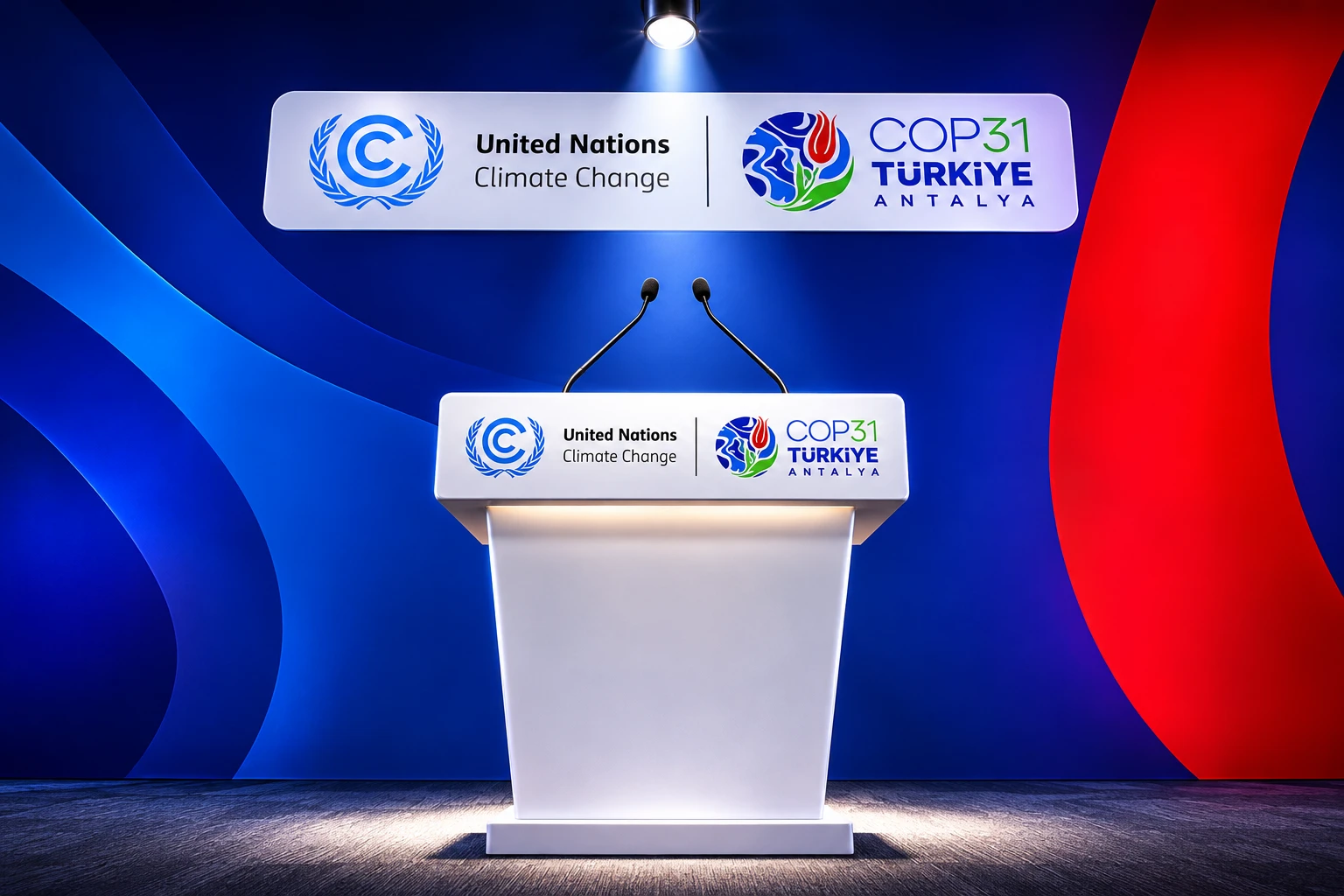
Turkey and Australia opened COP31 ranked 53rd and 54th on a global climate index, two of ten G20 members graded very low the same morning. They hold the gavel and the pen in Antalya while the United States sent no delegation and Britain’s Andy Burnham is the only G7 head of government on the leaders’ list.
The talks run from November 9 to 20 at the Antalya Expo Center, with Turkey hosting and Australia steering the text. The flagship offer is a pledge to lift electricity to 35 percent of final energy use by 2035, without a new roadmap off coal, oil and gas.
Turkey and Australia Rank Near the Bottom
Germanwatch and NewClimate Institute released the Climate Change Performance Index published Wednesday as presidents and ministers took their seats. The index scores 64 countries plus the European Union. No country earned a very high grade, so the first three places stay empty. Denmark leads from fourth for the sixth year running.
The United Kingdom sits seventh and is still the only G20 member among the high performers. Ten G20 countries landed in the very low band, and the authors named the twin COP presidencies in that group. G20 members account for over 75 percent of global greenhouse gases.
HOW THE HOSTS AND BIG EMITTERS SCORED
| Country | CCPI rank | At COP31 |
|---|---|---|
| Denmark | 4 | Index leader, no chair role |
| United Kingdom | 7 | Only G7 head attending |
| European Union | 19 | Ursula von der Leyen attending |
| Germany | 25 | Friedrich Merz absent |
| Turkey | 53 | Host and COP president |
| Australia | 54 | President of negotiations |
| China | 56 | Vice president Han Zheng attending |
| United States | 67 | No delegation |
| Iran | 68 | President Masoud Pezeshkian attending |
Jan Burck, the Germanwatch lead author, said no country is doing enough to meet the Paris Agreement and that the gap between leaders and laggards is widening. “Overall, current collective efforts are not enough to prevent catastrophic climate change. But we see clear potential for improvement,” he said.
Niklas Höhne of NewClimate Institute said fossil carbon emissions are projected to dip slightly in 2026 for the first time since the COVID-19 pandemic, with weaker oil demand linked to the war in Iran. That dip is a forecast, not a verdict on the two countries running the meeting.
The split job itself was the compromise struck at the end of COP30 in Belém. Turkey’s Murat Kurum is COP president. Australia’s Chris Bowen is president of negotiations, with exclusive authority over the negotiations from the close of Belém through Antalya. Prime Minister Anthony Albanese is in the room. The Pacific hosted a pre-COP in Fiji and Tuvalu in early October.
One G7 Leader Made It to Antalya
The official COP31 Türkiye account said 102 leaders from 95 countries were at the leaders summit. Burnham is due to speak on November 12. European Commission President Ursula von der Leyen came. French President Emmanuel Macron stayed in Paris for Armistice Day on November 11 and then for a European meeting in Ireland. German Chancellor Friedrich Merz, Italian Prime Minister Giorgia Meloni, Canadian Prime Minister Mark Carney and Japanese Prime Minister Sanae Takaichi also stayed away.
Mohamed Adow, director of Power Shift Africa, called it a disgrace that only one of the seven G7 heads of state and a handful of G20 leaders showed up. Chiara Martinelli, director of Climate Action Network Europe, said more than half of the top leaders of EU countries were missing and that Europe cannot steer a global transition from an empty chair. Climate Action Network gave its Fossil of the Day on November 10 to the absent leaders of wealthy countries.
China, the largest emitter, sent Vice President Han Zheng rather than Xi Jinping. India did not send Narendra Modi. The United States, the second-largest emitter, is out for a second straight year. President Donald Trump pulled Washington from the Paris Agreement, has called climate change a hoax, and has moved against offshore wind and power-plant emission limits. UNFCCC provisional lists show more than 92,000 people registered, which would make Antalya the largest COP on paper, with Turkey listing 2,950 delegates.
WHO SKIPPED THE LEADERS SUMMIT
- United States: No official delegation, the second year in a row under Trump.
- China and India: Xi Jinping and Narendra Modi stayed home; Han Zheng is speaking for Beijing.
- France, Germany, Italy: Macron, Merz and Meloni left von der Leyen as the senior EU political face.
- Canada and Japan: Carney and Takaichi are off the list, leaving Burnham as the sole G7 head.
Iran, last on the index at 68th, still sent President Masoud Pezeshkian. Brazil’s Luiz Inácio Lula da Silva came after winning re-election and said climate had slipped off the global agenda, crowded out by wars, inflation and geopolitical fights. “Brazil is back to defend the continuity of a healthy planet,” he said. Marshall Islands President Hilda Heine is among the leaders from states that face rising seas with almost no share of historic emissions.
Time for Action.
Let’s COP #COP31 #COP31Antalya #COP31Türkiye pic.twitter.com/vWgQkppIuL
— COP31 Türkiye (@turkiyecop31) November 11, 2026
The Four Pillars Guterres Named in Antalya
UN Secretary-General António Guterres told the leaders summit that an overshoot of 1.5 degrees Celsius is now inevitable, and that science is not a brief for surrender. Emissions in 2025 hit all-time highs. The last four years were the hottest on record. He said global emissions need to fall about 6 percent a year, and that current national plans, including the conditional ones, deliver at best one-third of that cut. Even if those plans are fully met, he said, the world would still be above 2.5 degrees by the end of the century.
Bowen, in his opening plenary on November 10, put today’s projections closer to 2.6 degrees, down from about 4 degrees before Paris. Those two figures describe different things: Bowen’s 2.6 is where current projections sit, and Guterres’s 2.5-plus is where full delivery of today’s plans still lands by 2100.
In remarks to the COP31 leaders summit, Guterres proposed a Climate Justice Compact built on shared responsibility, shared security and shared benefits. Developed countries would cut faster and pay. Emerging economies would speed the shift off fossil fuels. Developing countries would get support to adapt. He said emerging and developing economies outside China hold nearly two-thirds of humanity and receive less than one-fifth of global clean-energy investment, and that most pay two to three times more to borrow.
Fossil fuels must go the way of the dinosaurs. But that won’t happen on its own. The dinosaurs did not have a lobby. But fossil fuels do.
António Guterres, UN Secretary-General, COP31 leaders summit, Antalya
He set hard markers from the latest UNEP Emissions Gap report: renewable capacity at least triple 2025 levels by 2035, unabated coal power down at least 75 percent by then, and, by 2040, unabated coal all but gone and oil and gas use cut by around a third. Developed countries, he said, must lead in delivering at least $300 billion a year by 2035 and set milestones to at least triple adaptation finance by that date. The $1.3 trillion goal has to become money that actually arrives. Multilateral development banks, he added, must go beyond their Baku pledge of $120 billion a year by 2030.
Then he put two figures next to each other. In the last quarter the nine largest oil companies pocketed $95 billion. The Fund for Responding to Loss and Damage has received around $600 million, which he said is what those firms made in about 14 hours. “It’s time for governments to tax these windfall profits, and use them to help vulnerable countries recover,” he said. He also said he will no longer be secretary-general starting next year, and that he will keep telling the truth anyway.
Ten years ago solar generated 1 percent of the world’s electricity; last year it met nearly three-quarters of the growth in global electricity demand. A decade ago one in every hundred cars sold was electric; this year it is set to be nearly one in three. Clean energy is now the cheapest source of new electricity across most of the world, he said, and three-quarters of humanity lives in countries that import fossil fuels.
Why the Electrification Pledge Sidesteps Fossil Fuels
Turkey’s Action Agenda wants governments to sign a 35-by-35 pledge: electricity at 35 percent of final energy use by 2035. Bowen told delegates electricity now supplies only around one-fifth of that demand, with the rest still burned in transport, buildings and industry, and that COP31 needs to shift electricity from a fifth to a third. He tied that lift to energy security and to shielding households from price shocks, a live concern after the war in Iran pushed up oil, gasoline, fertilizer and pesticide prices.
The pledge does not say the new power has to be renewable. Gas exporters arrived with a simpler line: cut emissions, not fuels. That is the hole in the hosts’ offer. Electrifying cars and boilers while the grid still runs on coal and gas can lock fuel in for another cycle of plants. CCPI authors made the same point from the other direction, arguing that laggards with high electrification could climb fast if they swap fossil generation for renewables, because cleaning up power is the cheapest cut.
Turkey has not set national targets for the global pledge it is selling. Country experts on the index say its national climate plan allows emissions to rise by 2035 and does not put the country on track for net zero by 2053. In 2025, coal still supplied 34 percent of power. Solar capacity roughly tripled from 9.5 GW in 2022 to 28 GW in September 2026, yet electricity from fossil fuels still rose from 186 TWh to 201 TWh over 2022 to 2025. A Climate Law in July 2025 created an emissions trading system whose cap will be set later on an intensity basis. Pre-licenses for about 33 GW of batteries are on the books. New coal units keep surfacing in the permit queue, even after a court struck down extra units at Afşin Elbistan A.
Australia is a major coal and LNG exporter chairing talks that are supposed to speed a just transition for workers in those same fuels. Bowen has said gas can firm a grid that is adding wind and solar, coming on for an hour or two rather than running all day. That is a domestic power-system argument. It is also the argument fossil producers will use against any cover text that names an exit from oil and gas.
Belém Left the Fossil Roadmap off the Table
John Kerry, the former U.S. secretary of state and climate envoy, put the test in one line in Antalya: “We don’t need more promises, we need plans.” The last three COPs have been a lesson in how a plan gets watered down.
HOW THE FOSSIL PLEDGE SHRANK
- December 2023: COP28 in Dubai agrees to transition away from coal, oil and gas, the main drivers of warming, and to triple renewable capacity by 2030.
- November 2024: COP29 in Baku locks a climate-finance goal that Guterres now cites as at least $300 billion a year by 2035, with little new language on cutting fuel use.
- November 2025: COP30 in Belém adopts a “global mutirão” that calls for tripling adaptation finance by 2035 and launches a Belém Mission to 1.5, but drops a formal fossil-fuel roadmap after oil producers block it.
- November 9, 2026: COP31 opens in Antalya with Brazil handing over voluntary roadmaps on fuels and forests, and with Turkey and Australia asking countries to electrify demand instead.
More than 80 countries had wanted a fossil roadmap written into the Belém decision. Saudi Arabia and other producers stopped it. Brazil’s presidency said it would write the roadmaps anyway, outside the formal text, along with a deforestation plan and a Baku-to-Belém path toward $1.3 trillion a year by 2035. André Corrêa do Lago, who held the COP30 gavel, has said governments do not need more negotiations so much as finance, infrastructure and transport ministers at the table. Antalya is where that unfinished work lands, in a room missing most of the ministers’ bosses.
What COP31 Can Still Decide
Bowen listed more than 160 agenda items and 60 substantive mandates. A leaders’ photo does not close any of them. The fortnight still has to turn a joint presidency into text that 190-plus parties can live with, including countries that want fossil fuels named and countries that will walk if they are.
THE ITEMS STILL ON THE TABLE
- Just Transition Mechanism: Give the body agreed in Belém a way to support workers and communities as fuels decline.
- Mitigation Work Program: Move from dialogue to faster cuts, cooperation and investment, without a new fossil roadmap in last year’s cover decision.
- Global Goal on Adaptation: Set up the technical taskforce and follow through on tripling adaptation finance.
- Finance access: Make money faster and simpler to reach, the demand Australia heard from Pacific states at pre-COP.
- Adaptation Fund: Finish its transition and keep science in the process as the second global stocktake starts, due to conclude in 2028.
Kurum and Bowen have already said they will take forward a presidency-initiated, party-driven decision. Bowen called it focused and practical, not a long political declaration, and promised no surprises. He also said there will be a fight over whether that decision has value, what goes in it, and how far it goes. Clean-energy investment last year was about $2.2 trillion, nearly twice the flow to fossil fuels, he said, and more than 160 countries have filed updated national climate plans, with more than 130 filing their first biennial transparency reports. Those filings are paper until finance moves and fuels fall.
Lula pledged again to protect the Amazon. Pacific envoys from the Marshall Islands, Papua New Guinea and Fiji are inside the Australian negotiation team. The people who need the money still have to sit across from governments that did not send their leaders, and from a United States that is not in the room at all.
Erdogan Turned the Climate Podium Toward Gaza
Turkish President Recep Tayyip Erdogan opened as host and spent a large share of the speech on Gaza. “What has taken place in Gaza is not only a genocide, but it is also an ecocide,” he said, drawing applause, and he listed olive trees cut down, soil and water polluted, and cities turned into rubble. He also warned that every minute the Paris targets slip, the risks and costs grow, and he blamed a greedy mindset of overconsumption.
That mix is the meeting. The host wants electrification, zero waste and green industry on the Action Agenda, and used the climate stage for a war that is not on the UNFCCC docket. Guterres asked countries not to agree on everything, only to cooperate on what no country can solve alone. The index published the same morning says the two governments holding that cooperation scored very low on the work they are asking others to finish.
Delegates stay in Antalya through November 20. Guterres told them the overshoot can still be a temporary breach rather than a permanent sentence, if anyone in the room will write that into a decision the absentees cannot veto from home.

ADNOC Ship Hit in Hormuz Leaves One Crew Missing

SpiceJet’s Rs 5,500 Crore Plan Follows a Rescue That Failed

Hasina’s Return Fight Sets Fire to Yunus’s Bank

Bancroft Recants the 2018 Inquiry and Names the Team

Adhikari Ties the Saffron Saree Row to School Licences

Clancy Juror Says the Holdout Never Cited Evidence

The iPhone 18 Pro Max Splits Apple’s Fall in Two

OpenAI Calls GPT-6 Astra AGI Then Locks Its Exploits

Trump Claims Hormuz Control as Oil Holds Near $96

Russia Closes the Goethe-Institut Berlin Tried to Save

 NEWS2 months ago
Clancy Juror Says the Holdout Never Cited Evidence
- NEWS3 months ago
The iPhone 18 Pro Max Splits Apple’s Fall in Two
- NEWS3 months ago
OpenAI Calls GPT-6 Astra AGI Then Locks Its Exploits
- BUSINESS3 months ago
Trump Claims Hormuz Control as Oil Holds Near $96
- LIFESTYLE3 months ago
Russia Closes the Goethe-Institut Berlin Tried to Save
- AUTO3 months ago
Volkswagen’s Job Cuts Leave Four Plants Without Cars
- NEWS3 months ago
Dyson Puts Nurovi Robots on Sale Without the UV Flagship
- BUSINESS2 months ago
US Destroys Five Iranian Tankers as the Shock Hits Jordan










