
BUSINESS
Burnham’s Brexit Confession Meets a 0.4 Percent Deal
Andy Burnham told the Guildhall Brexit cost Britain up to 8 percent of GDP. Friday’s food, carbon and youth package is worth 0.4 percent.

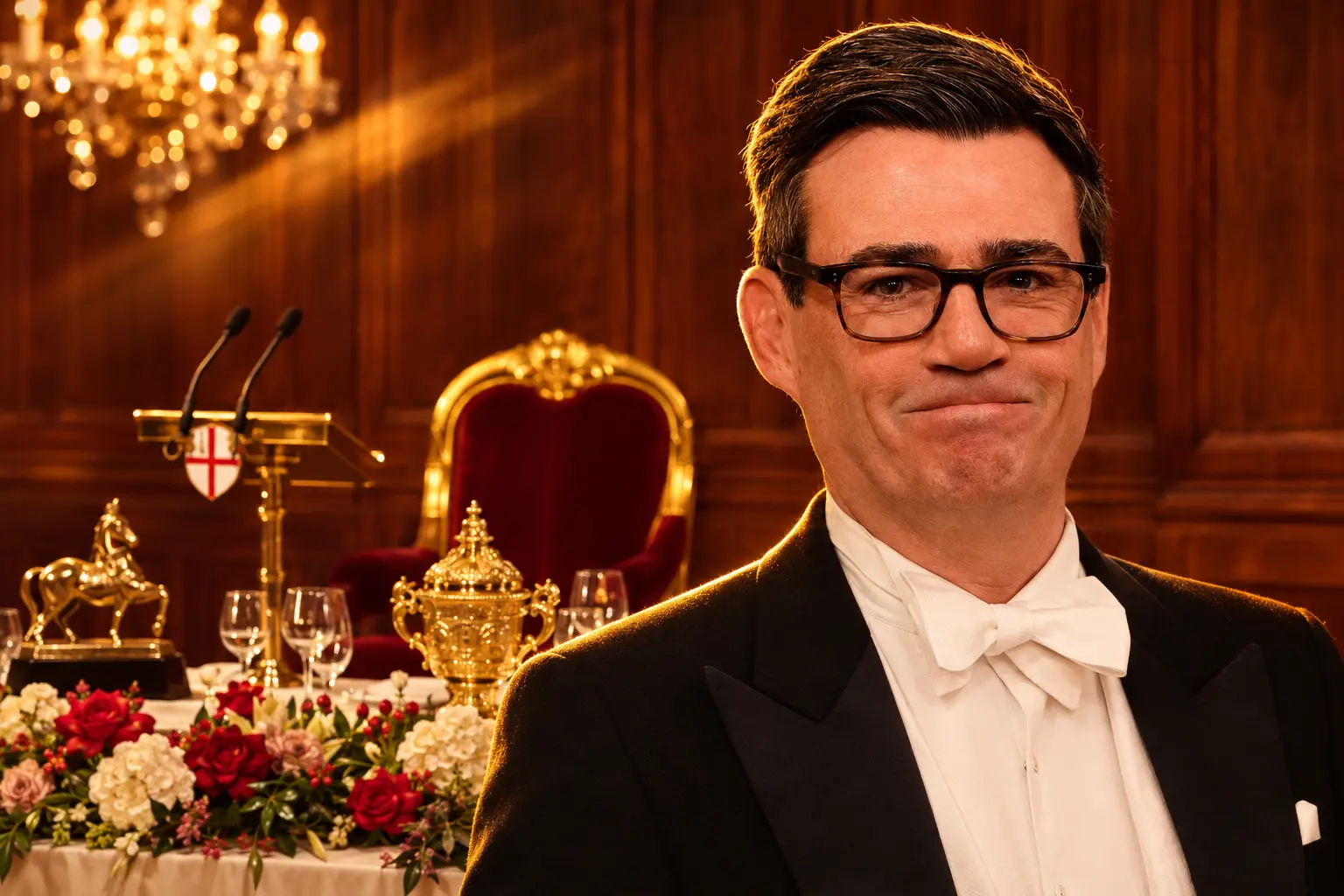
Prime Minister Andy Burnham told the Guildhall on Monday that Britain lost more than it gained from Brexit. He compared the 2016 divorce to the emperor’s new clothes, then set three tests for a limited reset with the European Union in Brussels on Friday.
The speech was the frankest account of the split a sitting Labour prime minister has given. The package on the table is not. Burnham said a deal could add up to 0.4 percent of GDP. He also said he will do nothing that crosses Labour’s 2024 red lines before the next general election, which still rules out the customs union and the single market.
The Emperor Had Nothing On
The Lord Mayor’s Banquet is a white-tie foreign policy set piece. Burnham used it to apply his Makerfield Test to Europe, four months after taking office on 20 July 2026. Makerfield, his Greater Manchester seat, voted by a clear majority to leave, he said, and the vote was aimed as much at Westminster as at Brussels.
It’s like the Emperor’s new clothes, where no one is prepared to say the obvious truth. Well, I do try to say things as I see them. And to be frank, we have lost more than we have gained in the last 10 years. The hard Brexit we were given is not good enough for Britain.
Andy Burnham, Prime Minister, Lord Mayor’s Banquet
In the same lost more than we have gained passage, he said financial services and tech had adapted and were thriving, while other sectors had suffered. He credited Keir Starmer with laying the groundwork for Friday and promised a “win-win” that was “not adversarial” and no longer about burning bridges.
He also said the promise to “take back control” of borders, laws and the economy had not been delivered. Control, in his telling, now means jobs, high streets and prices in places that have felt neglected, plus “the biggest transfer of power out of Westminster and Whitehall ever seen” in a Plan for Britain due next month.
THREE TESTS FOR ANY DEAL
- Manifesto line: It must be consistent with Labour’s 2024 pledges and the government’s red lines.
- 2016 test: It must improve the present arrangements and bring them closer to what people thought they were getting when they voted.
- Makerfield test: It must produce real gains in everyday life in parts of the country that have felt neglected for too long.
If those tests are met, he said, he will agree the deal. He named cheaper weekly shops, less red tape, progress on electricity bills, and more joint work on small boat crossings as the proof points, and said the head of M&S Food believes the food file will ease the weekly shop.
The Official Gap Dwarfs Friday’s Package
Burnham told the hall the Office for Budget Responsibility says Brexit has meant a 4 percent hit to the British economy, and that others put it at up to 8 percent of GDP. The OBR’s own page is narrower than that wording. It assumes the Trade and Cooperation Agreement will reduce long-run productivity by 4 percent relative to remaining in the EU, and that exports and imports will be about 15 percent lower than in that remain path.
That 4 percent is a gap versus a Britain that stayed, not a measured fall from 2016. Jamie Jenkins, a former head of health and economic statistics at the Office for National Statistics, posted that UK real GDP rose 14.7 percent from the referendum quarter to the third quarter of 2026, against 12.6 percent in France, 12.2 percent in Italy and 8.0 percent in Germany. Spain was up 22.2 percent on the same span. Observed growth and the remain-path gap can both be true, and they are not the same claim.
THE BREXIT MATH ON THE TABLE
| Estimate | What it measures | Who stands behind it |
|---|---|---|
| 4 percent | Long-run productivity versus remaining in the EU | Office for Budget Responsibility |
| Up to 8 percent of GDP | Broader hit cited in the Guildhall speech | Burnham, attributing it to “others” |
| Up to 0.4 percent of GDP | Sectoral reset of food rules, carbon markets and youth visas | Figure used by Burnham for Friday |
| About 0.5 percent of GDP | A customs union, a separate scenario | Centre for European Reform |
Charles Grant, director of the Centre for European Reform, wrote on 12 November that Burnham has been told the present reset agenda could raise GDP by up to 0.4 percent, and that even a customs union would only increase growth by about 0.5 percent. For a large lift, Grant argued, Britain would have to look at much or all of the single market, or at full membership.
A June CER model by John Springford and Anton Spisak found that goods exports to the EU are about 16 percent lower than they would have been inside the bloc. Goods imports are 14 percent lower. Services exports are down 7 percent and services imports 19 percent. Total UK exports to the EU are about 12 percent lower and imports about 16 percent lower. Leaving the customs union, on their split, cut goods exports to the EU by about 4 percent and goods imports by 1 percent. Most of the trade loss sits in the single market they say Britain left, not in the customs union some Labour figures still float as a halfway house.
Agrifood is the sharp end of that split. CER puts UK agrifood exports to the EU about 29 percent below the remain path, the largest goods-export loss in their sector table. That is the file Friday is supposed to ease.
What the Brussels Summit Can Sign
The second EU-UK Summit is in Brussels on 20 November 2026. European Council President António Costa and Commission President Ursula von der Leyen will host Burnham. Leaders are due to take stock of work since the first summit in London on 19 May 2025, covering defence and security, energy, agrifood rules, climate, people-to-people contacts, migration and law enforcement, and then issue a joint declaration.
The economic core is three files opened under Starmer and carried by Burnham. Draft texts have already been circulated to EU governments. None of them returns Britain to tariff-free, frictionless trade in the full single market.
THE THREE FILES FOR FRIDAY
- Food and plants: A sanitary and phytosanitary deal would cut post-Brexit checks and certificates on many animal and plant products, including export health certificates that have cost £200 a load and plant certificates at £25, and would let fresh sausages, burgers, shellfish from domestic waters and seed potatoes move again. Britain would follow EU food and plant rules as they change, with carve-outs talked about for precision breeding, novel foods and some pesticide rules. Pet passports would return.
- Carbon markets: Linking the UK and EU emissions trading systems is meant to spare firms each other’s carbon border taxes once those levies bite, and to sit alongside talks on electricity trading.
- Youth visas: A Youth Experience Scheme would let people aged 18 to 30 work, study or travel for limited periods. London wants a cap. Brussels has wanted a higher number. Student fee discounts for EU students have been a sticking point in the same talks.
Hamish Falconer, the minister for European relations, has said Britain could have a “voice in the room” on the food file but no vote on EU food policy, and that an exit clause is possible if a later government wanted to unwind the alignment. The Withdrawal Agreement Joint Committee, which he co-chairs with Commissioner Maroš Šefčovič, met on 10 November and pointed to the 20 November summit as the next political date.
Labour’s Manifesto Still Forbids the Customs Union
The 2024 Labour manifesto drew three lines: no return to the single market, the customs union, or freedom of movement. Burnham repeated them in all but those words. “We will do nothing that crosses our red lines this side of a General Election,” he said. Grant’s essay states the same three bans as the short-term strategy, with a longer argument parked until after the next election, which is due by July 2029.
That is the bind inside the emperor line. The speech treats the present relationship as inadequate for growth and security. The available deal is a set of sector files that, on the figures Burnham himself used, add up to 0.4 percent of GDP. A customs union, on CER’s separate figure, is about 0.5 percent. The larger trade losses in the CER work come from leaving the single market, which remains off the table.
The Liberal Democrats said the emperor had no clothes and then accused Labour of keeping Theresa May’s old lines for fear of splitting the party. They want a customs union and a return to the single market. Grant notes that more than half of Labour MPs sit for seats that voted Leave, and that several senior ministers, including Chancellor John Healey, Business Secretary Jonathan Reynolds and Culture Secretary Lisa Nandy, have shown little appetite for rejoining. Ed Balls, a former Labour cabinet minister, called a rethink “fraught with danger” if free movement ended up on the next manifesto.
Public opinion has moved even so. Grant cites a YouGov poll in June in which 57 percent said it was wrong to leave the EU and 30 percent said it was right. He also cites More in Common polling last summer that found only 11 of 632 mainland British constituencies would vote against membership if the 2016 question were asked again. Soft support is not a mandate to drop the 2024 lines before an election.
Makerfield Voted Leave and Now Audits Him
Burnham built the Makerfield Test in the June 2026 by-election that returned him to the Commons, then carried it into Downing Street. The test asks whether a policy works for Makerfield and places like it. On Monday he said the Brussels package would pass if it helped the weekly shop, cut business costs, moved electricity bills, and tightened work on illegal crossings.
Leave campaigners have already tried to turn the test around. Britain Unbound, a pro-Brexit group co-chaired by Lord Redwood, commissioned constituency polling that it says shows Makerfield voters want state-aid and VAT decisions kept in the UK. Burnham’s own speech conceded that a harder Brexit than voters were led to expect in 2016 had left “what was broken a decade ago” still broken. He still refused to treat Friday as a rerun of 2016.
The foreign policy wrapping was broader than food certificates. He called Brexit “the first domino to fall in a global move towards more isolationism and protectionism” and said it was “exactly what our enemies wanted,” with Russia seeking “disunity within NATO and a weaker Europe.” He named a Coalition of the Willing meeting in Berlin on Thursday, new sanctions, and talks that began in Abu Dhabi, and said Britain would take the G20 presidency in 2027 and the G7 presidency in 2028. Europe was the third of Churchill’s “majestic circles,” after the English-speaking world and a Commonwealth of 2.7 billion people. The EU file is where the growth claim is quantified, and it is the file that still cannot touch the 2024 bans.
Johnson Calls the Europe Pivot Madness
Boris Johnson said it was “madness to escalate the Brexit issue as your political priority,” and that Burnham would “impale himself and his party on this point.” He said he believed the public would back Brexit again if another vote were forced. Deputy Conservative leader Alex Burghart accused the prime minister of “reopening a debate the country settled long ago, while ignoring the challenges facing Britain today.” Conservatives have also called the reset a route “into the European Union via the back door.”
The Leave charge is not only nostalgia. It is that a public confession on the eve of a summit gives Brussels the whip hand. Kemi Badenoch made a version of that argument in October, saying Burnham had “blurted out everything he wants” and that the EU are tough negotiators. Grant records French advice in Brussels to keep the reset strict so that Britain concludes rejoining is the cleaner option. A confession that the emperor has nothing on does not improve a bargaining position if the other side already priced in the 4 percent gap.
Nigel Farage, speaking in Doncaster in early October, said Burnham had given him “the biggest boost in my career” by reopening Europe, and dared him to fight rejoining in the old Red Wall. That was six weeks before the Guildhall dinner. The Monday speech still feeds the same fight. It admits the hard Brexit failed and still withholds the two instruments that, on CER’s own split, would recover more of the trade loss than a customs union would.
After Brussels, the Longer Argument Starts
Burnham said that after the summit he will “initiate a discussion with our EU partners about options for our long-term relationship,” then present those options and an assessment “to inform decisions in the next Parliament.” “At every stage, the British people will be the boss.” That is a delayed argument, not a Friday signature. Legislation for the sectoral deal is due in Parliament the week after the summit.
FROM THE REFERENDUM TO BRUSSELS
- 23 June 2016: Britain votes 52 percent to 48 percent to leave the EU.
- 31 January 2020: The UK leaves the bloc, with a transition until the end of that year.
- 1 January 2021: The Trade and Cooperation Agreement takes effect.
- 19 May 2025: Starmer meets Costa and von der Leyen at the first EU-UK summit in London.
- 20 July 2026: Burnham becomes prime minister after winning Makerfield and the Labour leadership.
- 16 November 2026: He tells the Guildhall the hard Brexit is not good enough and cites a 0.4 percent deal.
- 20 November 2026: The second summit meets in Brussels on food rules, carbon markets and youth visas.
Friday can still be a working session on certificates, carbon and young workers. It cannot close the remain-path gap the official forecaster still carries, and it cannot restore the single market that CER says did most of the trade damage. The emperor line is on the record. The clothes on offer are a 0.4 percent package, with the larger argument reserved for a parliament that has not been elected yet.

ADNOC Ship Hit in Hormuz Leaves One Crew Missing

SpiceJet’s Rs 5,500 Crore Plan Follows a Rescue That Failed

Hasina’s Return Fight Sets Fire to Yunus’s Bank

Bancroft Recants the 2018 Inquiry and Names the Team

Adhikari Ties the Saffron Saree Row to School Licences

Clancy Juror Says the Holdout Never Cited Evidence

The iPhone 18 Pro Max Splits Apple’s Fall in Two

OpenAI Calls GPT-6 Astra AGI Then Locks Its Exploits

Trump Claims Hormuz Control as Oil Holds Near $96

Russia Closes the Goethe-Institut Berlin Tried to Save

 NEWS2 months ago
Clancy Juror Says the Holdout Never Cited Evidence
- NEWS3 months ago
The iPhone 18 Pro Max Splits Apple’s Fall in Two
- NEWS3 months ago
OpenAI Calls GPT-6 Astra AGI Then Locks Its Exploits
- BUSINESS3 months ago
Trump Claims Hormuz Control as Oil Holds Near $96
- LIFESTYLE3 months ago
Russia Closes the Goethe-Institut Berlin Tried to Save
- AUTO3 months ago
Volkswagen’s Job Cuts Leave Four Plants Without Cars
- NEWS3 months ago
Dyson Puts Nurovi Robots on Sale Without the UV Flagship
- BUSINESS2 months ago
US Destroys Five Iranian Tankers as the Shock Hits Jordan










