
NEWS
Abu Dhabi Talks Move Europe’s Security File to Moscow
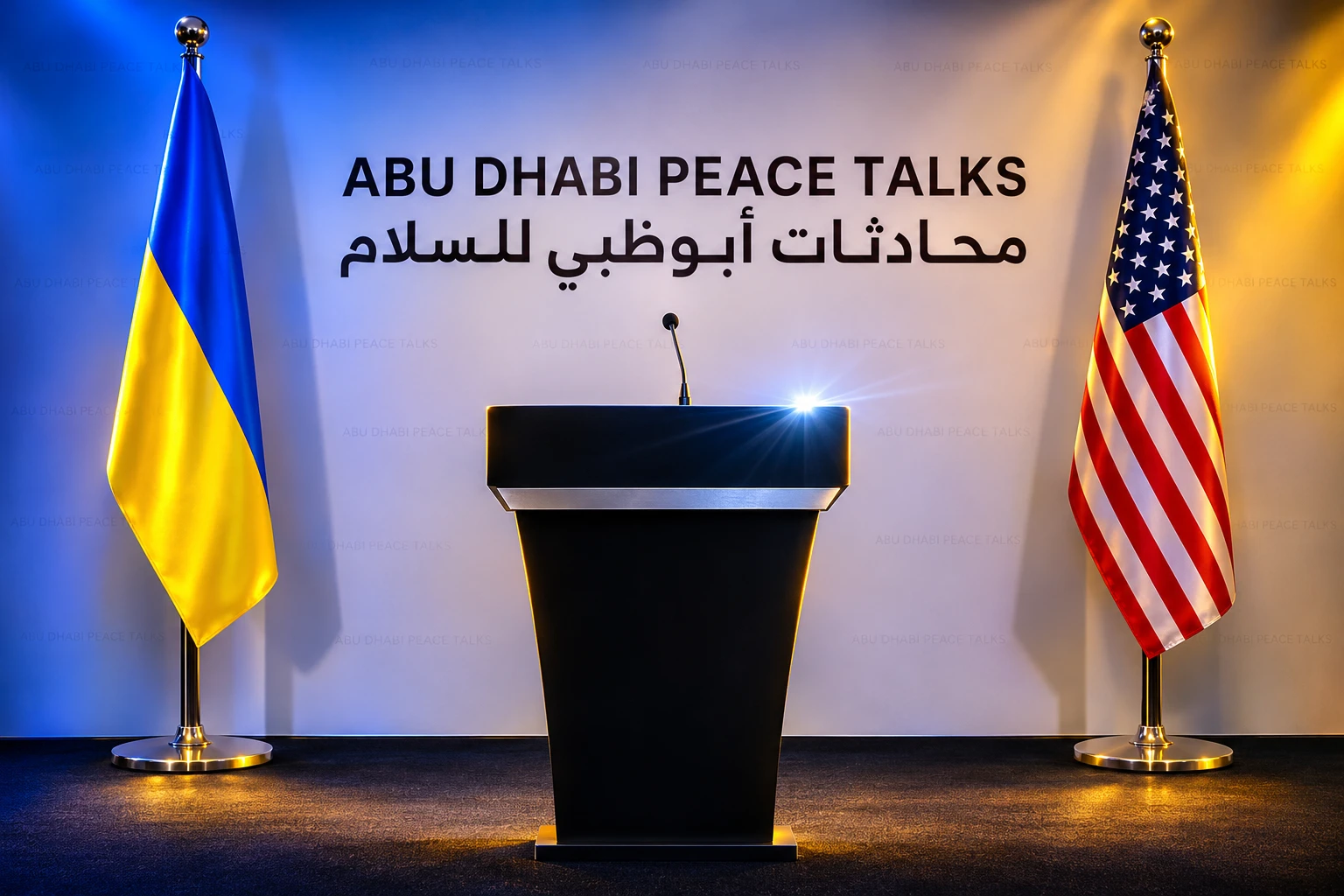
US, Russian and Ukrainian talks in Abu Dhabi produced a prisoner swap as Europe’s security order went to Moscow without a ceasefire or a European seat.

US, Russian and Ukrainian negotiators left Abu Dhabi on November 11 with a large prisoner exchange in principle and no ceasefire. American envoys then flew to Moscow, asking Vladimir Putin to let Europeans into a format he had just kept them out of.
The public product was humanitarian. The working file, on the Russian account, was Europe’s security order, discussed while Ukraine’s grid was still dark in six regions and while EU and NATO officials sat in a side room.
Abu Dhabi Closed With a Prisoner Swap and No Ceasefire
The first direct meeting of the three delegations since February ran two days in the UAE capital, with Jared Kushner and Steve Witkoff in the middle. A Russian embassy account of the first session put it at 4.5 hours. The second session ended in less than two hours.
Kushner called the round “a good first step” and said one of the positives was agreement on “the biggest humanitarian release of prisoners,” with the headcount to be set on November 12. Ukraine’s Rustem Umerov, who heads the Foreign Intelligence Service and led Kyiv’s team, confirmed the planned swap, as did Vladimir Medinsky, the Kremlin aide who has run Moscow’s talks since 2022. Davyd Arakhamia, who leads the Servant of the People faction in parliament and sat on the Ukrainian side, said it would be one of the largest exchanges, “possibly even the largest overall.”
Volodymyr Zelenskyy said on November 10 that negotiators had been discussing 1,000 to 1,500 prisoners from each side. Alexander Zorin, a Russian General Staff officer in the room, spoke of more than 1,000 from each side within two to three weeks, after a 1,000-for-1,000 return last year. Those figures were still not locked when Kushner and Witkoff landed in Moscow.
WHAT ABU DHABI PRODUCED
| File | Result after two days |
|---|---|
| Prisoners of war | Swap agreed in principle; numbers due November 12 |
| Ceasefire | No deal; talk of how to monitor one later |
| Territory | No deal; Kushner called it the hardest issue |
| Energy pause | No deal, despite overnight strikes |
| Europe at the main table | No seat; US envoys said they would ask Putin |
| Security guarantees | Both sides claimed progress; no text released |
Kushner said the talks “made good progress on understanding how to deconflict” and how to monitor a ceasefire, and on “major de-escalation postwar.” He also said there is no trust between the sides. Fighting did not pause for the sessions. Ukrenergo said Russian strikes hit energy sites in eight regions and cut power in six regions: Dnipropetrovsk, Donetsk, Kyiv, Sumy, Kharkiv and Chernihiv. Prime Minister Sergiy Koretsky said two people were killed in Ladyzhyn. Zelenskyy was in Denmark with Nordic leaders as the round opened, talking air defense and energy security while his negotiators sat in Abu Dhabi.
A Central File on Europe’s Security Order
Medinsky told reporters the European security system was a central topic, and that the sides “found mutual understanding in some areas, but not in others.” He added that “the whole organism is essentially sick,” that in Ukraine “an abscess has simply burst,” and that “a band-aid won’t fix this.” On land, he said “every inch of our land will be returned to Russia.”
That hierarchy was not a slip. A Russian source speaking before the round said the Ukrainian settlement, while critical, was “subordinate to the main objective, the creation of a comprehensive and indivisible security architecture for the entire continent.” Kushner had already put a “broader European security architecture” on paper the previous week, listing five goals and saying NATO would “remain central” while the United States also engaged Russia.
"Broader European security architecture" is Russian for ending or weakening NATO. https://t.co/8ztTmSg9GQ
— peacefare.net (@DanielSerwer) November 6, 2026
KUSHNER’S FIVE GOALS FOR THE ORDER
- Standing talks: Permanent security consultations among the parties.
- Crisis lines: Reliable communications when incidents spike.
- Open books: Greater military transparency.
- Matched steps: Reciprocal measures to cut escalation risk.
- A lasting shell: An enduring setup for long-term European security and stability.
Umerov said there had been “huge progress” on security issues and gave no details. Kushner said there had been “significant progress” on guarantees for Ukraine. Russia’s own demands for guarantees were discussed on the first day, Ukrainian sources said, with no public text. Liis Mure of Estonia’s International Center for Defense and Security noted that dialogue formats, confidence-building steps and arms control of this kind already existed in the OSCE and the NATO-Russia Council, and that Russia walked away from almost all of them.
The sequence is the second effect. A prisoner swap can be staged in two or three weeks without settling a front line. A new security order, once it is the price of even talking about a ceasefire, outlives the round that names it. That is the file Witkoff and Kushner carried to Moscow.
European Officials Waited Outside the Main Room
EU, NATO, British, French, German and Italian officials were in Abu Dhabi. They were not in the trilateral room. Umerov said Kyiv would “align our positions” with them first. Kushner said he and Witkoff would keep consulting those same capitals on “European security and Ukraine’s postwar future.” Kremlin spokesman Dmitry Peskov had already said the main meeting would exclude EU officials. Sergey Lavrov called a European role not a “promising approach.” Medinsky said the Russian delegation did not communicate with the Europeans and did not understand in what capacity they were there.
EUROPE’S TEAM IN ABU DHABI
- The Commission: Björn Seibert, chief of cabinet to Ursula von der Leyen.
- The Council: Anna-Maria Boura, chief foreign-policy adviser to António Costa.
- NATO staff: Geoffrey Van Leeuwen, chief of staff to Mark Rutte.
- National desks: Jonathan Powell for the United Kingdom, Günter Sautter for Germany, Fabrizio Saggio for Italy, plus French and E3 counterparts.
Von der Leyen drew a line before the first session. “Any meaningful discussions about Europe’s security architecture can only be undertaken once a ceasefire in Ukraine has been achieved,” she said, and “it must take place in an appropriate forum, in particular with NATO Allies and EU members.” Commission spokeswoman Paula Pinho said any European security setup is for the Union to decide, “because it’s a matter of its competence.”
Estonian Foreign Minister Margus Tsahkna said talking about European security without Europe is dangerous, and that an arms-control offer from Moscow would be easy to sell and hard to trust. Presidential security adviser Rainer Saks was blunter about the side-room model. “You cannot negotiate like that. Europe has to do its homework,” he said, after counting four or five capitals plus the Commission and NATO. Zelenskyy has warned of a “Yalta 2.0,” a phrase he uses for Western leaders carving Europe with Moscow. Arakhamia later said the round included an agreement to involve Europeans in the process. That involvement still needed Putin’s consent, which is why the next stop was not Brussels.
Wadephul Pointed Back to Helsinki, Paris and Budapest
German Foreign Minister Johann Wadephul rejected the premise that Europe must design a new order as the price of ending the war. Before leaving for a G7 meeting in Paris on November 9, he said Europe must be part of the search for a solution, and that the task is restoration of the existing security architecture, not a substitute written in Abu Dhabi or Moscow.
It is very clear that Europe does not need a new security architecture, as Russia is trying to make us believe, but rather quite simply the restoration of the existing security architecture. This includes the Helsinki Final Act, the Charter of Paris and the Budapest Memorandum, all of which aim to guarantee all borders and the sovereign equality of all states.
Johann Wadephul, German foreign minister, statement before the G7 meeting in Paris
Those three texts are not slogans. The Helsinki Final Act and the Charter of Paris are the OSCE’s founding political commitments from 1975 and 1990 on borders, sovereign equality and the right of states to choose their alliances. The 1994 Budapest Memorandum security assurances recorded that Russia, the United States and the United Kingdom would respect Ukraine’s independence, sovereignty and existing borders after Kyiv gave up the nuclear weapons on its territory, and would refrain from the threat or use of force against it.
Wadephul had set the same test three days earlier in Warsaw: no decision on Ukraine without Ukraine, and the security of Europe may not be decided without Europe. He also warned that the Abu Dhabi round would be judged on whether Russia dropped maximal demands or staged a “negotiation show” while strikes on civilians continued. The overnight blackouts in six regions were the test arriving on time.
What Russia and Ukraine Still Refuse to Trade
Territory stayed, in Kushner’s word, “the hardest.” Putin still wants Ukrainian forces out of Donetsk, Luhansk, Zaporizhzhia and Kherson, the four regions Moscow claimed in 2022 without holding all of them. He also wants Ukraine to drop NATO, shrink its armed forces, and ease rules on the Russian language and the Moscow-linked Orthodox Church. He has said he will use force if Kyiv refuses. Zelenskyy has ruled out handing over land Russia has not taken, and he rejects caps on the army or on Ukraine’s alliances.
THE GAP THAT HAS NOT MOVED
| Issue | Moscow’s line | Kyiv’s line |
|---|---|---|
| Land | Full claim on four oblasts plus Crimea | No cession of land Russia failed to take |
| NATO | Ukraine stays out | No ban on alliances |
| Army size | Hard caps (in 2022 drafts, 85,000 troops, 342 tanks, 40 km missiles) | No limits (in 2022 drafts, 250,000 troops, 800 tanks, 280 km) |
| Ceasefire first | Political order first, then the guns | Stop the fighting, then talk the order |
Those 2022 numbers are the last detailed public split on force limits, from the Istanbul drafts that never became a treaty. Nothing released in Abu Dhabi shows they have closed. Arakhamia said the Russian team arrived with “very strict instructions, leaving no room for bargaining,” and that he heard no ultimatums from the United States, Europe or Ukraine. Umerov had listed Kyiv’s priorities as a halt to the fighting, reliable postwar security guarantees, economic recovery, and humanitarian steps. The only item that left the building with a public yes was the humanitarian one.
President Sheikh Mohamed bin Zayed received the US delegation during the stay, with national security adviser Sheikh Tahnoon bin Zayed in the room. The UAE billed the hosting as part of a push for a political path. Hosting is not the same as setting the agenda. The agenda that survived contact with Medinsky was the continental order, plus a swap.
The Envoys Took the File to Putin First
Kushner said he and Witkoff would go to Moscow on November 12 “to go over what was discussed,” then to Dublin to brief Zelenskyy, who is due at an informal gathering of EU leaders on November 13. He said the Moscow stop was also meant to “get Europeans added to the format so we can make this a multilateral format,” and that they were “pushing a boulder uphill” toward a Putin-Zelenskyy meeting. Witkoff has shuttled to Moscow repeatedly since Donald Trump returned to office. Kirill Dmitriev, Putin’s special envoy, met the pair at Vnukovo after they landed on November 12.
The order of those visits is the argument. Europe’s seat is being treated as something Putin can grant, after a round in which his delegation would not even meet the Europeans who had flown in. Going to Moscow before Dublin means the readout Kyiv and Brussels get is already filtered through that conversation. That is the objection that keeps coming back, and it does not depend on guessing anyone’s private business.
FROM BRUSSELS LANGUAGE TO MOSCOW
- November 6, 2026: Kushner publishes five goals for a broader European security order and confirms the first trilateral with Ukraine and Russia since February.
- November 9, 2026: Von der Leyen says architecture talks wait on a ceasefire and belong in a NATO and EU forum; Wadephul says restore the old order, do not replace it.
- November 10, 2026: The trilateral opens in Abu Dhabi after a European coordination meeting; Russian strikes cut power in six Ukrainian regions.
- November 11, 2026: A second session of less than two hours ends with a prisoner swap in principle and no ceasefire or land deal.
- November 12, 2026: Kushner and Witkoff land in Moscow ahead of Putin; prisoner numbers are supposed to be fixed the same day; a Dublin briefing for Zelenskyy is next.
WHAT WE KNOW
- The swap: Both delegations and the US envoys confirmed a large exchange in principle.
- The gap: Territory, a ceasefire, and an energy pause were not agreed.
- The room: Europe was in Abu Dhabi and out of the main talks.
WHAT IS UNCONFIRMED
- The headcount: Zelenskyy’s 1,000 to 1,500 range and Zorin’s two-to-three-week timetable were not a signed list.
- The next round: Arakhamia said a date could be set after the Moscow visit; none was announced with the closing statements.
- Europe’s seat: Kushner said he would seek Putin’s backing to widen the format; Moscow had not granted it when the envoys landed.
Arakhamia said Ukrainian officials could still imagine a deal by the New Year. Trump had spoken the week before the round of a “very big agreement” involving “all of Europe.” The two-day table did not produce that agreement. It produced a prisoner swap, a promise to keep talking, and a plane to Vnukovo with Europe’s security order in the briefcase.
Kushner and Witkoff landed at Vnukovo on November 12. The prisoner numbers were supposed to be fixed the same day. Europe’s seat still needed Putin’s blessing.

ADNOC Ship Hit in Hormuz Leaves One Crew Missing

SpiceJet’s Rs 5,500 Crore Plan Follows a Rescue That Failed

Hasina’s Return Fight Sets Fire to Yunus’s Bank

Bancroft Recants the 2018 Inquiry and Names the Team

Adhikari Ties the Saffron Saree Row to School Licences

Clancy Juror Says the Holdout Never Cited Evidence

The iPhone 18 Pro Max Splits Apple’s Fall in Two

OpenAI Calls GPT-6 Astra AGI Then Locks Its Exploits

Trump Claims Hormuz Control as Oil Holds Near $96

Russia Closes the Goethe-Institut Berlin Tried to Save

 NEWS2 months ago
Clancy Juror Says the Holdout Never Cited Evidence
- NEWS3 months ago
The iPhone 18 Pro Max Splits Apple’s Fall in Two
- NEWS3 months ago
OpenAI Calls GPT-6 Astra AGI Then Locks Its Exploits
- BUSINESS3 months ago
Trump Claims Hormuz Control as Oil Holds Near $96
- LIFESTYLE3 months ago
Russia Closes the Goethe-Institut Berlin Tried to Save
- AUTO3 months ago
Volkswagen’s Job Cuts Leave Four Plants Without Cars
- NEWS3 months ago
Dyson Puts Nurovi Robots on Sale Without the UV Flagship
- BUSINESS2 months ago
US Destroys Five Iranian Tankers as the Shock Hits Jordan










