GAMING
Quordle 1757 Spends Its Rare Z on Razor
Quordle 1757 answers RAZOR, TUBER, MOUTH and ALOUD share O and U across three grids each, so the botanical word is cheaper than the Z in RAZOR.

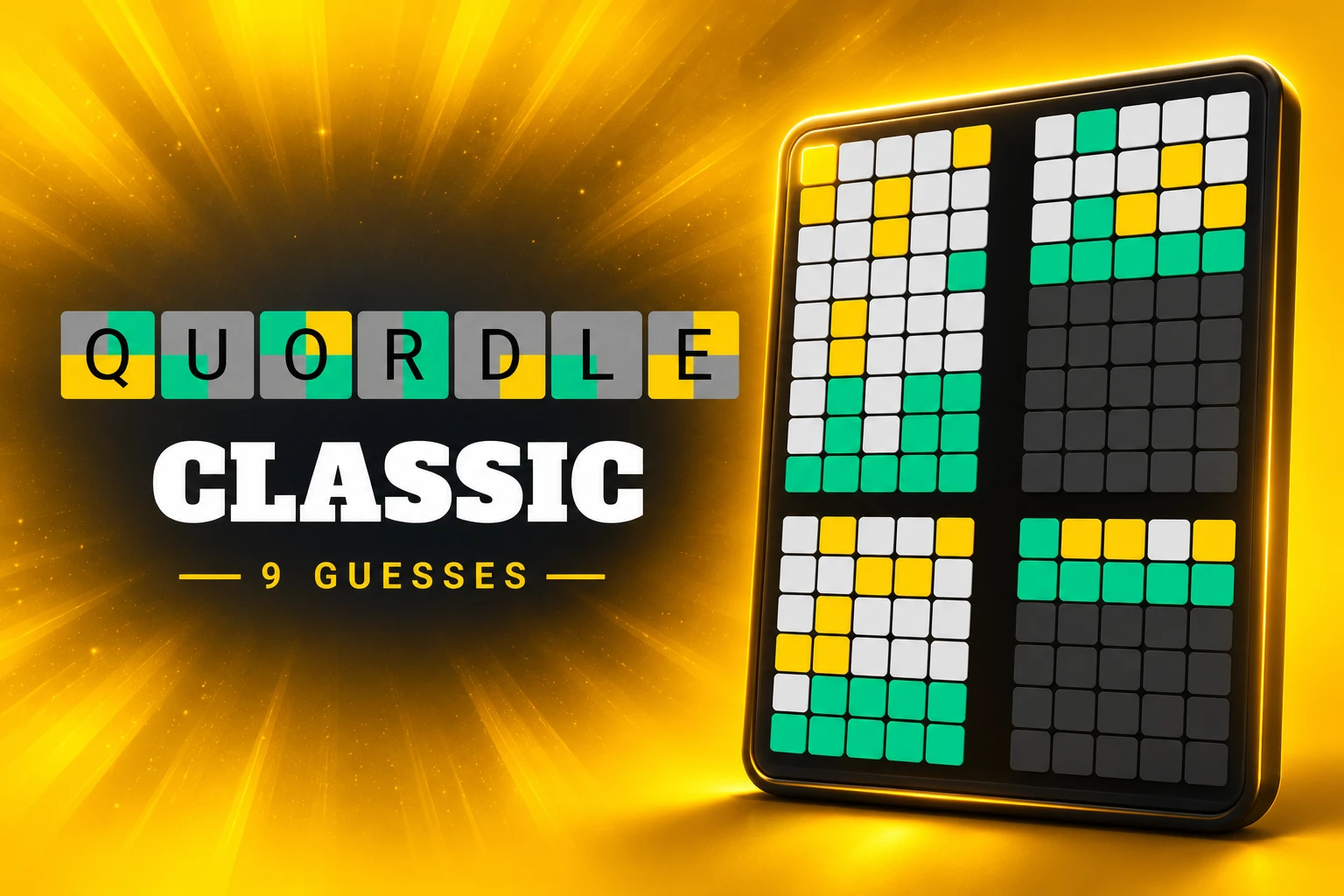
Classic Quordle 1757 answers are RAZOR, TUBER, MOUTH and ALOUD for Monday, November 16, 2026. You get nine shared guesses, and each five-letter try paints all four grids at once.
Hint pages flag TUBER as the vocabulary snag because it lives in botany. Count the letters and the expensive tile is the Z in RAZOR, after O shows up in three answers and U shows up in three.
Quordle 1757 Answers Are Razor, Tuber, Mouth and Aloud
Top-left is RAZOR, a shaving tool with R at both ends. Merriam-Webster defines it as a keen-edged cutting instrument for shaving or cutting hair, a word in English since the 14th century. The Z is the letter nobody wastes an early guess on, and the doubled R is the only repeat on the whole board.
Top-right is TUBER. Bottom-left is MOUTH, the opening through which food passes, bounded by the lips and holding the tongue and teeth. Bottom-right is ALOUD, an adverb Merriam-Webster glosses as with the speaking voice in a way that can be clearly heard, as in she read the story aloud.
THE FOUR GRIDS ON 1757
| Quadrant | Answer | Start / end | Vowel slots | Costly extra |
|---|---|---|---|---|
| Top-left | RAZOR | R / R | A at 2, O at 4 | Z, plus R twice |
| Top-right | TUBER | T / R | U at 2, E at 4 | B and E |
| Bottom-left | MOUTH | M / H | O at 2, U at 3 | H and M |
| Bottom-right | ALOUD | A / D | A at 1, O at 3, U at 4 | L and D |
RAZOR is the only answer with a repeated letter. TUBER, MOUTH and ALOUD each use five different letters. Stop at the row that already clicked; the rest of this piece walks the letter budget that binds them.
U Shows Up in Three of the Four Words
Treat the four answers as one bag of tiles and the “everyday life” set is a vowel engine. O sits in RAZOR, MOUTH and ALOUD. U sits in TUBER, MOUTH and ALOUD. That is three boards each, not a pair you notice only after MOUTH is done.
LETTERS THAT CROSS THE BOARD
| Letter | Answers that use it | How many grids |
|---|---|---|
| O | RAZOR, MOUTH, ALOUD | 3 |
| U | TUBER, MOUTH, ALOUD | 3 |
| R | RAZOR (twice), TUBER | 2 words, 3 tiles |
| A | RAZOR, ALOUD | 2 |
| T | TUBER, MOUTH | 2 |
| Z | RAZOR | 1 |
E and B live only in TUBER. H and M live only in MOUTH. L and D live only in ALOUD. Once MOUTH and ALOUD are on the board, TUBER is a placement job for B, E and R around a T and a U you already own. The botanical meaning still matters if you never look across grids. The second pass is cheaper if you do.
That is why an opener that actually tests A, E, O, U, R and T earns more on this quartet than a clever one-grid stab. A yellow U on MOUTH is also a yellow U on TUBER and ALOUD. A gray Z on three boards is still a live Z on RAZOR, which is the ugly kind of split this format is built to create.
Merriam-Webster Calls a Tuber a Fleshy Stem
TUBER is the word hint writers reach for when they want a “hard” label, and the dictionary that now hosts the game does not treat it as a synonym for potato. Merriam-Webster’s first sense is a short fleshy underground stem with tiny scale leaves, each holding a bud that can make a new plant. First known use is 1668, from Latin for a swelling.
Tuber, specialized storage stem of certain seed plants. Tubers are usually short and thickened and typically grow below the soil. Largely composed of starch-storing parenchyma tissue, they constitute the resting stage of various plants and enable overwintering in many species. As modified stems, most tubers bear minute scale leaves, each with a bud that has the potential for developing into a new plant. The potato is a typical tuber, as is the Jerusalem artichoke.
Britannica Editors, Encyclopaedia Britannica
Britannica also notes the sloppy everyday use: people call a dahlia’s store a tuber when it is a tuberous root. If you dug for “root vegetable” and stalled, that mix-up is the snag, not a missing letter. The potato’s “eyes” are buds on a stem. The specialized storage stem is the thing the grid wants, five letters, T at the front and R at the back.
On a solo Wordle board, that definition can burn guesses while you try ROOTS or BULB and get nowhere. On this Quordle board the vowels are already dripping over from MOUTH and ALOUD. The plant word is a B-and-E problem dressed up as a science problem.
The Board That Finishes Last Is Razor
Completed Classic grids posted on November 16 keep landing the top-left word on guess 8 or 9. That quadrant is RAZOR. TUBER often falls in the middle of the run, on guess 3 through 7, which is the opposite of a vocabulary boss fight.
Z is a terrible survey letter. You do not open with it, and you do not find it by accident unless a later probe word happens to carry it. RAZOR also asks you to believe R at both ends after you have already used R as a yellow or green on TUBER. Players who lock TUBER’s trailing R then stare at _A_O_ and still need the Z to make the shape obvious.
The doubled R is the other tax. Classic gives you one guess at a time for four hidden words, so a probe that reuses R to test the double can be a wasted row on MOUTH and ALOUD, where R is dead. The cheap play is to finish the boards that do not need Z, then spend a dedicated guess on a Z-word rather than hoping RAZOR appears while you are still hunting B.
MOUTH is the giveaway grid in that sequence. It is a common noun, vowels in a row in the middle, and it donates O, U and T to the rest of the sheet. Finish it and the other three boards get cheaper at once, which is the whole point of a shared keyboard.
Aloud Sounds Like a Word That Does Not Fit
ALOUD is the adverb on the sheet, and it is the one answer that is not a thing you can point at. Merriam-Webster’s current sense is audibility, not volume for its own sake. Reading aloud means the words leave the head and hit the air. It does not require shouting.
The trap is the cousin that sounds the same. Aloud and allowed are homophones, both commonly said /əlaʊd/, and they do different jobs. Aloud is the voice. Allowed is permission, the past tense of allow. Allowed has seven letters, so it cannot be entered. Allow has five, and that is the guess that actually fits the box while missing the meaning.
If you already have A, O and U from a vowel-heavy opener, ALLOW and ALOUD are neighbors. The L sits in slot 2 on ALLOW and slot 2 on ALOUD; the split is W versus D at the end, plus the extra U in ALOUD’s fourth slot. A board that already shows U in slot 4 is not ALLOW. It is ALOUD, and it is also feeding U to TUBER.
Keeping adverbs on the candidate list matters here in a way it does not on a board of four nouns. The other three answers are things. This one is a manner of speaking, and the grid will not hint you toward it if you only look for objects.
Nine Guesses Have to Cover Four Grids
Classic Quordle is the daily mode with nine guesses to solve four words. Wordle still spends six guesses on a single five-letter word. Nine sounds like a surplus until each row has to work on every unsolved grid, which leaves little room for a throwaway probe.
HOW THE GAME GOT TO 1757
- February 2022: Freddie Meyer releases Quordle, built from an early prototype by engineer David Mah, and the game later draws a million players.
- January 20, 2023: Meyer says Merriam-Webster has bought the game, adding he cannot think of a better home for it. Terms stay undisclosed. Greg Barlow, then the company’s president, calls it a favorite of Merriam-Webster editors.
- November 16, 2026: Classic puzzle 1757 posts RAZOR, TUBER, MOUTH and ALOUD on the dictionary company’s games page.
- Next daily reset: Classic puzzle 1758 replaces the board.
The sale put a dictionary and a four-grid daily under one roof, which is why TUBER reading like a glossary entry is not an accident of tone. You still have to find it with the same nine rows you use on RAZOR.
A CLEAN PATH THROUGH THIS SHEET
- Open wide: Spend guesses 1 and 2 on distinct letters that include A, E, O, U, R and T, and do not chase a single grid yet.
- Take MOUTH first: It is the common noun with O and U in the middle, and it donates T, O and U to the other boards.
- Cash ALOUD and TUBER next: ALOUD is the leftover A-O-U pattern that is not ALLOW; TUBER is then T, U, blank, blank, R with B and E still to place.
- Park RAZOR last: Once R and O are known, use a probe that actually carries Z instead of hoping the doubled R reveals itself.
That order is the opposite of solving “the hard word” first. The hard tile is Z. The hard word on paper is TUBER. The nine-guess budget cares about the tile.
Frequently Asked Questions
How Many Guesses Do Extreme and Chill Quordle Give You?
Extreme gives 8 guesses and uses more unusual words. Chill gives 12 guesses and uses fewer unusual words. Sequence shows one word at a time, Rescue asks you to repair a messy computer board, and Weekly Challenge unlocks after you solve a Daily Classic.
Who Built the Original Quordle Prototype?
Engineer David Mah built the early prototype. Freddie Meyer then reworked that code into the version released in February 2022, the game Merriam-Webster announced it had acquired on January 20, 2023.
Is a Dahlia’s Underground Store a True Tuber?
No. Britannica treats the potato as a typical stem tuber and flags the dahlia’s store as a tuberous root, a fleshy root that only resembles a tuber. Garden talk blurs the two; the five-letter answer on 1757 follows the stem sense.
Can Allowed Be Typed as a Quordle Guess?
No. Allowed has seven letters, and Classic only accepts five-letter words. The five-letter cousin that will go on the grid is ALLOW, which matches the sound of ALOUD at the start and then misses the D and the extra U.
Classic 1758 goes up on the next daily reset, and it will not copy this O-and-U stack. Until then the four answers stay RAZOR, TUBER, MOUTH and ALOUD, with the Z sitting on the board that posted grids kept saving for last.

ADNOC Ship Hit in Hormuz Leaves One Crew Missing

SpiceJet’s Rs 5,500 Crore Plan Follows a Rescue That Failed

Hasina’s Return Fight Sets Fire to Yunus’s Bank

Bancroft Recants the 2018 Inquiry and Names the Team

Adhikari Ties the Saffron Saree Row to School Licences

Clancy Juror Says the Holdout Never Cited Evidence

The iPhone 18 Pro Max Splits Apple’s Fall in Two

OpenAI Calls GPT-6 Astra AGI Then Locks Its Exploits

Trump Claims Hormuz Control as Oil Holds Near $96

Russia Closes the Goethe-Institut Berlin Tried to Save

 NEWS2 months ago
Clancy Juror Says the Holdout Never Cited Evidence
- NEWS3 months ago
The iPhone 18 Pro Max Splits Apple’s Fall in Two
- NEWS3 months ago
OpenAI Calls GPT-6 Astra AGI Then Locks Its Exploits
- BUSINESS3 months ago
Trump Claims Hormuz Control as Oil Holds Near $96
- LIFESTYLE3 months ago
Russia Closes the Goethe-Institut Berlin Tried to Save
- AUTO3 months ago
Volkswagen’s Job Cuts Leave Four Plants Without Cars
- NEWS3 months ago
Dyson Puts Nurovi Robots on Sale Without the UV Flagship
- BUSINESS2 months ago
US Destroys Five Iranian Tankers as the Shock Hits Jordan