
BUSINESS
India Bans Black Mass Exports to Feed Plants Still Waiting
India banned lithium-ion black mass exports on 10 November 2026, closing a tariff line that recorded no legal shipments while refiners still import powder.

India prohibited lithium-ion battery black mass exports on 10 November 2026, moving the powder under ITC(HS) code 85491400 from Free to Prohibited. The Directorate General of Foreign Trade issued Notification No. 49/2026-27 the same day, with effect at once and until further orders.
The commerce ministry said recyclers have built more capacity than they can fill, and that some of them have had to import the same powder. Global Trade Research Initiative founder Ajay Srivastava said the tariff line recorded no legal shipments in FY2025-26. The lock is aimed at a waste stream that has not yet arrived in volume, and at plants the state is already paying to refine rather than merely shred.
Notification 49 Closes Code 85491400
A commerce ministry note on 11 November 2026 said DGFT had amended the item from Free to Prohibited under the Foreign Trade (Development and Regulation) Act, 1992. Transitional arrangements under Para 1.05 of the Foreign Trade Policy, 2023, apply. The notice is not a blanket ban on every battery or every scrap line.
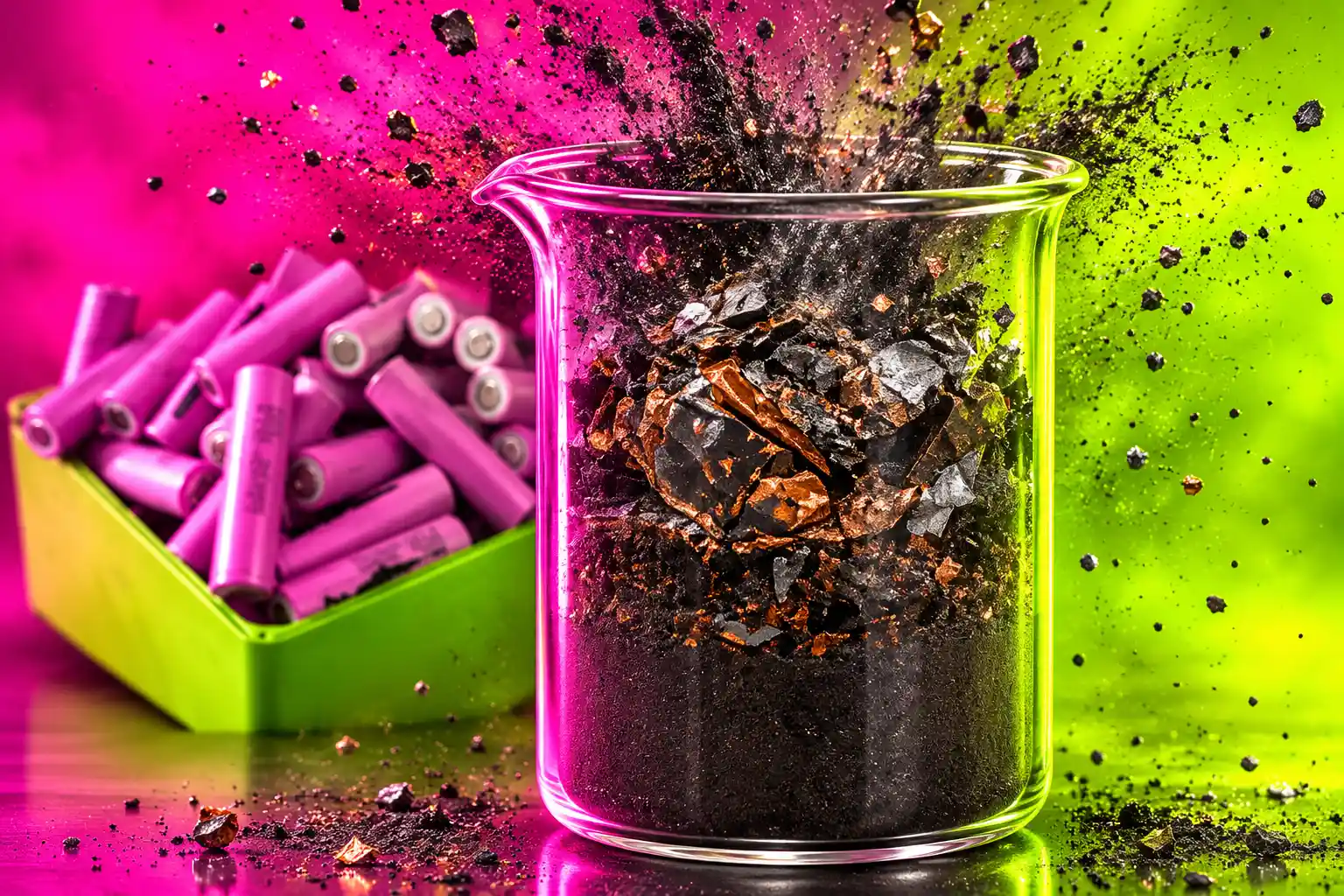
Black mass is the powder left after end-of-life lithium-ion packs and factory scrap are shredded and the larger pieces of metal and plastic are pulled out. The ministry said it holds recoverable lithium, cobalt, nickel and manganese. Those metals feed electric vehicles, cell plants, storage systems, electronics and renewable hardware, and India still buys a large share of them abroad.
WHAT NOTIFICATION 49 ACTUALLY COVERS
- The tariff line: ITC(HS) 85491400, waste and scrap of primary cells, primary batteries and electric accumulators, including spent cells, that are unsorted and do not contain lead, cadmium or mercury.
- The label in the notice: Lithium-ion battery black mass, including powder from end-of-life packs and from manufacturing waste.
- The duration: Immediate effect, until further orders, with FTP 2023 transitional rules for shipments already in the pipeline.
- What it does not do: It does not, on its face, rewrite the lines for lead-acid scrap or for lithium-ion waste that has already been sorted by chemical type.
The ministry said keeping the powder at home should raise use of domestic recycling and refining units, cut the foreign-exchange bill, and support “environmentally sound recycling of this hazardous material” under existing environmental rules. It also tied the step to Aatmanirbhar Bharat and to urban mining, the recovery of metals from products already inside the country rather than from new mines.
A Year of Zero Legal Shipments
Srivastava said India recorded zero exports of the product worldwide in FY2025-26 under this code, and that the government moved to stop future shipments so refiners can keep the material. That is a thin trade leak to close if the packing lists were honest. It is a larger problem if the powder was leaving under other names.
The ministry’s own note concedes both halves of the loop. Exports of black mass generated in India “divert this valuable secondary resource abroad,” it said, while domestic recyclers have, in some cases, had to import material to meet their requirements. The powder that left, and the salts that came back, are the same critical minerals travelling as waste one way and as industrial input the other.
The step is also in keeping with measures adopted by several major economies to retain critical mineral-bearing battery waste and Black Mass for domestic processing.
Ministry of Commerce and Industry, press note, 11 November 2026
Former Union minister Suresh Prabhu called the stop on unsorted lithium-ion battery waste, including black mass, welcome, and said India now needs plants and technology so the value stays here. The notice does the first half of that job. It does not, by itself, turn powder into battery-grade carbonate or sulphate.
Domestic Refiners Still Buy Powder From Abroad
An Observer Research Foundation analysis by Pranita Gupta, published on 18 September 2026, put India’s ability to recycle over 60,000 tonnes of lithium-ion batteries a year, a throughput that could yield about 30,000 tonnes of black mass. Attero’s recycling capacity is about 15,000 tonnes a year in that round-up. Lohum holds over 90 percent of India’s integrated lithium-ion recycling market, Gupta wrote.
Those tanks still hunt for feed. Gupta noted that domestic recyclers already top up local scrap with imports from Europe, the Middle East, Australia and Japan. The ministry now wants Indian-generated powder to stay in those same sheds. The constraint that follows is not a missing tariff rule. It is getting dead packs out of workshops, phone counters and two-wheeler yards and into licensed shredders fast enough to keep hydrometallurgy lines running.
THE FEEDSTOCK GAP BEHIND THE BAN
- Legal exports: GTRI said India recorded no shipments under code 85491400 in FY2025-26.
- Nameplate recycling: ORF put lithium-ion recycling capacity above 60,000 tonnes a year, enough for about 30,000 tonnes of black mass.
- Demand coming: Gupta cited EV sales of 2.3 million units in 2025 and lithium-ion demand rising from 15 GWh in 2025 to 127 GWh by 2030, against a 30 percent electric share of vehicle sales by 2030.
- Import bind: ORF said lithium and nickel are 100 percent imported, and that about 75 percent of lithium-ion batteries used in Indian EVs came from China, with the bill over $3 billion in FY2025.
India’s packs are mostly lithium-iron-phosphate, which ORF notes are over 40 percent cheaper than nickel-manganese-cobalt cells. The powder those packs produce is heavier in lithium, iron, copper and graphite than in nickel and cobalt. A ban that keeps LFP black mass at home is a lithium-and-graphite play more than a cobalt play, unless the mix of chemistries on Indian roads shifts.
Europe’s Hazardous Label Took Effect a Day Earlier
Commission Delegated Decision (EU) 2025/934 of 5 March 2025, which updates the European List of Waste, began to apply on 9 November 2026, one day before DGFT dated Notification 49. It adds a hazardous-waste code for the intermediate fraction from thermal or mechanical treatment of lithium-based batteries, the stream known as black mass. From that date the EU’s Waste Shipments Regulation blocks black mass exports to non-OECD countries and requires prior consent for movements inside the OECD.
Sarah Logan, a visiting fellow at the European Council on Foreign Relations, wrote in August 2026 that Europe still exports around 80 percent of its black mass for refining, mostly in Asia, with South Korea a key destination because of its OECD status. She put China’s share of global battery recycling capacity, shredding plus material recovery, at more than 80 percent in 2025. Those are different 80 percent figures: one is Europe’s outbound powder, the other is China’s grip on the plants that take it.
Logan also recorded that in July 2026 the United States empowered federal officials to block exports of end-of-life batteries and electronic waste so the material stays for domestic recycling. Europe’s own hydrometallurgical capacity, she wrote, is under 3,000 tonnes, about one-sixtieth of China’s, against a need for 120,000 to 135,000 tonnes of black-mass recycling a year by 2030. The European Commission’s Critical Raw Materials Act wants at least 25 percent of annual consumption of strategic raw materials to come from recycling by 2030.
THE WEEK THE SCRAP LOCK CLOSED
- March 2025: The EU reclassifies black mass and end-of-life lithium, nickel and zinc batteries as hazardous waste.
- July 2026: Washington authorises officials to block exports of end-of-life batteries and electronic waste; India’s Central Pollution Control Board issues recycling guidelines for waste batteries.
- 4 November 2026: India’s Cabinet approves a Rs 2,814 crore capex scheme for lithium and nickel processing plants.
- 9 November 2026: EU Decision 2025/934 starts to apply, shutting black-mass exports to non-OECD countries.
- 10 November 2026: DGFT Notification 49/2026-27 prohibits Indian black-mass exports under code 85491400.
India is doing, in one notice, what Brussels is trying to do with a hazardous-waste label and what Washington is trying to do with an export block. The difference is the size of the pile. Europe already has a large EV fleet coming off the road. India’s 2.3 million electric sales in 2025 are still a young stock. The Indian notice is a claim on tomorrow’s scrap, filed the day after Europe’s claim on today’s.
Subsidy Rules Exclude Pure Black Mass Lines
The commerce ministry said the export ban complements the National Critical Mineral Mission, including the Rs 1,500 crore Incentive Scheme the Cabinet approved in September 2025. That scheme’s design is the tell. It pays for refining. It does not pay for making more powder.
The Extraction Incentive From September 2025
The Prime Minister’s Office note on the scheme said it will run six years, from FY2025-26 to FY2030-31, on e-waste, lithium-ion battery scrap, and other scrap such as catalytic converters. It will pay a 20 percent capex subsidy on plant and machinery if production starts on time, plus an opex subsidy on incremental sales over FY2025-26, 40 percent in year two and 60 percent in year five. Total support is capped at Rs 50 crore for large entities and Rs 25 crore for small ones, with opex inside those caps limited to Rs 10 crore and Rs 5 crore. One-third of the outlay is earmarked for small and new recyclers, including start-ups.
The same note states the money is for the recycling chain involved in actual extraction of critical minerals, and not the chain involved in only black mass production. New Delhi will not subsidise a shredder that stops at powder. It will now also refuse to let that powder leave. The two rules point at the same gap: hydrometallurgy and pyrometallurgy lines that turn black mass into salts the cell plants can buy.
Officials expect the scheme to build at least 270 kilo ton of annual recycling capacity, yielding about 40 kilo ton of critical minerals a year, about Rs 8,000 crore of investment, and close to 70,000 direct and indirect jobs.
Four New Lithium and Nickel Plants
Six days before the export notice, on 4 November 2026, the Cabinet approved a separate Capex Support Scheme to Promote Critical Mineral Processing, with an outlay of Rs 2,814 crore ($300 million) from FY2026-27 to FY2030-31. A Cabinet note said it offers a 30 percent capital subsidy for four plants: two lithium units of at least 30 kt each and two nickel units of at least 50 kt each. Support is capped at Rs 500 crore per lithium beneficiary and Rs 900 crore per nickel beneficiary, Rs 1,000 crore plus Rs 1,800 crore, with Rs 14 crore left for administration. Cobalt is expected as a by-product of the nickel plants. This scheme processes ores and intermediary products into high-purity compounds. It is not a recycling subsidy. Together with the export ban, it is a bet that India can hold both mined feed and scrap feed long enough to refine them.
THE TWO SCHEMES THE BAN IS MEANT TO FEED
| Scheme | Outlay | Window | What it pays for |
|---|---|---|---|
| Critical Mineral Recycling Incentive | Rs 1,500 crore | FY2025-26 to FY2030-31 | Extraction of minerals from waste; black-mass-only lines excluded |
| Capex Support for Critical Mineral Processing | Rs 2,814 crore | FY2026-27 to FY2030-31 | 30% capex for two lithium plants (min 30 kt) and two nickel plants (min 50 kt) |
Retaining black mass, the commerce ministry said, will help ensure that capacity built under the recycling scheme has domestic feedstock. That sentence only holds if collection rises with the plants. Gupta’s ORF paper warned that recovered material still needs offtakers who can make precursors, cathode powders and cells. ORF also recorded that spent lithium-ion packs typically last 5 to 8 years, and that recycling them could supply more than 40 percent of India’s lithium demand once that wave arrives.
What Happens If the Powder Leaves Under Another Name?
Black mass can carry toxic electrolyte residues and heavy metals. The Ministry of Environment, Forest and Climate Change already treats it as hazardous waste, so the Hazardous and Other Wastes (Management and Transboundary Movement) Rules, 2016, already required written permission to ship it. A new “Prohibited” stamp on 85491400 does not, by itself, catch a consignment declared as something else.
Srivastava put the enforcement problem in one sentence. Hazardous-waste rules require prior permission, he said, but exporters can evade scrutiny by declaring the material as cobalt powder, a nickel intermediate or another industrial product. Customs, he added, will have to check how the material was produced as well as how it was declared, because a different name or tariff code can conceal the same waste.
Effective enforcement will depend on Customs checking how the material was produced as well as how it was declared since a different name or tariff code can conceal the same waste.
Ajay Srivastava, founder, Global Trade Research Initiative
Gupta noted that the Central Board of Indirect Taxes and Customs has already flagged lithium-ion shredding units that exported hazardous black mass under incorrect trade codes. That is the leak Notification 49 does not close unless officers open bags and match process to paperwork. Shredders that used to sell powder into that channel lose a margin. Hydromet plants that can take the powder, Attero, Lohum and their smaller peers, gain a captive domestic stream, but only if the packs actually reach them and only if the offtake for battery-grade salt exists inside India.
Keeping scrap is one step. Turning it into usable battery material is the business the Rs 1,500 crore scheme was written to buy, and that the export ban is now trying to force.
Frequently Asked Questions
What Is Lithium-Ion Battery Black Mass?
It is the dark powder left after lithium-ion packs or factory scrap are shredded and bulk metal and plastic are removed, and its mix follows the cathode. Indian electric vehicles mostly use lithium-iron-phosphate cells, so the powder is typically richer in lithium, iron, copper and graphite than in nickel and cobalt, which show up more in nickel-manganese-cobalt packs. Refiners then use hydrometallurgy, a water-and-chemical route, or pyrometallurgy, a heat route, to pull the metals into salts that cell plants can buy.
Does the Ban Cover Every Kind of Battery Scrap?
No. Notification 49 amends only ITC(HS) 85491400, the unsorted line that does not contain lead, cadmium or mercury and that the notice names as lithium-ion battery black mass. Lead-acid waste sits on other lines, and chemically sorted lithium-ion scrap is classified separately; the commerce ministry’s public note does not rewrite those entries. Whole new batteries for sale are not this tariff line.
How Long Before Today’s EV Packs Become Scrap?
ORF cites a typical service life of 5 to 8 years for spent lithium-ion packs, which means the large 2025 sales cohort starts returning in the early 2030s. The same analysis says recycling that stream could supply more than 40 percent of India’s lithium demand once it is collected, against a lithium-ion market ORF tracks from 15 GWh in 2025 to 127 GWh by 2030. The Battery Waste Management Rules, 2022, already bar landfill disposal and put collection duties on producers and importers through extended producer responsibility.
Why Do Some Indian Recyclers Import Black Mass?
ORF reported that processors top up scarce local scrap with powder from Europe, the Middle East, Australia and Japan because Indian generation still trails the tanks they have built. The commerce ministry said the same thing in plainer words: capacity has grown, feedstock has not, so some units have bought material abroad. The export ban does not stop those imports. It only tries to stop Indian-generated powder from leaving, which is why collection at home now decides whether the idle capacity actually runs.
Did Hazardous-Waste Law Already Restrict These Shipments?
Yes. Because black mass is classed as hazardous, the 2016 transboundary-waste rules already required written ministry permission before import or export, and CPCB issued a standard operating procedure for using black mass in January 2025. Srivastava’s point is that permission on paper failed when consignments moved as cobalt powder or a nickel intermediate. The new DGFT prohibition adds a trade-policy ban on one HS code; it still needs Customs to match the process on the factory floor to the name on the packing list.
Notification 49 stays in force until further orders. Srivastava said officers will have to inspect how the powder was made, not only the name on the form, and the packs that fill those forms are still on the road.

ADNOC Ship Hit in Hormuz Leaves One Crew Missing

SpiceJet’s Rs 5,500 Crore Plan Follows a Rescue That Failed

Hasina’s Return Fight Sets Fire to Yunus’s Bank

Bancroft Recants the 2018 Inquiry and Names the Team

Adhikari Ties the Saffron Saree Row to School Licences

Clancy Juror Says the Holdout Never Cited Evidence

The iPhone 18 Pro Max Splits Apple’s Fall in Two

OpenAI Calls GPT-6 Astra AGI Then Locks Its Exploits

Trump Claims Hormuz Control as Oil Holds Near $96

Russia Closes the Goethe-Institut Berlin Tried to Save

 NEWS2 months ago
Clancy Juror Says the Holdout Never Cited Evidence
- NEWS3 months ago
The iPhone 18 Pro Max Splits Apple’s Fall in Two
- NEWS3 months ago
OpenAI Calls GPT-6 Astra AGI Then Locks Its Exploits
- BUSINESS3 months ago
Trump Claims Hormuz Control as Oil Holds Near $96
- LIFESTYLE3 months ago
Russia Closes the Goethe-Institut Berlin Tried to Save
- AUTO3 months ago
Volkswagen’s Job Cuts Leave Four Plants Without Cars
- NEWS3 months ago
Dyson Puts Nurovi Robots on Sale Without the UV Flagship
- BUSINESS2 months ago
US Destroys Five Iranian Tankers as the Shock Hits Jordan










