
NEWS
France Blames Iran After Unlocked Fridge Controllers Caught Fire
France named an IRGC unit for cooking supermarket fridges, but the hacks ran through Danfoss panels left on the public internet.

France blamed an Iranian Revolutionary Guard cyber unit on 9 November for remote hacks that cooked supermarket fridges at more than 700 sites. Foreign Minister Jean-Noël Barrot told a G7 briefing in Paris that the Islamic Revolutionary Guard Corps ran the operation, and he said Europe-wide sanctions would follow.
The logins did not need a new implant. Attackers used web interfaces on Danfoss and Dixell refrigeration controllers, forced unlimited defrost cycles, and switched off the temperature alarms that should have woken a night technician.
France Names Shahid Kaveh for the October Fridge Sabotage
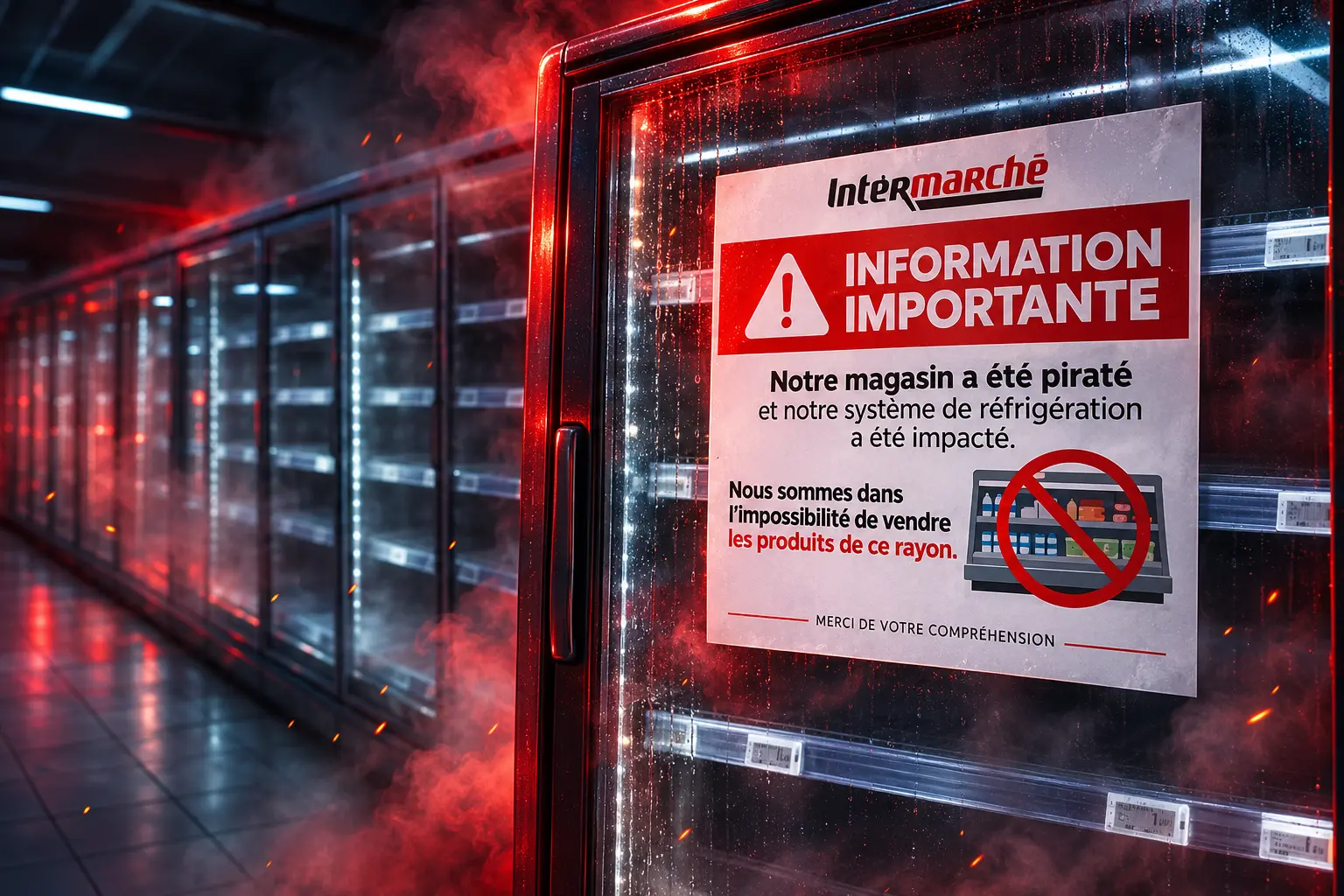
The campaign ran through the night of 11 to 12 October 2026. Controllers that manage whole banks of cases and cold rooms were pushed as high as 50°C (122°F). Food spoiled in piles. Investigators counted at least 15 fires. The foreign ministry put the grocery losses at tens of millions of euros.
Barrot said the work traced to Shahid Kaveh, an offensive cyber unit under the Guard’s Electronic and Cyber Center. Paris prosecutor Laure Beccuau opened a judicial inquiry the same day against the unit’s head, his two deputies, and anyone else identified, and she asked for international arrest warrants. The charges cover organised attacks on data systems and damage dangerous to people, aggravated because they were committed to serve a foreign power, in this case Iran.
Thanks to the remarkable efforts of government agencies, I am able to confirm that the Islamic Republic of Iran’s Revolutionary Guards are responsible for this attack.
Jean-Noël Barrot, Minister for Europe and Foreign Affairs, G7 briefing in Paris
The ministry called the episode the first sabotage-only cyber campaign on French soil, and it said Shahid Kaveh remains a persistent threat to critical systems. Intermarché, E. Leclerc, Carrefour, Monoprix and Coopérative U were among the banners hit. The agencies’ joint writeup also recorded butcher shops, a slaughterhouse and food plants among the more than 700 sites.
France published the charge in public, in French and in English, rather than leaving it inside classified channels.
#Iran | Declaration of attribution to Iran of cyber attacks against France pic.twitter.com/M47TXme0sd
— France Diplomacy 🇫🇷🇪🇺 (@francediplo_EN) November 10, 2026
Iran has not accepted the charge. The French paper pins the October wave. It does not, in the text released on 9 November, pin the later hits on blood-plasma rooms or on grocery fridges in other European countries.
Who Runs Shahid Kaveh in the IRGC
Investigators at the Cyber Crisis Coordination Center, the C4 grouping of ANSSI, the DGSE, the DGSI, the armament directorate and cyber command, said the job matched a known Shahid Kaveh pattern. They cited Farsi artifacts, IP addresses that resolved to devices in Iran, reused tooling and infrastructure, and promotion of the attack on CyberbanNews, an outlet they tie to the unit.
The unit works under several online names, including CyberAveng3rs, Soldiers of Solomon, Mr. Soul and Cyber Isnaad Front. U.S. agencies have already tied CyberAveng3rs to internet-exposed industrial controllers at water utilities, including the Unitronics breach in Aliquippa in 2023 and a July 2026 disruption of more than 30 Minnesota water systems. That history is why a supermarket defrost job did not look, to French services, like random vandalism.
THE NAMES IN THE C4 ANNEX
- Hamid Reza Lashgarian: Head of the IRGC Electronic and Cyber Center, named in the French annex as the senior figure over the cyber center.
- Mahdi Lashgarian: Named as a commander of Shahid Kaveh, the unit France says executed the fridge operation.
- Reza Salarvand: Named as a commander of Shahid Kaveh alongside Mahdi Lashgarian.
Beccuau’s inquiry is aimed at the unit’s head and two deputies, which lines up with that annex. A joint report naming Shahid Kaveh commanders went out the same day as Barrot’s G7 remarks, with photographs in the appendix.
Some readers will treat Farsi strings and Iranian IP addresses as a gift. Those traces can be spoofed, and a judicial opening is not a conviction. The stronger match, in the French file, is the unit’s prior habit of walking into operational-technology gear that still answers on a public address, the same habit that made water-plant panels in the United States a recurring target.
Danfoss Left a Date-Based Admin Login in the Firmware
CERT-FR, in emergency alert CERTFR-2026-ALE-012, named the hardware: Danfoss AK-SM and AK-SC refrigeration supervisors, then Copeland and Dixell XWEB units after a second night of failures. Store contractors use those web panels to fix faults remotely and to pull the temperature logs that food-safety rules demand. That is why so many of them have public IP addresses.
Danfoss told reporters that most of the compromised French gear was old. The AK-SM 800 has been end-of-life since May 2021. The AK-SC 355 left the catalogue in 2016. Neither line gets security updates. Some current AK-SM 800A units were hit as well, and Danfoss said those boxes were running outdated firmware. Copeland, which owns Dixell, said in an email that a flaw had been found in “a discontinued, end-of-life generation of controllers,” and that it was working with customers to stop a repeat.
End-of-Life Models Have No Fix Coming
A store that still runs an AK-SM 800 cannot patch its way out. Containment means taking the management page off the internet, putting any remote access behind a VPN or a short allowlist, and hanging a temperature alarm that does not depend on the same box. CERT-FR’s first instruction was simpler than a firmware chart: remove the controllers from the internet.
Researchers at Pen Test Partners put the same point in plainer words after the French night.
Cyber hygiene would have prevented the access: take the controller off the public internet, put remote access behind a VPN and an IP allowlist, bring third-party kit onto the network in a controlled, owned and documented way rather than leaving it on a contractor’s own connection, change known and default credentials, and patch to a current release.
Pen Test Partners, security researchers, technical note on the French fridge hacks
A Calendar Code Worked as the Admin Password
On the current AK-SM 800A line, the hole had a name. CVE-2025-41450, disclosed in March 2025, let an unauthenticated caller log in as administrator with a code derived from the calendar date, no real password required. CISA’s advisory ICSA-25-140-03 warned that a datetime-based password on AK-SM 8xxA units was exploitable remotely, and that versions prior to R4.2 were affected. Releases 4.3.1 and later also closed two companion flaws, CVE-2025-41451 and CVE-2025-41452. Claroty’s Team82 showed in August 2026 how the date login and a command-injection bug could be chained for remote code execution.
Danfoss has not confirmed the exact first step used in October. Sekoia’s honeypots later saw callers asking boxes for the system date, which is the prelude you would expect if someone intended to mint that daily code, and they also saw password sprays against Supervisor and admin accounts using 12345. Sekoia could not prove the date login was the October key. It could show that the campaign was not sophisticated in the usual sense: the operators changed temperature setpoints, defrost cycles and alarm thresholds. They did not wipe filesystems. Reconnaissance on French devices had started more than a week before the night of 11 October.
Simon Edwards, chief executive of the testing lab SE Labs, asked the question the vendors’ patch notes leave hanging: why were the fridges on the internet at all, and reachable without passwords?
1,825 French StoreView Panels Faced the Open Internet
Censys counted 1,825 StoreView hosts exposed in France on 11 October, the day the first wave hit. That was 61% of the StoreView panels it could see worldwide. Of those French hosts, 1,158 were on firmware below 4.2, the builds in which the admin password can be derived from the date.
DANFOSS STOREVIEW HOSTS IN FRANCE
| Firmware group | 11 October | 14 October |
|---|---|---|
| Below 4.2 (date-based password) | 1,158 | 341 |
| 4.2.4 (two later flaws still open) | 191 | 61 |
| 4.3.1 or later (patched) | 475 | 133 |
| Total French hosts | 1,825 | 537 |
By 14 October the French total had fallen to 537, a 71% drop in three days. Every firmware bucket shrank by about the same share, including the patched group. Operators were not racing to 4.3.1. They were yanking the panels off the public internet, which is the move CERT-FR wanted, because a patched supervisor still has no business answering on a raw address.
That drop is the part a sanctions list cannot do. Shahid Kaveh, on the French account, walked through a door that grocery contractors had left open for remote maintenance. Sekoia, watching Censys, saw more than 2,700 Danfoss systems exposed worldwide on 11 October. By 4 p.m. on 12 October, about half of the previously exposed French systems were no longer reachable. Closed-source reporting to Sekoia indicated the boxes had not been bricked; their setpoints had been changed, and victims were taking them offline.
The Same Defrost Command Hit Blood Plasma Rooms
A second wave arrived on the night of 1 to 2 November. Sekoia recorded the same modus operandi, food spoilage and interrupted trade, across about a dozen European countries, including Belgium, the Netherlands, Germany and Sweden. French officials have listed losses in Belgium, Luxembourg, the Netherlands, Finland, Ireland and Sweden. France has not, in the 9 November file, attributed that wave to Shahid Kaveh.
The same night, cold rooms used by the Établissement Français du Sang were retargeted through a contractor. The EFS said on 3 November that a refrigeration provider’s supervision systems at three sites had their temperature and defrost thresholds raised to very high levels on 2 November. Alarms reached on-call staff in time. Plasma bags for transfusions and for medicines were moved or secured. No blood products were lost, and the EFS said it found no health impact. Frédéric Pacoud, the EFS president, said the service could have lost samples or plasma bags meant for patients if the warning had come later.
Coolworld, the Dutch temperature-control firm named as the supplier at those sites, said it was aware of an incident in remote monitoring software and that the flaw being discussed “relates to a component from a third-party supplier and was outside Coolworld’s direct control.”
THE COLD-CHAIN ATTACK CALENDAR
- 11 to 12 October 2026: Attackers force defrost cycles on refrigeration controllers at more than 700 French supermarket and food-retail sites.
- 12 to 13 October 2026: A second night hits stores on Dixell and Copeland XWEB gear, and CERT-FR widens its alert beyond Danfoss.
- 1 to 2 November 2026: A second grocery wave lands in several European countries, and EFS plasma rooms at three sites have their thresholds raised before staff isolate them.
- 5 November 2026: CISA, the FBI, HHS, USDA and DOT publish a joint warning on industrial refrigeration and cold-chain monitors.
- 9 November 2026: France attributes the October wave to Shahid Kaveh and asks for arrest warrants.
- 10 November 2026: The Iranian ambassador is summoned in Paris.
WHAT WE KNOW
- October in France: Paris has named Shahid Kaveh, published indicators, and opened a criminal case against the unit’s leadership.
- The hardware path: CERT-FR named Danfoss AK-SM and AK-SC supervisors and Copeland and Dixell XWEB units, and it told owners to take management interfaces off the internet.
- EFS outcome: Three blood-service sites were affected through a contractor on 2 November, and no products were lost.
WHAT IS UNCONFIRMED
- The November grocery wave: France’s attribution paper covers the October French campaign, not the later hits in other European countries.
- The blood-bank contractor: EFS and Coolworld have not publicly tied that incident to Shahid Kaveh.
- The exact October login: Danfoss has not confirmed whether the date-based admin code was the key that night.
Pro-Russian personas including NoName057(16) and Z-Pentest tried to claim the fridge job. Sekoia called that claim unsubstantiated, noting NoName’s record of empty boasts and a dump that looked like stolen-password logs rather than a controller breach. The Kremlin denied a role on 5 November. France’s filing points the other way, at least for October.
Five U.S. Agencies Told Operators to Pull Controllers Offline
On 5 November, before Paris named Iran, five U.S. agencies told operators in health, food, chemicals and transport to treat industrial refrigeration and cold-chain monitors as an active target. CISA, the FBI, HHS, USDA and the Department of Transportation issued a joint fact sheet on industrial refrigeration that describes actors changing temperatures and forcing continuous heating and defrost cycles, with inventory loss and fire risk as the physical result.
Every organization that depends on refrigeration and monitoring systems should assume it could be a target. We urge you to review the joint fact sheet and take action now to close known security gaps.
Chris Butera, CISA Acting Executive Assistant Director for Cybersecurity, 5 November 2026 statement
Brett Leatherman, who leads FBI cyber, said in the agencies’ video that attackers were getting in through controllers that were unpatched, reachable from the internet, or still using default passwords from the manual, and he cited the French blood-service attempt as the example that alarms can still save the stock if they actually ring.
Malicious cyber actors are targeting industrial refrigeration & cold chain monitoring systems. Our joint Fact Sheet with federal partners outlines key steps orgs can take to reduce risks to inventory, equipment, and operations. Read more 👉 https://t.co/K5HofsazmU pic.twitter.com/Det07rTWsz
— Cybersecurity and Infrastructure Security Agency (@CISAgov) November 5, 2026
HOW U.S. AGENCIES SAY TO HARDEN THE BOXES
- Public addresses: Take controller panels off the internet, and if remote access is still required, put it behind a firewall or edge device that is kept current.
- Logins: Change default passwords and stop using the codes printed in the manufacturer’s manual.
- Firmware: Apply vendor patches and keep the running build current where a patch still exists.
- Old iron: Identify, retire and replace legacy devices the vendor no longer supports, the category that includes the AK-SM 800 and AK-SC 355.
That list is a facilities brief, not a diplomatic one. It applies to a U.S. grocery warehouse and to a French Super U in the same sentence, because the product families are the same. Gérôme Billois, a partner at Wavestone, noted that Shahid Kaveh has been active since 2020 and is known for jobs against water systems in the United States. The French fridge night is that playbook moved onto food.
Barrot Summons Iran’s Ambassador and Keeps Cyber Options Open
On 10 November the foreign ministry said the Iranian ambassador had been summoned that morning. Barrot, speaking on France Info, said France would push EU sanctions over an attack of unprecedented scale and aggression, and he left room for steps that would not be announced. He said France would take whatever measures were necessary, including some it would not discuss publicly, if they were judged proportionate and needed to deter new attacks and to punish those responsible. He also said cyber-defence doctrine gave Paris a range of options, which is as close as a foreign minister comes to saying a silent response is on the table.
EU High Representative Kaja Kallas, asked at the G7 in Paris, said ministers could take the file at the Foreign Affairs Council on 16 November. “Cyber incidents that are happening in Europe, if they are attributed, our response should be strong,” she said. That meeting is the first formal slot for the listings France wants against Iranian entities and individuals tied to the fridge operation and to other malicious cyber activity.
Paris has a recent template. The EU adopted sanctions in March 2026 against Emennet Pasargad, a private Iranian firm France ties to earlier destabilisation work, including the 2023 Charlie Hebdo intrusion and activity around the 2024 Paris Olympics. Barrot’s new proposal is meant to sit on top of that list, not replace it. Travel bans and asset freezes are the tools he named for people held responsible.
None of that closes an AK-SM 800. Censys still saw 537 French StoreView hosts on the internet on 14 October, after the fires, after CERT-FR’s alert, after chains had thrown out meat and ice cream. The patched share shrank as fast as the unpatched share, which is evidence that the useful control was a firewall rule, not a firmware file. Sanctions can name Reza Salarvand. They cannot reach a contractor VPN that was never turned on.

ADNOC Ship Hit in Hormuz Leaves One Crew Missing

SpiceJet’s Rs 5,500 Crore Plan Follows a Rescue That Failed

Hasina’s Return Fight Sets Fire to Yunus’s Bank

Bancroft Recants the 2018 Inquiry and Names the Team

Adhikari Ties the Saffron Saree Row to School Licences

Clancy Juror Says the Holdout Never Cited Evidence

The iPhone 18 Pro Max Splits Apple’s Fall in Two

OpenAI Calls GPT-6 Astra AGI Then Locks Its Exploits

Trump Claims Hormuz Control as Oil Holds Near $96

Russia Closes the Goethe-Institut Berlin Tried to Save

 NEWS2 months ago
Clancy Juror Says the Holdout Never Cited Evidence
- NEWS3 months ago
The iPhone 18 Pro Max Splits Apple’s Fall in Two
- NEWS3 months ago
OpenAI Calls GPT-6 Astra AGI Then Locks Its Exploits
- BUSINESS3 months ago
Trump Claims Hormuz Control as Oil Holds Near $96
- LIFESTYLE3 months ago
Russia Closes the Goethe-Institut Berlin Tried to Save
- AUTO3 months ago
Volkswagen’s Job Cuts Leave Four Plants Without Cars
- NEWS3 months ago
Dyson Puts Nurovi Robots on Sale Without the UV Flagship
- BUSINESS2 months ago
US Destroys Five Iranian Tankers as the Shock Hits Jordan










