
NEWS
Democrats Flip the House and Still Lack a Veto Override
Democrats flipped the House in the 2026 midterms with 253 seats, a 41-seat wave that still cannot override a Trump veto.

Democrats held 253 called House seats as of November 5, a 41-seat gain that flips Congress and still leaves them 37 votes short of a veto override. Republicans held 157, with 410 of 435 races called after the November 3 midterm elections. The party already has the 218 seats that control the chamber.
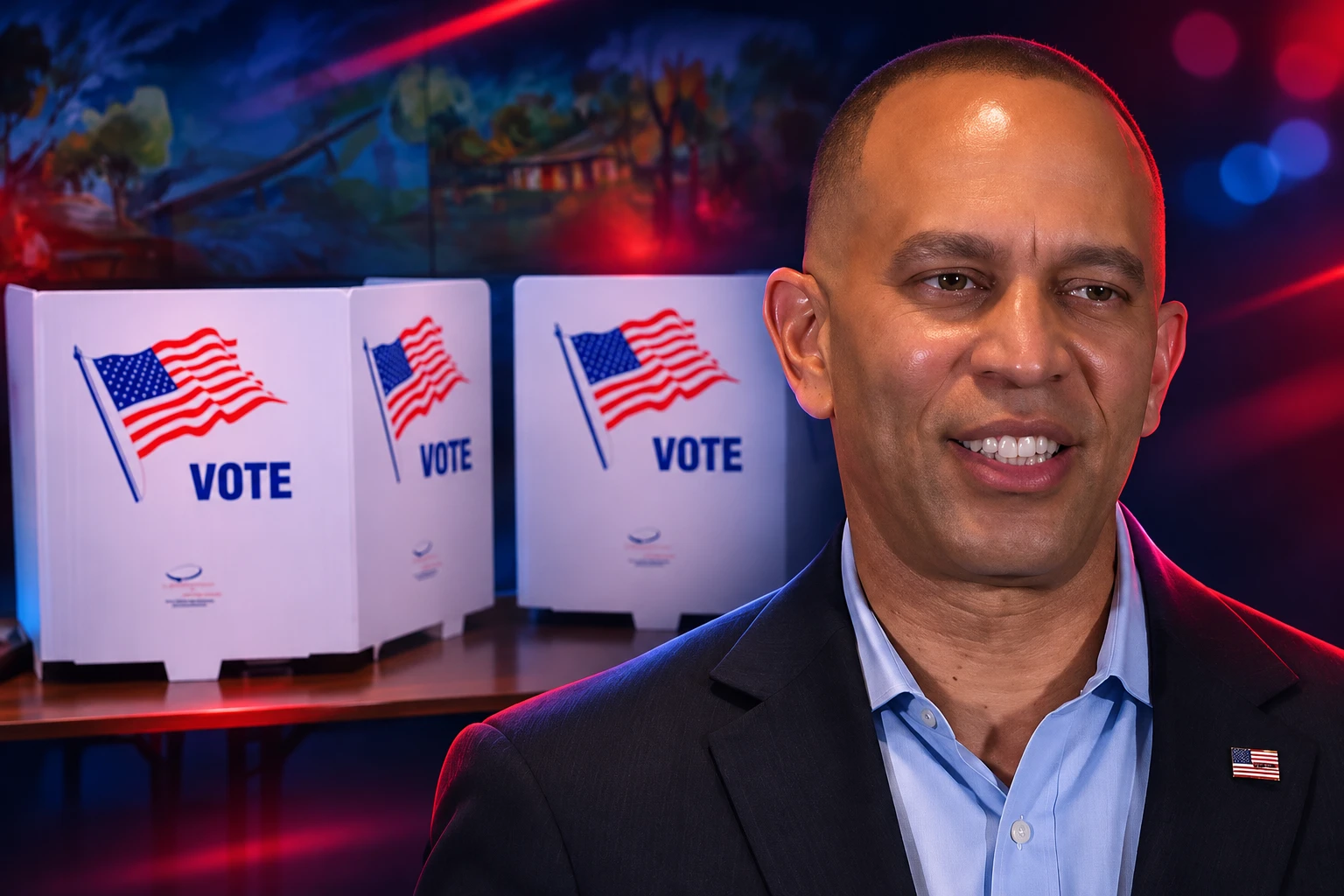
House Democratic leader Hakeem Jeffries, in line to become the first Black speaker when the new Congress meets in January 2027, told reporters his caucus will win at least 255 seats once every vote is tallied. That projection and the called board are different counts. Neither one reaches the 290 House votes that, with a full chamber, override a president.
Democrats Hold 253 Called Seats, With 25 Races Open
The November 5 board is large enough to organize the House, elect a speaker, and hand every committee gavel to Democrats. It is not a finished map. Twenty-five races remained uncalled, most of them in seats Republicans had held.
THE HOUSE MATH AS OF NOVEMBER 5
| Measure | Seats |
|---|---|
| Seats needed to organize the House | 218 |
| Called Democratic seats | 253 |
| Called Republican seats | 157 |
| Races still uncalled | 25 |
| Two-thirds veto override, full House | 290 |
| Democratic total after the 1974 elections | 291 |
Jeffries’s 255 figure, if it holds, would still sit 35 votes under 290. The remaining contests can widen the majority. They cannot, on any realistic remaining map, create an override.
Ballotpedia’s pre-election tracker had Democrats defending 22 districts Donald Trump carried in 2024 and Republicans defending eight that Kamala Harris carried. The called flips cut through both of those lists and through seats the national parties had treated as safe. Montana’s 1st went to Democrat Sam Forstag. Arizona’s 1st went to Amish Shah. In Pennsylvania’s 1st, Bob Harvie beat Republican incumbent Brian Fitzpatrick.
The Watergate House Had a Veto-Proof Majority
The 1974 comparison that attached itself to this result is a mood, not a seat count. After Watergate and Richard Nixon’s resignation, voters did not flip the House to Democrats. They expanded a majority the party already held, and they expanded it past two-thirds.
The House historian’s profile of the 94th Congress records 291 Democrats and 144 Republicans on election day. The 93rd Congress had sat at 242 Democrats, 192 Republicans, and one independent. That is a Democratic gain of 49 seats and a Republican loss of 48, and it put the House one seat over the 290 that can beat a veto.
Brookings Institution Vital Statistics on Congress show the president’s party lost 48 House seats in 1974. That is the Watergate wipeout. It is not the board Democrats hold now.
MIDTERM HOUSE SHOCKS, PRESIDENT’S PARTY
| Election | President’s party | House change | Chamber after |
|---|---|---|---|
| 1974 | Republican | -48 | Democrats held and expanded |
| 1994 | Democratic | -54 | Republicans took the House |
| 2010 | Democratic | -63 | Republicans took the House |
| 2018 | Republican | -41 | Democrats took the House |
| 2026 (called, Nov. 5) | Republican | -41 | Democrats took the House |
On net seats, 2026 is tracking Trump’s first midterm, not Ford’s. Democrats took the House in 2018 by 41 seats and lost ground in the Senate. This time they took both chambers. That is the break with 2018. It is still not 1974.
Why a 41-Seat Wave Still Cannot Override Trump
A House majority writes bills and runs hearings. A two-thirds majority writes laws over a veto. Democrats have the first. They are 37 called seats short of the second, and the Senate math is harsher still.
With every member voting, an override takes 290 in the House and 67 in the Senate. Democrats hold 54 Senate seats, including two independents who caucus with them, with Alaska and Mississippi uncalled. That is 13 votes short of 67 and 6 short of the 60 that break a filibuster. Philip Wallach, a senior fellow at the American Enterprise Institute, said Democrats might still peel off Republicans on selected bills. They cannot do it as a party vote.
WHAT THE NEW MAJORITY CAN AND CANNOT DO
- Pass House bills: A simple majority can move legislation to the Senate and force Trump to use the veto in public.
- Run oversight: Committee chairs can issue subpoenas covering the Iran war, federal firings, and Justice Department decisions.
- Block nominees: Senate control lets Democrats stop judges, cabinet officers, and any Supreme Court vacancy for the rest of the term.
- Override a veto: They need 37 more House votes than the 253 already called, plus 13 more senators than 54.
- Break a filibuster: Fifty-four votes do not get to 60. Most major bills still need Republican signatures or a rule change.
- Remove a president: The House can impeach on 218. Conviction still takes two-thirds of the Senate.
Trump has already pointed to the veto and said Democrats will want to work with him. Jeffries has said the public does not want payback. Those two sentences can both be true and still produce two years of bills that die on a desk.
Larger modern waves did change control, and they still did not look like 1974’s veto-proof House. Republicans took 63 House seats in the 2010 wave and 54 in 1994. Those majorities could harass a Democratic president. They could not write his laws for him.
Republicans Lost Ground in 99 Percent of Counted Counties
The House board is the thing that changes Washington. The county canvass is the thing that explains how seats this far from the old battleground list moved.
THE COUNTY CANVASS BY NOVEMBER 4
- 99 percent: Republicans lost ground in 99 percent of roughly 2,200 counties where most ballots were in.
- 8 points: Across those counties, the Republican share of the vote fell 8 points compared with Trump’s 2024 showing.
- 14 points: In 64 majority-Hispanic counties with Senate contests, the Republican share was 14 points below Trump’s 2024 mark.
- 11-point floor: As of November 4, Republicans had not yet won a House seat in a district Trump carried by less than 11 points in 2024.
That last figure is why incumbents who spent the cycle treating their seats as safe ended up on concession calls. The 2024 coalition did not hold as a floor under Republican members. It receded in rich counties and poor ones, in cities and in suburbs, and in counties that had moved toward Trump two years earlier.
Kansas elected a Democratic senator for the first time in 94 years. In Texas, James Talarico beat Ken Paxton, Trump’s preferred candidate, and became the state’s first Democratic senator-elect in 38 years. Those are statewide races, but they sit on the same shift as the House map: the 2024 numbers were not a new normal. They were a high-water mark the party could not defend 24 months later.
North Carolina’s New Map Cost Republicans Five Seats
Nine states used different congressional lines than in 2024. California, Florida, North Carolina, Tennessee, and Texas redrew mid-decade on purpose. Ohio changed maps under state law. Alabama, Louisiana, and Utah changed them because of court fights.
The Republican project was to thicken a thin majority. Trump pushed Texas, Florida, and North Carolina to squeeze more red seats out of the same voters. California Democrats answered with a map aimed at five Republican incumbents, and a Utah court order created a Democratic-leaning Salt Lake City seat.
As of November 5, Democrats had won or were leading in 12 of the 15 Democratic-held seats Republicans had redrawn to make more conservative. In California they were on track to take all five of the Republican seats they had targeted. In Texas, Republicans had hoped to pick up five seats and instead flipped the 32nd, where Jace Yarbrough beat Dan Barrios, while Democrats held four of the five targets and took the 23rd and the 15th besides.
North Carolina was the clearest own-goal. Republicans redrew the map, the state’s sixth in seven cycles, to put Don Davis in a district Trump would have carried by about 12 points. Davis won. Democrats flipped five Republican-held North Carolina seats, including the one held by Richard Hudson, who had chaired the National Republican Congressional Committee. Stretching one seat meant thinning the ones next to it, and a wave does its damage in the thinned seats.
Senate Control Gives Democrats a Confirmation Blockade
The House story is a majority that cannot finish a law without Trump. The Senate story is a majority that can stop him from staffing the rest of his term.
Democrats have 54 seats, counting the two independents, after taking at least seven Republican-held seats. Iowa, Kansas, Maine, North Carolina, Ohio, South Carolina, and Texas are the called flips. Alaska and Mississippi were still uncalled on November 5. Republicans entered the night at 53-47 and have 44 called seats, with those two races outstanding.
Chuck Schumer is in line to be majority leader. That gavel decides which nominees get a hearing. Ambassadors, assistant secretaries, and federal judges all need 54 votes they may not have. A Supreme Court vacancy in 2027 or 2028 would land in a Democratic Senate, not a Republican one. Trump keeps the veto. He does not keep an open run at the courts.
Jeffries has already listed the bills he wants on the floor in the first stretch of the new Congress: reverse Medicaid cuts enacted on July 4, 2025, extend Affordable Care Act tax credits, wind down the Iran war, and roll back tariffs. Each of those can pass the House on 253 votes. Each of them can die by veto, or die at 60 in the Senate, unless some Republicans sign on.
Jeffries Is Lined Up for Speaker With Holdouts Already Listed
The speakership is the first vote the new majority will take, and it is the first place the size of the win cuts both ways. A caucus in the 250s can lose a handful of members on a speaker ballot and still elect one. It also contains the progressives who won primaries against the party and the suburban moderates who won Trump districts, and both groups think the night belongs to them.
Mike Johnson was correct. The polls were wrong. It wasn’t simply a blue wave. It was an American tsunami. House Democrats have decisively taken back control of the Congress. We will win at least 255 seats, if not more, once every vote has been tallied.
Hakeem Jeffries, House Democratic leader, news conference, November 4, 2026
Jeffries also said the country chose the economy over extremism and that voters do not want the party to get even. “We ran on affordability. We won on affordability. And now it’s our job to govern on affordability.” Rep. Greg Stanton of Arizona, a leader of the New Democrat Coalition, said the scale of the majority lets Jeffries govern without being leveraged by anyone.
That is the centrist reading of 253 seats. It is not a unanimous one. Some newly elected progressives have not committed to vote for him, including Representative-elect Darializa Avila Chevalier of New York. The incoming class will meet behind closed doors later in November to name a speaker candidate. Nobody else is running a public campaign for the job. The holdouts do not have to beat him. They only have to make the opening ballot look like a negotiation.
FROM ELECTION NIGHT TO THE GAVEL
- November 3, 2026: Voters flip the House and Senate in the midterm election.
- November 4, 2026: Jeffries calls the result an American tsunami and projects at least 255 House seats.
- November 5, 2026: Called tallies show Democrats 253, Republicans 157, with 25 House races and two Senate races open.
- Later November 2026: Newly elected House Democrats meet in private to choose a speaker candidate.
- January 2027: The new Congress convenes, holds the speaker election, and Jeffries, if elected, becomes first in the House and second in the presidential line after Vice President JD Vance.
The 25 uncalled House races will move the margin by the time that January vote is held. They will not move it onto the 1974 side of 290. Democrats take the gavels, the subpoenas, and the nomination calendar into Trump’s last two years with a majority that can investigate him and cannot, on its own, override him.

ADNOC Ship Hit in Hormuz Leaves One Crew Missing

SpiceJet’s Rs 5,500 Crore Plan Follows a Rescue That Failed

Hasina’s Return Fight Sets Fire to Yunus’s Bank

Bancroft Recants the 2018 Inquiry and Names the Team

Adhikari Ties the Saffron Saree Row to School Licences

Clancy Juror Says the Holdout Never Cited Evidence

The iPhone 18 Pro Max Splits Apple’s Fall in Two

OpenAI Calls GPT-6 Astra AGI Then Locks Its Exploits

Trump Claims Hormuz Control as Oil Holds Near $96

Russia Closes the Goethe-Institut Berlin Tried to Save

 NEWS2 months ago
Clancy Juror Says the Holdout Never Cited Evidence
- NEWS3 months ago
The iPhone 18 Pro Max Splits Apple’s Fall in Two
- NEWS3 months ago
OpenAI Calls GPT-6 Astra AGI Then Locks Its Exploits
- BUSINESS3 months ago
Trump Claims Hormuz Control as Oil Holds Near $96
- LIFESTYLE3 months ago
Russia Closes the Goethe-Institut Berlin Tried to Save
- AUTO3 months ago
Volkswagen’s Job Cuts Leave Four Plants Without Cars
- NEWS3 months ago
Dyson Puts Nurovi Robots on Sale Without the UV Flagship
- BUSINESS2 months ago
US Destroys Five Iranian Tankers as the Shock Hits Jordan










