
BUSINESS
Apple’s 10-K Hands Memory Suppliers the AI Bill
Evercore kept a $380 Apple target after the 10-K showed $89.7 billion of factory orders, a memory pre-buy that pays NAND vendors before Siri AI revenue shows up.

Evercore ISI kept its Outperform rating and $380 target on Apple after the fiscal 2026 10-K showed $89.7 billion of manufacturing purchase orders. Shares in the Nov. 4 note were $331.90, which puts that target 14.5% higher. Chief executive John Ternus had already told analysts on Nov. 2 that $33 billion of the jump landed in one quarter.
The cash is earmarked for parts. NAND and DRAM vendors will collect first, and a slice of each iPhone, Mac, and iPad sale now sits in deferred revenue because Siri AI joined the bundled services Apple recognizes later.
Apple Locked $89.7 Billion of Factory Orders
Apple filed the annual report on Nov. 3 for the year ended Sept. 26, 2026. The commitments note lists manufacturing purchase obligations of $89.7 billion, with $82.7 billion payable within 12 months. That is 92.2% of the total. The remaining $7.0 billion falls after that window.
The June 10-Q had put manufacturing orders at $57.0 billion, almost all of it ($56.2 billion) due inside a year. The filing math is a $32.7 billion sequential rise. Ternus rounded the same move to $33 billion on the call and said the figure would appear in the annual report the next day.
PURCHASE OBLIGATIONS AT YEAR-END
| Item | June 27, 2026 | Sept. 26, 2026 |
|---|---|---|
| Manufacturing purchase obligations | $57.0 billion | $89.7 billion |
| Payable within 12 months | $56.2 billion | $82.7 billion |
| Payable after 12 months | $0.8 billion | $7.0 billion |
Other purchase obligations, which the 10-K says cover supplier arrangements, licensed content, intellectual property, distribution rights, and capital assets, were $27.3 billion, with $9.9 billion due within 12 months. Stacked with the factory orders, the two lines total $117.0 billion, against $71.0 billion a year earlier, a 65% rise. The portion payable after 12 months, $24.4 billion versus $8.6 billion, grew faster than the near-term stack.
The same week’s earnings release posted September quarter revenue of $114.5 billion, up 12% from a year earlier, with diluted earnings per share of $2.10. iPhone sales were $57.6 billion, up 17.5%. Mac sales were $10.8 billion, up 23.7%. Gross margin was 47.9%, including about 1 percentage point from tariff refunds. Fiscal 2026 sales were $479 billion, and net income was $132.2 billion. The factory-order line is the tell the income statement does not carry.
Memory Suppliers Get Paid First
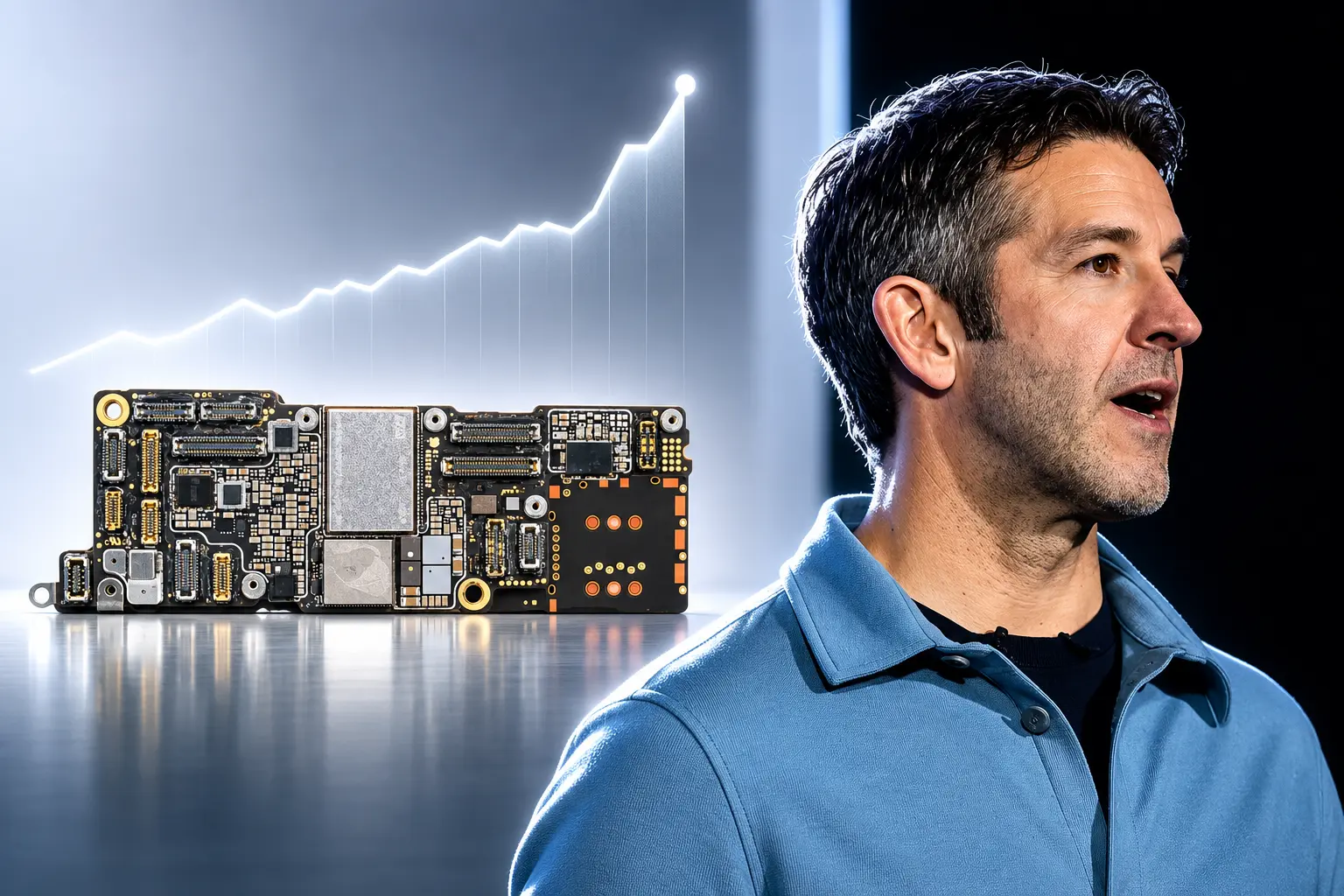
Evercore’s note assumed a large share of the sequential order jump was memory, especially NAND. Ternus did not split the $33 billion by part. He did say memory cost more in September than in June, will cost more again in the December quarter, and will keep climbing after that. Chief financial officer Kevan Parekh said that once tariff refunds are stripped out of both quarters, the one-point sequential drop in gross margin was driven entirely by memory.
What we’re seeing with memory pricing right now is unprecedented.
John Ternus, CEO, Apple Q4 fiscal 2026 earnings call
That line is a transfer of pricing power. Apple spent years as the buyer that could demand most-favored-customer terms, audit a vendor’s books, and refuse a delivery when spot prices were falling. Those habits left suppliers holding custom chips. When AI data-center buyers began paying more, the next wafers went there. SK hynix has said long-term agreements already cover more than 50% of its 2027 and 2028 output, with prices reset inside agreed bands. Samsung, Micron, and Kioxia sit on the other side of the same bid.
THE MEMORY BILL INSIDE THE IPHONE
- Contract prices: TrendForce expects conventional DRAM contracts to rise 10% to 15% in the fourth quarter and NAND flash to rise 15% to 20%.
- Phone bill of materials: Memory’s share of a 256GB iPhone Pro rose from about 10% a year earlier to 34% of the iPhone Pro bill in the third quarter of 2026, and TrendForce says it could exceed 40% in the first half of 2027.
- Whole-phone cost: The same house puts the iPhone 18 Pro’s total bill of materials up 38% year over year.
- Flash spend: TechInsights estimates Apple will spend about $25 billion on flash storage in 2026, against $6 billion in 2025, on roughly the same volume.
COO Sabih Khan joined the call to talk supply. Executives said Mac and iPad production will be tight from the next quarter, mainly because of memory, not because demand vanished. Apple has already lifted Mac, iPad, and iPhone prices to claw some of that back. The 10-K still warns that supply constraints and rising costs for advanced semiconductors, memory, and storage are expected to intensify.
How Siri AI Changes iPhone Revenue
The revenue note is the other place the AI cycle shows up in cash timing. Apple has long split an iPhone, Mac, or iPad sale into hardware delivered at shipment and a bundle of product-related services taken over time. The 10-K now names that second obligation as the right to receive iCloud, Siri and Siri AI, and Maps. Because Apple lacks observable stand-alone prices for the bundle, it allocates a portion of the selling price using estimated stand-alone selling prices, then defers that slice and recognizes it straight-line over the period the services are expected to be provided.
Deferred revenue rose 8% to $14.8 billion from $13.7 billion. The current portion was $9.636 billion, against $9.055 billion. Of fiscal 2026 sales, $8.717 billion had been sitting in the opening deferred-revenue balance, versus $8.229 billion the year before. Siri AI launched in beta for U.S. English users in September and added French, Japanese, Korean, Portuguese, and Spanish in October. Ternus called it “a completely reimagined assistant that is powerful, personal, private and deeply relevant to our users’ daily lives.”
The accounting choice matters more than the slogan. A larger deferred slice makes reported hardware look a little lighter in the quarter a phone ships and a little stickier in Services later. Parekh already said that once a customer owns a device, an on-device AI task costs Apple very little extra, while a request that hits a server shows up as a Services cost. Ternus said Siri already handles more than 2.5 billion requests a day, and that customers who blow past daily limits on server-side features will be able to buy more capacity. He did not give a price, an allowance, or a date. The 10-K still treats the in-box assistant as a bundled performance obligation, not as that extra paid SKU.
Component Inventory Nearly Quintupled in a Year
The balance sheet is where the pre-buy is already sitting. Year-end inventories of $14.541 billion compare with $5.718 billion a year earlier, a 154% rise. Almost all of the build is parts.
INVENTORY AT SEPT. 26
- Components: $10.447 billion, against $2.124 billion a year earlier, 4.9 times, or 392% higher.
- Finished goods: $4.094 billion, against $3.594 billion.
- Payables: Accounts payable were $82.252 billion, against $69.860 billion, so vendors are funding a slice of the stack.
- Cash cost: Inventory soaked up $8.9 billion of operating cash flow in fiscal 2026, after $1.4 billion the year before.
Evercore read the sequential move as about $3.4 billion of extra total inventory in the September quarter, with components up about $2.8 billion, or 37%, from June. Ternus said Apple still expects some benefit in December from cheaper chips bought earlier, and a decreasing benefit after that as that carry-in rolls off. Greater China revenue in the quarter was $17.5 billion, up 21%, and $82.4 billion for the year, up 28%. Evercore’s own cut of September-quarter EBIT margins had China down about 400 basis points year over year to 39.6% even with that sales growth, and the Americas up about 310 basis points to 43.1%. Volume came back. The parts bill came with it.
Evercore Holds $380 Against a Split Street
Amit Daryanani, Evercore ISI’s hardware analyst, is not treating the parts bill as a reason to step off. He had already lifted the target to $380 from $365 on Sept. 18 after a U.S. consumer survey of about 4,000 people pointed to a richer iPhone mix, including a preference for higher-memory configurations and a potential ASP rise of more than 20%. The 10-K note keeps that target and flags healthy demand, the NAND-heavy order book, and the Siri AI deferral as the new evidence.
ANALYST TARGETS AFTER THE 10-K
| Firm | Stance | Target |
|---|---|---|
| Evercore ISI | Outperform, reiterated Nov. 4 | $380 |
| JPMorgan | Cut on Services growth and gross-margin pressure | $355 |
| Wedbush | Outperform; cites 7% to 10% December sales growth | Not restated in the note |
| DA Davidson | Raised on iPhone upgrades and Mac, cool on Services | $295 |
| Aletheia Capital | Sell; flags fiscal 2027 as profitless growth | Sell, no buy target |
The spread is the argument. Daryanani is underwriting mix, price, and a holiday hardware load that the $89.7 billion of orders is meant to feed. JPMorgan and Aletheia are underwriting the other side of the same 10-K: memory inflation, a Services line that grew 9.8% in the quarter to $31.6 billion, and a year in which R&D already jumped to $45.8 billion from $34.6 billion. DA Davidson’s $295 target can sit next to a raised number and still imply the stock, at $331.90, is paying for a cycle the parts market has already billed.
Carry-In Memory Will Not Offset the Next Rise
Apple guided December-quarter gross margin to 45% to 46%, down from 47.9%, and pointed to higher memory costs plus the Siri AI ramp. Sales guidance for that quarter is 7% to 10% growth year over year, the softest of the last five calls. Parekh said most of the tariff refunds are in, so that 1-point prop does not ride into the holiday print. Operating cash flow in the September quarter was $28 billion, and Apple returned $28 billion to shareholders, including a $0.27 quarterly dividend payable Nov. 16 to holders of record on Nov. 12.
The 10-K also widened the AI risk language. Demand for cloud compute and storage has tightened supply, stretched lead times, and lifted costs, and Apple says it relies on third-party cloud providers on top of its own data centers. Investment in data-center capacity, the filing says, involves long-term commitments for components and equipment that raise capital spending, liabilities, and obligations. Licensed intangible assets net of amortization rose to $20.943 billion from $9.179 billion. The note does not name the licenses.
Ternus said the company still expects “even higher memory costs” in December, “partly offset” by the June Mac and iPad price increases, the September iPhone increases, leftover cheap inventory, and lower costs on some non-memory parts. Looking past December, “we see the pricing for memory purchases continuing to increase.” The 10-K’s supply note is blunter: the company expects those trends to intensify for memory and storage. Evercore can keep $380 on the back of that order book. The first cash from it is already spoken for on a supplier’s invoice.
Frequently Asked Questions
How does Apple recognize Siri AI revenue on iPhone sales?
Apple treats Siri AI as part of the second material performance obligation on iPhone, Mac, and iPad sales, alongside iCloud and Maps, and defers the allocated amount on a straight-line basis. Of the $14.8 billion deferred-revenue balance at Sept. 26, 2026, the company expects 65% to be realized in less than a year, 22% within one to two years, 11% within two to three years, and 2% after three years.
What longer-dated purchase commitments did the 10-K add?
A separate schedule of unconditional purchase obligations with more than a year to run totaled $24.844 billion at year-end, against $13.308 billion a year earlier, and lists $6.712 billion due in fiscal 2027. Those contracts sit on top of the $89.7 billion manufacturing line and are described as supplier arrangements, distribution rights, and licensed intellectual property and content.
How much did Apple spend on research and development in fiscal 2026?
Research and development expense was $45.8 billion, up from $34.6 billion in fiscal 2025. In the September quarter alone it was $11.730 billion, against $8.866 billion a year earlier, a rise that landed in the same period as the Siri AI ramp and the wider AI risk language in the 10-K.
When did Evercore ISI first take the Apple target to $380?
Daryanani raised the target to $380 from $365 on Sept. 18, 2026, after Evercore’s U.S. survey of about 4,000 consumers pointed to a stronger iPhone refresh, a tilt toward Pro and Pro Max, and pricing that could rise more than 20% on mix and higher-memory configurations. The Nov. 4 note after the 10-K left that $380 figure unchanged.
Disclaimer: This article is news reporting and analysis of Apple’s fiscal 2026 filings, its Nov. 2 earnings call, and a subsequent analyst note. It is informational only and is not investment advice, a recommendation to buy or sell Apple shares or any other security, or a forecast of future returns. Readers should consult a licensed financial adviser or other qualified investment professional who can consider their own objectives, risk tolerance, and tax situation before acting. Ratings, price targets, inventory figures, purchase obligations, and margin guides reflect the cited filings and notes as published and can change with later results, guidance, or research.

ADNOC Ship Hit in Hormuz Leaves One Crew Missing

SpiceJet’s Rs 5,500 Crore Plan Follows a Rescue That Failed

Hasina’s Return Fight Sets Fire to Yunus’s Bank

Bancroft Recants the 2018 Inquiry and Names the Team

Adhikari Ties the Saffron Saree Row to School Licences

Clancy Juror Says the Holdout Never Cited Evidence

The iPhone 18 Pro Max Splits Apple’s Fall in Two

OpenAI Calls GPT-6 Astra AGI Then Locks Its Exploits

Trump Claims Hormuz Control as Oil Holds Near $96

Russia Closes the Goethe-Institut Berlin Tried to Save

 NEWS2 months ago
Clancy Juror Says the Holdout Never Cited Evidence
- NEWS3 months ago
The iPhone 18 Pro Max Splits Apple’s Fall in Two
- NEWS3 months ago
OpenAI Calls GPT-6 Astra AGI Then Locks Its Exploits
- BUSINESS3 months ago
Trump Claims Hormuz Control as Oil Holds Near $96
- LIFESTYLE3 months ago
Russia Closes the Goethe-Institut Berlin Tried to Save
- AUTO3 months ago
Volkswagen’s Job Cuts Leave Four Plants Without Cars
- NEWS3 months ago
Dyson Puts Nurovi Robots on Sale Without the UV Flagship
- BUSINESS2 months ago
US Destroys Five Iranian Tankers as the Shock Hits Jordan










