
BUSINESS
Indian Navy Cut Off a Pirate Mothership Run Off Somalia
India boxed the hijacked dhow Azini for more than 48 hours after it ran toward a shipping lane, then freed 20 Iranian crew before it could hunt merchants.

The Indian Navy freed all 20 crew of the Iranian fishing vessel Azini on November 2 after boxing the dhow more than 48 hours off Somalia. Defence Minister Rajnath Singh put the scene more than 3,000 km from Mumbai. The dhow had already been steered toward a merchant traffic lane, which is why the Navy treated it as a launch pad, not only as a hostage boat.
A mission-deployed warship, a maritime reconnaissance aircraft, Marine Commandos, and an Indian Air Force C-17 did the work. No crew member was hurt. The Ministry of Defence reported the safe rescue of all 20 crew members and said the pirates had been overcome. It did not say how many were seized, or where they went.
Azini Had Already Closed on a Shipping Lane
The Maritime Security Centre, Indian Ocean, which supports the European Union’s Operation ATALANTA, logged the hijack as Alert 161/26. Armed pirates took the Iranian dhow at about 09:00 UTC on October 29, 2026, off northeastern Somalia. Crew safety was then unknown.
By 04:00 UTC on October 30 the first printed fix sat at 09°42’N 053°55’E, about 185 nautical miles east of Bandar Bayla. A later fix put Azini at 09°47’N 055°45’E, about 110 nautical miles farther east and closing on the maritime traffic lane. That is a day’s steam from a fishing ground toward the routes that run east and south of Socotra.
THE AZINI TRACK
- October 29, 2026, about 09:00 UTC: Armed pirates hijack Azini off northeastern Somalia.
- October 30, 2026, 04:00 UTC: First published fix at 09°42’N 053°55’E, about 185 nautical miles east of Bandar Bayla.
- October 31, 2026: MSCIO issues Alert 161/26 and warns the dhow could be used as a mothership.
- Update 01: Latest fix 09°47’N 055°45’E, approaching the maritime traffic lane.
- November 2, 2026: Indian forces free all 20 crew after more than 48 hours on station.
- November 3, 2026: The Ministry of Defence publishes the operation note; Iran’s embassy in New Delhi thanks India.
A Puntland Maritime Police Force officer put the boarding party at 12 men between Bandar Bayla and Hafun. The Navy statement did not repeat that figure. MSCIO never confirmed a follow-on attack from Azini. The warning was about what the next day of steaming would allow.
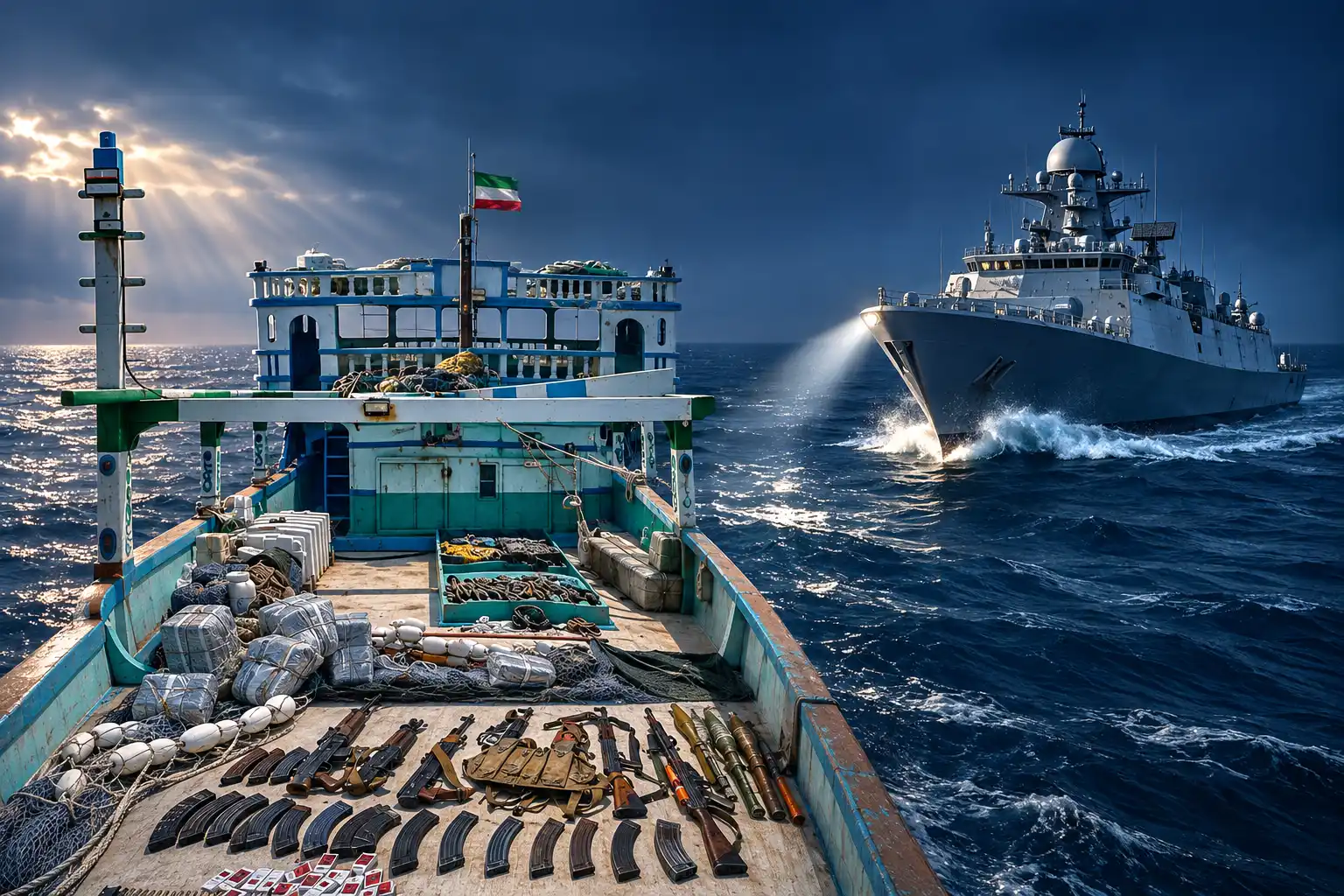
The Box Before the Boarding
The Ministry of Defence said a mission-deployed warship and a patrol aircraft found Azini after persistent surveillance, then used “calibrated non-kinetic measures” to hold it and stop an escape. The Navy did not name the kit. The point of that phrasing is the order of work: freeze the dhow first, board it second.
Storming a small fishing boat packed with hostages is the trap. A dhow that can still make way is worse. Once it sits on a lane, skiffs can peel off against merchants that never see the mother craft until the last mile. Abhishek Mishra, an associate fellow at the Manohar Parrikar Institute for Defence Studies and Analyses, wrote in September that the hijacking of fishing dhows to use as motherships is the same method that made the 2009 to 2011 wave hard to contain.
WHAT A MOTHERSHIP BUYS A PIRATE GROUP
- Endurance: A captured dhow carries fuel, water, and men far past the range of an open skiff.
- Cover: A fishing hull on a working ground does not look like a warship’s quarry until it turns east.
- Reach: MSCIO warned Azini could be used as a mothership to conduct further piracy attacks once it neared the traffic lane.
- Hostages as a shield: Twenty crew on deck raise the cost of any shot that hits the hull.
Illegal foreign fishing still strips Somalia’s coastal catch, Mishra wrote, and pirates sell hijacking as a reply to that theft. The federal government has not rebuilt a navy that can police its own water. The international patrols that bottled the last wave are thinner now, because hulls have been pulled toward the Red Sea and the Strait of Hormuz. That is the gap a dhow on a lane walks into.
MARCOS Came Out of a C-17
After the dhow was held, Marine Commandos were added by a precision airdrop from an IAF C-17. The Ministry of Defence called the last move a swift tactical intervention. All 20 crew walked off unhurt. Briefings and the operation photographs identify the warship as the destroyer INS Kolkata, the same class lead ship named by retired Rear Admiral M.D. Suresh after the announcement. The written ministry note still says only “a mission-deployed warship.”
THE BOARDING PACKAGE
- The hold: Warship and patrol aircraft lock the dhow’s movement without a stated use of guns on the hull.
- The lift: An IAF C-17 puts Marine Commandos onto the scene from the air.
- The take: Commandos secure Azini, the pirate threat is overcome, 20 crew are freed.
- The distance: Rajnath Singh put the job more than 3,000 km from Mumbai.
Singh announced the result on November 2. He congratulated the Navy on a 48-hour operation and tied the Air Force into the same line.
The swift localisation, interception and safe release of the crew and vessel from significantly-armed pirates, with timely support from the Indian Air Force, speak well of the Indian Navy’s high operational readiness and ability to respond decisively to maritime threats across the region.
Rajnath Singh, Defence Minister of India, on X
My congratulations to #Indian Navy for successfully executing a meticulously coordinated 48-hour operation to rescue all 20 crew members of the pirated fishing vessel, Azini, more than 3000 km from Mumbai in the Arabian Sea, on 02 Nov 26.
The swift localisation, interception and… pic.twitter.com/8AmopTMKRM
— Rajnath Singh (@rajnathsingh) November 2, 2026
The ministry note struck a similar tone, calling the job proof of joint work across the services and repeating India’s line as First Responder in the Indian Ocean Region. The photographs released with Singh’s post show armed commandos on a small deck and a weapons cache laid out beside them. They do not show a gunfight.
Somali Pirates Held 94% of World Hostages
Azini was one boat. The books behind it are uglier. The ICC International Maritime Bureau, in its mid-year tally released on July 9, 2026, recorded 38 piracy and armed-robbery incidents worldwide in the first half of the year, down from 90 in the first half of 2025 and 60 in the first half of 2024. That is the lowest mid-year count since 1992. Crew harm did not fall with the headline.
Sixty-seven crew were taken hostage in those six months, two were threatened, and one was injured. Somali pirates accounted for 94% of all crew taken hostage. Four ships were hijacked in the region between April and May, the bureau said, with more approaches in June. IMB Director Michael Howlett called the global drop encouraging and then cut the other way.
There is no room for complacency. Crew safety remains at risk, and the slight uptick of Somali piracy is a reminder that continued vigilance and regional cooperation remain essential to protect seafarers, global shipping and trade.
Michael Howlett, Director, ICC International Maritime Bureau, July 9, 2026
TWO SNAPSHOTS OF THE SAME WAVE
| Measure | Figure | Window |
|---|---|---|
| Global piracy and armed-robbery incidents | 38 | First half of 2026, IMB |
| Crew taken hostage worldwide | 67 | First half of 2026, IMB |
| Share of those hostages held by Somali pirates | 94% | First half of 2026, IMB |
| Regional hijacks, April to May | 4 vessels | IMB mid-year note |
| Ships still held in the region | 6, with more than 90 seafarers | IMO, August 24, 2026 |
IMO Secretary-General Arsenio Dominguez, after the hijack of SEAMULL on August 20, said that seizure made a sixth ship held by pirates and armed robbers in waters that were getting too dangerous for crews. More than 90 seafarers were then captive, often short of food, fresh water, and care. He asked for their immediate and unconditional release and said the world should not look away from the Gulf of Aden because other crises had pulled the cameras.
Those August ships were still a live problem when Azini turned east in late October. Freeing 20 Iranian fishermen does not reopen those ledgers. It does remove one more hull that could have added names to them.
The Ruen Template on a Fishing Dhow
INS Kolkata has done this work before. On March 16, 2024, after a 40-hour calibrated operation, Indian forces freed 17 crew of the hijacked merchant ship MV Ruen and took 35 pirates, a sequence set out in a National Maritime Foundation paper on India’s piracy response. That boarding also used an air drop of MARCOS along with boats from an IAF C-17 Globemaster. The Ruen action sat about 2,600 km from the Indian coast, a different baseline from Singh’s “more than 3,000 km from Mumbai” line on Azini, so the two distances should not be ranked as one race.
In July 2026 a Mumbai special court convicted all 35 Ruen pirates under the Maritime Anti-Piracy Act. Mishra called that the close of a legal loop India did not have in the last Somali wave: intercept at sea, keep a clean evidence trail, and try the men at home. The Azini note does not say whether anyone from this dhow will face the same court. Until that is stated, the Ruen convictions are the precedent, not the sequel.
TWO INDIAN BOARDINGS
| Azini | MV Ruen | |
|---|---|---|
| Date secured | November 2, 2026 | March 16, 2024 |
| Crew freed | 20 | 17 |
| Distance as cited | More than 3,000 km from Mumbai | About 2,600 km from the Indian coast |
| How MARCOS arrived | Precision airdrop from an IAF C-17 | C-17 airdrop of MARCOS and boats |
| Hold before the board | Calibrated non-kinetic measures, more than 48 hours | 40-hour calibrated operation |
| Pirates | Not numbered in the Navy statement (12 per a Puntland officer) | 35, all convicted in July 2026 |
The method is now a script: find the hijacked hull, pin it so it cannot reach a lane or a beach, then put commandos on it from the air so a destroyer does not have to lie alongside a boat full of hostages. Azini was a fishing dhow, not a bulk carrier. That is the mothership problem in miniature. A cheap hull, once stolen, does the same job Ruen was meant to do, at lower cost to the gang.
Iran Thanked India After the Lane Was Cleared
On November 3 the Embassy of the Islamic Republic of Iran in New Delhi named the 20 as Iranian crew and thanked the Indian government, the Navy, and the Air Force. That closes the nationality gap the early alerts left open. It also fixes who owed whom a phone call after a dhow that never flew an Indian flag was taken back more than 3,000 km from Mumbai.
The Embassy of the Islamic Republic of Iran in New Delhi expresses its sincere appreciation to the Government of India, the Indian Navy and the Indian Air Force for their successful operation to rescue the 20 Iranian crew members of the fishing vessel Azini from pirates.
Embassy of the Islamic Republic of Iran in New Delhi, on X, November 3, 2026
Operation ATALANTA later called the incident closed after anti-piracy military forces liberated the vessel. MSCIO’s own mothership line had already done the other job: it told every merchant inside BMP range to treat a fishing boat on that heading as a weapon, not as traffic.
India still has men and hulls in the western Indian Ocean because the last quiet years did not kill the business, they only parked it. Mishra’s September warning was that ransom money is teaching the model to pay again, and that other navies are now crowding the same coast. Azini is the smaller proof. Twenty crew got off a dhow that had already walked about 110 nautical miles toward a lane. The next mothership will try the same walk if the box is not already there.

ADNOC Ship Hit in Hormuz Leaves One Crew Missing

SpiceJet’s Rs 5,500 Crore Plan Follows a Rescue That Failed

Hasina’s Return Fight Sets Fire to Yunus’s Bank

Bancroft Recants the 2018 Inquiry and Names the Team

Adhikari Ties the Saffron Saree Row to School Licences

Clancy Juror Says the Holdout Never Cited Evidence

The iPhone 18 Pro Max Splits Apple’s Fall in Two

OpenAI Calls GPT-6 Astra AGI Then Locks Its Exploits

Trump Claims Hormuz Control as Oil Holds Near $96

Russia Closes the Goethe-Institut Berlin Tried to Save

 NEWS2 months ago
Clancy Juror Says the Holdout Never Cited Evidence
- NEWS3 months ago
The iPhone 18 Pro Max Splits Apple’s Fall in Two
- NEWS3 months ago
OpenAI Calls GPT-6 Astra AGI Then Locks Its Exploits
- BUSINESS3 months ago
Trump Claims Hormuz Control as Oil Holds Near $96
- LIFESTYLE3 months ago
Russia Closes the Goethe-Institut Berlin Tried to Save
- AUTO3 months ago
Volkswagen’s Job Cuts Leave Four Plants Without Cars
- NEWS3 months ago
Dyson Puts Nurovi Robots on Sale Without the UV Flagship
- BUSINESS2 months ago
US Destroys Five Iranian Tankers as the Shock Hits Jordan










